
VMware 2V0-11.25 Practice Exams
Last updated on Nov 16,2026- Exam Code: 2V0-11.25
- Exam Name: VMware Cloud Foundation 5.2 Administrator
- Certification Provider: VMware
- Latest update: Nov 16,2026
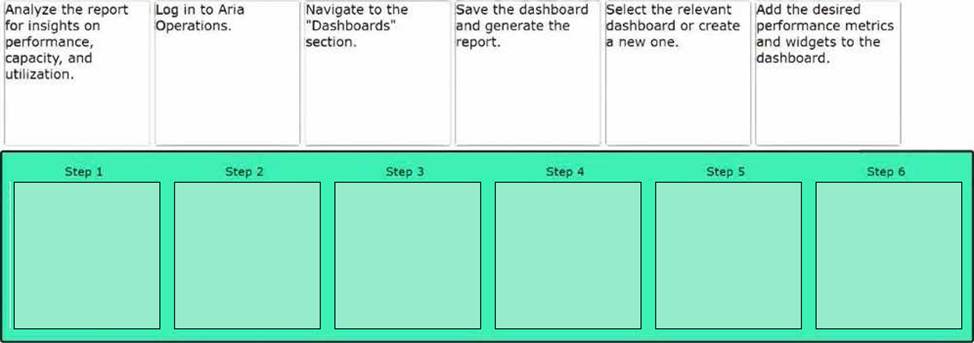
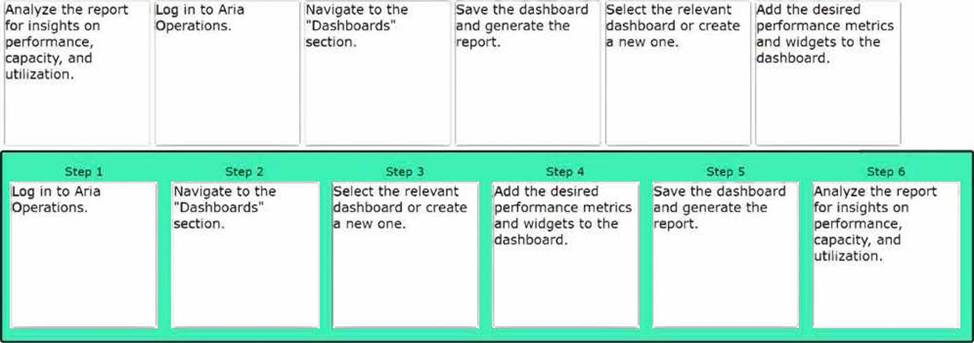
DRAG DROP
Arrange the steps in the correct order to generate a performance report in Aria Operations.
An administrator is tasked with migrating a set of virtual machines between data centers using HCX.
To minimize downtime and ensure data consistency, which two HCX migration options should be considered? (Choose two.)
- A . HCX Replication Assisted vMotion (RAV)
- B . HCX Network Extension
- C . HCX Bulk Migration
- D . HCX Cold Migration
- E . HCX vMotion
B
Explanation:
VM storage policies in a VMware vSphere environment are used to define and enforce specific storage requirements for virtual machines, such as performance (e.g., IOPS), availability (e.g., RAID levels), and redundancy. These policies ensure that VMs are placed on storage that meets their particular needs and that storage resources are utilized effectively.
An administrator needs to ensure that their VMware Cloud Foundation-based private cloud solution can support multi-tenancy for different departments within their organization.
What two configurations and components are necessary to achieve this? (Choose two.)
- A . Configure vSAN storage policies for each department.
- B . Use vSphere Resource Pools to allocate resources to different departments.
- C . Deploy Aria Automation to enable self-service provisioning for tenants.
- D . Use NSX to create isolated network segments for each tenant.
B, D
Explanation:
vSphere Resource Pools allow for the allocation of CPU, memory, and storage resources to different departments (tenants) within the VMware Cloud Foundation environment. This ensures that each department has its own dedicated resources, preventing resource contention between them.
NSX can be used to create isolated network segments (logical networks) for each tenant, ensuring network security and segmentation between departments. Each department can have its own isolated network environment.
An administrator is preparing to deploy VMware Aria Suite Lifecycle using SDDC Manager.
Which three are prerequisites for deploying Aria Suite Lifecycle? (Choose three.)
- A . Ensure that a custom SSL certificate specifying the FQDN of the appliance is available.
- B . Ensure that the NTP and DNS settings specified in SDDC Manager are valid for all management components.
- C . Verify that the password for the admin(g>local user account meets the complexity requirements.
- D . Ensure that the Application Virtual Networks have been configured.
- E . Ensure the VMware Software Install Bundle for VMware Aria Suite Lifecycle is in the local bundle repository.
A, B, E
Explanation:
Ensure that a custom SSL certificate specifying the FQDN of the appliance is available: A custom SSL certificate for the FQDN of the Aria Suite Lifecycle appliance is required for secure communication between components.
Ensure that the NTP and DNS settings specified in SDDC Manager are valid for all management components: Accurate NTP and DNS settings are crucial for time synchronization and proper domain resolution in the environment.
Ensure the VMware Software Install Bundle for VMware Aria Suite Lifecycle is in the local bundle repository: The required software bundle must be available in the local repository to ensure successful deployment.
An administrator is tasked with deploying a new application that requires both virtual machines and containers.
Which two components of VMware Cloud Foundation would be utilized to provide a unified platform for managing these workloads? (Choose two.)
- A . Aria Operations
- B . IaaS Control Plane
- C . HCX
- D . NSX
- E . Aria Suite Lifecycle
A, D
Explanation:
Aria Operations: Aria Operations (formerly vRealize Operations) provides a unified platform for managing both virtual machines (VMs) and containers, offering monitoring, analytics, and performance management for the entire environment.
NSX: NSX provides network virtualization and security, which can be used to manage network traffic for both VMs and containers, offering a consistent networking model for both workloads.
Which option should be chosen when placing a vSAN host into maintenance mode to ensure all data remains accessible during maintenance, while minimizing the time required to complete the operation?
- A . Quick Migration
- B . No Data Migration
- C . Ensure Accessibility
- D . Full Data Migration
C
Explanation:
When placing a vSAN host into maintenance mode, choosing "Ensure Accessibility" ensures that all data remains accessible during the maintenance operation. It moves data off the host only if necessary, prioritizing accessibility while minimizing downtime. This option is designed to minimize the time required to complete the operation compared to "Full Data Migration."
Which tool is most appropriate for analyzing detailed network performance metrics in a vSphere environment?
- A . vSphere CLI
- B . vSphere Client
- C . vSAN Health Service
- D . Aria Operations
D
Explanation:
Aria Operations (formerly vRealize Operations) is the most appropriate tool for analyzing detailed network performance metrics in a vSphere environment. It provides comprehensive monitoring, analytics, and performance management, including network performance metrics across the vSphere infrastructure.
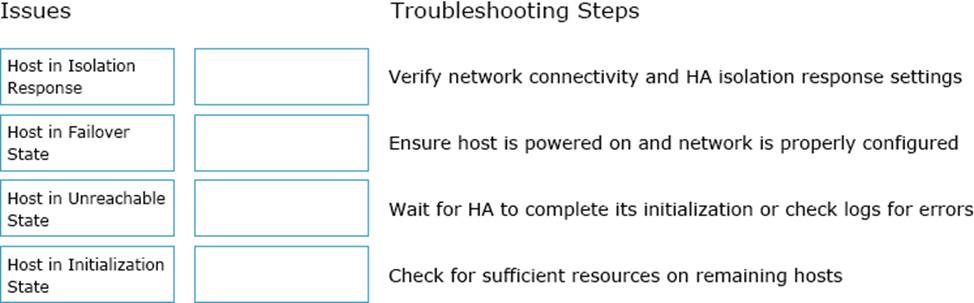
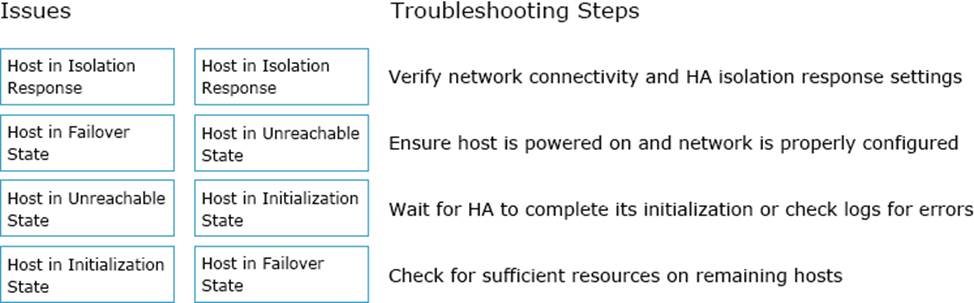
DRAG DROP
Match each vSphere HA host state issue with its troubleshooting step.
Which four storage options are available in the SDDC Manager UI during deployment of a VI workload domain in VMware Cloud Foundation? (Choose four.)
- A . iSCSCI
- B . NFS
- C . vVol
- D . DATASTOR
- E . VMS on NFS
- F . VMFS on FC
- G . vSAN
B, C, F, G
Explanation:
NFS: NFS (Network File System) can be used as a storage option during the deployment of a VI workload domain, typically for storing virtual machine files.
vVol: vVol (Virtual Volumes) provides a storage framework to allow for policy-driven management of virtual machine storage.
VMFS on FC: VMFS (VMware File System) on Fibre Channel (FC) provides block-level storage for virtual machines and is widely used in VMware environments.
vSAN: vSAN (Virtual SAN) is VMware’s hyper-converged storage solution, which combines compute and storage resources in a VMware environment, and is available as a storage option for a workload domain.
An administrator logged into NSX Manager to view host details. The administrator noticed that the "Tunnel" status for the ESXi hosts, in the VI workload domain, is showing down.
What is a possible reason the ESXi host tunnels are showing down in NSX?
- A . The IGMP has been disabled on the network.
- B . The MTU setting for the host TEPs has been set to 1500.
- C . The host TEP IP addresses are being dynamically assigned through DHCP instead of being statically assigned.
- D . The overlay traffic is being blocked by the gateway firewall.
B
Explanation:
The "Tunnel" status in NSX indicates the status of the VXLAN tunnels used for communication between ESXi hosts. If the MTU setting for the host Tunnel Endpoint (TEP) is incorrectly set to 1500, this can cause issues with VXLAN encapsulation, as VXLAN packets typically require an MTU of at least 1600 bytes to function correctly. Setting the MTU too low can cause packet drops and result in the tunnel status being down.