
VMware 2V0-11.25 Practice Exams
Last updated on Nov 16,2026- Exam Code: 2V0-11.25
- Exam Name: VMware Cloud Foundation 5.2 Administrator
- Certification Provider: VMware
- Latest update: Nov 16,2026
A company wants to enhance the network virtualization and security capabilities within their VMware Cloud Foundation environment. The goal is to block traffic even between virtual machines connected to the same logical segment (L2 network) using micro segmentation.
Which component can achieve the company’s goals?
- A . VMware NSX Intelligence
- B . Network Detection and Response
- C . VMware vDefend
- D . Intrusion Prevention System
A
Explanation:
VMware NSX Intelligence is a component of VMware NSX that provides micro-segmentation capabilities, enabling the company to block traffic between virtual machines even if they are connected to the same logical segment (Layer 2 network). It enhances security by applying fine-grained security policies at the virtual machine level, preventing unauthorized communication.
An administrator needs to add a new cluster to an existing VI workload domain. The existing cluster in the domain is using NFS as its principal storage.
Which principal storage options are available for the new cluster?
- A . vSAN, NFS, or VMFS on Fibre Channel
- B . NFS or vSAN
- C . NFS only
- D . vSAN, NFS, VMFS on Fibre Channel, or vVols
B
Explanation:
In a VMware Cloud Foundation (VCF) environment, when adding a new cluster to an existing VI workload domain, the new cluster must use the same principal storage as the existing cluster. Since the existing cluster is using NFS, the available storage options for the new cluster would be NFS or vSAN, depending on the configuration.
An administrator is tasked with troubleshooting an issue where some VMs are not appearing in the vCenter inventory after a recent migration to a new vSphere environment.
Which two components should the administrator examine to resolve this issue? (Choose two.)
- A . The storage policies applied to the VMs.
- B . The network settings of the new vSphere environment.
- C . The compatibility of the VM hardware version with the new vSphere environment.
- D . The registration status of the VMs in the new vSphere environment.
- E . The vSphere permissions assigned to the VMs.
C, D
Explanation:
If the hardware version of the virtual machines is incompatible with the new vSphere environment, the VMs may not appear or may fail to register properly. Ensuring compatibility between the VM hardware version and the vSphere environment is essential for successful VM migration.
If the VMs are not correctly registered in the new vSphere environment after migration, they won’t show up in the vCenter inventory. Checking the registration status helps to identify if this is the issue.
After deploying the VMware Cloud Foundation management domain, an administrator needs to configure backup for the components within the domain.
Which two steps are involved in configuring the backup of VMware Cloud Foundation management components? (Choose two.)
- A . Configure an external SFTP backup repository on the SDDC Manager.
- B . Manually export the NSX configuration to the SDDC Manager.
- C . Enable the vCenter Server snapshot manager on the SDDC Manager.
- D . Install a third-party backup solution on each ESXi host.
- E . Create a backup schedule on the SDDC manager to automate taking regular backups.
A, E
Explanation:
To configure backups for the VMware Cloud Foundation management components, you must set up an external SFTP backup repository within the SDDC Manager. This repository will store the backup files for management components like vCenter, NSX Manager, and SDDC Manager itself.
Creating a backup schedule within the SDDC Manager ensures that regular, automated backups are taken, helping to maintain data integrity and recovery options for the management domain.
DRAG DROP
Match each networking issue with the corresponding troubleshooting step.
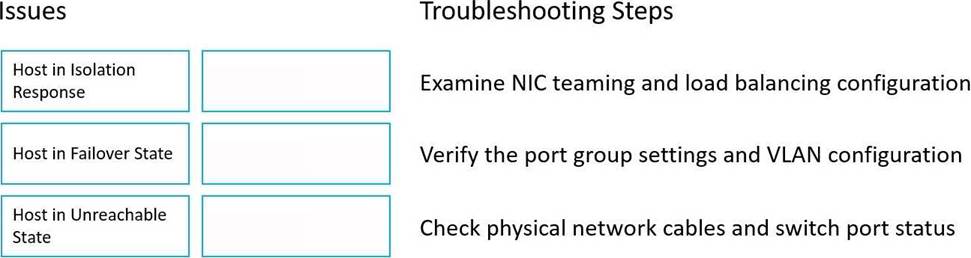
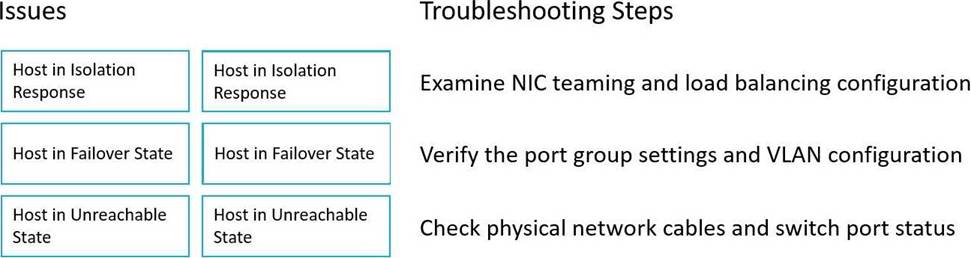
An administrator is deploying an NSX Edge cluster from SDDC Manager. The administrator plans to
configure the Border Gateway Protocol (BGP) to enable dynamic routing with the upstream physical networking.
Which three values must be provided when configuring BGP? (Choose three.)
- A . BGP Password
- B . BGP Autonomous System Number (ASN)
- C . BGP Router ID
- D . BGP Peer IP
- E . BGP Route Topology
B, C, D
Explanation:
The BGP Autonomous System Number (ASN) is a unique identifier that must be configured for BGP to define the routing domain.
The BGP Router ID is used to uniquely identify the BGP router in the network.
The BGP Peer IP is required to establish a BGP peering relationship with an upstream router or another BGP-enabled device.
An administrator needs to perform lifecycle management for their VMware Cloud Foundation components, including upgrading the SDDC Manager.
Which three steps should be followed to successfully upgrade VMware Cloud Foundation? (Choose three.)
- A . Backup all VMware Cloud Foundation components before starting the upgrade.
- B . Disable DRS and HA on all clusters before initiating the upgrade.
- C . Manually download the update bundles with a secure browser from the VMware website.
- D . Perform a pre-check to ensure that all components are compatible with the new version.
- E . Use the SDDC Manager Ul to initiate the upgrade process.
A, D, E
Explanation:
Backing up all VMware Cloud Foundation components ensures that data is protected in case the upgrade process encounters issues.
Performing a pre-check is important to verify that all components are compatible with the new version to avoid compatibility issues during the upgrade process.
The SDDC Manager UI is used to initiate the upgrade process, providing a guided and consistent method for upgrading the VMware Cloud Foundation environment.
What is the primary symptom of an issue with vSphere HA host states?
- A . VMs are not being migrated using vMotion
- B . Snapshots cannot be created or consolidated
- C . Hosts frequently disconnect from vCenter Server
- D . HA-protected VMs are not restarted after a host failure
D
Explanation:
vSphere HA (High Availability) is designed to automatically restart virtual machines on other hosts in the cluster in case of a host failure. If there is an issue with vSphere HA host states, the primary symptom is that HA-protected VMs do not restart after a host failure, which indicates a problem with HA configuration or functionality.
An administrator needs to configure Network IO Control (NIOC) on a Virtual Distributed Switch (VDS) to prioritize storage traffic over other types of traffic.
Which two steps should be followed? (Choose two.)
- A . Disable all other traffic types to ensure storage traffic gets full bandwidth.
- B . Navigate to the VDS settings in the vSphere Client and enable NIOC.
- C . Migrate all VM traffic to a standard switch.
- D . Create a new port group specifically for storage traffic.
- E . Assign shares and limits to the new port group to prioritize the storage traffic.
B, E
Explanation:
Network IO Control (NIOC) must be enabled on the Virtual Distributed Switch (VDS) via the vSphere Client to begin configuring and managing bandwidth allocation and prioritization for different types of traffic.
After enabling NIOC, you can assign shares and limits to the specific port group (in this case, for storage traffic) to prioritize the traffic over other types of network traffic.
Which VMware vSphere feature provides the ability to define and apply datastore capabilities to ensure virtual machines meet specific performance and availability requirements?
- A . Storage Policy Components
- B . Storage Policies
- C . Performance Service
- D . Host Profiles
B
Explanation:
Storage Policies in VMware vSphere allow administrators to define and apply specific storage
requirements for virtual machines, ensuring they meet desired performance and availability standards. These policies enable the alignment of VM storage needs with the capabilities of the underlying datastores.