
Salesforce MuleSoft Integration Architect I Practice Exams
Last updated on Nov 16,2026- Exam Code: MuleSoft Integration Architect I
- Exam Name: Salesforce Certified MuleSoft Integration Architect I
- Certification Provider: Salesforce
- Latest update: Nov 16,2026
An organization has deployed both Mule and non-Mule API implementations to integrate its
customer and order management systems. All the APIs are available to REST clients on the public internet.
The organization wants to monitor these APIs by running health checks: for example, to determine if an API can properly accept and process requests. The organization does not have subscriptions to any external monitoring tools and also does not want to extend its IT footprint.
What Anypoint Platform feature provides the most idiomatic (used for its intended purpose) way to monitor the availability of both the Mule and the non-Mule API implementations?
- A . API Functional Monitoring
- B . Runtime Manager
- C . API Manager
- D . Anypoint Visualizer
D
Explanation:
Reference: https://docs.mulesoft.com/visualizer/
An organization uses a four (4) node customer hosted Mule runtime cluster to host one (1) stateless api implementation. The API is accessed over HTTPS through a load balancer that uses round-robin for load distribution. Each node in the cluster has been sized to be able to accept four (4) times the current number of requests.
Two (2) nodes in the cluster experience a power outage and are no longer available. The load balancer directs the outage and blocks the two unavailable the nodes from receiving further HTTP requests.
What performance-related consequence is guaranteed to happen to average, assuming the remaining cluster nodes are fully operational?
- A . 100% increase in the average response time of the API
- B . 50% reduction in the throughput of the API
- C . 100% increase in the number of requests received by each remaining node
- D . 50% increase in the JVM heap memory consumed by each remaining node
A
Explanation:
* "100% increase in the throughput of the API" might look correct, as the number of requests processed per second might increase, but is it guaranteed to increase by 100%? Using 4 nodes will definitely increase throughput of system. But it is cant be precisely said if there would be 100% increase in throughput as it depends on many other factors. Also it is nowhere mentioned in the description that all nodes have same CPU/memory assigned. The question is about the guaranteed behavior
* Increasing number of nodes will have no impact on response time as we are scaling
application horizontally and not vertically. Similarly there is no change in JVM heap memory usage.
* So Correct answer is 50% reduction in the number of requests being received by each node This is because of the two reasons.
1) API is mentioned as stateless
2) Load Balancer is used
A Mule application name Pub uses a persistence object store. The Pub Mule application is deployed to Cloudhub and it configured to use Object Store v2.
Another Mule application name sub is being developed to retrieve values from the Pub Mule application persistence object Store and will also be deployed to cloudhub.
What is the most direct way for the Sub Mule application to retrieve values from the Pub Mule application persistence object store with the least latency?
- A . Use an object store connector configured to access the Pub Mule application persistence object store
- B . Use a VM connector configured to directly access the persistence queue of the Pub Mule application persistence object store.
- C . Use an Anypoint MQ connector configured to directly access the Pub Mule application persistence object store
- D . Use the Object store v2 REST API configured to access the Pub Mule application persistence object store.
D
Explanation:
* The Object Store V2 API enables API access to Anypoint Platform Object Store v2.
* You can configure a Mule app to use the Object Store REST API to store and retrieve values from an object store in another Mule app. However, Object Store v2 is not designed for app-to-app communication. To share data between two Mule4 apps, use a queue in Anypoint MQ.
* The Object Store v2 APIs enable you to use REST to perform the following:
– Retrieve a list of object stores and keys associated with an application.
– Store and retrieve key-value pairs in an object store.
– Delete key-value pairs from an object store.
– Retrieve Object Store usage statistics for your organization.
– Object Store provides these APIs:
Object Store API
Object Store Stats API
Reference: https://docs.mulesoft.com/object-store/osv2-apis
Additional Info:
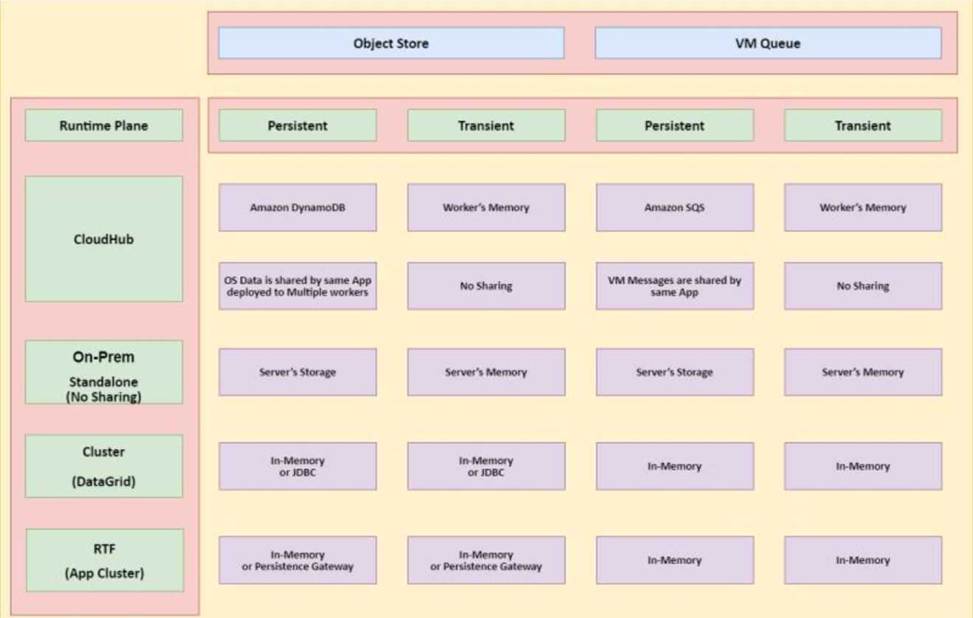
When to use Object Store and when to use VM
An organization uses one specific CloudHub (AWS) region for all CloudHub deployments.
How are CloudHub workers assigned to availability zones (AZs) when the organization’s Mule applications are deployed to CloudHub in that region?
- A . Workers belonging to a given environment are assigned to the same AZ within that region.
- B . AZs are selected as part of the Mule application’s deployment configuration.
- C . Workers are randomly distributed across available AZs within that region.
- D . An AZ is randomly selected for a Mule application, and all the Mule application’s CloudHub workers are assigned to that one AZ
C
Explanation:
Correct answer is Workers are randomly distributed across available AZs within that region. This ensure high availability for deployed mule applications Mulesoft documentation reference: https://docs.mulesoft.com/runtime-manager/cloudhub-hadr
A marketing organization is designing a Mule application to process campaign data. The Mule application will periodically check for a file in a SFTP location and process the records in the file. The size of the file can vary from 10MB to 5GB. Due to the limited availabiltty of vCores, the Mule application is deployed to a single CloudHub worker configured with vCore size 0.2.
The application must transform and send different formats of this file to three different downstream SFTP locations.
What is the most idiomatic (used for its intended purpose) and performant way to configure the SFTP operations or event sources to process the large files to support these deployment requirements?
- A . Use an in-memory repeatable stream
- B . Use a file-stored non-repeatable stream
- C . Use an in-memory non-repeatable stream
- D . Use a file-stored repeatable stream
A
Explanation:
Reference: https://docs.mulesoft.com/mule-runtime/4.4/streaming-about
An insurance company is implementing a MuleSoft API to get inventory details from the two vendors. Due to network issues, the invocations to vendor applications are getting timed-out intermittently. But the transactions are successful upon reprocessing
What is the most performant way of implementing this requirement?
- A . Implement a scatter-gather scope to invoke the two vendor applications on two different route
Use the Until-Successful scope to implement the retry mechanism for timeout errors on each route - B . Implement a Choice scope to invoke the two vendor applications on two different route Use the try-catch scope to implement the retry mechanism for timeout errors on each route
- C . Implement a For-Each scope to invoke the two vendor applications
Use until successful scope to implement the retry mechanism for the timeout errors - D . Implement Round-Robin scope to invoke the two vendor applications on two different routes Use the Try-Catch scope to implement retry mechanism for timeout errors on each route
A global, high-volume shopping Mule application is being built and will be deployed to CloudHub. To improve performance, the Mule application uses a Cache scope that maintains cache state in a CloudHub object store. Web clients will access the Mule application over HTTP from all around the world, with peak volume coinciding with business hours in the web client’s geographic location.
To achieve optimal performance, what Anypoint Platform region should be chosen for the CloudHub object store?
- A . Choose the same region as to where the Mule application is deployed
- B . Choose the US-West region, the only supported region for CloudHub object stores
- C . Choose the geographically closest available region for each web client
- D . Choose a region that is the traffic-weighted geographic center of all web clients
A
Explanation:
CloudHub object store should be in same region where the Mule application is deployed. This will give optimal performance.
Before learning about Cache scope and object store in Mule 4 we understand what is in general
Caching is and other related things.
WHAT DOES “CACHING” MEAN?
Caching is the process of storing frequently used data in memory, file system or database which saves processing time and load if it would have to be accessed from original source location every time.
In computing, a cache is a high-speed data storage layer which stores a subset of data, so that future requests for that data are served up faster than is possible by accessing the data’s primary storage location. Caching allows you to efficiently reuse previously retrieved or computed data.
How does Caching work?
The data in a cache is generally stored in fast access hardware such as RAM (Random-access memory) and may also be used in correlation with a software component. A cache’s primary purpose is to increase data retrieval performance by reducing the need to access the underlying slower storage layer.
Caching in MULE 4
In Mule 4 caching can be achieved in mule using cache scope and/or object-store. Cache scope
internally uses Object Store to store the data.
What is Object Store
Object Store lets applications store data and states across batch processes, Mule components, and applications, from within an application. If used on cloud hub, the object store is shared between applications deployed on Cluster.
Cache Scope is used in below-mentioned cases:
● Need to store the whole response from the outbound processor
● Data returned from the outbound processor does not change very frequently
● As Cache scope internally handle the cache hit and cache miss scenarios it is more readable Object Store is used in below-mentioned cases:
● Need to store custom/intermediary data
● To store watermarks
● Sharing the data/stage across applications, schedulers, batch.
If CloudHub object store is in same region where the Mule application is deployed it will aid in fast access of data and give optimal performance.
An organization has several APIs that accept JSON data over HTTP POST. The APIs are all publicly available and are associated with several mobile applications and web applications. The organization does NOT want to use any authentication or compliance policies for these APIs, but at the same time, is worried that some bad actor could send payloads that could somehow compromise the applications or servers running the API implementations.
What out-of-the-box Anypoint Platform policy can address exposure to this threat?
- A . Apply a Header injection and removal policy that detects the malicious data before it is used
- B . Apply an IP blacklist policy to all APIs; the blacklist will Include all bad actors
- C . Shut out bad actors by using HTTPS mutual authentication for all API invocations
- D . Apply a JSON threat protection policy to all APIs to detect potential threat vectors
D
Explanation:
We need to note few things about the scenario which will help us in reaching the correct solution. Point 1: The APIs are all publicly available and are associated with several mobile applications and web applications. This means Apply an IP blacklist policy is not viable option. as blacklisting IPs is limited to partial web traffic. It can’t be useful for traffic from mobile application
Point 2: The organization does NOT want to use any authentication or compliance policies for these
APIs. This means we can not apply HTTPS mutual authentication scheme.
Header injection or removal will not help the purpose.
By its nature, JSON is vulnerable to JavaScript injection. When you parse the JSON object, the malicious code inflicts its damages. An inordinate increase in the size and depth of the JSON payload can indicate injection. Applying the JSON threat protection policy can limit the size of your JSON payload and thwart recursive additions to the JSON hierarchy.
Hence correct answer is Apply a JSON threat protection policy to all APIs to detect potential threat vectors
A stock trading company handles millions of trades a day and requires excellent performance and reliability within its stock trading system. The company operates a number of event-driven APIs Implemented as Mule applications that are hosted on various customer-hosted Mule clusters and needs to enable message exchanges between the APIs within their internal network using shared message queues.
What is an effective way to meet the cross-cluster messaging requirements of its event-driven APIs?
- A . Non-transactional JMS operations with a reliability pattern and manual acknowledgements
- B . Persistent VM queues with automatic acknowledgements
- C . JMS transactions with automatic acknowledgements
- D . extended Architecture (XA) transactions and XA connected components with manual acknowledgements
A Mule application is running on a customer-hosted Mule runtime in an organization’s network. The Mule application acts as a producer of asynchronous Mule events. Each Mule event must be broadcast to all interested external consumers outside the Mule application. The Mule events should be published in a way that is guaranteed in normal situations and also minimizes duplicate delivery in less frequent failure scenarios.
The organizational firewall is configured to only allow outbound traffic on ports 80 and 443. Some external event consumers are within the organizational network, while others are located outside the firewall.
What Anypoint Platform service is most idiomatic (used for its intended purpose) for publishing these Mule events to all external consumers while addressing the desired reliability goals?
- A . CloudHub VM queues
- B . Anypoint MQ
- C . Anypoint Exchange
- D . CloudHub Shared Load Balancer
B
Explanation:
Set the Anypoint MQ connector operation to publish or consume messages, or to accept (ACK) or not accept (NACK) a message.
Reference: https://docs.mulesoft.com/mq/