
Salesforce MuleSoft Integration Architect I Practice Exams
Last updated on Nov 16,2026- Exam Code: MuleSoft Integration Architect I
- Exam Name: Salesforce Certified MuleSoft Integration Architect I
- Certification Provider: Salesforce
- Latest update: Nov 16,2026
When a Mule application using VM queues is deployed to a customer-hosted cluster or multiple CloudHub v1.0 workers/replicas, how are messages consumed across the nodes?
- A . Sequentially, from a dedicated Anypoint MQ queue
- B . Sequentially, only from the primary node
- C . In a non-deterministic way
- D . Round-robin, within an XA transaction
A leading bank implementing new mule API.
The purpose of API to fetch the customer account balances from the backend application and display them on the online platform the online banking platform. The online banking platform will send an array of accounts to Mule API get the account balances.
As a part of the processing the Mule API needs to insert the data into the database for auditing purposes and this process should not have any performance related implications on the account balance retrieval flow
How should this requirement be implemented to achieve better throughput?
- A . Implement the Async scope fetch the data from the backend application and to insert records in the Audit database
- B . Implement a for each scope to fetch the data from the back-end application and to insert records into the Audit database
- C . Implement a try-catch scope to fetch the data from the back-end application and use the Async scope to insert records into the Audit database
- D . Implement parallel for each scope to fetch the data from the backend application and use Async scope to insert the records into the Audit database
According to the National Institute of Standards and Technology (NIST), which cloud computing deployment model describes a composition of two or more distinct clouds that support data and application portability?
- A . Private cloud
- B . Hybrid cloud 4
- C . Public cloud
- D . Community cloud
A gaming company has implemented an API as a Mule application and deployed the API implementation to a CloudHub 2.0 private space. The API implementation must connect to a mainframe application running in the customer’s on-premises corporate data center and also to a Kafka cluster running in an Amazon AWS VPC.
What is the most efficient way to enable the API to securely connect from its private space to the mainframe application and Kafka cluster?
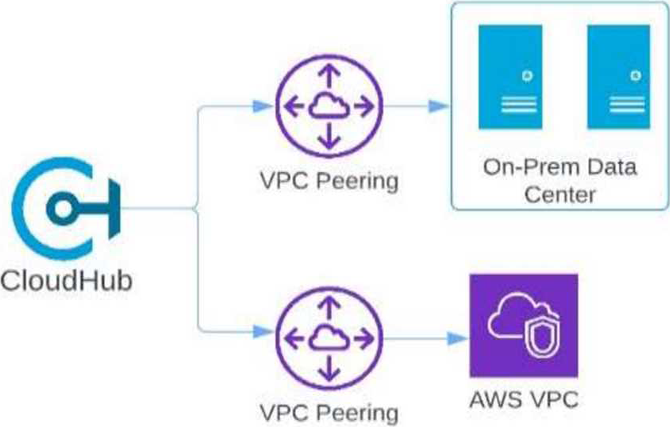
A) In Runtime Manager, set up VPC peering between the CloudHub 2.0 private network and the on-premises data center.
In the AWS account, set up VPC peering between the AWS VPC and the CloudHub 2.0 private network.
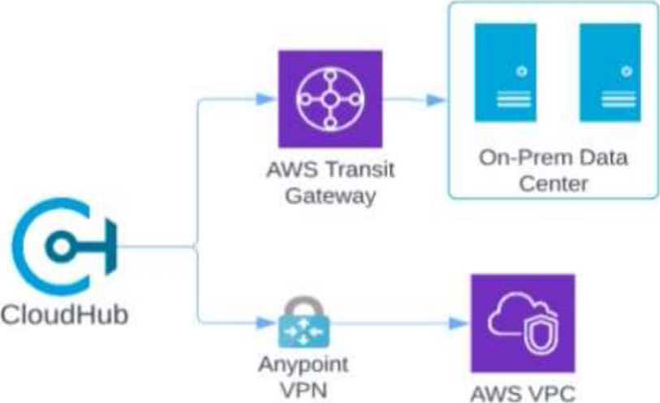
B) In the AWS account, attach the CloudHub 2.0 private space to an AWS transit gateway that routes from the CloudHub 2.0 private space to the on-premises data center. In Runtime Manager, configure an Anypoint VPN to route from the CloudHub 2.0 private space to the AWS VPC.
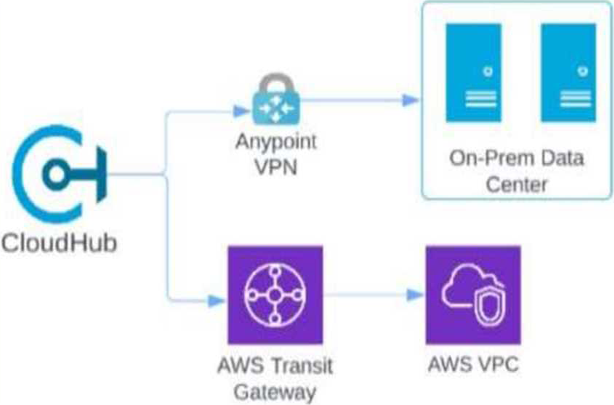
C) In Runtime Manager, configure an Anypoint VPN to route from the CloudHub 2.0 private space to the on-premises data center. In the AWS account, attach the private..
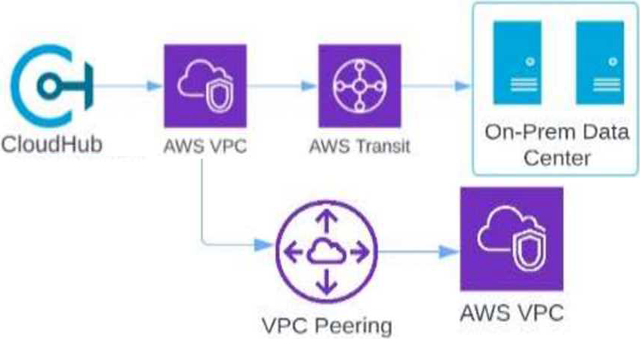
D) In the AWS account, attach the private space directly to the AWS VPC, In the AWS account, use an AWS transit gateway to route from the AWS VPC to the on-premises data center.
- A . Option A
- B . Option B
- C . Option C
- D . Option D
Refer to the exhibit.
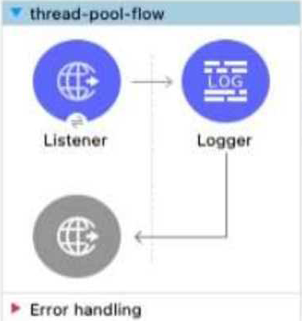
A customer is running Mule applications on Runtime Fabric for Self-Managed Kubernetes (RTF-BYOKS) in a multi-cloud environment.
Based on this configuration, how do Agents and Runtime Manager communicate, and what Is exchanged between them?
- A . BLOCKING_IO, UBER
- B . UBER, Dedicated NIO Selector Pool
- C . CPU_LITE, CPU_INTENSIVE
- D . Shared NIO Selector Pool, CPU_LITE
A Mule application is being designed To receive nightly a CSV file containing millions of records from an external vendor over SFTP, The records from the file need to be validated, transformed. And then written to a database. Records can be inserted into the database in any order.
In this use case, what combination of Mule components provides the most effective and performant way to write these records to the database?
- A . Use a Parallel for Each scope to Insert records one by one into the database
- B . Use a Scatter-Gather to bulk insert records into the database
- C . Use a Batch job scope to bulk insert records into the database.
- D . Use a DataWeave map operation and an Async scope to insert records one by one into the database.
C
Explanation:
Correct answer is Use a Batch job scope to bulk insert records into the database
* Batch Job is most efficient way to manage millions of records.
A few points to note here are as follows:
Reliability: If you want reliabilty while processing the records, i.e should the processing survive a runtime crash or other unhappy scenarios, and when restarted process all the remaining records, if yes then go for batch as it uses persistent queues.
Error Handling: In Parallel for each an error in a particular route will stop processing the remaining records in that route and in such case you’d need to handle it using on error continue, batch process does not stop during such error instead you can have a step for failures and have a dedicated handling in it.
Memory footprint: Since question said that there are millions of records to process, parallel for each will aggregate all the processed records at the end and can possibly cause Out Of Memory.
Batch job instead provides a BatchResult in the on complete phase where you can get the count of
failures and success. For huge file processing if order is not a concern definitely go ahead with Batch Job
What are two reasons why a typical MuleSoft customer favors a MuleSoft-hosted Anypoint Platform runtime plane over a customer-hosted runtime for its Mule application deployments? (Choose two.)
- A . Reduced application latency
- B . Increased application isolation
- C . Reduced time-to-market for the first application
- D . Increased application throughput
- E . Reduced IT operations effort
The application must process a medium rate of records from a source to a target system using a Batch Job scope.
To make the Mule application more reliable, the Mule application will be deployed to two CloudHub 1.0 workers.
Following MuleSoft-recommended best practices, how should the Mule application deployment typically be configured in Runtime Manger to best support the performance and reliability goals of both the Batch Job scope and the file processing VM queues?
- A . Check the Persistent VM queues checkbox in the application deployment configuration
- B . Check the Non-persistent VM queues checkbox in the application deployment configuration
- C . In the Runtime Manager Properties tab, disable persistent VM queues for Batch Job scopes
- D . In the Runtime Manager Properties tab, enable persistent VM queues for the FTPS connector
What API policy would LEAST likely be applied to a Process API?
- A . Custom circuit breaker
- B . Client ID enforcement
- C . Rate limiting
- D . JSON threat protection
D
Explanation:
Key to this question lies in the fact that Process API are not meant to be accessed directly by clients. Lets analyze options one by one. Client ID enforcement: This is applied at process API level generally to ensure that identity of API clients is always known and available for API-based analytics Rate Limiting: This policy is applied on Process Level API to secure API’s against degradation of service that can happen in case load received is more than it can handle Custom circuit breaker: This is also quite useful feature on process level API’s as it saves the API client the wasted time and effort of invoking a failing API. JSON threat protection: This policy is not required at Process API and rather implemented as Experience API’s. This policy is used to safeguard application from malicious attacks by injecting malicious code in JSON object. As ideally Process API’s are never called from external world, this policy is never used on Process API’s Hence correct answer is JSON threat protection MuleSoft Documentation Reference: https://docs.mulesoft.com/api-manager/2.x/policy-mule3-json-threat
Refer to the exhibit.
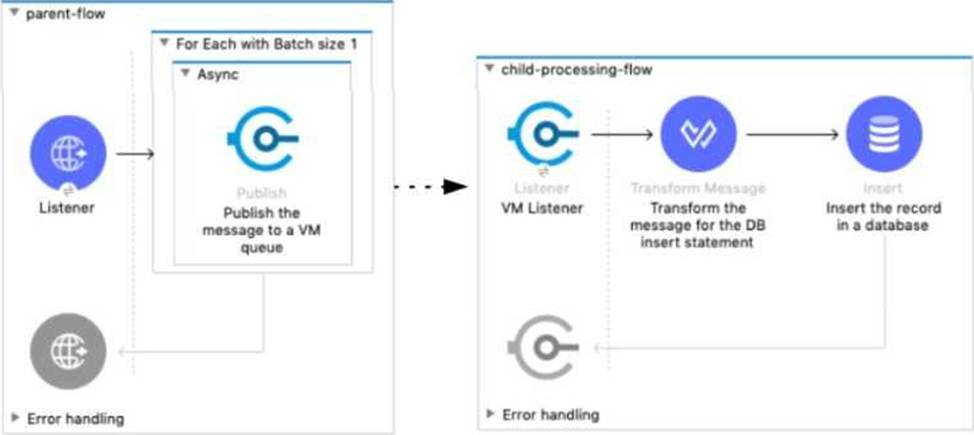
A Mule 4 application has a parent flow that breaks up a JSON array payload into 200 separate items, then sends each item one at a time inside an Async scope to a VM queue.
A second flow to process orders has a VM Listener on the same VM queue. The rest of this flow processes each received item by writing the item to a database.
This Mule application is deployed to four CloudHub workers with persistent queues enabled.
What message processing guarantees are provided by the VM queue and the CloudHub workers, and how are VM messages routed among the CloudHub workers for each invocation of the parent flow under normal operating conditions where all the CloudHub workers remain online?
- A . EACH item VM message is processed AT MOST ONCE by ONE CloudHub worker, with workers chosen in a deterministic round-robin fashion Each of the four CloudHub workers can be expected to process 1/4 of the Item VM messages (about 50 items)
- B . EACH item VM message is processed AT LEAST ONCE by ONE ARBITRARY CloudHub worker Each of the four CloudHub workers can be expected to process some item VM messages
- C . ALL Item VM messages are processed AT LEAST ONCE by the SAME CloudHub worker where the parent flow was invoked
This one CloudHub worker processes ALL 200 item VM messages - D . ALL item VM messages are processed AT MOST ONCE by ONE ARBITRARY CloudHub worker This one CloudHub worker processes ALL 200 item VM messages
B
Explanation:
Correct answer is EACH item VM message is processed AT LEAST ONCE by ONE ARBITRARY CloudHub worker. Each of the four CloudHub workers can be expected to process some item VM messages In Cloudhub, each persistent VM queue is listened on by every CloudHub worker – But each message is read and processed at least once by only one CloudHub worker and the duplicate processing is possible – If the CloudHub worker fails, the message can be read by another worker to prevent loss of messages and this can lead to duplicate processing – By default, every CloudHub worker’s VM Listener receives different messages from VM Queue Referenece: https://dzone.com/articles/deploying-mulesoft-application-on-1-worker-vs-mult