
Salesforce MuleSoft Integration Architect I Practice Exams
Last updated on Nov 16,2026- Exam Code: MuleSoft Integration Architect I
- Exam Name: Salesforce Certified MuleSoft Integration Architect I
- Certification Provider: Salesforce
- Latest update: Nov 16,2026
When using Anypoint Platform across various lines of business with their own Anypoint Platform business groups, what configuration of Anypoint Platform is always performed at the organization level as opposed to at the business group level?
- A . Environment setup
- B . Identity management setup
- C . Role and permission setup
- D . Dedicated Load Balancer setup
B
Explanation:
* Roles are business group specific. Configure identity management in the Anypoint Platform master organization. As the Anypoint Platform organization administrator, you can configure identity management in Anypoint Platform to set up users for single sign-on (SSO).
* Roles and permissions can be set up at business group and organization level also. But Identity Management setup is only done at Organization level
* Business groups are self-contained resource groups that contain Anypoint Platform resources such as applications and APIs. Business groups provide a way to separate and control access to Anypoint Platform resources because users have access only to the busine
A new Mule application has been deployed through Runtime Manager to CloudHub 1.0 using a CI/CD pipeline with sensitive properties set as cleartext. The Runtime Manager Administrator opened a high priority incident ticket about this violation of their security requirements indicating
these sensitive properties values must not be stored or visible in Runtime Manager but should be changeable in Runtime Manager by Administrators with proper permissions.
How can the Mule application be deployed while safely hiding the sensitive properties?
- A . Add an ArrayList of all the sensitive properties’ names in the mule-artifact.json file of the application
- B . Add encrypted versions of the sensitive properties as global configuration properties in the Mule application
- C . Add a new wrapper.java.additional.xx parameter for each sensitive property in the wrapper.conf file used by the CI/CD pipeline scripts
- D . Create a variable for each sensitive property and declare them as hidden in the CI/CD pipeline scripts
Refer to the exhibit.
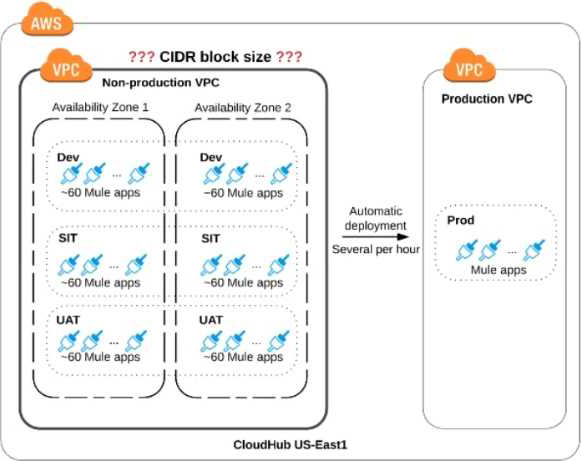
An organization is sizing an Anypoint VPC for the non-production deployments of those Mule applications that connect to the organization’s on-premises systems. This applies to approx. 60 Mule applications. Each application is deployed to two CloudHub i workers. The organization currently has three non-production environments (DEV, SIT and UAT) that share this VPC. The AWS region of the VPC has two AZs.
The organization has a very mature DevOps approach which automatically progresses each application through all non-production environments before automatically deploying to production.
This process results in several Mule application deployments per hour, using CloudHub’s normal zero-downtime deployment feature.
What is a CIDR block for this VPC that results in the smallest usable private IP address range?
- A . 10.0.0.0/26 (64 IPS)
- B . 10.0.0.0/25 (128 IPs)
- C . 10.0.0.0/24 (256 IPs)
- D . 10.0.0.0/22 (1024 IPs)
D
Explanation:
Mule applications are deployed in CloudHub workers and each worker is assigned with a dedicated IP
• For zero downtime deployment, each worker in CloudHub needs additional IP addresses
• A few IPs in a VPC are reserved for infrastructure (generally 2 IPs)
• The IP addresses are usually in a private range with a subnet block specifier, such as 10.0.0.1/24
• The smallest CIDR network subnet block you can assign for your VPC is /24 (256 IP addresses) (60*3 env * 2 worker per application) + 50% of (total) for zero downtime = 540 In this case correct answer is 10.0.0.0/22 as this provided 1024 IP’s. Other IP’s are insufficient.
A large life sciences customer plans to use the Mule Tracing module with the Mapped Diagnostic Context (MDC) logging operations to enrich logging in its Mule application and to improve tracking by providing more context in the Mule application logs. The customer also wants to improve throughput and lower the message processing latency in its Mule application flows.
After installing the Mule Tracing module in the Mule application, how should logging be performed in flows in Mule applications, and what should be changed In the log4j2.xml files?
- A . In the flows, add Mule Tracing module Set logging variable operations before any Core Logger components.
In log4j2.xml files, change the appender’s pattern layout to use %MDC and then assign the appender to a Logger or Root element. - B . In the flows, add Mule Tracing module Set logging variable operations before any Core Logger components.
In log4j2.xmI files, change the appender’s pattern layout to use the %MDC placeholder and then assign the appender to an AsyncLogger element. - C . In the flows, add Mule Tracing module Set logging variable operations before any Core Logger components.
In log4j2.xmI files, change the appender’’s pattern layout to use %asyncLogger placeholder and then assign the appender to an AsyncLogger element. - D . In the flows, wrap Logger components in Async scopes. In log4j2.xmI files, change the appender’s pattern layout to use the %asyncLogger placeholder and then assign the appender to a Logger or Root element.
An organization has chosen Mulesoft for their integration and API platform.
According to the Mulesoft catalyst framework, what would an integration architect do to create achievement goals as part of their business outcomes?
- A . Measure the impact of the centre for enablement
- B . build and publish foundational assets
- C . agree upon KPI’s and help develop and overall success plan
- D . evangelize API’s
As a part of business requirement, old CRM system needs to be integrated using Mule application. CRM system is capable of exchanging data only via SOAP/HTTP protocol.
As an integration architect who follows API led approach, what is the the below step you will perform so that you can share document with CRM team?
- A . Create RAML specification using Design Center
- B . Create SOAP API specification using Design Center
- C . Create WSDL specification using text editor
- D . Create WSDL specification using Design Center
C
Explanation:
Correct answer is Create WSDL specification using text editor SOAP services are specified using WSDL. A client program connecting to a web service can read the WSDL to determine what functions are available on the server. We can not create WSDL specification in Design Center. We need to use external text editor to create WSDL.
Refer to the exhibit.
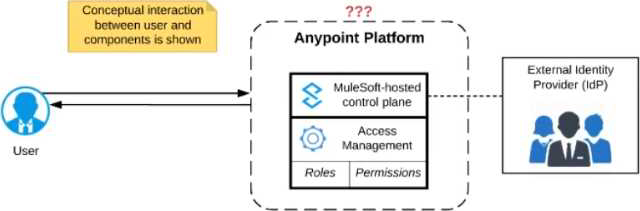
Anypoint Platform supports role-based access control (RBAC) to features of the platform. An organization has configured an external Identity Provider for identity management with Anypoint Platform.
What aspects of RBAC must ALWAYS be controlled from the Anypoint Platform control plane and CANNOT be controlled via the external Identity Provider?
- A . Controlling the business group within Anypoint Platform to which the user belongs
- B . Assigning Anypoint Platform permissions to a role
- C . Assigning Anypoint Platform role(s) to a user
- D . Removing a user’s access to Anypoint Platform when they no longer work for the organization
B
Explanation:
* By default, Anypoint Platform performs its own user management
C For user management, one external IdP can be integrated with the Anypoint Platform organization (note: not at business group level)
C Permissions and access control are still enforced inside Anypoint Platform and CANNOT be controlled via the external Identity Provider * As the Anypoint Platform organization administrator, you can configure identity management in Anypoint Platform to set up users for single sign-on (SSO). * You can map users in a federated organization’s group to a role which also gives the flexibility of controlling the business group within Anypoint Platform to which the user belongs to. Also user can nbe removed from external identity management system when they no longer work for the organization. So they wont be able to authenticate using SSO to login to Anypoint Platform. * Using external identity we can no change permissions of a particular role in Mulesoft Anypoint platform. * So Correct answer is Assigning Anypoint Platform permissions to a role
What approach configures an API gateway to hide sensitive data exchanged between API consumers and API implementations, but can convert tokenized fields back to their original value for other API requests or responses, without having to recode the API implementations?
- A . Create both masking and tokenization formats and use both to apply a tokenization policy in an API gateway to mask sensitive values in message payloads with characters, and apply a corresponding detokenization policy to return the original values to other APIs
- B . Create a masking format and use it to apply a tokenization policy in an API gateway to mask sensitive values in message payloads with characters, and apply a corresponding detokenization policy to return the original values to other APIs
- C . Use a field-level encryption policy in an API gateway to replace sensitive fields in message payload with encrypted values, and apply a corresponding field-level decryption policy to return the original values to other APIs
- D . Create a tokenization format and use it to apply a tokenization policy in an API gateway to replace sensitive fields in message payload with similarly formatted tokenized values, and apply a corresponding detokenization policy to return the original values to other APIs
The implementation of a Process API must change.
What is a valid approach that minimizes the impact of this change on API clients?
- A . Implement required changes to the Process API implementation so that whenever possible, the Process API’s RAML definition remains unchanged
- B . Update the RAML definition of the current Process API and notify API client developers by sending them links to the updated RAML definition
- C . Postpone changes until API consumers acknowledge they are ready to migrate to a new Process API or API version
- D . Implement the Process API changes in a new API implementation, and have the old API implementation return an HTTP status code 301 – Moved Permanently to inform API clients they should be calling the new API implementation
A
Explanation:
* Option B shouldn’t be used unless extremely needed, if RAML is changed, client needs to accommodate changes. Question is about minimizing impact on Client. So this is not a valid choice.
* Option C isn’t valid as Business can’t stop for consumers acknowledgment.
* Option D again needs Client to accommodate changes and isn’t viable option.
* Best choice is A where RAML definition isn’t changed and underlined functionality is changed without any dependency on client and without impacting client.
Following MuleSoft best practices, what MuleSoft runtime deployment option best meets the company’s goals to begin its digital transformation journey?
- A . Runtime Fabric on VMs/bare metal
- B . CloudHub runtimes
- C . Customer-hosted runtimes provisioned by a MuleSoft services partner
- D . Customer-hosted self-provisioned runtimes