
Salesforce MuleSoft Integration Architect I Practice Exams
Last updated on Nov 16,2026- Exam Code: MuleSoft Integration Architect I
- Exam Name: Salesforce Certified MuleSoft Integration Architect I
- Certification Provider: Salesforce
- Latest update: Nov 16,2026
Which Mulesoft feature helps users to delegate their access without sharing sensitive credentials or giving full control of accounts to 3rd parties?
- A . Secure Scheme
- B . client id enforcement policy
- C . Connected apps
- D . Certificates
C
Explanation:
Connected Apps
The Connected Apps feature provides a framework that enables an external application to integrate with Anypoint Platform using APIs through OAuth 2.0 and OpenID Connect. Connected apps help users delegate their access without sharing sensitive credentials or giving full control of their accounts to third parties. Actions taken by connected apps are audited, and users can also revoke access at any time. Note that some products do not currently include client IDs in this release of the Connected Apps feature. The Connected Apps feature enables you to use secure authentication protocols and control an app’s access to user data. Additionally, end users can authorize the app to access their Anypoint Platform data.
Mule Ref Doc: https://docs.mulesoft.com/access-management/connected-apps-overview
An airline is architecting an API connectivity project to integrate its flight data into an online aggregation website. The interface must allow for secure communication high-performance and asynchronous message exchange.
What are suitable interface technologies for this integration assuming that Mulesoft fully supports these technologies and that Anypoint connectors exist for these interfaces?
- A . AsyncAPI over HTTPS
AMQP with RabbitMQ JSON/REST over HTTPS - B . XML over ActiveMQ XML over SFTP XML/REST over HTTPS
- C . CSV over FTP YAM L over TLS JSON over HTTPS
- D . SOAP over HTTPS HOP over TLS gRPC over HTTPS
The ABC company has an Anypoint Runtime Fabric on VMs/Bare Metal (RTF-VM) appliance installed on its own customer-hosted AWS infrastructure.
Mule applications are deployed to this RTF-VM appliance. As part of the company standards, the Mule application logs must be forwarded to an external log management tool (LMT).
Given the company’s current setup and requirements, what is the most idiomatic (used for its intended purpose) way to send Mule application logs to the external LMT?
- A . In RTF-VM, install and configure the external LTM’s log-forwarding agent
- B . In RTF-VM, edit the pod configuration to automatically install and configure an Anypoint Monitoring agent
- C . In each Mule application, configure custom Log4j settings
- D . In RTF-VM. configure the out-of-the-box external log forwarder
A
Explanation:
Reference: https://help.mulesoft.com/s/article/Enable-external-log-forwarding-for-Mule-applications-deployed-in-RTF
An API implementation is being designed that must invoke an Order API which is known to repeatedly experience downtime. For this reason a fallback API is to be called when the Order API is unavailable.
What approach to designing invocation of the fallback API provides the best resilience?
- A . Redirect client requests through an HTTP 303 temporary redirect status code to the fallback API whenever the Order API is unavailable
- B . Set an option in the HTTP Requester component that invokes the order API to instead invoke a fallback API whenever an HTTP 4XX or 5XX response status code is received from Order API
- C . Create a separate entry for the order API in API manager and then invoke this API as a fallback API if the primary Order API is unavailable
- D . Search Anypoint Exchange for a suitable existing fallback API and them implement invocations to their fallback API in addition to the Order API
A
Explanation:
* Resilience testing is a type of software testing that observes how applications act under stress. It’s meant to ensure the product’s ability to perform in chaotic conditions without a loss of core functions or data; it ensures a quick recovery after unforeseen, uncontrollable events.
* In case an API invocation fails ― even after a certain number of retries ― it might be adequate to invoke a different API as a fallback. A fallback API, by definition, will never be ideal for the purpose of the API client, otherwise it would be the primary API.
* Here are some examples for fallback APIs:
– An old, deprecated version of the same API.
– An alternative endpoint of the same API and version (e.g. API in another CloudHub region).
– An API doing more than required, and therefore not as performant as the primary API.
– An API doing less than required and therefore forcing the API Client to offer a degraded service, which is still better than no service at all.
* API clients implemented as Mule applications offer the ‘Until Successful Scope and Exception’ strategies at their disposal, which together allow configuring fallback actions such as a fallback API invocation.
* All HTTP response status codes within the 3xx category are considered redirection messages. These codes indicate to the user agent (i.e. your web browser) that an additional action is required in order to complete the request and access the desired resource
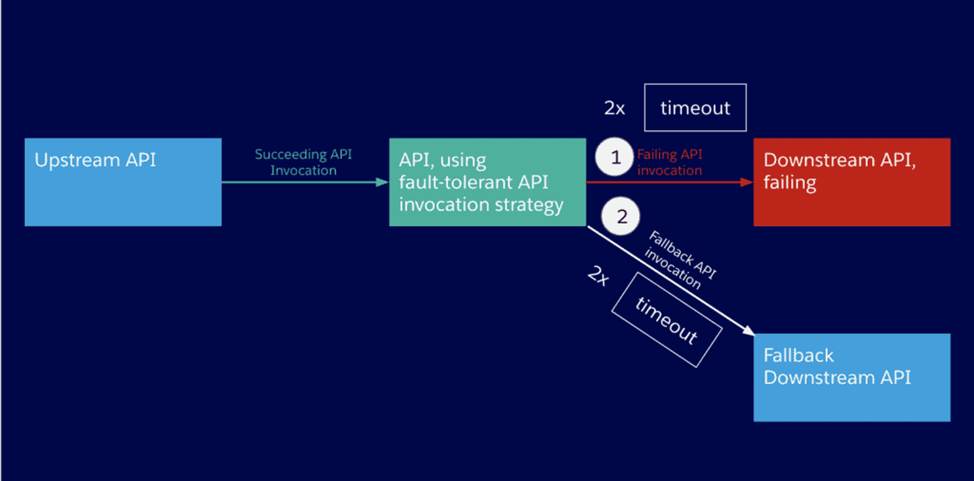
Hence correct answer is Redirect client requests through an HTTP 303 temporary redirect status code to the fallback API whenever the Order API is unavailable
An API implementation is being developed to expose data from a production database via HTTP requests. The API implementation executes a database SELECT statement that is dynamically created based upon data received from each incoming HTTP request. The developers are planning to use various types of testing to make sure the Mule application works as expected, can handle specific workloads, and behaves correctly from an API consumer perspective.
What type of testing would typically mock the results from each SELECT statement rather than actually execute it in the production database?
- A . Unit testing (white box)
- B . Integration testing
- C . Functional testing (black box)
- D . Performance testing
A
Explanation:
In Unit testing instead of using actual backends, stubs are used for the backend services. This ensures that developers are not blocked and have no dependency on other systems.
In Unit testing instead of using actual backends, stubs are used for the backend services. This ensures that developers are not blocked and have no dependency on other systems. Below are the typical characteristics of unit testing.
— Unit tests do not require deployment into any special environment, such as a staging environment
— Unit tests san be run from within an embedded Mule runtime
— Unit tests can/should be implemented using MUnit
— For read-only interactions to any dependencies (such as other APIs): allowed to invoke production endpoints
— For write interactions: developers must implement mocks using MUnit
— Require knowledge of the implementation details of the API implementation under test
An organization is sizing an Anypoint VPC to extend their internal network to Cloudhub.
For this sizing calculation, the organization assumes 150 Mule applications will be deployed among three (3) production environments and will use Cloudhub’s default zero-downtime feature. Each Mule application is expected to be configured with two (2) Cloudhub workers. This is expected to result in several Mule application deployments per hour.
- A . 10.0.0.0/21(2048 IPs)
- B . 10.0.0.0/22(1024IPs)
- C . 10.0.0.0/23(512 IPs)
- D . 10.0.0.0/24(256 IPs)
A
Explanation:
* When you create an Anypoint VPC, the range of IP addresses for the network must be specified in the form of a Classless Inter-Domain Routing (CIDR) block, using CIDR notation.
* This address space is reserved for Mule workers, so it cannot overlap with any address space used in your data center if you want to peer it with your VPC.
* To calculate the proper sizing for your Anypoint VPC, you first need to understand that the number of dedicated IP addresses is not the same as the number of workers you have deployed.
* For each worker deployed to CloudHub, the following IP assignation takes place: For better fault tolerance, the VPC subnet may be divided into up to four Availability Zones.
* A few IP addresses are reserved for infrastructure. At least two IP addresses per worker to perform at zero-downtime.
* Hence in this scenario 2048 IP’s are required to support the requirement.
An organization’s governance process requires project teams to get formal approval from all key stakeholders for all new Integration design specifications. An integration Mule application Is being designed that interacts with various backend systems. The Mule application will be created using Anypoint Design Center or Anypoint Studio and will then be deployed to a customer-hosted runtime.
What key elements should be included in the integration design specification when requesting approval for this Mule application?
- A . SLAs and non-functional requirements to access the backend systems
- B . Snapshots of the Mule application’s flows, including their error handling
- C . A list of current and future consumers of the Mule application and their contact details
- D . The credentials to access the backend systems and contact details for the administrator of each system
A
Explanation:
SLAs and non-functional requirements to access the backend systems. Only this option actually speaks to design parameters and reqs.
* Below two are technical implementations and not the part of design:
– Snapshots of the Mule application’s flows, including their error handling
– The credentials to access the backend systems and contact details for the administrator of each system
* List of consumers is not relevant to the design
According to MuleSoft’s recommended REST conventions, which HTTP method should an API use to specify how AP clients can request data from a specified resource?
- A . POST
- B . PUT
- C . PATCH
- D . GET
Which component of Anypoint platform belongs to the platform control plane?
- A . Runtime Fabric
- B . Runtime Replica
- C . Anypoint Connectors
- D . API Manager
What condition requires using a CloudHub Dedicated Load Balancer?
- A . When cross-region load balancing is required between separate deployments of the same Mule application
- B . When custom DNS names are required for API implementations deployed to customer-hosted Mule runtimes
- C . When API invocations across multiple CloudHub workers must be load balanced
- D . When server-side load-balanced TLS mutual authentication is required between API implementations and API clients
D
Explanation:
Correct answer is When server-side load-balanced TLS mutual authentication is required between API implementations and API clients CloudHub dedicated load balancers (DLBs) are an optional component of Anypoint Platform that enable you to route external HTTP and HTTPS traffic to multiple Mule applications deployed to CloudHub workers in a Virtual Private Cloud (VPC).
Dedicated load balancers enable you to:
* Handle load balancing among the different CloudHub workers that run your application.
* Define SSL configurations to provide custom certificates and optionally enforce two-way SSL client authentication.
* Configure proxy rules that map your applications to custom domains. This enables you to host your applications under a single domain