
Salesforce MuleSoft Integration Architect I Practice Exams
Last updated on Nov 16,2026- Exam Code: MuleSoft Integration Architect I
- Exam Name: Salesforce Certified MuleSoft Integration Architect I
- Certification Provider: Salesforce
- Latest update: Nov 16,2026
Refer to the exhibit.
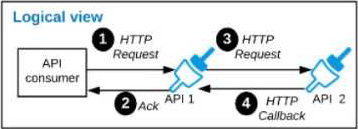
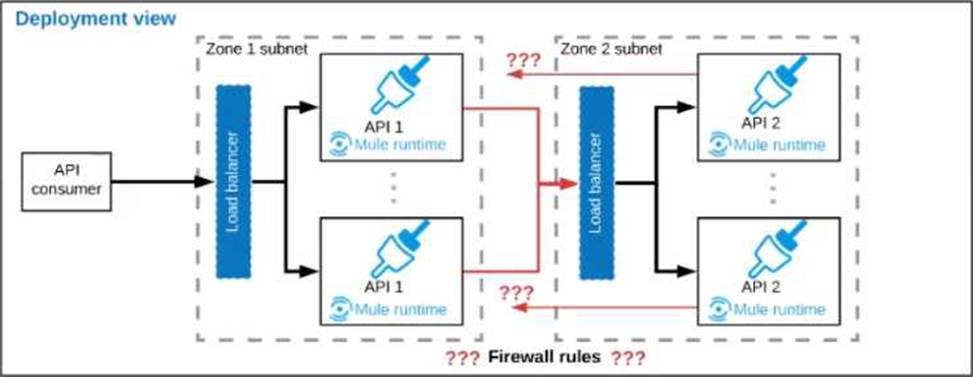
A business process involves two APIs that interact with each other asynchronously over HTTP. Each API is implemented as a Mule application. API 1 receives the initial HTTP request and invokes API 2 (in a fire and forget fashion) while API 2, upon completion of the processing, calls back into API l to notify about completion of the asynchronous process.
Each API Is deployed to multiple redundant Mule runtimes and a separate load balancer, and is deployed to a separate network zone.
In the network architecture, how must the firewall rules be configured to enable the above Interaction between API 1 and API 2?
- A . To authorize the certificate to be used both APIs
- B . To enable communication from each API’s Mule Runtimes and Network zone to the load balancer of the other API
- C . To open direct two-way communication between the Mule Runtimes of both API’s
- D . To allow communication between load balancers used by each API
B
Explanation:
* If your API implementation involves putting a load balancer in front of your APIkit application, configure the load balancer to redirect URLs that reference the baseUri of the application directly. If the load balancer does not redirect URLs, any calls that reach the load balancer looking for the application do not reach their destination.
* When you receive incoming traffic through the load balancer, the responses will go out the same way. However, traffic that is originating from your instance will not pass through the load balancer. Instead, it is sent directly from the public IP address of your instance out to the Internet. The ELB is not involved in that scenario.
* The question says “each API is deployed to multiple redundant Mule runtimes”, that seems to be a hint for self hosted Mule runtime cluster. Set Inbound allowed for the LB, outbound allowed for runtime to request out.
* Hence correct way is to enable communication from each API’s Mule Runtimes and Network zone to the load balancer of the other API. Because communication is asynchronous one
Reference: https://docs.mulesoft.com/apikit/4.x/configure-load-balancer-task
An Integration Mule application is being designed to synchronize customer data between two systems. One system is an IBM Mainframe and the other system is a Salesforce Marketing Cloud (CRM) instance. Both systems have been deployed in their typical configurations, and are to be invoked using the native protocols provided by Salesforce and IBM.
What interface technologies are the most straightforward and appropriate to use in this Mute application to interact with these systems, assuming that Anypoint Connectors exist that implement these interface technologies?
- A . IBM: DB access CRM: gRPC
- B . IBM: REST CRM:REST
- C . IBM: Active MQ CRM: REST
- D . IBM: CICS CRM: SOAP
D
Explanation:
Correct answer is IBM: CICS CRM: SOAP
* Within Anypoint Exchange, MuleSoft offers the IBM CICS connector. Anypoint Connector for IBM CICS Transaction Gateway (IBM CTG Connector) provides integration with back-end CICS apps using the CICS Transaction Gateway.
* Anypoint Connector for Salesforce Marketing Cloud (Marketing Cloud Connector) enables you to connect to the Marketing Cloud API web services (now known as the Marketing Cloud API), which is also known as the Salesforce Marketing Cloud. This connector exposes convenient operations via SOAP for exploiting the capabilities of Salesforce Marketing Cloud.
An organization’s security requirements mandate centralized control at all times over authentication and authorization of external applications when invoking web APIs managed on Anypoint Platform.
What Anypoint Platform feature is most idiomatic (used for its intended purpose), straightforward, and maintainable to use to meet this requirement?
- A . Client management configured in access management
- B . Identity management configured in access management
- C . Enterprise Security module coded in Mule applications
- D . External access configured in API Manager
A
Explanation:
Reference: https://blogs.mulesoft.com/dev-guides/api-security-ways-to-authenticate-and-authorize/
A Mule application uses the Database connector.
What condition can the Mule application automatically adjust to or recover from without needing to restart or redeploy the Mule application?
- A . One of the stored procedures being called by the Mule application has been renamed
- B . The database server was unavailable for four hours due to a major outage but is now fully operational again
- C . The credentials for accessing the database have been updated and the previous credentials are no longer valid
- D . The database server has been updated and hence the database driver library/JAR needs a minor version upgrade
B
Explanation:
* Any change in the application will require a restart except when the issue outside the app. For below situations, you would need to redeploy the code after doing necessary changes
— One of the stored procedures being called by the Mule application has been renamed. In this case, in the Mule application you will have to do changes to accommodate the new stored procedure name.
— Required redesign of Mule applications to follow microservice architecture principles. As code is changed, deployment is must
— If the credentials changed and you need to update the connector or the properties.
— The credentials for accessing the database have been updated and the previous credentials are no longer valid. In this situation you need to restart or redeploy depending on how credentials are configured in Mule application.
* So Correct answer is The database server was unavailable for four hours due to a major outage but is now fully operational again as this is the only external issue to application.
Refer to the exhibit.
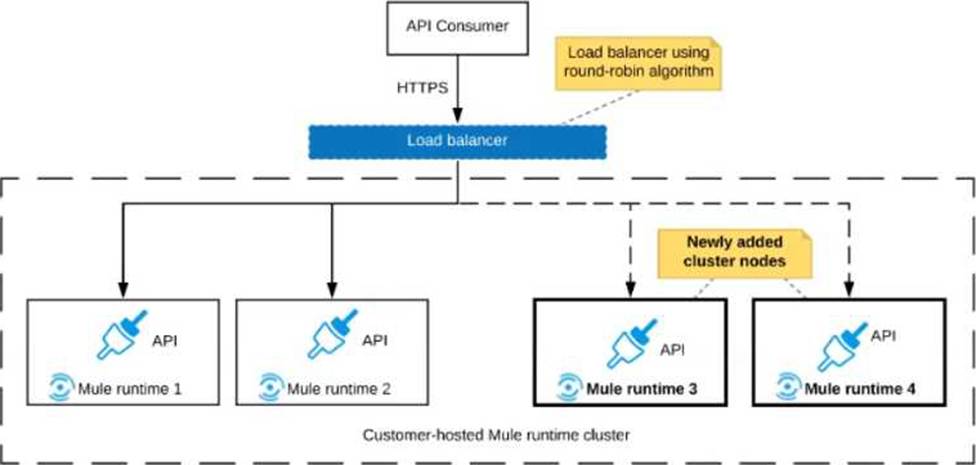
An organization uses a 2-node Mute runtime cluster to host one stateless API implementation. The API is accessed over HTTPS through a load balancer that uses round-robin for load distribution. Two additional nodes have been added to the cluster and the load balancer has been configured to recognize the new nodes with no other change to the load balancer.
What average performance change is guaranteed to happen, assuming all cluster nodes are fully operational?
- A . 50% reduction in the response time of the API
- B . 100% increase in the throughput of the API
- C . 50% reduction In the JVM heap memory consumed by each node
- D . 50% reduction In the number of requests being received by each node
An organization uses a set of customer-hosted Mule runtimes that are managed using the Mulesoft-hosted control plane.
What is a condition that can be alerted on from Anypoint Runtime Manager without any custom components or custom coding?
- A . When a Mule runtime on a given customer-hosted server is experiencing high memory consumption during certain periods
- B . When an SSL certificate used by one of the deployed Mule applications is about to expire
- C . When the Mute runtime license installed on a Mule runtime is about to expire
- D . When a Mule runtime’s customer-hosted server is about to run out of disk space
A
Explanation:
Correct answer is When a Mule runtime on a given customer-hosted server is experiencing high memory consumption during certain periods Using Anypoint Monitoring, you can configure two different types of alerts: Basic alerts for servers and Mule apps Limit per organization: Up to 50 basic alerts for users who do not have a Titanium subscription to Anypoint Platform You can set up basic alerts to trigger email notifications when a metric you are measuring passes a specified threshold. You can create basic alerts for the following metrics for servers or Mule apps:
For on-premises servers and CloudHub apps:
* CPU utilization
* Memory utilization
* Thread count Advanced alerts for graphs in custom dashboards in Anypoint Monitoring.
You must have a Titanium subscription to use this feature. Limit per organization: Up to 20 advanced alerts
The retrieve Balances flow in the Mule application is designed to use an operation in a connector to the Finance system (the Finance operation) that can only look up one account record at a time, and a operation from a different connector to the Audit system (the Audit operation) that can only insert one account record at a time.
To best meet the performance-related requirements, what scope or scopes should be used and how should they be used to incorporate the Finance operation and Audit operation into the retrieve Balances flow?
- A . Wrap the Finance operation in a Parallel For-Each scope. Wrap the Audit operation in a Async scope.
- B . Wrap the Finance operation in a Until-Successful scope. Wrap the Audit operation in a Try-Catch scope.
- C . Wrap both connector operations in a Async scope.
- D . Wrap both connector operations in a For-Each scope.
What is true about automating interactions with Anypoint Platform using tools such as Anypoint Platform REST API’s, Anypoint CLI or the Mule Maven plugin?
- A . By default, the Anypoint CLI and Mule Maven plugin are not included in the Mule runtime
- B . Access to Anypoint Platform API;s and Anypoint CLI can be controlled separately thruough the roles and permissions in Anypoint platform, so that specific users can get access to Anypoint CLI while others get access to the platform API’s
- C . Anypoint Platform API’s can only automate interactions with CloudHub while the Mule maven plugin is required for deployment to customer hosted Mule runtimes
- D . API policies can be applied to the Anypoint platform API’s so that only certain LOS’s has access to specific functions
A
Explanation:
Correct answer is By default, the Anypoint CLI and Mule Maven plugin are not included in the Mule runtime Maven is not part of runtime though it is part of studio. You do not need it to deploy in order to deploy your app. Same is the case with CLI.
As a part of project, existing java implementation is being migrated to Mulesoft. Business is very tight on the budget and wish to complete the project in most economical way possible.
Canonical object model using java is already a part of existing implementation. Same object model is required by mule application for a business use case.
What is the best way to achieve this?
- A . Make use of Java module
- B . Create similar model for Mule applications
- C . Create a custom application to read Java code and make it available for Mule application
- D . Use Anypoint exchange
A
Explanation:
Mule 4 is built to:
• Minimize the need for custom code.
• Avoid the need for you to know or understand Java.
However, some advanced uses cases require integration with custom Java code, such as:
• Reuse of a library, such as a tax calculation library.
• Reuse of a canonical object model that is standard in the organization.
• Execution of custom logic using Java.
Mule ref doc: https://docs.mulesoft.com/java-module/1.2/
A manufacturing company plans to deploy Mule applications to its own Azure Kubernetes service infrastructure. The organization wants to make the Mule applications more available and robust by deploying each Mule application to an isolated Mule runtime in a Docker container while managing all the Mule applications from the MuleSoft-hosted control plane.
What choice of runtime plane meets these organizational requirements?
- A . CloudHub 2.0
- B . Customer-hosted self-provisioned runtime plane
- C . Anypoint Service Mesh
- D . Anypoint Runtime Fabric