Salesforce MuleSoft Integration Architect I Practice Exams
Last updated on Nov 16,2026- Exam Code: MuleSoft Integration Architect I
- Exam Name: Salesforce Certified MuleSoft Integration Architect I
- Certification Provider: Salesforce
- Latest update: Nov 16,2026
According to MuleSoft, what is a major distinguishing characteristic of an application network in relation to the integration of systems, data, and devices?
- A . It uses a well-organized monolithic approach with standards
- B . It is built for change and self-service
- C . It leverages well-accepted internet standards like HTTP and JSON
- D . It uses CI/CD automation for real-time project delivery
An IT integration delivery team begins a project by gathering all of the requirements, and proceeds to execute the remaining project activities as sequential, non-repeating phases.
Which IT project delivery methodology is this team following?
- A . Kanban
- B . Scrum
- C . Waterfall
- D . Agile
An auto mobile company want to share inventory updates with dealers Dl and D2 asynchronously and concurrently via queues Q1 and Q2. Dealer Dl must consume the message from the queue Q1 and dealer D2 to must consume a message from the queue Q2.
Dealer D1 has implemented a retry mechanism to reprocess the transaction in case of any errors while processing the inventers updates. Dealer D2 has not implemented any retry mechanism.
How should the dealers acknowledge the message to avoid message loss and minimize impact on the current implementation?
- A . Dealer D1 must use auto acknowledgement and dealer D2 can use manual acknowledgement and acknowledge the message after successful processing
- B . Dealer D1 can use auto acknowledgement and dealer D2 can use IMMEDIATE acknowledgement and acknowledge the message of successful processing
- C . Dealer D1 and dealer D2 must use AUTO acknowledgement and acknowledge the message after successful processing
- D . Dealer D1 can use AUTO acknowledgement and dealer D2 must use manual acknowledgement and acknowledge the message
after successful processing
An integration team uses Anypoint Platform and follows MuleSoft’s recommended approach to full lifecycle API development.
Which step should the team’s API designer take before the API developers implement the AP! Specification?
- A . Generate test cases using MUnit so the API developers can observe the results of running the API
- B . Use the scaffolding capability of Anypoint Studio to create an API portal based on the API specification
- C . Publish the API specification to Exchange and solicit feedback from the API’s consumers
- D . Use API Manager to version the API specification
An organization has strict unit test requirement that mandate every mule application must have an MUnit test suit with a test case defined for each flow and a minimum test coverage of 80%.
A developer is building Munit test suit for a newly developed mule application that sends API request to an external rest API.
What is the effective approach for successfully executing the Munit tests of this new application while still achieving the required test coverage for the Munit tests?
- A . Invoke the external endpoint of the rest API from the mule floors
- B . Mark the rest API invocations in the Munits and then call the mocking service flow that simulates standard responses from the REST API
- C . Mock the rest API invocation in the Munits and return a mock response for those invocations
- D . Create a mocking service flow to simulate standard responses from the rest API and then configure the mule flows to call the marking service flow
A new upstream API Is being designed to offer an SLA of 500 ms median and 800 ms maximum (99th percentile) response time. The corresponding API implementation needs to sequentially invoke 3 downstream APIs of very similar complexity. The first of these downstream APIs offers the following SLA for its response time: median: 100 ms, 80th percentile: 500 ms, 95th percentile: 1000 ms.
If possible, how can a timeout be set in the upstream API for the invocation of the first downstream API to meet the new upstream API’s desired SLA?
- A . Set a timeout of 100 ms; that leaves 400 ms for the other two downstream APIs to complete
- B . Do not set a timeout; the Invocation of this API Is mandatory and so we must wait until it responds
- C . Set a timeout of 50 ms; this times out more invocations of that API but gives additional room for retries
- D . No timeout is possible to meet the upstream API’s desired SLA; a different SLA must be negotiated with the first downstream API or invoke an alternative API
D
Explanation:
Before we answer this question, we need to understand what median (50th percentile) and 80th percentile means. If the 50th percentile (median) of a response time is 500ms that means that 50% of my transactions are either as fast or faster than 500ms.
If the 90th percentile of the same transaction is at 1000ms it means that 90% are as fast or faster and only 10% are slower. Now as per upstream SLA, 99th percentile is 800 ms which means 99% of the incoming requests should have response time less than or equal to 800 ms. But as per one of the backend API, their 95th percentile is 1000 ms which means that backend API will take 1000 ms or less than that for 95% of. requests. As there are three API invocation from upstream API, we can not conclude a timeout that can be set to meet the desired SLA as backend SLA’s do not support it. Let see why other answers are not correct.
1) Do not set a timeout –> This can potentially violate SLA’s of upstream API
2) Set a timeout of 100 ms; —> This will not work as backend API has 100 ms as median meaning only 50% requests will be answered in this time and we will get timeout for 50% of the requests. Important thing to note here is, All APIs need to be executed sequentially, so if you get timeout in first API, there is no use of going to second and third API. As a service provider you wouldn’t want to keep 50% of your consumers dissatisfied. So not the best option to go with.
*To quote an example: Let’s assume you have built an API to update customer contact details.
– First API is fetching customer number based on login credentials
– Second API is fetching Info in 1 table and returning unique key
– Third API, using unique key provided in second API as primary key, updating remaining details
* Now consider, if API times out in first API and can’t fetch customer number, in this case, it’s useless to call API 2 and 3 and that is why question mentions specifically that all APIs need to be executed sequentially.
3) Set a timeout of 50 ms –> Again not possible due to the same reason as above Hence correct answer is No timeout is possible to meet the upstream API’s desired SLA; a different SLA must be
negotiated with the first downstream API or invoke an alternative API
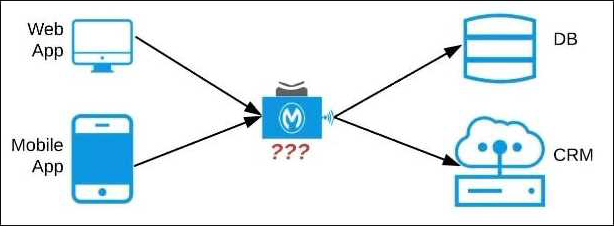
An organization needs to enable access to their customer data from both a mobile app and a web application, which each need access to common fields as well as certain unique fields. The data is available partially in a database and partially in a 3rd-party CRM system.
What APIs should be created to best fit these design requirements?
- A . A Process API that contains the data required by both the web and mobile apps, allowing these applications to invoke it directly and access the data they need thereby providing the flexibility to add more fields in the future without needing API changes.
- B . One set of APIs (Experience API, Process API, and System API) for the web app, and another set for
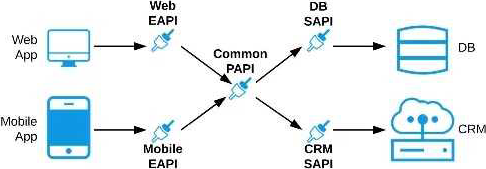
the mobile app. - C . Separate Experience APIs for the mobile and web app, but a common Process API that invokes separate System APIs created for the database and CRM system
- D . A common Experience API used by both the web and mobile apps, but separate Process APIs for the web and mobile apps that interact with the database and the CRM System.
C
Explanation:
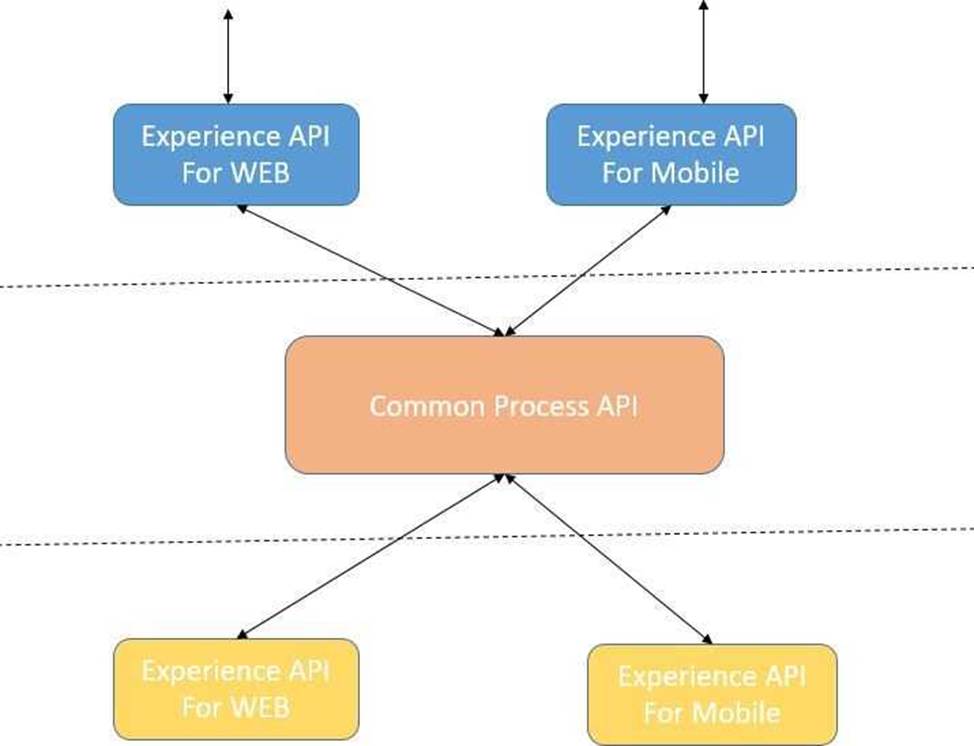
Lets analyze the situation in regards to the different options available Option: A common Experience API but separate Process APIs Analysis: This solution will not work because having common experience layer will not help the purpose as mobile and web applications will have different set of requirements which cannot be fulfilled by single experience layer API
Option: Common Process API Analysis: This solution will not work because creating a common process API will impose limitations in terms of flexibility to customize API;s as per the requirements of different applications. It is not a recommended approach.
Option: Separate set of API’s for both the applications Analysis: This goes against the principle of Anypoint API-led connectivity approach which promotes creating reusable assets. This solution may work but this is not efficient solution and creates duplicity of code.
Hence the correct answer is: Separate Experience APIs for the mobile and web app, but a common Process API that invokes separate System APIs created for the database and CRM system
Lets analyze the situation in regards to the different options available Option: A common Experience API but separate Process APIs Analysis: This solution will not work because having common experience layer will not help the purpose as mobile and web applications will have different set of requirements which cannot be fulfilled by single experience layer API
Option: Common Process API Analysis: This solution will not work because creating a common process API will impose limitations in terms of flexibility to customize API; s as per the requirements of different applications. It is not a recommended approach.
Option: Separate set of API’s for both the applications Analysis: This goes against the principle of Anypoint API-led connectivity approach which promotes creating reusable assets. This solution may work but this is not efficient solution and creates duplicity of code.
Hence the correct answer is: Separate Experience APIs for the mobile and web app, but a common Process API that invokes separate System APIs created for the database and CRM system
A new Mule application under development must implement extensive data transformation logic. Some of the data transformation functionality is already available as external transformation services that are mature and widely used across the organization; the rest is highly specific to the new Mule application.
The organization follows a rigorous testing approach, where every service and application must be extensively acceptance tested before it is allowed to go into production.
What is the best way to implement the data transformation logic for this new Mule application while minimizing the overall testing effort?
- A . Implement and expose all transformation logic as mlaoservices using DataWeave, so it can be reused by any application component that needs it, including the new Mule application
- B . Implement transformation logic in the new Mute application using DataWeave, replicating the transformation logic of existing transformation services
- C . Extend the existing transformation services with new transformation logic and Invoke them from the new Mule application
- D . Implement transformation logic in the new Mute application using DataWeave, invoking existing transformation services when possible
D
Explanation:
Correct answer is Implement transformation logic in the new Mule application using DataWeave, invoking existing transformation services when possible.
* The key here minimal testing effort, "Extend existing transformation logic" is not a feasible option because additional functionality is highly specific to the new Mule application so it should not be a part of commonly used functionality. So this option is ruled out.
* "Implement transformation logic in the new Mule application using DataWeave, replicating the transformation logic of existing transformation services" Replicating the transformation logic of existing transformation services will cause duplicity of code. So this option is ruled out.
* "Implement and expose all transformation logic as microservices using DataWeave, so it can be reused by any application component that needs it, including the new Mule application" as question specifies that the transformation is app specific and wont be used outside
A system API EmployeeSAPI is used to fetch employee’s data from an underlying SQL database. The architect must design a caching strategy to query the database only when there is an update to
the employees stable or else return a cached response in order to minimize the number of redundant transactions being handled by the database.
What must the architect do to achieve the caching objective?
- A . Use an On Table Row on employees table and call invalidate cache Use an object store caching strategy and expiration interval to empty
- B . Use a Scheduler with a fixed frequency every hour triggering an invalidate cache flow Use an object store caching strategy and expiration interval to empty
- C . Use a Scheduler with a fixed frequency every hour triggering an invalidate cache flow Use an object store caching strategy and set expiration interval to 1-hour
- D . Use an on table rule on employees table call invalidate cache and said new employees data to cache
Use an object store caching strategy and set expiration interval to 1-hour
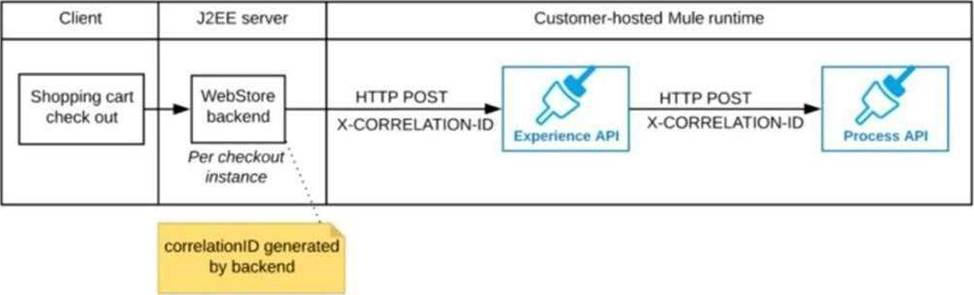
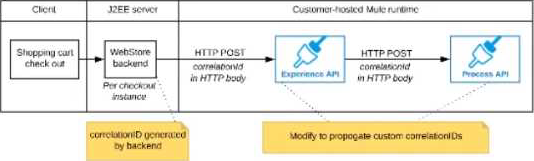
Refer to the exhibit.
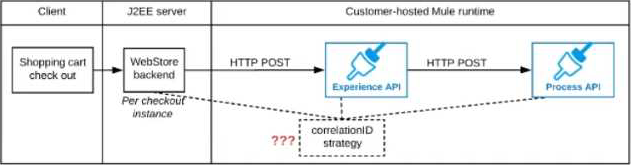
A shopping cart checkout process consists of a web store backend sending a sequence of API invocations to an Experience API, which in turn invokes a Process API. All API invocations are over HTTPS POST. The Java web store backend executes in a Java EE application server, while all API implementations are Mule applications executing in a customer -hosted Mule runtime. End-to-end correlation of all HTTP requests and responses belonging to each individual checkout Instance is required. This is to be done through a common correlation ID, so that all log entries written by the web store backend, Experience API implementation, and Process API implementation include the same correlation ID for all requests and responses belonging to the same checkout instance.
What is the most efficient way (using the least amount of custom coding or configuration) for the web store backend and the implementations of the Experience API and Process API to participate in end-to-end correlation of the API invocations for each checkout instance?
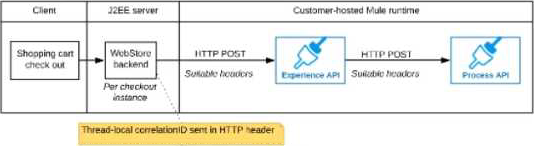
A) The web store backend, being a Java EE application, automatically makes use of the thread-local correlation ID generated by the Java EE application server and automatically transmits that to the Experience API using HTTP-standard headers
No special code or configuration is included in the web store backend, Experience API, and Process API implementations to generate and manage the correlation ID
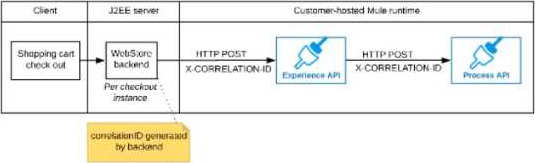
B) The web store backend generates a new correlation ID value at the start of checkout and sets it on the X-CORRELATlON-lt HTTP request header In each API invocation belonging to that checkout
No special code or configuration is included in the Experience API and Process API implementations to generate and manage the correlation ID
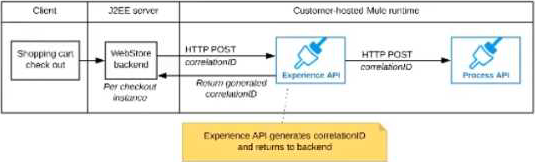
C) The Experience API implementation generates a correlation ID for each incoming HTTP request and passes it to the web store backend in the HTTP response, which includes it in all subsequent API invocations to the Experience API.
The Experience API implementation must be coded to also propagate the correlation ID to the Process API in a suitable HTTP request header
D) The web store backend sends a correlation ID value in the HTTP request body In the way required by the Experience API
The Experience API and Process API implementations must be coded to receive the custom correlation ID In the HTTP requests and propagate It in suitable HTTP request headers
- A . Option A
- B . Option B
- C . Option C
- D . Option D
B
Explanation:
Correct answer is "The web store backend generates a new correlation ID value at the start of checkout and sets it on the X¬CORRELATION-ID HTTP request header in each API invocation belonging to that checkout No special code or configuration is included in the Experience API and Process API implementations to generate and manage the correlation ID": By design, Correlation Ids cannot be changed within a flow in Mule 4 applications and can be set only at source. This ID is part of the Event Context and is generated as soon as the message is received by the application. When a HTTP Request is received, the request is inspected for "X-Correlation-Id" header. If "X-Correlation-Id" header is present, HTTP connector uses this as the Correlation Id. If "X-Correlation-Id" header is NOT present, a Correlation Id is randomly generated. For Incoming HTTP Requests: In order to set a custom Correlation Id, the client invoking the HTTP request must set "X-Correlation-Id" header. This will ensure that the Mule Flow uses this Correlation Id. For Outgoing HTTP Requests: You can also propagate the existing Correlation Id to downstream APIs. By default, all outgoing HTTP Requests send "X-Correlation-Id" header. However, you can choose to set a different value to "X-Correlation-Id" header or set "Send Correlation Id" to NEVER.
Mulesoft
Reference: https://help.mulesoft.com/s/article/How-to-Set-Custom-Correlation-Id-for-Flows-with-HTTP-Endpoint-in-Mule-4