
Salesforce MuleSoft Integration Architect I Practice Exams
Last updated on Nov 16,2026- Exam Code: MuleSoft Integration Architect I
- Exam Name: Salesforce Certified MuleSoft Integration Architect I
- Certification Provider: Salesforce
- Latest update: Nov 16,2026
In which order are the API Client, API Implementation, and API interface components called in a typical REST request?
- A . API Client > API implementation > API Interface
- B . API interface > API Client > API Implementation
- C . API Client > API Interface > API implementation
- D . API Implementation > API Interface > API Client
A company is building an application network and has deployed four Mule APIs: one experience API, one process API, and two system APIs. The logs from all the APIs are aggregated in an external log aggregation tool. The company wants to trace messages that are exchanged between multiple API implementations.
What is the most idiomatic (based on its intended use) identifier that should be used to implement Mule event tracing across the multiple API implementations?
- A . Mule event ID
- B . Mule correlation ID
- C . Client’s IP address
- D . DataWeave UUID
B
Explanation:
Correct answer is Mule correlation ID By design, Correlation Ids cannot be changed within a flow in Mule 4 applications and can be set only at source. This ID is part of the Event Context and is generated as soon as the message is received by the application. When a HTTP Request is received, the request is inspected for "X-Correlation-Id" header. If "X-Correlation-Id" header is present, HTTP connector uses this as the Correlation Id. If "X-Correlation-Id" header is NOT present, a Correlation Id is randomly generated. For Incoming HTTP Requests: In order to set a custom Correlation Id, the client invoking the HTTP request must set "X-Correlation-Id" header. This will ensure that the Mule Flow uses this Correlation Id. For Outgoing HTTP Requests: You can also propagate the existing Correlation Id to downstream APIs. By default, all outgoing HTTP Requests send "X-Correlation-Id" header. However, you can choose to set a different value to "X-Correlation-Id" header or set "Send Correlation Id" to NEVER.
Which productivity advantage does Anypoint Platform have to both implement and manage an AP?
- A . Automatic API proxy generation
- B . Automatic API specification generation
- C . Automatic API semantic versioning
- D . Automatic API governance
A company is planning to extend its Mule APIs to the Europe region. Currently all new applications are deployed to Cloudhub in the US region following this naming convention {API name}-{environment}. for example, Orders-SAPI-dev, Orders-SAPI-prod etc.
Considering there is no network restriction to block communications between API’s, what strategy should be implemented in order to apply the same new API’s running in the EU region of CloudHub as well to minimize latency between API’s and target users and systems in Europe?
- A . Set region property to Europe (eu-de) in API manager for all the mule application No need to change the naming convention
- B . Set region property to Europe (eu-de) in API manager for all the mule application
Change the naming convention to {API name}-{environment}-{region} and communicate this change to the consuming applications and users - C . Set region property to Europe (eu-de) in runtime manager for all the mule application No need to change the naming convention
- D . Set region property to Europe (eu-de) in runtime manager for all the mule application
Change the naming convention to {API name}-{environment}-{region} and communicate this change to the consuming applications and users
An Order microservice and a Fulfillment microservice are being designed to communicate with their dients through message-based integration (and NOT through API invocations).
The Order microservice publishes an Order message (a kind of command message) containing the details of an order to be fulfilled. The intention is that Order messages are only consumed by one
Mute application, the Fulfillment microservice.
The Fulfilment microservice consumes Order messages, fulfills the order described therein, and then publishes an OrderFulfilted message (a kind of event message). Each OrderFulfilted message can be consumed by any interested Mule application, and the Order microservice is one such Mute application.
What is the most appropriate choice of message broker(s) and message destination(s) in this scenario?
- A . Order messages are sent to an Anypoint MQ exchange OrderFulfilled messages are sent to an Anypoint MQ queue Both microservices interact with Anypoint MQ as the message broker, which must therefore scale to support the load of both microservices
- B . Order messages are sent to a JMS queue. OrderFulfilled messages are sent to a JMS topic Both microservices interact with the same JMS provider (message broker) instance, which must therefore scale to support the load of both microservices
- C . Order messages are sent directly to the Fulfillment microservices. OrderFulfilled messages are sent directly to the Order microservice The Order microservice interacts with one AMQP-compatible message broker and the Fulfillment microservice interacts with a different AMQP-compatible message broker, so that both message brokers can be chosen and scaled to best support the load of each microservice
- D . Order messages are sent to a JMS queue. OrderFulfilled messages are sent to a JMS topic The Order microservice interacts with one JMS provider (message broker) and the Fulfillment microservice interacts with a different JMS provider, so that both message brokers can be chosen and scaled to best support the load of each microservice
B
Explanation:
* If you need to scale a JMS provider/ message broker, – add nodes to scale it horizontally or – add memory to scale it vertically
* Cons of adding another JMS provider/ message broker: – adds cost. – adds complexity to use two JMS brokers – adds Operational overhead if we use two brokers, say, ActiveMQ and IBM MQ
* So Two options that mention to use two brokers are not best choice.
* It’s mentioned that "The Fulfillment microservice consumes Order messages, fulfills the order described therein, and then publishes an OrderFulfilled message. Each OrderFulfilled message can be consumed by any interested Mule application." – When you publish a message on a topic, it goes to all the subscribers who are interested – so zero to many subscribers will receive a copy of the message. – When you send a message on a queue, it will be received by exactly one consumer.
* As we need multiple consumers to consume the message below option is not valid choice: "Order messages are sent to an Anypoint MQ exchange. OrderFulfilled messages are sent to an Anypoint MQ queue. Both microservices interact with Anypoint MQ as the message broker, which must therefore scale to support the load of both microservices"
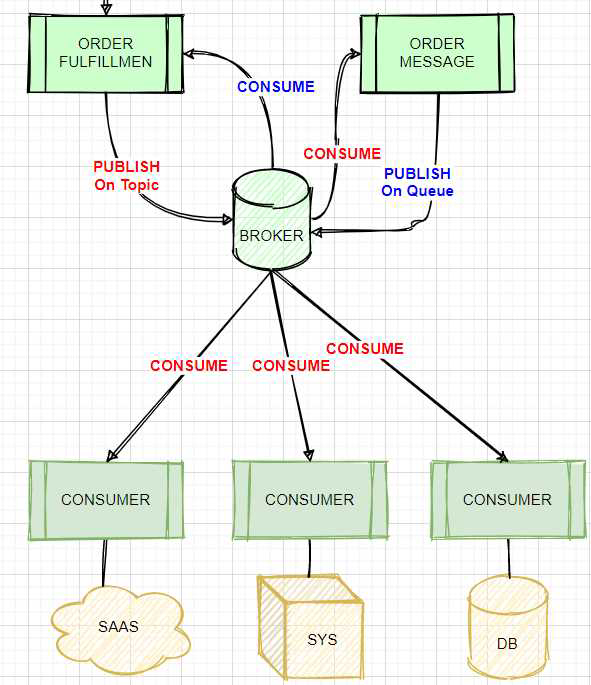
* Order messages are only consumed by one Mule application, the Fulfillment microservice, so we will publish it on queue and OrderFulfilled message can be consumed by any interested Mule application so it need to be published on Topic using same broker.
* Correct Answer. Best choice in this scenario is: "Order messages are sent to a JMS queue. OrderFulfilled messages are sent to a JMS topic. Both microservices interact with the same JMS provider (message broker) instance, which must therefore scale to support the load of both microservices" Tried to depict scenario in diagram:
What operation can be performed through a JMX agent enabled in a Mule application?
- A . View object store entries
- B . Replay an unsuccessful message
- C . Set a particular tog4J2 log level to TRACE
- D . Deploy a Mule application
A
Explanation:
JMX Management Java Management Extensions (JMX) is a simple and standard way to manage applications, devices, services, and other resources. JMX is dynamic, so you can use it to monitor and manage resources as they are created, installed, and implemented. You can also use JMX to monitor and manage the Java Virtual Machine (JVM). Each resource is instrumented by one or more Managed Beans, or MBeans. All MBeans are registered in an MBean Server. The JMX server agent consists of an MBean Server and a set of services for handling Mbeans. There are several agents provided with Mule for JMX support. The easiest way to configure JMX is to use the default JMX support agent. Log4J Agent The log4j agent exposes the configuration of the Log4J instance used by Mule for JMX management. You enable the Log4J agent using the <jmx-log4j> element. It does not take any additional properties MuleSoft
Reference: https://docs.mulesoft.com/mule-runtime/3.9/jmx-management
Additional nodes are being added to an existing customer-hosted Mule runtime cluster to improve performance. Mule applications deployed to this cluster are invoked by API clients through a load balancer.
What is also required to carry out this change?
- A . A new load balancer must be provisioned to allow traffic to the new nodes in a round-robin fashion
- B . External monitoring tools or log aggregators must be configured to recognize the new nodes
- C . API implementations using an object store must be adjusted to recognize the new nodes and persist to them
- D . New firewall rules must be configured to accommodate communication between API clients and the new nodes
B
Explanation:
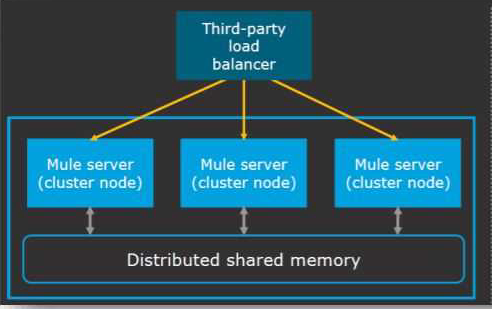
* Clustering is a group of servers or mule runtime which acts as a single unit.
* Mulesoft Enterprise Edition supports scalable clustering to provide high availability for the Mulesoft application.
* In simple terms, virtual servers composed of multiple nodes and they communicate and share information through a distributed shared memory grid.
* By default, Mulesoft ensures the High availability of applications if clustering implemented.
* Let’s consider the scenario one of the nodes in cluster crashed or goes down and under maintenance. In such cases, Mulesoft will ensure that requests are processed by other nodes in the cluster. Mulesoft clustering also ensures that the request is load balanced between all the nodes in a cluster.
* Clustering is only supported by on-premise Mule runtime and it is not supported in Cloudhub. Correct answer is External monitoring tools or log aggregators must be configured to recognize the new nodes
* Rest of the options are automatically taken care of when a new node is added in cluster.
Reference: https://docs.mulesoft.com/runtime-manager/cluster-about
A corporation has deployed Mule applications to different customer-hosted Mule runtimes. Mule applications deployed to these Mule runtimes are managed by Anypoint Platform.
What needs to be installed or configured (if anything) to monitor these Mule applications from Anypoint Monitoring, and how is monitoring data from each Mule application sent to Anypoint Monitoring?
- A . Enable monitoring of individual Mule applications from the Runtime Manager application settings.
Runtime Manager sends monitoring data to Anypoint Monitoring for each deployed Mule application. - B . Install a Runtime Manager agent on each Mule runtime.
Each Runtime Manager agent sends monitoring data from the Mule applications running in its Mule runtime to Runtime Manager, then Runtime Manager sends monitoring data to Anypoint Monitoring. - C . Leave the out-of-the-box Anypoint Monitoring agent unchanged in its default Mule runtime installation.
Each Anypoint Monitoring agent sends monitoring data from the Mule applications running in its Mule runtime to Runtime Manager, then Runtime Manager sends monitoring data to Anypoint Monitoring. - D . Install an Anypoint Monitoring agent on each Mule runtime.
Each Anypoint Monitoring agent sends monitoring data from the Mule applications running in its Mule runtime to Anypoint Monitoring.
An organization is designing the following two Mule applications that must share data via a common persistent object store instance:
– Mule application P will be deployed within their on-premises datacenter.
– Mule application C will run on CloudHub in an Anypoint VPC.
The object store implementation used by CloudHub is the Anypoint Object Store v2 (OSv2).
What type of object store(s) should be used, and what design gives both Mule applications access to the same object store instance?
- A . Application P uses the Object Store connector to access a persistent object store Application C accesses this persistent object store via the Object Store REST API through an IPsec tunnel
- B . Application C and P both use the Object Store connector to access the Anypoint Object Store v2
- C . Application C uses the Object Store connector to access a persistent object Application P accesses the persistent object store via the Object Store REST API
- D . Application C and P both use the Object Store connector to access a persistent object store
C
Explanation:
Correct answer is Application A accesses the persistent object store via the Object Store REST API Application B uses the Object Store connector to access a persistent object * Object Store v2 lets CloudHub applications store data and states across batch processes, Mule components and applications, from within an application or by using the Object Store REST API. * On-premise Mule applications cannot use Object Store v2. * You can select Object Store v2 as the implementation for Mule 3 and Mule 4 in CloudHub by checking the Object Store V2 checkbox in Runtime Manager at deployment time.
* CloudHub Mule applications can use Object Store connector to write to the object store
* The only way on-premises Mule applications can access Object Store v2 is via the Object Store REST API.
* You can configure a Mule app to use the Object Store REST API to store and retrieve values from an object store in another Mule app.
An organization is migrating all its Mule applications to Runtime Fabric (RTF). None of the Mule applications use Mule domain projects.
Currently, all the Mule applications have been manually deployed to a server group among several customer hosted Mule runtimes.
Port conflicts between these Mule application deployments are currently managed by the DevOps team who carefully manage Mule application properties files.
When the Mule applications are migrated from the current customer-hosted server group to Runtime Fabric (RTF), fo the Mule applications need to be rewritten and what DevOps port configuration responsibilities change or stay the same?
- A . Yes, the Mule applications Must be rewritten
DevOps No Longer needs to manage port conflicts between the Mule applications - B . Yes, the Mule applications Must be rewritten
DevOps Must Still Manage port conflicts. - C . NO, The Mule applications do NOT need to be rewritten DevOps MUST STILL manage port conflicts
- D . NO, the Mule applications do NO need to be rewritten
DevOps NO LONGER needs to manage port conflicts between the Mule applications.
C
Explanation:
* Anypoint Runtime Fabric is a container service that automates the deployment and orchestration of your Mule applications and gateways.
* Runtime Fabric runs on customer-managed infrastructure on AWS, Azure, virtual machines (VMs) or bare-metal servers.
* As none of the Mule applications use Mule domain projects. applications are not required to be rewritten. Also when applications are deployed on RTF, by default ingress is allowed only on 8081.
* Hence port conflicts are not required to be managed by DevOps team