
Salesforce MuleSoft Integration Architect I Practice Exams
Last updated on Nov 16,2026- Exam Code: MuleSoft Integration Architect I
- Exam Name: Salesforce Certified MuleSoft Integration Architect I
- Certification Provider: Salesforce
- Latest update: Nov 16,2026
According to MuteSoft, which principle is common to both Service Oriented Architecture (SOA) and API-led connectivity approaches?
- A . Service centralization
- B . Service statefulness
- C . Service reusability
- D . Service interdependence
An organization is choosing between API-led connectivity and other integration approaches.
According to MuleSoft, which business benefits is associated with an API-led connectivity approach using Anypoint Platform?
- A . improved security through adoption of monolithic architectures
- B . Increased developer productivity through sell-service of API assets
- C . Greater project predictability through tight coupling of systems
- D . Higher outcome repeatability through centralized development
A corporation has deployed multiple mule applications implementing various public and private API’s to different cloudhub workers. These API’s arc Critical applications that must be highly available and in line with the reliability SLA as defined by stakeholders.
How can API availability (liveliness or readiness) be monitored so that Ops team receives outage notifications?
- A . Enable monitoring of individual applications from Anypoint monitoring
- B . Configure alerts with failure conditions in runtime manager
- C . Configure alerts failure conditions in API manager
- D . Use any point functional monitoring test API’s functional behavior
An organization is designing a Mule application to periodically poll an SFTP location for new files containing sales order records and then process those sales orders. Each sales order must be processed exactly once.
To support this requirement, the Mule application must identify and filter duplicate sales orders on the basis of a unique ID contained in each sales order record and then only send the new sales orders to the downstream system.
What is the most idiomatic (used for its intended purpose) Anypoint connector, validator, or scope
that can be configured in the Mule application to filter duplicate sales orders on the basis of the unique ID field contained in each sales order record?
- A . Configure a Cache scope to filter and store each record from the received file by the order ID
- B . Configure a Database connector to filter and store each record by the order ID
- C . Configure an Idempotent Message Validator component to filter each record by the order ID
- D . Configure a watermark In an On New or Updated File event source to filter unique records by the order ID
C
Explanation:
Reference: https://docs.mulesoft.com/mule-runtime/3.9/idempotent-filter
The company’s FTPS server login username and password
- A . TLS context trust store containing a public certificate for the company. The company’s PGP public key that was used to sign the files
- B . The partner’s PGP public key used by the company to login to the FTPS server. A TLS context key store containing the private key for the company
The partner’s PGP private key that was used to sign the files - C . The company’s FTPS server login username and password. A TLS context trust store containing a public certificate for ftps.partner.com
The partner’s PGP public key that was used to sign the files - D . The partner’s PGP public key used by the company to login to the FTPS server. A TLS context key store containing the private key for ftps.partner.com
The company’s PGP private key that was used to sign the files
A key Cl/CD capability of any enterprise solution is a testing framework to write and run repeatable tests.
Which component of Anypoint Platform provides the te6t automation capabilities for customers to use in their pipelines?
- A . Anypoint CLl
- B . Mule Maven Plugin
- C . Exchange Mocking Service
- D . MUnit
An organization has implemented a continuous integration (CI) lifecycle that promotes Mule applications through code, build, and test stages. To standardize the organization’s CI journey, a new dependency control approach is being designed to store artifacts that include information such as dependencies, versioning, and build promotions.
To implement these process improvements, the organization will now require developers to maintain all dependencies related to Mule application code in a shared location.
What is the most idiomatic (used for its intended purpose) type of system the organization should use in a shared location to standardize all dependencies related to Mule application code?
- A . A MuleSoft-managed repository at repository.mulesoft.org
- B . A binary artifact repository
- C . API Community Manager
- D . The Anypoint Object Store service at cloudhub.io
A company is designing an integration Mule application to process orders by submitting them to a back-end system for offline processing. Each order will be received by the Mule application through an HTTP5 POST and must be acknowledged immediately.
Once acknowledged the order will be submitted to a back-end system. Orders that cannot be successfully submitted due to the rejections from the back-end system will need to be processed manually (outside the banking system).
The mule application will be deployed to a customer hosted runtime and will be able to use an existing ActiveMQ broker if needed. The ActiveMQ broker is located inside the organization’s firewall. The back-end system has a track record of unreliability due to both minor network connectivity issues and longer outages.
Which combination of Mule application components and ActiveMQ queues are required to ensure automatic submission of orders to the back-end system while supporting but minimizing manual order processing?
- A . One or more On Error scopes to assist calling the back-end system An Untill successful scope containing VM components for long retries A persistent dead-letter VM queue configure in Cloud hub
- B . An Until Successful scope to call the back-end system One or more ActiveMQ long-retry queues One or more ActiveMQ dead-letter queues for manual processing
- C . One or more on-Error scopes to assist calling the back-end system one or more ActiveMQ long-retry queues A persistent dead-letter Object store configuration in the CloudHub object store service
- D . A batch job scope to call the back in system An Untill successful scope containing Object Store components for long retries. A dead-letter object store configured in the Mule application
Refer to the exhibit.
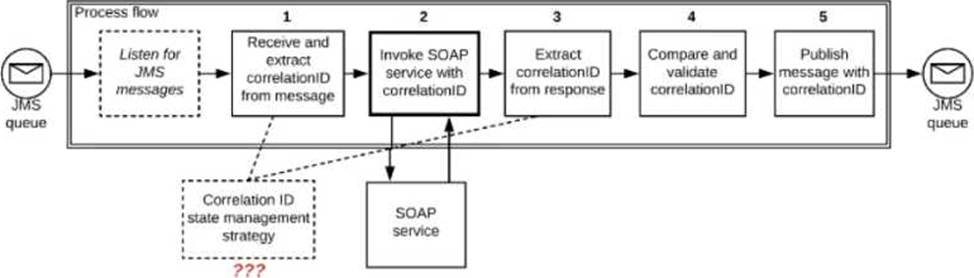
A Mule application is deployed to a multi-node Mule runtime cluster. The Mule application uses the competing consumer pattern among its cluster replicas to receive JMS messages from a JMS queue. To process each received JMS message, the following steps are performed in a flow: Step l: The JMS Correlation ID header is read from the received JMS message.
Step 2: The Mule application invokes an idempotent SOAP webservice over HTTPS, passing the JMS Correlation ID as one parameter in the SOAP request.
Step 3: The response from the SOAP webservice also returns the same JMS Correlation ID.
Step 4: The JMS Correlation ID received from the SOAP webservice is validated to be identical to the JMS Correlation ID received in Step 1.
Step 5: The Mule application creates a response JMS message, setting the JMS Correlation ID message header to the validated JMS Correlation ID and publishes that message to a response JMS queue.
Where should the Mule application store the JMS Correlation ID values received in Step 1 and Step 3 so that the validation in Step 4 can be performed, while also making the overall Mule application highly available, fault-tolerant, performant, and maintainable?
- A . Both Correlation ID values should be stored in a persistent object store
- B . Both Correlation ID values should be stored In a non-persistent object store
- C . The Correlation ID value in Step 1 should be stored in a persistent object store
The Correlation ID value in step 3 should be stored as a Mule event variable/attribute - D . Both Correlation ID values should be stored as Mule event variable/attribute
C
Explanation:
* If we store Correlation id value in step 1 as Mule event variables/attributes, the values will be cleared after server restart and we want system to be fault tolerant.
* The Correlation ID value in Step 1 should be stored in a persistent object store.
* We don’t need to store Correlation ID value in Step 3 to persistent object store. We can store it but
as we also need to make application performant. We can avoid this step of accessing persistent object store.
* Accessing persistent object stores slow down the performance as persistent object stores are by default stored in shared file systems.
* As the SOAP service is idempotent in nature. In case of any failures, using this Correlation ID saved in first step we can make call to SOAP service and validate the Correlation ID.
Top of Form Additional Information:
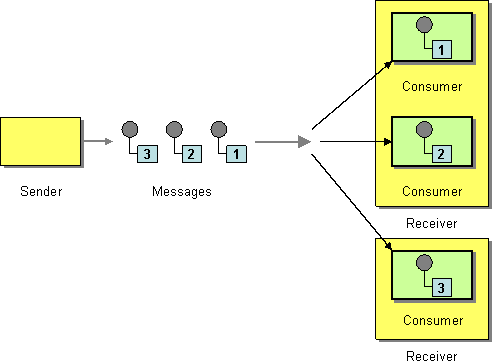
* Competing Consumers are multiple consumers that are all created to receive messages from a single Point-to-Point Channel. When the channel delivers a message, any of the consumers could potentially receive it. The messaging system’s implementation determines which consumer actually receives the message, but in effect the consumers compete with each other to be the receiver. Once a consumer receives a message, it can delegate to the rest of its application to help process the message.
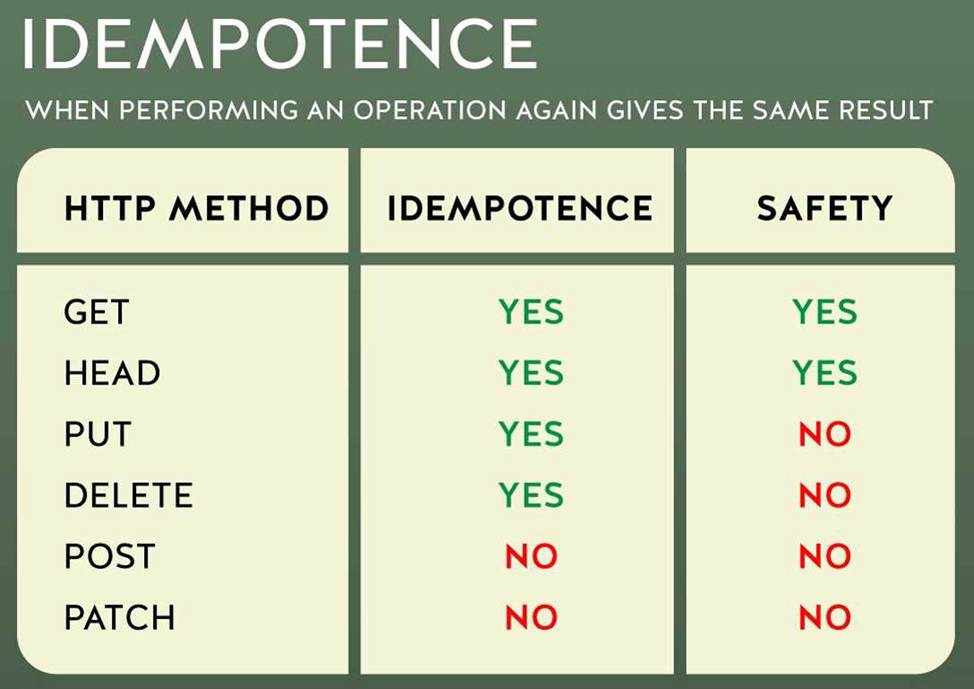
* In case you are unaware about term idempotent re is more info:
Idempotent operations means their result will always same no matter how many times these operations are invoked.
Bottom of Form
A project team uses RAML specifications to document API functional requirements and deliver API definitions. As per the current legal requirement, all designed API definitions to be augmented with an additional non-functional requirement to protect the services from a high rate of requests according to define service level agreements.
Assuming that the project is following Mulesoft API governance and policies, how should the project team convey the necessary non-functional requirement to stakeholders?
- A . Create proxies in API manager for the non functional requirement and publish to exchange
- B . Add all non functional requirements as comments to RAML specification and publish to exchange
- C . Create various SLA’s in API manager for the non functional requirement and publish to exchange
- D . Update API definitions with the fragment for the appropriate policy and publish to exchange