
Salesforce MuleSoft Integration Architect I Practice Exams
Last updated on Nov 16,2026- Exam Code: MuleSoft Integration Architect I
- Exam Name: Salesforce Certified MuleSoft Integration Architect I
- Certification Provider: Salesforce
- Latest update: Nov 16,2026
An organization designing a hybrid, load balanced, single cluster production environment. Due to performance service level agreement goals, it is looking into running the Mule applications in an active-active multi node cluster configuration.
What should be considered when running its Mule applications in this type of environment?
- A . All event sources, regardless of time, can be configured as the target source by the primary node in the cluster
- B . An external load balancer is required to distribute incoming requests throughout the cluster nodes
- C . A Mule application deployed to multiple nodes runs in an isolation from the other nodes in the cluster
- D . Although the cluster environment is fully installed configured and running, it will not process any requests until an outage condition is detected by the primary node in the cluster.
Anypoint Exchange is required to maintain the source code of some of the assets committed to it, such as Connectors, Templates, and API specifications.
What is the best way to use an organization’s source-code management (SCM) system in this context?
- A . Organizations should continue to use an SCM system of their choice, in addition to keeping source
code for these asset types in Anypoint Exchange, thereby enabling parallel development, branching, and merging - B . Organizations need to use Anypoint Exchange as the main SCM system to centralize versioning and avoid code duplication
- C . Organizations can continue to use an SCM system of their choice for branching and merging, as long as they follow the branching and merging strategy enforced by Anypoint Exchange
- D . Organizations need to point Anypoint Exchange to their SCM system so Anypoint Exchange can pull source code when requested by developers and provide it to Anypoint Studio
B
Explanation:
* Organization should continue to use SCM system of their choice, in addition to keeping source code for these asset types in Anypoint Exchange, thereby enabling parallel development, branching.
* Reason is that Anypoint exchange is not full fledged version repositories like GitHub.
* But at same time it is tightly coupled with Mule assets
Which Exchange asset type represents configuration modules that extend the functionality of an API and enforce capabilities such as security?
- A . Rulesets
- B . Policies
- C . RESTAPIs
- D . Connectors
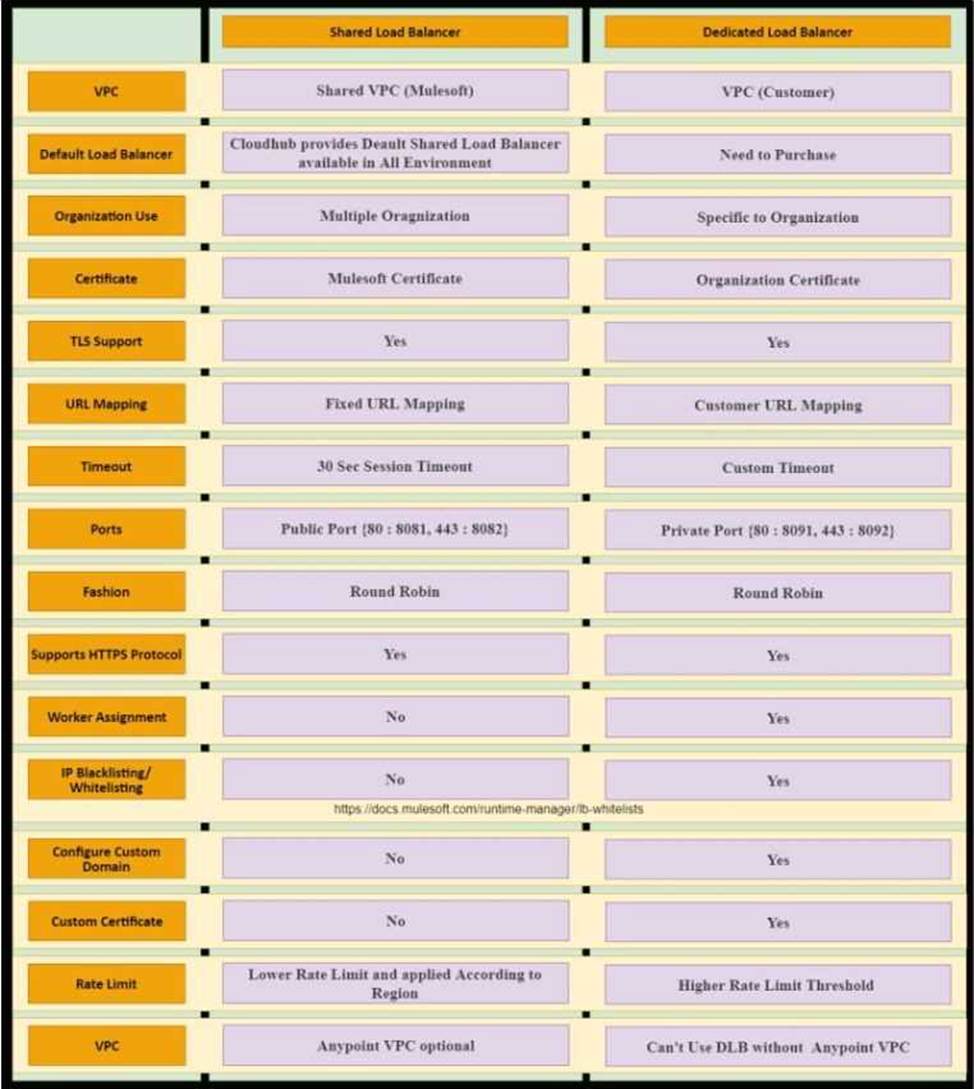
What comparison is true about a CloudHub Dedicated Load Balancer (DLB) vs. the CloudHub Shared Load Balancer (SLB)?
- A . Only a DLB allows the configuration of a custom TLS server certificate
- B . Only the SLB can forward HTTP traffic to the VPC-internal ports of the CloudHub workers
- C . Both a DLB and the SLB allow the configuration of access control via IP whitelists
- D . Both a DLB and the SLB implement load balancing by sending HTTP requests to workers with the lowest workloads
A
Explanation:
* Shared load balancers don’t allow you to configure custom SSL certificates or proxy rules
* Dedicated Load Balancer are optional but you need to purchase them additionally if needed.
* TLS is a cryptographic protocol that provides communications security for your Mule app. TLS offers many different ways of exchanging keys for authentication, encrypting data, and guaranteeing message integrity.
* The CloudHub Shared Load Balancer terminates TLS connections and uses its own server-side certificate.
* Only a DLB allows the configuration of a custom TLS server certificate
* DLB enables you to define SSL configurations to provide custom certificates and optionally enforce two-way SSL client authentication.
* To use a DLB in your environment, you must first create an Anypoint VPC. Because you can associate multiple environments with the same Anypoint VPC, you can use the same dedicated load balancer for your different environments.
* MuleSoft
Reference: https://docs.mulesoft.com/runtime-manager/dedicated-load-balancer-tutorial
Additional Info on SLB Vs DLB:
Which type of communication is managed by a service mesh in a microservices architecture?
- A . Communication between microservices runtime administrators
- B . Communication between microservices developers
- C . Communication between microservices
- D . Communication between trading partner services