
Salesforce MuleSoft Integration Architect I Practice Exams
Last updated on Nov 16,2026- Exam Code: MuleSoft Integration Architect I
- Exam Name: Salesforce Certified MuleSoft Integration Architect I
- Certification Provider: Salesforce
- Latest update: Nov 16,2026
What limits if a particular Anypoint Platform user can discover an asset in Anypoint Exchange?
- A . Design Center and RAML were both used to create the asset
- B . The existence of a public Anypoint Exchange portal to which the asset has been published
- C . The type of the asset in Anypoint Exchange
- D . The business groups to which the user belongs
D
Explanation:
* "The existence of a public Anypoint Exchange portal to which the asset has been published" – question does not mention anything about the public portal. Beside the public portal is open to the internet, to anyone.
* If you cannot find an asset in the current business group scopes, search in other scopes. In the left navigation bar click All assets (assets provided by MuleSoft and your own master organization), Provided by MuleSoft, or a business group scope. User belonging to one Business Group can see assets related to his group only
Reference:
https://docs.mulesoft.com/exchange/to-find-info
https://docs.mulesoft.com/exchange/asset-details Correct answer is
The business groups to which the user belongs
An integration team follows MuleSoft’s recommended approach to full lifecycle API development.
Which activity should this team perform during the API implementation phase?
- A . Validate the API specification
- B . Use the API specification to build the MuleSoft application
- C . Design the API specification
- D . Use the API specification to monitor the MuleSoft application
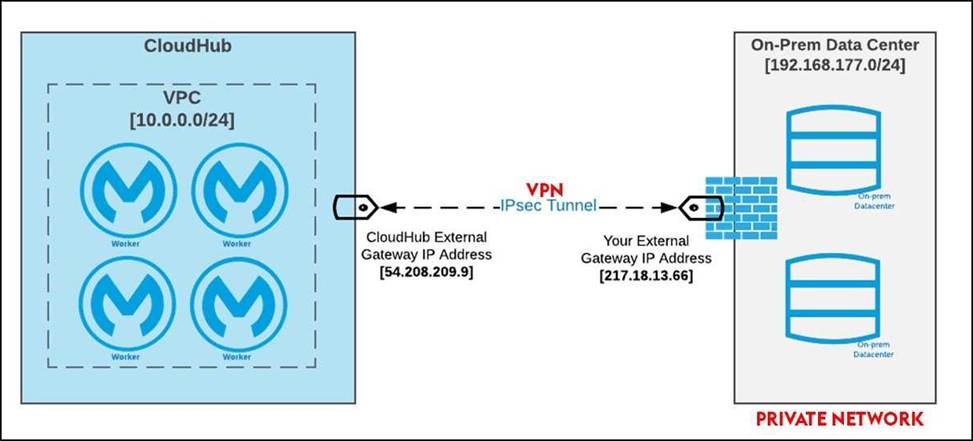
Mule applications need to be deployed to CloudHub so they can access on-premises database systems. These systems store sensitive and hence tightly protected data, so are not accessible over the internet.
What network architecture supports this requirement?
- A . An Anypoint VPC connected to the on-premises network using an IPsec tunnel or AWS DirectConnect, plus matching firewall rules in the VPC and on-premises network
- B . Static IP addresses for the Mule applications deployed to the CloudHub Shared Worker Cloud, plus
matching firewall rules and IP
whitelisting in the on-premises network - C . An Anypoint VPC with one Dedicated Load Balancer fronting each on-premises database system, plus matching IP whitelisting in the load balancer and firewall rules in the VPC and on-premises network
- D . Relocation of the database systems to a DMZ in the on-premises network, with Mule applications deployed to the CloudHub Shared Worker Cloud connecting only to the DMZ
A
Explanation:
* "Relocation of the database systems to a DMZ in the on-premises network, with Mule applications deployed to the CloudHub Shared Worker Cloud connecting only to the DMZ" is not a feasible option
* "Static IP addresses for the Mule applications deployed to the CloudHub Shared Worker Cloud, plus matching firewall rules and IP whitelisting in the on-premises network" – It is risk for sensitive data. – Even if you whitelist the database IP on your app, your app wont be able to connect to the database so this is also not a feasible option
* "An Anypoint VPC with one Dedicated Load Balancer fronting each on-premises database system, plus matching IP whitelisting in the load balancer and firewall rules in the VPC and on-premises network" Adding one VPC with a DLB for each backend system also makes no sense, is way too much work.
Why would you add a LB for one system.
* Correct answer. "An Anypoint VPC connected to the on-premises network using an IPsec tunnel or AWS DirectConnect, plus matching firewall rules in the VPC and on-premises network"
IPsec Tunnel You can use an IPsec tunnel with network-to-network configuration to connect your on-premises data centers to your Anypoint VPC. An IPsec VPN tunnel is generally the recommended solution for VPC to on-premises connectivity, as it provides a standardized, secure way to connect. This method also integrates well with existing IT infrastructure such as routers and appliances.
Reference: https://docs.mulesoft.com/runtime-manager/vpc-connectivity-methods-concept
Refer to the exhibit.
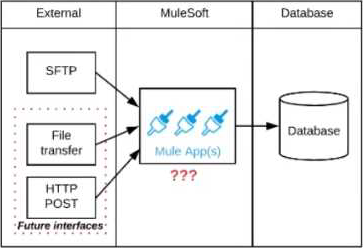
A business process involves the receipt of a file from an external vendor over SFTP. The file needs to be parsed and its content processed, validated, and ultimately persisted to a database. The delivery mechanism is expected to change in the future as more vendors send similar files using other mechanisms such as file transfer or HTTP POST.
What is the most effective way to design for these requirements in order to minimize the impact of future change?
- A . Use a MuleSoft Scatter-Gather and a MuleSoft Batch Job to handle the different files coming from different sources
- B . Create a Process API to receive the file and process it using a MuleSoft Batch Job while delegating the data save process to a System API
- C . Create an API that receives the file and invokes a Process API with the data contained In the file, then have the Process API process the data using a MuleSoft Batch Job and other System APIs as needed
- D . Use a composite data source so files can be retrieved from various sources and delivered to a MuleSoft Batch Job for processing
C
Explanation:
* Scatter-Gather is used for parallel processing, to improve performance. In this scenario, input files are coming from different vendors so mostly at different times. Goal here is to minimize the impact of future change. So scatter Gather is not the correct choice.
* If we use 1 API to receive all files from different Vendors, any new vendor addition will need changes to that 1 API to accommodate new requirements. So Option A and C are also ruled out.
* Correct answer is Create an API that receives the file and invokes a Process API with the data contained in the file, then have the Process API process the data using a MuleSoft Batch Job and other System APIs as needed. Answer to this question lies in the API led connectivity approach.
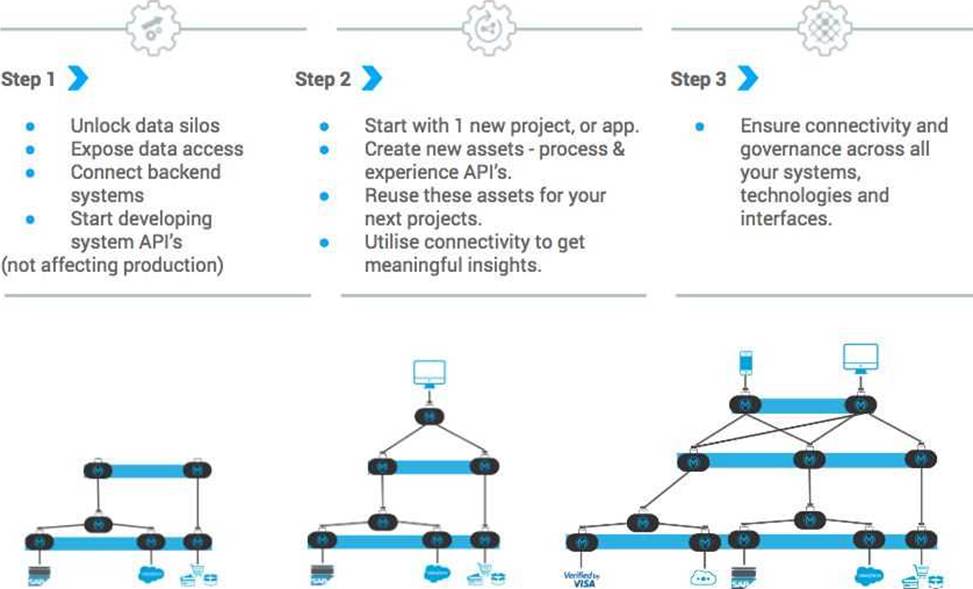
* API-led connectivity is a methodical way to connect data to applications through a series of reusable and purposeful modern APIs that are each developed to play a specific role C unlock data from systems, compose data into processes, or deliver an experience. System API: System API tier, which provides consistent, managed, and secure access to backend systems. Process APIs: Process APIs take core assets and combines them with some business logic to create a higher level of value. Experience APIs: These are designed specifically for consumption by a specific end-user app or device.
So in case of any future plans, organization can only add experience API on addition of new Vendors, which reuse the already existing process API. It will keep impact minimal.
How are the API implementation, API client, and API consumer combined to invoke and process an API?
- A . The API consumer creates an API implementation, which receives API invocations from an API such that they are processed for an API client
- B . The API consumer creates an API client which sends API invocations to an API such that they are processed by an API implementation
- C . An API client creates an API consumer, which receives API invocation from an API such that they are processed for an API implementation
- D . The API client creates an API consumer which sends API invocations to an API such that they are processed by API implementation
C
Explanation:
The API consumer creates an API client which sends API invocations to an API such that they are processed by an API implementation
This is based on below definitions API client
• An application component • that accesses a service
• by invoking an API of that service – by definition of the term API over HTTP API consumer
• A business role, which is often assigned to an individual
• that develops API clients, i.e., performs the activities necessary for enabling an API client to invoke APIs API implementation
• An application component
• that implements the functionality
A rale limiting policy has been applied to a soap VI.2 API published in Clondhub. The API implementation catches errors in a global error handler on error propagate in the main flow for HTTP: RETRY_EXHAUSTED with HTTP status set to 429 and any with the HTTP status set to 500.
What is the expected H1TP status when the client exceeds the quota of the API calls?
- A . HTTP status 429 as defined in the HTTP: RETRY EXHAUSTED error handler in the API
- B . HTTP status 500 as defined in the ANY error handler in the API since an API: RETRY_EXHAUSTED will be generated
- C . HTTP status 401 unauthorized for policy violation
- D . HTTP status 400 from the rate-limiting policy violation since the call does not reach the back-end
What aspects of a CI/CD pipeline for Mule applications can be automated using MuleSoft-provided Maven plugins?
- A . Compile, package, unit test, validate unit test coverage, deploy
- B . Compile, package, unit test, deploy, integration test (Incorrect)
- C . Compile, package, unit test, deploy, create associated API instances in API Manager
- D . Import from API designer, compile, package, unit test, deploy, publish to Anypoint Exchange
A
Explanation:
Correct answer is "Compile, package, unit test, validate unit test coverage, deploy": Anypoint Platform supports continuous integration and continuous delivery using industry standard tools Mule Maven Plugin The Mule Maven plugin can automate building, packaging and deployment of Mule applications from source projects Using the Mule Maven plugin, you can automate your Mule application deployment to CloudHub, to Anypoint Runtime Fabric, or on-premises, using any of the following deployment strategies
• CloudHub deployment
• Runtime Fabric deployment
• Runtime Manager REST API deployment
• Runtime Manager agent deployment MUnit Maven Plugin
The MUnit Maven plugin can automate test execution, and ties in with the Mule Maven plugin. It provides a full suite of integration and unit test capabilities, and is fully integrated with Maven and Surefire for integration with your continuous deployment environment. Since MUnit 2.x, the coverage report goal is integrated with the maven reporting section. Coverage Reports are generated during Maven’s site lifecycle, during the coverage-report goal. One of the features of MUnit Coverage is to fail the build if a certain coverage level is not reached. MUnit is not used for integration testing Also publishing to Anypoint Exchange or to create associated API instances in API Manager is not a part of CICD pipeline which can ne achieved using mulesoft provided maven plugin
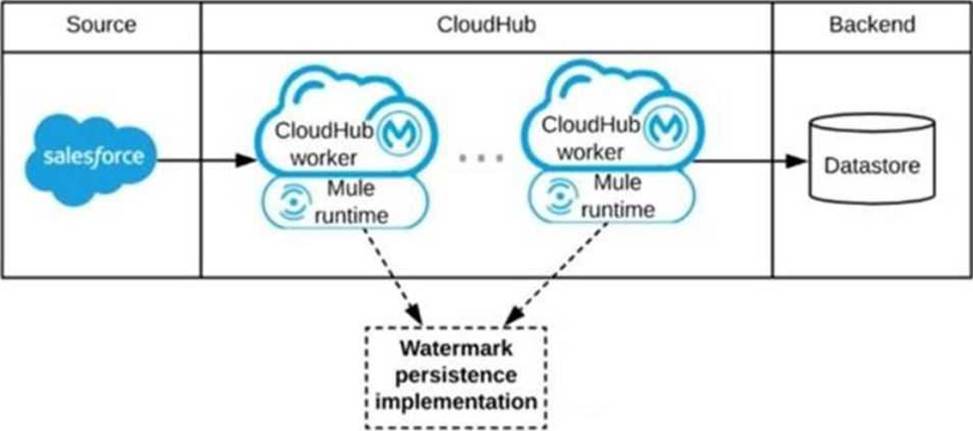
Architecture mentioned in the question can be diagrammatically put as below. Persistent Object Store is the correct answer.
* Mule Object Stores: An object store is a facility for storing objects in or across Mule applications.
Mule uses object stores to persist data for eventual retrieval.
Mule provides two types of object stores:
1) In-memory store C stores objects in local Mule runtime memory. Objects are lost on shutdown of the Mule runtime. So we cant use in memory store in our scenario as we want to share watermark within all cloudhub workers
2) Persistent store C Mule persists data when an object store is explicitly configured to be persistent. Hence this watermark will be available even any of the worker goes down
Which key DevOps practice and associated Anypoint Platform component should a MuteSoft integration team adopt to improve delivery quality?
- A . A Continuous design with API Designer
- B . Automated testing with MUnit
- C . Passive monitoring with Anypoint Monitoring
- D . Manual testing with Anypoint Studio
An insurance provider is implementing Anypoint platform to manage its application infrastructure and is using the customer hosted runtime for its business due to certain financial requirements it must meet. It has built a number of synchronous API’s and is currently hosting these on a mule runtime on one server These applications make use of a number of components including heavy use of object stores and VM queues.
Business has grown rapidly in the last year and the insurance provider is starting to receive reports of reliability issues from its applications.
The DevOps team indicates that the API’s are currently handling too many requests and this is over loading the server. The team has also mentioned that there is a significant downtime when the server is down for maintenance.
As an integration architect, which option would you suggest to mitigate these issues?
- A . Add a load balancer and add additional servers in a server group configuration
- B . Add a load balancer and add additional servers in a cluster configuration
- C . Increase physical specifications of server CPU memory and network
- D . Change applications by use an event-driven model
One of the backend systems involved by the API implementation enforces rate limits on the number of request a particle client can make.
Both the back-end system and API implementation are deployed to several non-production environments including the staging environment and to a particular production environment. Rate limiting of the back-end system applies to all non-production environments. The production environment however does not have any rate limiting.
What is the cost-effective approach to conduct performance test of the API implementation in the non-production staging environment?
- A . Including logic within the API implementation that bypasses in locations of the back-end system in the staging environment and invoke a Mocking service that replicates typical back-end system responses
Then conduct performance test using this API implementation - B . Use MUnit to simulate standard responses from the back-end system.
Then conduct performance test to identify other bottlenecks in the system - C . Create a Mocking service that replicates the back-end system’s production performance characteristics
Then configure the API implementation to use the mocking service and conduct the performance test - D . Conduct scaled-down performance tests in the staging environment against rate-limiting back-end system. Then upscale performance results to full production scale