
Salesforce MuleSoft Integration Architect I Practice Exams
Last updated on Nov 16,2026- Exam Code: MuleSoft Integration Architect I
- Exam Name: Salesforce Certified MuleSoft Integration Architect I
- Certification Provider: Salesforce
- Latest update: Nov 16,2026
The AnyAirline organization’s passenger reservations center is designing an integration solution that combines invocations of three different System APIs (bookFlight, bookHotel, and bookCar) in a business transaction. Each System API makes calls to a single database.
The entire business transaction must be rolled back when at least one of the APIs fails.
What is the most idiomatic (used for its intended purpose) way to integrate these APIs in near real-time that provides the best balance of consistency, performance, and reliability?
- A . Implement eXtended Architecture (XA) transactions between the API implementations Coordinate between the API implementations using a Saga pattern
Implement caching in each API implementation to improve performance - B . Implement local transactions within each API implementation
Configure each API implementation to also participate in the same eXtended Architecture (XA) transaction
Implement caching in each API implementation to improve performance - C . Implement local transactions in each API implementation
Coordinate between the API implementations using a Saga pattern
Apply various compensating actions depending on where a failure occurs - D . Implement an eXtended Architecture (XA) transaction manager in a Mule application using a Saga pattern
Connect each API implementation with the Mule application using XA transactions Apply various compensating actions depending on where a failure occurs
C
Explanation:
Reference: https://aws.amazon.com/blogs/compute/building-a-serverless-distributed-application-using-a-saga-orchestration-pattern/
A Mule application contains a Batch Job scope with several Batch Step scopes. The Batch Job scope is configured with a batch block size of 25.
A payload with 4,000 records is received by the Batch Job scope.
When there are no errors, how does the Batch Job scope process records within and between the Batch Step scopes?
- A . The Batch Job scope processes multiple record blocks in parallel, and a block of 25 records can jump ahead to the next Batch Step scope over an earlier block of records
Each Batch Step scope is invoked with one record in the payload of the received Mule event For each Batch Step scope, all 25 records within a block are processed in parallel
All the records in a block must be completed before the block of 25 records is available to the next Batch Step scope - B . The Batch Job scope processes each record block sequentially, one at a time
Each Batch Step scope is invoked with one record in the payload of the received Mule event
For each Batch Step scope, all 25 records within a block are processed sequentially, one at a time
All 4000 records must be completed before the blocks of records are available to the next Batch Step scope - C . The Batch Job scope processes multiple record blocks in parallel, and a block of 25 records can jump ahead to the next Batch Step scope over an earlier block of records
Each Batch Step scope is invoked with one record in the payload of the received Mule event
For each Batch Step scope, all 25 records within a block are processed sequentially, one record at a time
All the records in a block must be completed before the block of 25 records is available to the next Batch Step scope - D . The Batch Job scope processes multiple record blocks in parallel
Each Batch Step scope is invoked with a batch of 25 records in the payload of the received Mule event
For each Batch Step scope, all 4000 records are processed in parallel
Individual records can jump ahead to the next Batch Step scope before the rest of the records finish processing in the current Batch Step scope
A
Explanation:
Reference: https://docs.mulesoft.com/mule-runtime/4.4/batch-processing-concept
In preparation for a digital transformation initiative, an organization is reviewing related IT integration projects that failed for various for reason.
According to MuleSoft’s surveys of global IT leaders, what is a common cause of IT project failure that this organization may likely discover in its assessment?
- A . Following an Agile delivery methodology
- B . Reliance on an Integration-Platform-as-a-Service (iPaaS)
- C . Spending too much time on enablement
- D . Lack of alignment around business outcomes
An external REST client periodically sends an array of records in a single POST request to a Mule application API endpoint.
The Mule application must validate each record of the request against a JSON schema before sending it to a downstream system in the same order that it was received in the array Record processing will take place inside a router or scope that calls a child flow. The child flow has its own error handling defined. Any validation or communication failures should not prevent further processing of the remaining records.
To best address these requirements what is the most idiomatic(used for it intended purpose) router or scope to used in the parent flow, and what type of error handler should be used in the child flow?
- A . First Successful router in the parent flow On Error Continue error handler in the child flow
- B . For Each scope in the parent flow
On Error Continue error handler in the child flow - C . Parallel For Each scope in the parent flow On Error Propagate error handler in the child flow
- D . Until Successful router in the parent flow On Error Propagate error handler in the child flow
B
Explanation:
Correct answer is For Each scope in the parent flow On Error Continue error handler in the child flow. You can extract below set of requirements from the question a) Records should be sent to downstream system in the same order that it was received in the array b) Any validation or communication failures should not prevent further processing of the remaining records First requirement can be met using For Each scope in the parent flow and second requirement can be met using On Error Continue scope in child flow so that error will be suppressed.
What Mule application can have API policies applied by Anypoint Platform to the endpoint exposed by that Mule application?
- A . A Mule application that accepts requests over HTTP/1x
- B . A Mule application that accepts JSON requests over TCP but is NOT required to provide a response.
- C . A Mule application that accepts JSON requests over WebSocket
- D . A Mule application that accepts gRPC requests over HTTP/2
A
Explanation:
* HTTP/1.1 keeps all requests and responses in plain text format.
* HTTP/2 uses the binary framing layer to encapsulate all messages in binary format, while still maintaining HTTP semantics, such as verbs, methods, and headers. It came into use in 2015, and offers several methods to decrease latency, especially when dealing with mobile platforms and server-intensive graphics and videos
* Currently, Mule application can have API policies only for Mule application that accepts requests over HTTP/1x
An organization has various integrations implemented as Mule applications. Some of these Mule applications are deployed to custom hosted Mule runtimes (on-premises) while others execute in the MuleSoft-hosted runtime plane (CloudHub). To perform the Integra functionality, these Mule applications connect to various backend systems, with multiple applications typically needing to access the backend systems.
How can the organization most effectively avoid creating duplicates in each Mule application of the credentials required to access the backend systems?
- A . Create a Mule domain project that maintains the credentials as Mule domain-shared resources Deploy the Mule applications to the Mule domain, so the credentials are available to the Mule applications
- B . Store the credentials in properties files in a shared folder within the organization’s data center Have the Mule applications load properties files from this shared location at startup
- C . Segregate the credentials for each backend system into environment-specific properties files Package these properties files in each Mule application, from where they are loaded at startup
- D . Configure or create a credentials service that returns the credentials for each backend system, and that is accessible from customer-hosted and MuleSoft-hosted Mule runtimes Have the Mule applications toad the properties at startup by invoking that credentials service
D
Explanation:
* "Create a Mule domain project that maintains the credentials as Mule domain-shared resources" is wrong as domain project is not supported in Cloudhub
* We should Avoid Creating duplicates in each Mule application but below two options cause duplication of credentials – Store the credentials in properties files in a shared folder within the organization’s data center. Have the Mule applications load properties files from this shared location at startup – Segregate the credentials for each backend system into environment-specific properties files. Package these properties files in each Mule application, from where they are loaded at startup So these are also wrong choices
* Credentials service is the best approach in this scenario. Mule domain projects are not supported on CloudHub. Also its is not recommended to have multiple copies of configuration values as this makes difficult to maintain Use the Mule Credentials Vault to encrypt data in a .properties file. (In the context of this document, we refer to the .properties file simply as the properties file.) The properties file in Mule stores data as key-value pairs which may contain information such as usernames, first and last names, and credit card numbers. A Mule application may access this data as it processes messages, for example, to acquire login credentials for an external Web service. However, though this sensitive, private data must be stored in a properties file for Mule to access, it must also be protected against unauthorized C and potentially malicious C use by anyone with access to the Mule application
What is not true about Mule Domain Project?
- A . This allows Mule applications to share resources
- B . Expose multiple services within the Mule domain on the same port
- C . Only available Anypoint Runtime Fabric
- D . Send events (messages) to other Mule applications using VM queues
C
Explanation:
* Mule Domain Project is ONLY available for customer-hosted Mule runtimes, but not for Anypoint Runtime Fabric
* Mule domain project is available for Hybrid and Private Cloud (PCE). Rest all provide application isolation and can’t support domain project.
What is Mule Domain Project?
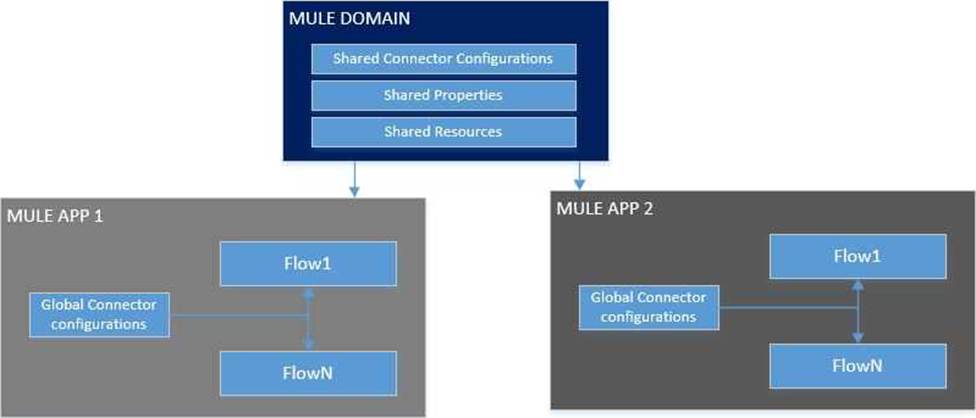
* A Mule Domain Project is implemented to configure the resources that are shared among different projects. These resources can be used by all the projects associated with this domain. Mule applications can be associated with only one domain, but a domain can be associated with multiple projects. Shared resources allow multiple development teams to work in parallel using the same set of reusable connectors. Defining these connectors as shared resources at the domain level allows the team to: – Expose multiple services within the domain through the same port. – Share the connection to persistent storage. – Share services between apps through a well-defined interface. – Ensure consistency between apps upon any changes because the configuration is only set in one place.
* Use domains Project to share the same host and port among multiple projects. You can declare the http connector within a domain project and associate the domain project with other projects. Doing this also allows to control thread settings, keystore configurations, time outs for all the requests made within multiple applications. You may think that one can also achieve this by duplicating the http connector configuration across all the applications. But, doing this may pose a nightmare if you have to make a change and redeploy all the applications.
* If you use connector configuration in the domain and let all the applications use the new domain instead of a default domain, you will maintain only one copy of the http connector configuration. Any changes will require only the domain to the redeployed instead of all the applications.
You can start using domains in only three steps:
1) Create a Mule Domain project
2) Create the global connector configurations which needs to be shared across the applications inside the Mule Domain project
3) Modify the value of domain in mule-deploy.properties file of the applications
Mule application muleA deployed in cloudhub uses Object Store v2 to share data across instances. As a part of new requirement, application muleB which is deployed in same region wants to access this Object Store.
Which of the following option you would suggest which will have minimum latency in this scenario?
- A . Object Store REST API
- B . Object Store connector
- C . Both of the above option will have same latency
- D . Object Store of one mule application cannot be accessed by other mule application.
A
Explanation:
V2 Rest API is recommended for on premise applications to access Object Store. It also comes with overhead of encryption and security of using rest api. With Object Store v2, the API call is localized to the same data center as the Runtime Manager app.
But in this case requirement is to access the OS of other mule application and not the same mule application.
You can configure a Mule app to use the Object Store REST API to store and retrieve values from an object store in another Mule app.
However, Object Store v2 is not designed for app-to-app communication.
A finance giant is planning to migrate all its Mule applications to Runtime fabric (RTF). Currently all Mule applications are deployed cloud hub using automated CI/CD scripts.
As an integration architect, which of the below step would you suggest to ensure that the applications from cloudhub are migrated properly to Runtime Fabric (RTF) with an assumption that organization is keen on keeping the same deployment strategy.
- A . No changes need to be made to POM.xml file and CI/CD script should be modified as per the RTF configurations
- B . runtimeFabric dependency should be added as a mule plug-in to POM.xml file and CI/CD script should be modified as per the RTF configurations
- C . runtimeFabric deployment should be added to POM.xml file in all
the mule applications and CI/CD script should be modified as per the RTF configurations - D . runtimeFabric profile should be added mule configuration files in the mule applications and CI/CD script should be modified as per the RTF configurations
A system administrator needs to determine when permissions were last changed for an Anypoint Platform user.
Which Anypoint Platform component should the administrator use to obtain this information?
- A . Audit Logging
- B . Anypoint Monitoring
- C . Anypiont Studio
- D . Mule Stack Traces