
Salesforce MuleSoft Integration Architect I Practice Exams
Last updated on Nov 16,2026- Exam Code: MuleSoft Integration Architect I
- Exam Name: Salesforce Certified MuleSoft Integration Architect I
- Certification Provider: Salesforce
- Latest update: Nov 16,2026
An organization has an HTTPS-enabled Mule application named Orders API that receives requests from another Mule application named Process Orders.
The communication between these two Mule applications must be secured by TLS mutual authentication (two-way TLS).
At a minimum, what must be stored in each truststore and keystore of these two Mule applications to properly support two-way TLS between the two Mule applications while properly protecting each Mule application’s keys?
- A . Orders API truststore: The Orders API public key
Process Orders keystore: The Process Orders private key and public key - B . Orders API truststore: The Orders API private key and public key
Process Orders keystore: The Process Orders private key public key - C . Orders API truststore: The Process Orders public key
Orders API keystore: The Orders API private key and public key
Process Orders truststore: The Orders API public key
Process Orders keystore: The Process Orders private key and public key - D . Orders API truststore: The Process Orders public key
Orders API keystore: The Orders API private key
Process Orders truststore: The Orders API public key
Process Orders keystore: The Process Orders private key
C
Explanation:
Reference: https://www.caeliusconsulting.com/blogs/one-way-and-two-way-tls-and-their-implementation-in-mulesoft/
Refer to the exhibit.
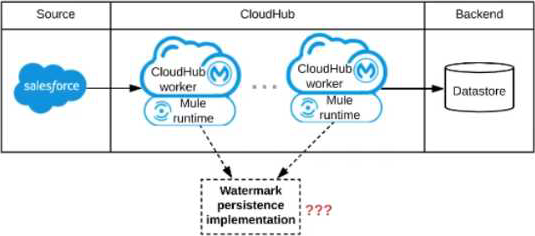
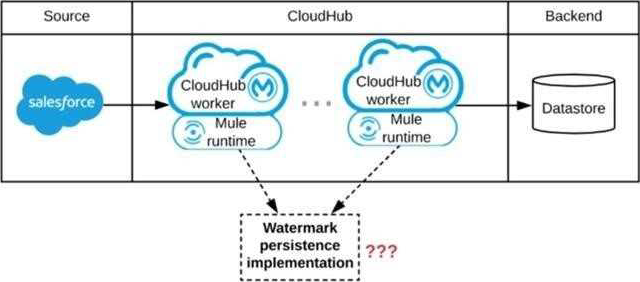
A Mule application is being designed to be deployed to several CIoudHub workers. The Mule application’s integration logic is to replicate changed Accounts from Satesforce to a backend system every 5 minutes.
A watermark will be used to only retrieve those Satesforce Accounts that have been modified since the last time the integration logic ran.
What is the most appropriate way to implement persistence for the watermark in order to support the required data replication integration logic?
- A . Persistent Anypoint MQ Queue
- B . Persistent Object Store
- C . Persistent Cache Scope
- D . Persistent VM Queue
B
Explanation:
* An object store is a facility for storing objects in or across Mule applications. Mule uses object stores to persist data for eventual retrieval.
* Mule provides two types of object stores:
1) In-memory store C stores objects in local Mule runtime memory. Objects are lost on shutdown of the Mule runtime.
2) Persistent store C Mule persists data when an object store is explicitly configured to be persistent. In a standalone Mule runtime, Mule creates a default persistent store in the file system. If you do not specify an object store, the default persistent object store is used.
MuleSoft
Reference: https://docs.mulesoft.com/mule-runtime/3.9/mule-object-stores
A Mule application is built to support a local transaction for a series of operations on a single database. The Mule application has a Scatter-Gather that participates in the local transaction.
What is the behavior of the Scatter-Gather when running within this local transaction?
- A . Execution of each route within the Scatter-Gather occurs sequentially
Any error that occurs inside the Scatter-Gather will result in a rollback of all the database operations - B . Execution of all routes within the Scatter-Gather occurs in parallel
Any error that occurs inside the Scatter-Gather will result in a rollback of all the database operations - C . Execution of each route within the Scatter-Gather occurs sequentially
Any error that occurs inside the Scatter-Gather will NOT result in a rollback of any of the database operations - D . Execution of each route within the Scatter-Gather occurs in parallel
Any error that occurs inside the Scatter-Gather will NOT result in a rollback of any of the database operations
A
Explanation:
Reference: https://docs.mulesoft.com/mule-runtime/4.4/transaction-management
An Organization has previously provisioned its own AWS VPC hosting various servers. The organization now needs to use Cloudhub to host a Mule application that will implement a REST API once deployed to Cloudhub, this Mule application must be able to communicate securely with the customer-provisioned AWS VPC resources within the same region, without being interceptable on the public internet.
What Anypoint Platform features should be used to meet these network communication requirements between Cloudhub and the existing customer-provisioned AWS VPC?
- A . Add a Mulesoft hosted Anypoint VPC configured and with VPC Peering to the AWS VPC
- B . Configure an external identity provider (IDP) in Anypoint Platform with certificates from the customer provisioned AWS VPC
- C . Add a default API Whitelisting policy to API Manager to automatically whitelist the customer provisioned AWS VPC IP ranges needed by the Mule applicaton
- D . Use VM queues in the Mule application to allow any non-mule assets within the customer provisioned AWS VPC to subscribed to and receive messages
A
Explanation:
Correct answer is: Add a Mulesoft hosted Anypoint VPC configured and with VPC Peering to the AWS VPC
* Connecting to your Anypoint VPC extends your corporate network and allows CloudHub workers to access resources behind your corporate firewall.
* You can connect on-premises data centers through a secured VPN tunnel, or a private AWS VPC through VPC peering, or by using AWS Direct Connect.
MuleSoft Doc Reference: https://docs.mulesoft.com/runtime-manager/virtual-private-cloud
According to MuleSoft, which system integration term describes the method, format, and protocol used for communication between two system?
- A . Component
- B . interaction
- C . Message
- D . Interface
Refer to the exhibit.
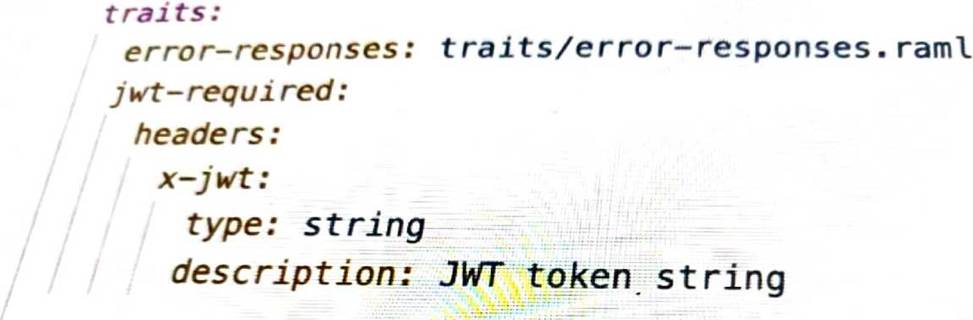
What is the type data format shown in the exhibit?
- A . JSON
- B . XML
- C . YAML
- D . CSV
An organization uses Mule runtimes which are managed by Anypoint Platform – Private Cloud Edition.
What MuleSoft component is responsible for feeding analytics data to non-MuleSoft analytics platforms?
- A . Anypoint Exchange
- B . The Mule runtimes
- C . Anypoint API Manager
- D . Anypoint Runtime Manager
D
Explanation:
Correct answer is Anypoint Runtime Manager
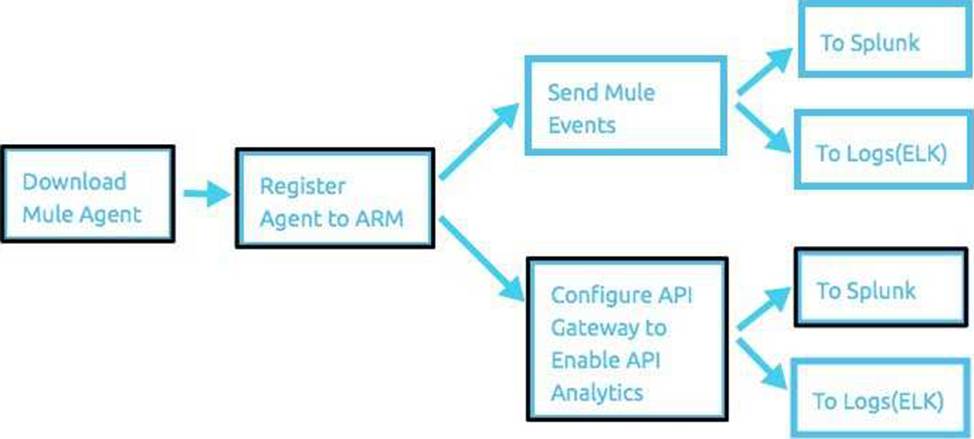
MuleSoft Anypoint Runtime Manager (ARM) provides connectivity to Mule Runtime engines deployed across your organization to provide centralized management, monitoring and analytics reporting. However, most enterprise customers find it necessary for these on-premises runtimes to integrate with their existing non MuleSoft analytics / monitoring systems such as Splunk and ELK to support a single pane of glass view across the infrastructure.
* You can configure the Runtime Manager agent to export data to external analytics tools. Using either the Runtime Manager cloud console or Anypoint Platform Private Cloud Edition, you can:
–> Send Mule event notifications, including flow executions and exceptions, to Splunk or ELK. –> Send API Analytics to Splunk or ELK. Sending data to third-party tools is not supported for applications deployed on CloudHub.
You can use the CloudHub custom log appender to integrate with your logging system.
Reference:
https://docs.mulesoft.com/runtime-manager/ https://docs.mulesoft.com/release-notes/runtime-manager-agent/runtime-manager-agent-release-notes
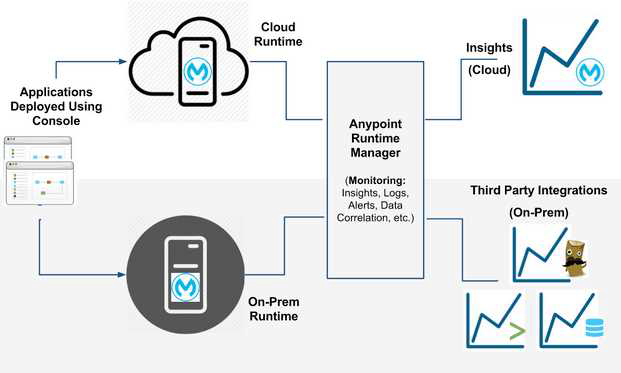
Additional Info:
It can be achieved in 3 steps:
1) register an agent to a runtime manager,
2) configure a gateway to enable API analytics to be sent to non MuleSoft analytics platform (Splunk for ex.) C as highlighted in the following diagram and
3) setup dashboards.
A mule application is required to periodically process large data set from a back-end database to Salesforce CRM using batch job scope configured properly process the higher rate of records. The application is deployed to two cloudhub workers with no persistence queues enabled.
What is the consequence if the worker crashes during records processing?
- A . Remaining records will be processed by a new replacement worker
- B . Remaining records be processed by second worker
- C . Remaining records will be left and processed
- D . All the records will be processed from scratch by the second worker leading to duplicate
processing
According to MuleSoft, what Action should an IT organization take regarding its technology assets in order to close the IT delivery.
- A . Make assets easily discoverable via a central repository
- B . Focus project delivery efforts on custom assets that meet the specific requirements of each individual line of business
- C . Create weekly meetings that all members of IT attend to present justification and request approval to use existing assets
- D . Hire additional staff to meet the demand for asset creation required for approved projects and timelines
An application load balancer routes requests to a RESTful web API secured by Anypoint Flex Gateway.
Which protocol is involved in the communication between the load balancer and the Gateway?
- A . SFTP
- B . HTTPS
- C . LDAP
- D . SMTP