
Salesforce MuleSoft Integration Architect I Practice Exams
Last updated on Nov 16,2026- Exam Code: MuleSoft Integration Architect I
- Exam Name: Salesforce Certified MuleSoft Integration Architect I
- Certification Provider: Salesforce
- Latest update: Nov 16,2026
A Mule application contains a Batch Job with two Batch Steps (Batch_Step_l and Batch_Step_2). A payload with 1000 records is received by the Batch Job.
How many threads are used by the Batch Job to process records, and how does each Batch Step process records within the Batch Job?
- A . Each Batch Job uses SEVERAL THREADS for the Batch Steps Each Batch Step instance receives ONE record at a time as the payload, and RECORDS are processed IN PARALLEL within and between the two Batch Steps
- B . Each Batch Job uses a SINGLE THREAD for all Batch steps Each Batch step instance receives ONE record at a time as the payload, and RECORDS are processed IN ORDER, first through Batch_Step_l and then through Batch_Step_2
- C . Each Batch Job uses a SINGLE THREAD to process a configured block size of record Each Batch Step instance receives A BLOCK OF records as the payload, and BLOCKS of records are processed IN ORDER
- D . Each Batch Job uses SEVERAL THREADS for the Batch Steps Each Batch Step instance receives ONE record at a time as the payload, and BATCH STEP INSTANCES execute IN PARALLEL to process records and Batch Steps in ANY order as fast as possible
A
Explanation:
* Each Batch Job uses SEVERAL THREADS for the Batch Steps
* Each Batch Step instance receives ONE record at a time as the payload. It’s not received in a block, as it does not wait for multiple records to be completed before moving to next batch step. (So Option D is out of choice)
* RECORDS are processed IN PARALLEL within and between the two Batch Steps.
* RECORDS are not processed in order. Let’s say if second record completes batch_step_1 before record 1, then it moves to batch_step_2 before record 1. (So option C and D are out of choice)
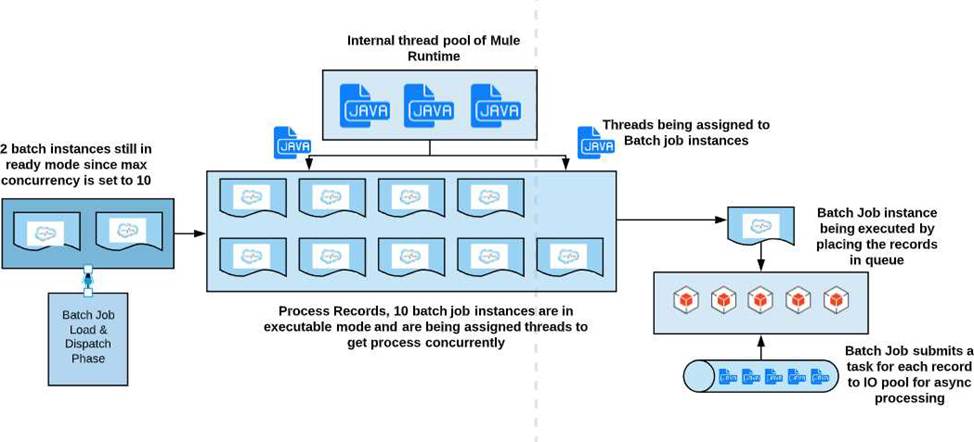
* A batch job is the scope element in an application in which Mule processes a message payload as a batch of records. The term batch job is inclusive of all three phases of processing: Load and Dispatch, Process, and On Complete.
* A batch job instance is an occurrence in a Mule application whenever a Mule flow executes a batch job. Mule creates the batch job instance in the Load and Dispatch phase. Every batch job instance is identified internally using a unique String known as batch job instance id.
Mule application A receives a request Anypoint MQ message REQU with a payload containing a variable-length list of request objects. Application A uses the For Each scope to split the list into individual objects and sends each object as a message to an Anypoint MQ queue.
Service S listens on that queue, processes each message independently of all other messages, and sends a response message to a response queue.
Application A listens on that response queue and must in turn create and publish a response Anypoint MQ message RESP with a payload containing the list of responses sent by service S in the same order as the request objects originally sent in REQU.
Assume successful response messages are returned by service S for all request messages.
What is required so that application A can ensure that the length and order of the list of objects in RESP and REQU match, while at the same time maximizing message throughput?
- A . Use a Scatter-Gather within the For Each scope to ensure response message order Configure the Scatter-Gather with a persistent object store
- B . Perform all communication involving service S synchronously from within the For Each scope, so objects in RESP are in the exact same order as request objects in REQU
- C . Use an Async scope within the For Each scope and collect response messages in a second For Each scope in the order In which they arrive, then send RESP using this list of responses
- D . Keep track of the list length and all object indices in REQU, both in the For Each scope and in all communication involving service Use persistent storage when creating RESP
D
Explanation:
Correct answer is Perform all communication involving service S synchronously from within the For Each scope, so objects in RESP are in the exact same order as request objects in REQU: Using Anypoint MQ, you can create two types of queues: Standard queue These queues don’t guarantee a specific message order. Standard queues are the best fit for applications in which messages must be delivered quickly. FIFO (first in, first out) queue These queues ensure that your messages arrive in order. FIFO queues are the best fit for applications requiring strict message ordering and exactly-once delivery, but in which message delivery speed is of less importance Use of FIFO queue is no where in the option and also it decreased throughput. Similarly persistent object store is not the preferred solution approach when you maximizing message throughput. This rules out one of the options. Scatter Gather does not support ObjectStore. This rules out one of the options. Standard Anypoint MQ queues don’t guarantee a specific message order hence using another for each block to collect response wont work as requirement here is to ensure the order. Hence considering all the above factors the feasible approach is Perform all communication involving service S synchronously from within the For Each scope, so objects in RESP are in the exact same order as request objects in REQU
An organization has deployed runtime fabric on an eight note cluster with performance profile. An API uses and non persistent object store for maintaining some of its state data.
What will be the impact to the stale data if server crashes?
- A . State data is preserved
- B . State data is rolled back to a previously saved version
- C . State data is lost
- D . State data is preserved as long as more than one more is unaffected by the crash
A mule application is deployed to a Single Cloudhub worker and the public URL appears in Runtime Manager as the APP URL.
Requests are sent by external web clients over the public internet to the mule application App url. Each of these requests routed to the HTTPS Listener event source of the running Mule application. Later, the DevOps team edits some properties of this running Mule application in Runtime Manager.
Immediately after the new property values are applied in runtime manager, how is the current Mule application deployment affected and how will future web client requests to the Mule application be handled?
- A . Cloudhub will redeploy the Mule application to the OLD Cloudhub worker
New web client requests will RETURN AN ERROR until the Mule application is redeployed to the OLD Cloudhub worker - B . CloudHub will redeploy the Mule application to a NEW Cloudhub worker
New web client requests will RETURN AN ERROR until the NEW Cloudhub worker is available - C . Cloudhub will redeploy the Mule application to a NEW Cloudhub worker
New web client requests are ROUTED to the OLD Cloudhub worker until the NEW Cloudhub worker is available. - D . Cloudhub will redeploy the mule application to the OLD Cloudhub worker
New web client requests are ROUTED to the OLD Cloudhub worker BOTH before and after the Mule application is redeployed.
C
Explanation:
CloudHub supports updating your applications at runtime so end users of your HTTP APIs experience zero downtime. While your application update is deploying, CloudHub keeps the old version of your application running. Your domain points to the old version of your application until the newly uploaded version is fully started. This allows you to keep servicing requests from your old application while the new version of your application is starting.
A company is designing a mule application to consume batch data from a partner’s ftps server The data files have been compressed and then digitally signed using PGP.
What inputs are required for the application to securely consumed these files?
- A . ATLS context Key Store requiring the private key and certificate for the company PGP public key of partner
PGP private key for the company - B . ATLS context first store containing a public certificate for partner ftps server and the PGP public key of the partner
TLS contact Key Store containing the FTP credentials - C . TLS context trust or containing a public certificate for the ftps server The FTP username and password The PGP public key of the partner
- D . The PGP public key of the partner
The PGP private key for the company
The FTP username and password
An organization plans to extend its Mule APIs to the EU (Frankfurt) region.
Currently, all Mule applications are deployed to CloudHub 1.0 in the default North American region, from the North America control plane, following this naming convention: {API-name}― {environment} (for example, Orderssapi―dev, Orders-sapi-―qa, Orders-sapi-―prod, etc.). There is no network restriction to block communications between APIs.
What strategy should be implemented in order to deploy the same Mule APIs to the CloudHub 1.0 EU region from the North America control plane, as well as to minimize latency between APIs and target users and systems in Europe?
- A . In Runtime Manager, for each Mule application deployment, set the Region property to EU (Frankfurt) and reuse the same Mule application mame as in the North American region.
Communicate the new urls {API-name}―{environment}.de-ci.cloudhub.io to the consuming API clients In Europe. - B . In API Manager, set the Region property to EU (Frankfurt) to create an API proxy named {API-name}―proxy―{environment} for each Mule application.
Communicate the new url {API-name}―proxy―{environment}.de-c1.cloudhub.io to the consuming API clients In Europe. - C . In Runtime Manager, for each Mule application deployment, leave the Region property blank (default) and change the Mule application name to {API-name}― {environment).de-cl.
Communicate the new urls {API-name}―{environment}.de-ci1.cloudhub.io to the consuming API clients in Europe. - D . In API Manager, leave the Region property blank (default) to deploy an API proxy named {API-name}~proxy~- (environment}.de-cl for each Mule application.
Communicate the new url {API-name}―proxy―{environment}.de-cl.cloudhub.io to the consuming API clients in Europe.
A project team is working on an API implementation using the RAML definition as a starting point. The team has updated the definition to include new operations and has published a new version to exchange. Meanwhile another team is working on a mule application consuming the same API implementation.
During the development what has to be performed by the mule application team to take advantage of the newly added operations?
- A . Scaffold the client application with the new definition
- B . Scaffold API implementation application with the new definition
- C . Update the REST connector from exchange in the client application
- D . Update the API connector in the API implementation and publish to exchange
How does timeout attribute help inform design decisions while using JMS connector listening for incoming messages in an extended architecture (XA) transaction?
- A . After the timeout is exceeded, stale JMS consumer threads are destroyed and new threads are created
- B . The timeout specifies the time allowed to pass between receiving JMS messages on the same JMS connection and then after the timeout new JMS connection is established
- C . The time allowed to pass between committing the transaction and the completion of the mule flow and then after the timeout flow processing triggers an error
- D . The timeout defines the time that is allowed to pass without the transaction ending explicitly and after the timeout expires, the transaction rolls back
Which Exchange asset type represents a complete API specification in RAML or OAS format?
- A . Connectors
- B . REST APIs
- C . API Spec Fragments
- D . SOAP APIs
A REST API is being designed to implement a Mule application.
What standard interface definition language can be used to define REST APIs?
- A . Web Service Definition Language (WSDL)
- B . OpenAPI Specification (OAS)
- C . YAML
- D . AsyncAPI Specification