
Salesforce MuleSoft Integration Architect I Practice Exams
Last updated on Nov 16,2026- Exam Code: MuleSoft Integration Architect I
- Exam Name: Salesforce Certified MuleSoft Integration Architect I
- Certification Provider: Salesforce
- Latest update: Nov 16,2026
A leading e-commerce giant will use Mulesoft API’s on runtime fabric (RTF) to process customer orders. Some customer’s sensitive information such as credit card information is also there as a part of a API payload.
What approach minimizes the risk of matching sensitive data to the original and can convert back to the original value whenever and wherever required?
- A . Apply masking to hide the sensitive information and then use API
- B . manager to detokenize the masking format to return the original value
- C . create a tokenization format and apply a tokenization policy to the API Gateway
- D . Used both masking and tokenization
- E . Apply a field level encryption policy in the API Gateway
Refer to the exhibit.
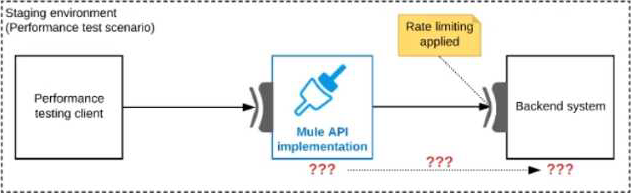
One of the backend systems invoked by an API implementation enforces rate limits on the number of requests a particular client can make. Both the backend system and the API implementation are deployed to several non-production environments in addition to production.
Rate limiting of the backend system applies to all non-production environments. The production environment, however, does NOT have any rate limiting.
What is the most effective approach to conduct performance tests of the API implementation in a staging (non-production) environment?
- A . Create a mocking service that replicates the backend system’s production performance characteristics. Then configure the API implementation to use the mocking service and conduct the
performance tests - B . Use MUnit to simulate standard responses from the backend system then conduct performance tests to identify other bottlenecks in the system
- C . Include logic within the API implementation that bypasses invocations of the backend system in a performance test situation. Instead invoking local stubs that replicate typical backend system responses then conduct performance tests using this API Implementation
- D . Conduct scaled-down performance tests in the staging environment against the rate limited backend system then upscale performance results to full production scale
A
Explanation:
Correct answer is Create a mocking service that replicates the backend system’s production performance characteristics. Then configure the API implementation to use the mocking service and conduct the performance tests
* MUnit is for only Unit and integration testing for APIs and Mule apps. Not for performance Testing, even if it has the ability to Mock the backend.
* Bypassing the backend invocation defeats the whole purpose of performance testing. Hence it is not a valid answer.
* Scaled down performance tests cant be relied upon as performance of API’s is not linear against load.
A Mule application is being designed for deployment to a single CloudHub worker. The Mule application will have a flow that connects to a SaaS system to perform some operations each time the flow is invoked.
The SaaS system connector has operations that can be configured to request a short-lived token (fifteen minutes) that can be reused for subsequent connections within the fifteen minute time window. After the token expires, a new token must be requested and stored.
What is the most performant and idiomatic (used for its intended purpose) Anypoint Platform component or service to use to support persisting and reusing tokens in the Mule application to help speed up reconnecting the Mule application to the SaaS application?
- A . Nonpersistent object store
- B . Persistent object store
- C . Variable
- D . Database
D
Explanation:
Reference: https://docs.mulesoft.com/mule-runtime/4.4/reconnection-strategy-about
Which Anypoint Platform component helps integration developers discovers and share reusable APIs, connectors, and templates?
- A . Anypoint Exchange
- B . API Manager
- C . Anypoint Studio
- D . Design Center
A platform architect includes both an API gateway and a service mesh in the architect of a distributed application for communication management.
Which type of communication management does a service mesh typically perform in this architecture?
- A . Between application services and the firewall
- B . Between the application and external API clients
- C . Between services within the application
- D . Between the application and external API implementations.
An organization is building out a test suite for their application using MUnit.
The Integration Architect has recommended using Test Recorder in Anypoint Studio to record the processing flows and then configure unit tests based on the captured events.
What Is a core consideration that must be kept In mind while using Test Recorder?
- A . The Recorder supports loops where the structure of the data being tested changes inside the Iteration
- B . Mocking values resulting from parallel processes are possible and will not affect theexecution of the processors that follow in the test
- C . The Recorder supports mocking a message before or inside a Foreach processor
- D . Tests for flows cannot be created if Mule errors are raised Inside the flows, even if the errors are handled by On-Error Continue error handlers
A retail company is implementing a MuleSoft API to get inventory details from two vendors by Invoking each vendor’s online applications. Due to network issues, the invocations to the vendor applications are timing out intermittently, but the requests are successful after re-invoking each vendor application.
What is the most performant way of implementing the API to invoke each vendor application and to retry invocations that generate timeout errors?
- A . Use a For-Each scope to invoke the two vendor applications in series, one after the other.
Place the For-Each scope inside an Until-Successful scope to retry requests that raise timeout errors. - B . Use a Choice scope to Invoke each vendor application on a separate route. Place the Choice scope inside an Until-Successful scope to retry requests that raise timeout errors.
- C . Use a Scatter-Gather scope to invoke each vendor application on a separate route.
Use an Until-Successful scope in each route to retry requests that raise timeout errors. - D . Use a Round-Robin scope to invoke each vendor application on a separate route.
Use a Try-Catch scope in each route to retry requests that raise timeout errors.
A set of integration Mule applications, some of which expose APIs, are being created to enable a new business process. Various stakeholders may be impacted by this. These stakeholders are a combination of semi-technical users (who understand basic integration terminology and concepts such as JSON and XML) and technically skilled potential consumers of the Mule applications and APIs.
What Is an effective way for the project team responsible for the Mule applications and APIs being built to communicate with these stakeholders using Anypoint Platform and its supplied toolset?
- A . Use Anypoint Design Center to implement the Mule applications and APIs and give the various stakeholders access to these Design Center projects, so they can collaborate and provide feedback
- B . Create Anypoint Exchange entries with pages elaborating the integration design, including API notebooks (where applicable) to help the stakeholders understand and interact with the Mule applications and APIs at various levels of technical depth
- C . Use Anypoint Exchange to register the various Mule applications and APIs and share the RAML definitions with the stakeholders, so they can be discovered
- D . Capture documentation about the Mule applications and APIs inline within the Mule integration flows and use Anypoint Studio’s Export Documentation feature to provide an HTML version of this documentation to the stakeholders
B
Explanation:
As the stakeholders are semitechnical users, preferred option is Create Anypoint Exchange entries with pages elaborating the integration design, including API notebooks (where applicable) to help the stakeholders understand and interact with the Mule applications and APIs at various levels of technical depth
Which Anypoint Platform component should a MuleSoft developer use to create an API specification prior to building the API implementation?
- A . MUnit
- B . API Designer
- C . API Manager
- D . Runtime Manager
A company is modernizing its legal systems lo accelerate access lo applications and data while supporting the adoption of new technologies. The key to achieving this business goal is unlocking the companies’ key systems and dala including microservices miming under Docker and kubernetes containers using apis.
Considering the current aggressive backlog and project delivery requirements the company wants to take a strategic approach in the first phase of its transformation projects by quickly deploying API’s in mule runtime that are able lo scale, connect to on premises systems and migrate as needed.
Which runtime deployment option supports company’s goals?
- A . Customer hosted self provisioned runtimes
- B . Cloudhub runtimes
- C . Runtime fabric on self managed Kubernetes
- D . Runtime fabric on Vmware metal