
Salesforce MuleSoft Integration Architect I Practice Exams
Last updated on Nov 16,2026- Exam Code: MuleSoft Integration Architect I
- Exam Name: Salesforce Certified MuleSoft Integration Architect I
- Certification Provider: Salesforce
- Latest update: Nov 16,2026
Refer to the exhibit.
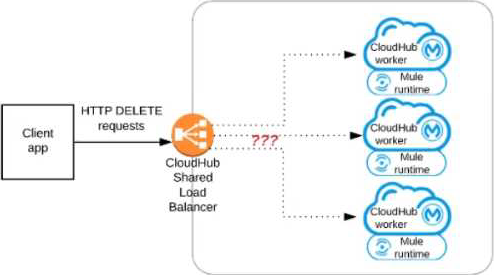
A Mule application has an HTTP Listener that accepts HTTP DELETE requests. This Mule application Is deployed to three CloudHub workers under the control of the CloudHub Shared Load Balancer. A web client makes a sequence of requests to the Mule application’s public URL.
How is this sequence of web client requests distributed among the HTTP Listeners running in the three CloudHub workers?
- A . Each request is routed to the PRIMARY CloudHub worker in the PRIMARY Availability Zone (AZ)
- B . Each request is routed to ONE ARBiTRARY CloudHub worker in the PRIMARY Availability Zone (AZ)
- C . Each request Is routed to ONE ARBiTRARY CloudHub worker out of ALL three CloudHub workers
- D . Each request is routed (scattered) to ALL three CloudHub workers at the same time
C
Explanation:
Correct behavior is Each request is routed to ONE ARBITRARY CloudHub worker out of ALL three CloudHub workers
Organization wants to achieve high availability goal for Mule applications in customer hosted runtime plane. Due to the complexity involved, data cannot be shared among of different instances of same Mule application.
What option best suits to this requirement considering high availability is very much critical to the organization?
- A . The cluster can be configured
- B . Use third party product to implement load balancer
- C . High availability can be achieved only in CloudHub
- D . Use persistent object store
B
Explanation:
High availability is about up-time of your application
A) High availability can be achieved only in CloudHub isn’t correct statement. It can be achieved in customer hosted runtime planes as well
B) An object store is a facility for storing objects in or across Mule applications. Mule runtime engine (Mule) uses object stores to persist data for eventual retrieval. It can be used for disaster recovery but not for High Availability. Using object store can’t guarantee that all instances won’t go down at once. So not an appropriate choice.
Reference: https://docs.mulesoft.com/mule-runtime/4.3/mule-object-stores
C) High availability can be achieved by below two models for on-premise MuleSoft implementations.
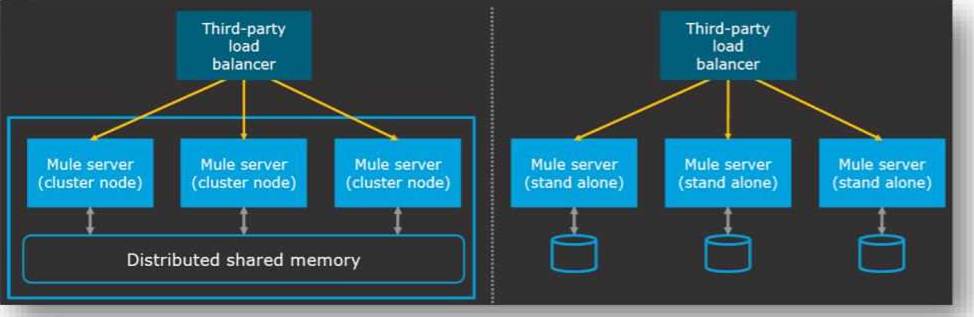
1) Mule Clustering C Where multiple Mule servers are available within the same cluster environment and the routing of requests will be done by the load balancer. A cluster is a set of up to eight servers that act as a single deployment target and high-availability processing unit. Application instances in a cluster are aware of each other, share common information, and synchronize statuses. If one server fails, another server takes over processing applications. A cluster can run multiple applications. (refer left half of the diagram)
In given scenario, it’s mentioned that ‘data cannot be shared among of different instances’. So this is not a correct choice.
Reference: https://docs.mulesoft.com/runtime-manager/cluster-about
2) Load balanced standalone Mule instances C The high availability can be achieved even without cluster, with the usage of third party load balancer pointing requests to different Mule servers. This approach does not share or synchronize data between Mule runtimes. Also high availability achieved as load balanced algorithms can be implemented using external load balancer. (refer right half of the diagram)
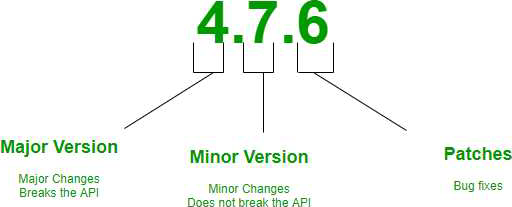
An API has been updated in Anypoint Exchange by its API producer from version 3.1.1 to 3.2.0 following accepted semantic versioning practices and the changes have been communicated via the API’s public portal. The API endpoint does NOT change in the new version.
How should the developer of an API client respond to this change?
- A . The update should be identified as a project risk and full regression testing of the functionality that uses this API should be run.
- B . The API producer should be contacted to understand the change to existing functionality.
- C . The API producer should be requested to run the old version in parallel with the new one.
- D . The API client code ONLY needs to be changed if it needs to take advantage of new features.
D
Explanation:
* Semantic Versioning is a 3-component number in the format of X.Y.Z, where: X stands for a major version.
Y stands for a minor version: Z stands for a patch.
So, SemVer is of the form Major.Minor.Patch Coming to our question, minor version of the API has been changed which is backward compatible. Hence there is no change required on API client end. If they want to make use of new featured that have been added as a part of minor version change they may need to change code at their end. Hence correct answer is The API client code ONLY needs to be changed if it needs to take advantage of new features.
An organization is evaluating using the CloudHub shared Load Balancer (SLB) vs creating a CloudHub dedicated load balancer (DLB). They are evaluating how this choice affects the various types of certificates used by CloudHub deployed Mule applications, including MuleSoft-provided, customer-provided, or Mule application-provided certificates.
What type of restrictions exist on the types of certificates for the service that can be exposed by the CloudHub Shared Load Balancer (SLB) to external web clients over the public internet?
- A . Underlying Mule applications need to implement own certificates
- B . Only MuleSoft provided certificates can be used for server side certificate
- C . Only self signed certificates can be used
- D . All certificates which can be used in shared load balancer need to get approved by raising support ticket
B
Explanation:
Correct answer is Only MuleSoft provided certificates can be used for server side certificate
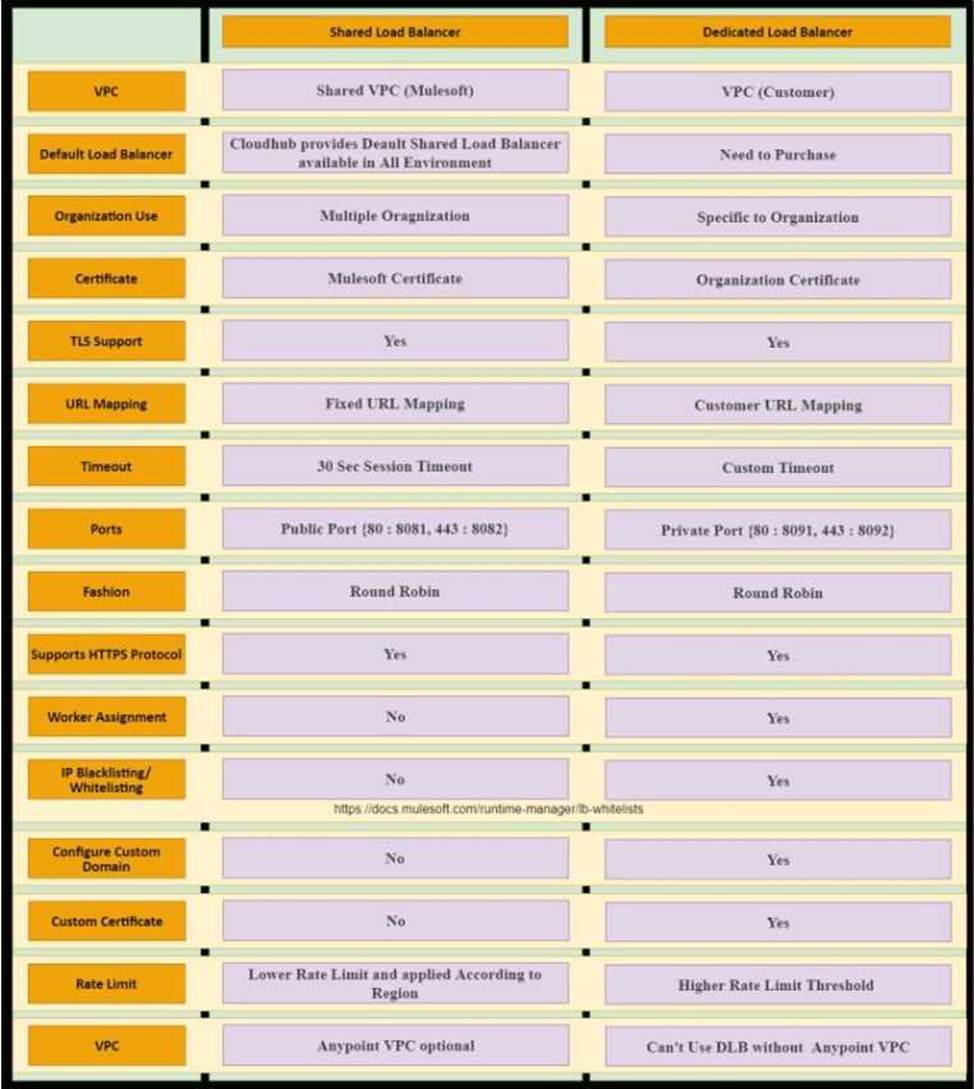
* The CloudHub Shared Load Balancer terminates TLS connections and uses its own server-side certificate.
* You would need to use dedicated load balancer which can enable you to define SSL configurations to provide custom certificates and optionally enforce two-way SSL client authentication.
* To use a dedicated load balancer in your environment, you must first create an Anypoint VPC. Because you can associate multiple environments with the same Anypoint VPC, you can use the same dedicated load balancer for your different environments.
Additional Info on SLB Vs DLB:
A Mule application is deployed to a cluster of two (2) cusomter-hosted Mule runtimes. Currently the node name Alice is the primary node and node named bob is the secondary node. The mule application has a flow that polls a directory on a file system for new files. The primary node Alice fails for an hour and then restarted.
After the Alice node completely restarts, from what node are the files polled, and what node is now the primary node for the cluster?
- A . Files are polled from Alice node Alice is now the primary node
- B . Files are polled form Bob node Alice is now the primary node
- C . Files are polled from Alice node Bob is the now the primary node
- D . Files are polled form Bob node
Bob is now the primary node
D
Explanation:
* Mule High Availability Clustering provides basic failover capability for Mule. * When the primary Mule Runtime becomes unavailable, for example, because of a fatal JVM or hardware failure or it’s taken offline for maintenance, a backup Mule Runtime immediately becomes the primary node and resumes processing where the failed instance left off. * After a system administrator recovers a failed Mule Runtime server and puts it back online, that server automatically becomes the backup node. In this case, Alice, once up, will become backup
Reference: https://docs.mulesoft.com/mule-runtime/4.3/hadr-guide So correct choice is: Files are polled form Bob node Bob is now the primary node
An organization’s IT team follows an API-led connectivity approach and must use Anypoint Platform to implement a System AP that securely accesses customer data. The organization uses Salesforce as the system of record for all customer data, and its most important objective is to reduce the overall development time to release the System API.
The team’s integration architect has identified four different approaches to access the customer data from within the implementation of the System API by using different Anypoint Connectors that all meet the technical requirements of the project.
- A . Use the Anypoint Connector for Database to connect to a MySQL database to access a copy of the customer data
- B . Use the Anypoint Connector for HTTP to connect to the Salesforce APIs to directly access the customer data
- C . Use the Anypoint Connector for Salesforce to connect to the Salesforce APIs to directly access the customer data
- D . Use the Anypoint Connector tor FTP to download a file containing a recent near-real time extract of the customer data
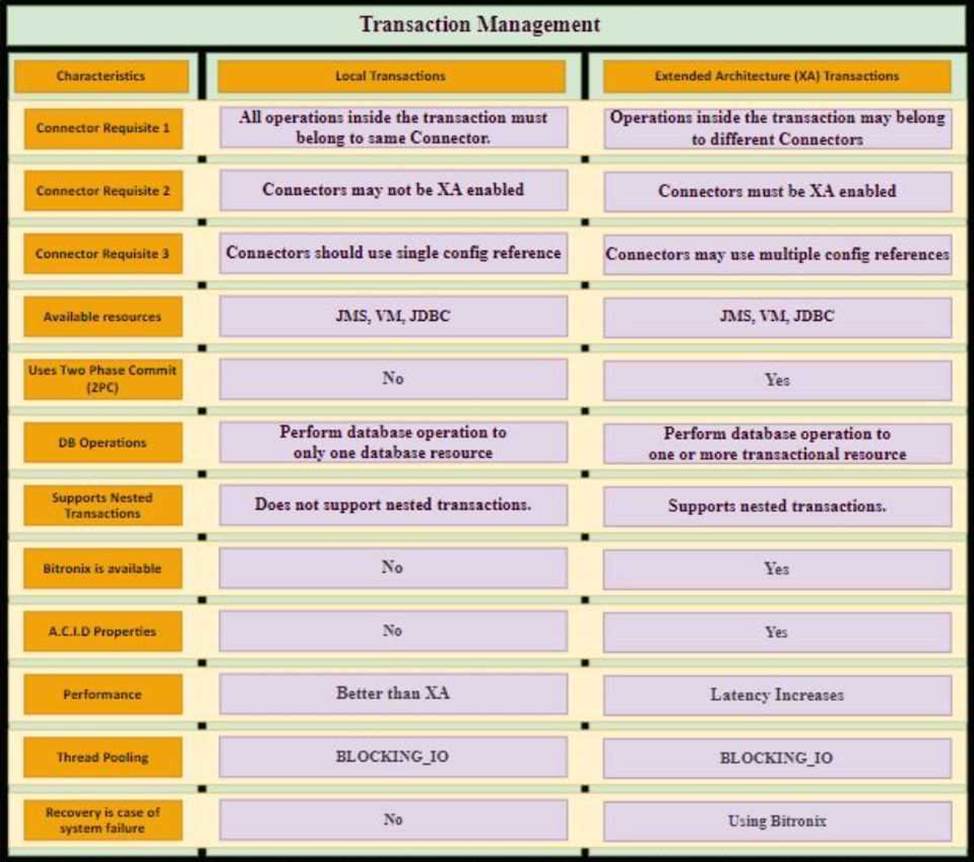
An XA transaction Is being configured that involves a JMS connector listening for Incoming JMS messages.
What is the meaning of the timeout attribute of the XA transaction, and what happens after the timeout expires?
- A . The time that is allowed to pass between committing the transaction and the completion of the Mule flow After the timeout, flow processing triggers an error
- B . The time that Is allowed to pass between receiving JMS messages on the same JMS connection After the timeout, a new JMS connection Is established
- C . The time that Is allowed to pass without the transaction being ended explicitly After the timeout, the transaction Is forcefully rolled-back
- D . The time that Is allowed to pass for state JMS consumer threads to be destroyed After the timeout, a new JMS consumer thread is created
C
Explanation:
* Setting a transaction timeout for the Bitronix transaction manager
● Set the transaction timeout either
C In wrapper.conf
C In CloudHub in the Properties tab of the Mule application deployment
● The default is 60 secs. It is defined as
mule.bitronix.transactiontimeout = 120
* This property defines the timeout for each transaction created for this manager.
If the transaction has not terminated before the timeout expires it will be automatically rolled
back.
———————————————————————————————————————
Additional Info around Transaction Management:
Bitronix is available as the XA transaction manager for Mule applications
● To use Bitronix, declare it as a global configuration element in the Mule application <bti:transaction-manager />
● Each Mule runtime can have only one instance of a Bitronix transaction manager, which is shared by all Mule applications
● For customer-hosted deployments, define the XA transaction manager in a Mule domain
C Then share this global element among all Mule applications in the Mule runtime
According to MuleSoft, a synchronous invocation of a RESTful API using HTTP to get an individual customer record from a single system is an example of which system integration interaction pattern?
- A . Request-Reply
- B . Multicast
- C . Batch
- D . One-way
A company is planning to migrate its deployment environment from on-premises cluster to a Runtime Fabric (RTF) cluster. It also has a requirement to enable Mule applications deployed to a Mule runtime instance to store and share data across application replicas and restarts.
How can these requirements be met?
- A . Anypoint object store V2 to share data between replicas in the RTF cluster
- B . Install the object store pod on one of the cluster nodes
- C . Configure Persistence Gateway in any of the servers using Mule Object Store
- D . Configure Persistent Gateway at the RTF
A DevOps team has adequate observability of individual system behavior and performance, but it struggles to track the entire lifecycle of each request across different microservices.
Which additional observability approach should this team consider adopting?
- A . Analytics
- B . Metrics
- C . Tracing
- D . Data mining