
Salesforce MuleSoft Integration Architect I Practice Exams
Last updated on Nov 16,2026- Exam Code: MuleSoft Integration Architect I
- Exam Name: Salesforce Certified MuleSoft Integration Architect I
- Certification Provider: Salesforce
- Latest update: Nov 16,2026
An API has been unit tested and is ready for integration testing. The API is governed by a Client ID Enforcement policy in all environments.
What must the testing team do before they can start integration testing the API in the Staging environment?
- A . They must access the API portal and create an API notebook using the Client ID and Client Secret supplied by the API portal in the Staging environment
- B . They must request access to the API instance in the Staging environment and obtain a Client ID and Client Secret to be used for testing the API
- C . They must be assigned as an API version owner of the API in the Staging environment
- D . They must request access to the Staging environment and obtain the Client ID and Client Secret for that environment to be used for testing the API
B
Explanation:
* It’s mentioned that the API is governed by a Client ID Enforcement policy in all environments.
* Client ID Enforcement policy allows only authorized applications to access the deployed API implementation.
* Each authorized application is configured with credentials: client_id and client_secret.
* At runtime, authorized applications provide the credentials with each request to the API implementation.
MuleSoft
Reference: https://docs.mulesoft.com/api-manager/2.x/policy-mule3-client-id-based-
policies
An organization is successfully using API led connectivity, however, as the application network grows, all the manually performed tasks to publish share and discover, register, apply policies to, and deploy an API are becoming repetitive pictures driving the organization to automate this process using efficient CI/’CD pipeline.
Considering Anypoint platforms capabilities how should the organization approach automating is API lifecycle?
- A . Use runtime manager rest apis for API management and mavenforAPI deployment
- B . Use Maven with a custom configuration required for the API lifecycle
- C . Use Anypoint CLI or Anypoint Platform REST apis with scripting language such as groovy
- D . Use Exchange rest api’s for API management and MavenforAPI deployment
A retailer is designing a data exchange interface to be used by its suppliers. The interface must support secure communication over the public internet. The interface must also work with a wide variety of programming languages and IT systems used by suppliers.
What are suitable interface technologies for this data exchange that are secure, cross-platform, and internet friendly, assuming that Anypoint Connectors exist for these interface technologies?
- A . EDJFACT XML over SFTP JSON/REST over HTTPS
- B . SOAP over HTTPS HOP over TLS gRPC over HTTPS
- C . XML over ActiveMQ XML over SFTP XML/REST over HTTPS
- D . CSV over FTP YAML over TLS JSON over HTTPS
C
Explanation:
* As per definition of API by Mulesoft, it is Application Programming Interface using HTTP-based protocols. Non-HTTP-based programmatic interfaces are not APIs.
* HTTP-based programmatic interfaces are APIs even if they don’t use REST or JSON. Hence implementation based on Java RMI, CORBA/IIOP, raw TCP/IP interfaces are not API’s as they are not using HTTP.
* One more thing to note is FTP was not built to be secure. It is generally considered to be an insecure protocol because it relies on clear-text usernames and passwords for authentication and does not use encryption.
* Data sent via FTP is vulnerable to sniffing, spoofing, and brute force attacks, among other basic attack methods.
Considering the above points only correct option is -XML over ActiveMQ
– XML over SFTP
– XML/REST over HTTPS
An integration Mute application consumes and processes a list of rows from a CSV file. Each row must be read from the CSV file, validated, and the row data sent to a JMS queue, in the exact order as in the CSV file.
If any processing step for a row falls, then a log entry must be written for that row, but processing of other rows must not be affected.
What combination of Mute components is most idiomatic (used according to their intended purpose) when Implementing the above requirements?
- A . Scatter-Gather component On Error Continue scope
- B . VM connector first Successful scope On Error Propagate scope
- C . For Each scope On Error Continue scope
- D . Async scope On Error Propagate scope
C
Explanation:
* On Error Propagate halts execution and sends error to the client. In this scenario it’s mentioned that "processing of other rows must not be affected" so Option B and C are ruled out.
* Scatter gather is used to club multiple responses together before processing. In this scenario, we need sequential processing. So option A is out of choice.
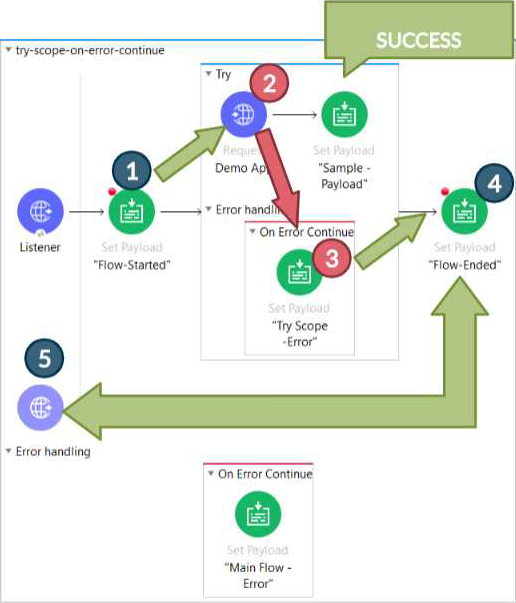
* Correct answer is For Each scope & On Error Continue scope Below requirement can be fulfilled in the below way
1) Using For Each scope, which will send each row from csv file sequentially. each row needs to be sent sequentially as requirement is to send the message in exactly the same way as it is mentioned in the csv file
2) Also other part of requirement is if any processing step for a row fails then it should log an error but should not affect other record processing . This can be achieved using On error Continue scope on these set of activities. so that error will not halt the processing. Also logger needs to be added in error handling section so that it can be logged.
* Attaching diagram for reference. Here it’s try scope, but similar would be the case with For Each loop.
An integration Mule application is deployed to a customer-hosted multi-node Mule 4 runtime duster. The Mule application uses a Listener operation of a JMS connector to receive incoming messages from a JMS queue.
How are the messages consumed by the Mule application?
- A . Depending on the JMS provider’s configuration, either all messages are consumed by ONLY the primary cluster node or else ALL messages are consumed by ALL cluster nodes
- B . Regardless of the Listener operation configuration, all messages are consumed by ALL cluster nodes
- C . Depending on the Listener operation configuration, either all messages are consumed by ONLY the primary cluster node or else EACH message is consumed by ANY ONE cluster node
- D . Regardless of the Listener operation configuration, all messages are consumed by ONLY the primary cluster node
C
Explanation:
Correct answer is Depending on the Listener operation configuration, either all messages are consumed by ONLY the primary cluster node or else EACH message is consumed by ANY ONE cluster node
For applications running in clusters, you have to keep in mind the concept of primary node and how the connector will behave. When running in a cluster, the JMS listener default behavior will be to receive messages only in the primary node, no matter what kind of destination you are consuming from. In case of consuming messages from a Queue, you’ll want to change this configuration to receive messages in all the nodes of the cluster, not just the primary. This can be done with the primaryNodeOnly parameter:
<jms:listener config-ref="config" destination="${inputQueue}" primaryNodeOnly="false"/>
An organization plans to migrate its deployment environment from an onpremises cluster to a Runtime Fabric (RTF) cluster. The on-premises Mule applications are currently configured with persistent object stores.
There is a requirement to enable Mule applications deployed to the RTF cluster to store and share data across application replicas and through restarts of the entire RTF cluster.
How can these reliability requirements be met?
- A . Replace persistent object stores with persistent VM queues in each Mule application deployment
- B . Install the Object Store pod on one of the cluster nodes
- C . Configure Anypoint Object Store v2 to share data between replicas in the RTF cluster
- D . Configure the Persistence Gateway in the RTF installation
A payment processing company has implemented a Payment Processing API Mule application to process credit card and debit card transactions, Because the Payment Processing API handles highly sensitive information, the payment processing company requires that data must be encrypted both In-transit and at-rest.
To meet these security requirements, consumers of the Payment Processing API must create request message payloads in a JSON format specified by the API, and the message payload values must be encrypted.
How can the Payment Processing API validate requests received from API consumers?
- A . A Transport Layer Security (TLS) – Inbound policy can be applied in API Manager to decrypt the message payload and the Mule application implementation can then use the JSON Validation module to validate the JSON data
- B . The Mule application implementation can use the APIkit module to decrypt and then validate the JSON data
- C . The Mule application implementation can use the Validation module to decrypt and then validate the JSON data
- D . The Mule application implementation can use DataWeave to decrypt the message payload and then use the JSON Scheme Validation module to validate the JSON data
An organization is creating a Mule application that will be deployed to CloudHub. The Mule application has a property named dbPassword that stores a database user’s password.
The organization’s security standards indicate that the dbPassword property must be hidden from every Anypoint Platform user after the value is set in the Runtime Manager Properties tab.
What configuration in the Mule application helps hide the dbPassword property value in Runtime Manager?
- A . Use secure::dbPassword as the property placeholder name and store the cleartext (unencrypted) value in a secure properties placeholder file
- B . Use secure::dbPassword as the property placeholder name and store the property encrypted value in a secure properties placeholder file
- C . Add the dbPassword property to the secureProperties section of the pom.xml file
- D . Add the dbPassword property to the secureProperties section of the mule-artifact.json file
B
Explanation:
Reference: https://docs.mulesoft.com/runtime-manager/secure-application-properties
An organization is designing an integration Mule application to process orders by submitting them to a back-end system for offline processing. Each order will be received by the Mule application through
an HTTPS POST and must be acknowledged immediately. Once acknowledged, the order will be submitted to a back-end system. Orders that cannot be successfully submitted due to rejections from the back-end system will need to be processed manually (outside the back-end system).
The Mule application will be deployed to a customer-hosted runtime and is able to use an existing ActiveMQ broker if needed. The ActiveMQ broker is located inside the organization’s firewall. The back-end system has a track record of unreliability due to both minor network connectivity issues and longer outages.
What idiomatic (used for their intended purposes) combination of Mule application components and ActiveMQ queues are required to ensure automatic submission of orders to the back-end system while supporting but minimizing manual order processing?
- A . An Until Successful scope to call the back-end system One or more ActiveMQ long-retry queues
One or more ActiveMQ dead-letter queues for manual processing - B . One or more On Error scopes to assist calling the back-end system An Until Successful scope containing VM components for long retries
A persistent dead-letter VM queue configured in CloudHub - C . One or more On Error scopes to assist calling the back-end system One or more ActiveMQ long-retry queues
A persistent dead-letter object store configured in the CloudHub Object Store service - D . A Batch Job scope to call the back-end system
An Until Successful scope containing Object Store components for long retries A dead-letter object store configured in the Mule application
Which Salesforce API is invoked to deploy, retrieve, create, update, or delete customization information, such as custom object definitions using Mule Salesforce Connectors in a Mule application?
- A . sObject Platform Action API
- B . User Interface API
- C . Metadata API
- D . Process Rules API