
PECB ISO-9001 Lead Auditor Practice Exams
Last updated on Oct 21,2026- Exam Code: ISO-9001 Lead Auditor
- Exam Name: QMS ISO 9001:2015 Lead Auditor
- Certification Provider: PECB
- Latest update: Oct 21,2026
You are conducting a third-party Stage 1 audit at ABC Ltd, a single-site organisation that manufactures wooden furniture. You interview the Technical Director to learn more about the organisation. The Technical Director explains that they have had a successful year and that obtaining ISO 9001 certification will support the further growth of the business. You ask for an overview of the organisation’s structure and its interrelationships with external interested parties.
The Technical Director shows you a document detailing all business processes and interrelationships. You notice in this document that another organisation called Teak Ltd manufactures wooden furniture on behalf of ABC Ltd. The Technical Director confirms this capability has been accounted for in the scope of the quality management system. You learn that the furniture manufactured by Teak Ltd has accounted for 40% of the sales revenue over the previous 12 months.
Which two of the following options best describe how you would plan the audit of the interrelationship with Teak Ltd during the Stage 2 audit at ABC Ltd?
- A . Verify Teak Ltd supply arrangements as described in the ABC Ltd quality management system
- B . Verify if Teak Ltd are certified to ISO 9001
- C . Verify the controls concerning customer property implemented by Teak Ltd
- D . Verify how ABC Ltd evaluates the performance of Teak Ltd
- E . Verify the quality management system at Teak Ltd by conducting an audit at their site
- F . Verify whether the design processes of Teak Ltd comply with ISO 9001
You work as an external quality consultant for an organisation, ‘A’, which provides packaged food to the public. You are asked to lead a team (you as the leader and two other auditors) to audit a supplier, ‘B’, to ISO 9001 which provides packaging materials to your organisation. It is 4 pm and the audit is close to an end; you are having an internal meeting with the team to decide what will be presented to the auditee during the Closing meeting. The Closing meeting was scheduled at 5 pm.
You, as Audit Team Leader, audited top management. You explain to the audit team that you identified two nonconformities:
a. There is no documented information on Top Management Reviews, as required in clause 9.3 of ISO 9001:2015.
b. There is no evidence of Top Management Commitment as required in clause 5.1 of ISO 9001:2015. (e.g., not ensuring the availability of resources to operate the QMS, not ensuring the establishment of objectives, no promotion of improvement, no promotion of the process approach).
All agreed to present these two nonconformities. They went to meet the Top Management of ‘B’ and noticed that the General Manager and three other managers (Production, Human Resources, and Sales) were present in the meeting room.
Considering the seriousness of the two nonconformities to Top Management, as audit team leader, from the following select the best option:
- A . Present the nonconformities to the whole group and inform that you will recommend your company to remove them from the approved suppliers list.
- B . Present the nonconformities to the managers, inform them that the report will be sent within 10 days, close the meeting and leave the site.
- C . Ask the General Manager to have a private conversation in which you present the nonconformities only to him because of their sensitive nature.
- D . Present the nonconformities to the whole group and analyse with them how to overcome this situation.
DRAG DROP
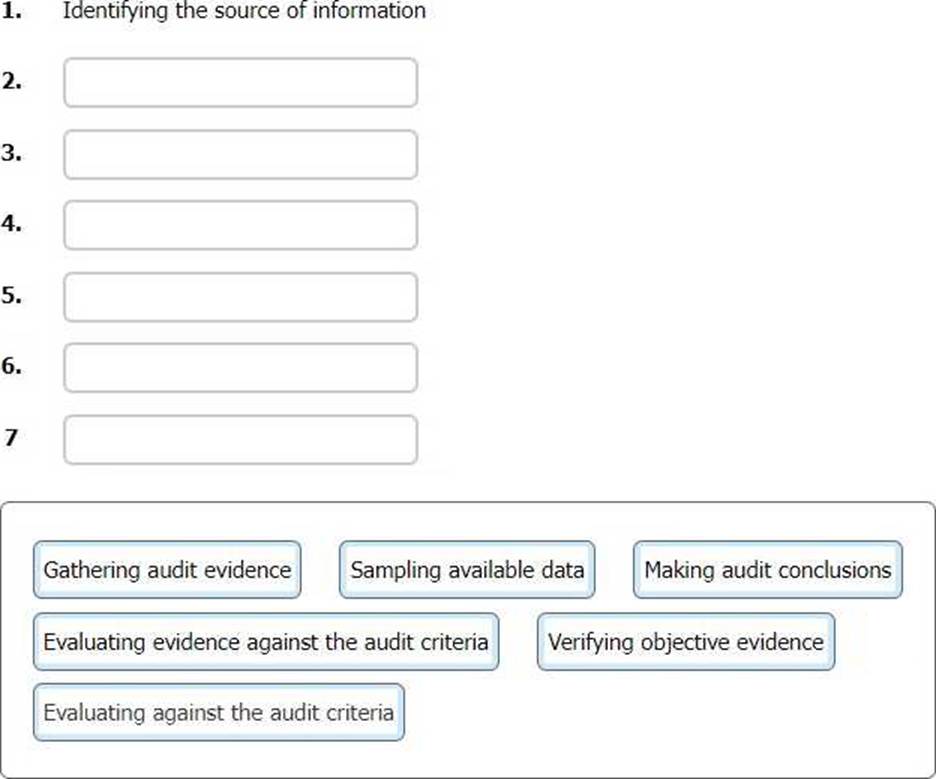
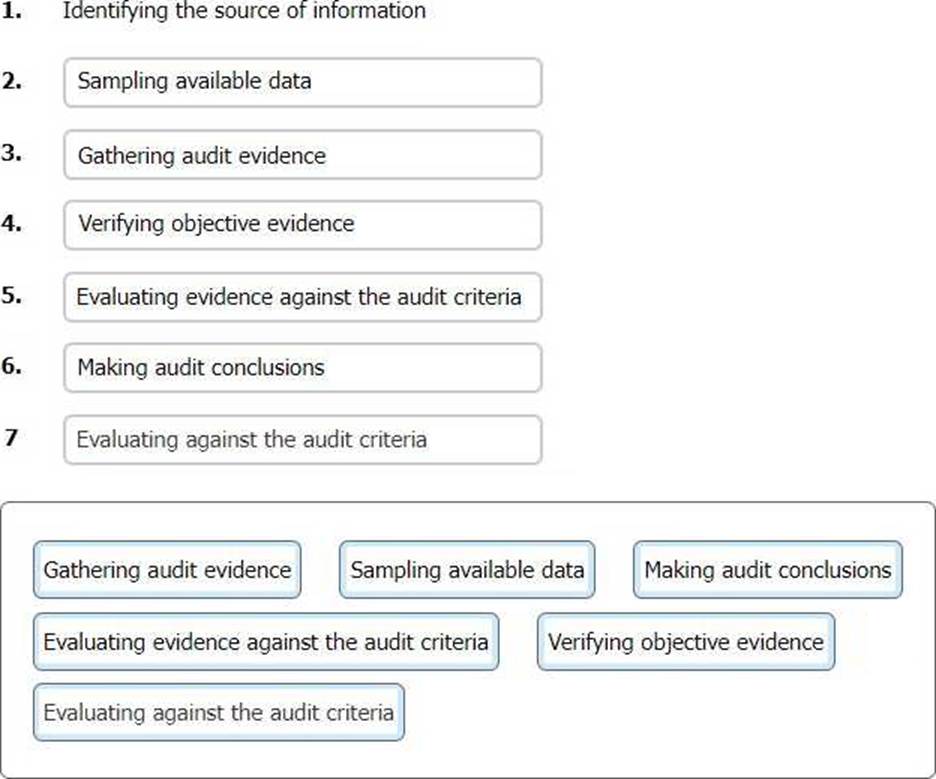
In the context of a management system audit, identify the sequence of a typical process for collecting and verifying information. The first one has been done for you.
To complete the sequence click on the blank section you want to complete so it is highlighted in red and then click on the applicable text from the options below. Alternatively, drag and drop the options to the appropriate blank section.
In a third-party audit to ISO 9001, select two options of when the organisation is required to act in response to reported findings.
- A . A recommendation is given in the report.
- B . A finding of good practice is reported.
- C . An opportunity for improvement is raised.
- D . A major non-conformity is raised.
- E . A finding of conformity is reported.
- F . A minor non-conformity is raised.
Which two of the following work documents are not required for audit planning by an auditor conducting a certification audit?
- A . A career history of the quality manager
- B . A checklist
- C . A list of interested parties
- D . An audit plan
- E . An evidence sampling strategy
- F . An organisation’s financial statement
XYZ Corporation is an organisation that employs 100 people. As audit team leader, you are conducting a certification audit at Stage 1. When reviewing the quality management system (QMS) documentation, you find that quality objectives have been set for every employee in the organisation except top management.
The Quality Manager complains that this has created a lot of resistance to the QMS, and the Chief Executive is asking questions about how much it will cost. He asks for your opinion on whether this is the correct method of setting objectives.
Three months after Stage 1, you return to XYZ Corporation to conduct a Stage 2 certification audit as Audit Team Leader with one other auditor. You find that the Quality Manager has cancelled the previous quality objectives for all employees and replaced them with a single objective for himself. This states that "The Quality Manager will drive multiple improvements in the QMS in the next year". The Quality Manager indicates that this gives him the authority to issue instructions to department managers when quality improvement is needed. He says that this approach has the full backing of senior management.
He shows you the latest Quality Improvement Request that was included in the last management review.
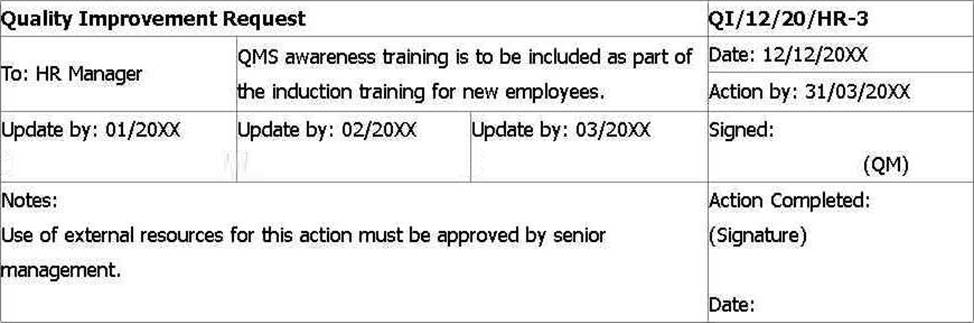
After further auditing, the issues below were found. Select three statements that apply to the term ‘audit trail’
- A . Decisions on improvement action timescales not involving departmental managers.
- B . Evaluation of the results of the improvement action not always documented by the Quality Manager.
- C . Limited knowledge of the content of Quality Improvement Requests by departmental staff.
- D . Quality improvements not aligning with the quality policy.
- E . The single quality objective set for the organisation by the Quality Manager.
- F . Top management claim not to be aware of the improvement request (QI/12/20/HR-3) initiated by the Quality Manager.
Select the phrase that best describes the purpose of a quality management system to ISO 9001 in relation to the performance of an organization.
- A . Manages the performance
- B . Monitors the performance
- C . Dictates the performance
- D . Improves the performance
You are auditing an organisation that has been certificated to ISO 9001 for ten years. The organisation is a privately-owned, multi-site car tyre fitting organisation. You are auditing one of the sites. You are auditing the car tyre fitting service. You are interviewing the Site Manager (SM).
You: "Would you explain the car tyre fitting service?"
SM: "Of course. Customers typically call us by phone with their requirements. We ask them what they want. We check whether we have the tyres
they need in stock. If we don’t have the tyres in stock, we contact our supplier to confirm when they would be able to supply the tyres. We then determine the cost. We then check what availability we have in our busy schedule to fit the new tyres. We then inform the customer with details of cost and when we can fit the tyres. If the customer is happy to proceed with the booking, we update our Work Schedule. The same process applies for customers who walk into our office and for online requests."
You: "What information do you retain should there be a defect reported by a manufacturer of tyres that you have fitted?"
SM: "We maintain records of customer names, addresses and contact phone numbers. We maintain a record of the type of tyre fitted and the tyre manufacturers batch information. We also maintain a record of the registration numbers of the vehicles we have fitted tyres to. All records are in our Work Schedule."
Which two of the following options you would take to enable you to gather further audit evidence to validate what the Site Manager has told you?
- A . Interview a customer to determine how satisfied they are with the service.
- B . Interview a tyre fitter to determine how long they have worked for the organisation.
- C . Interview a tyre fitter to determine the type and batch of each tyre fitted to a car.
- D . Review the training record of the site manager.
- E . Review the Work Schedule dated three years ago and verify what information has been recorded.
- F . Review the Work Schedule for the past three weeks and verify what information has been recorded.
DRAG DROP
You, as auditor, are in dialogue with the quality lead and managing director of a small business that supplies specialist laboratory equipment and furniture.
You: "I’d like to look at how you manage change in the organisation.
What changes have you made as a business, say, over the last 12 months?"
Auditee: "We have made some strategic changes, the main one being that we no longer manufacture our
own products in house."
You: "That sounds like quite a significant change.
What has been the impact of that?"
Auditee: "We now mainly sell other manufacturers’ products, under their brand names, and have outsourced manufacture of our own brand products to one of our suppliers. Unfortunately, we had to make six members of our staff redundant. This represents about 20% of our workforce, so this has been quite a challenging time."
You: "I’m sure.
What were the reasons for making the change?"
Auditee: "Our manufacturing section was a small operation, and we struggled to cope with fluctuations in demand. During busy periods, we found it hard to meet lead times, and in quiet periods we had staff with little to do. This was having an impact on customer satisfaction and meant we had to charge premium prices that made our product uncompetitive."
You: "How did you go about the change?"
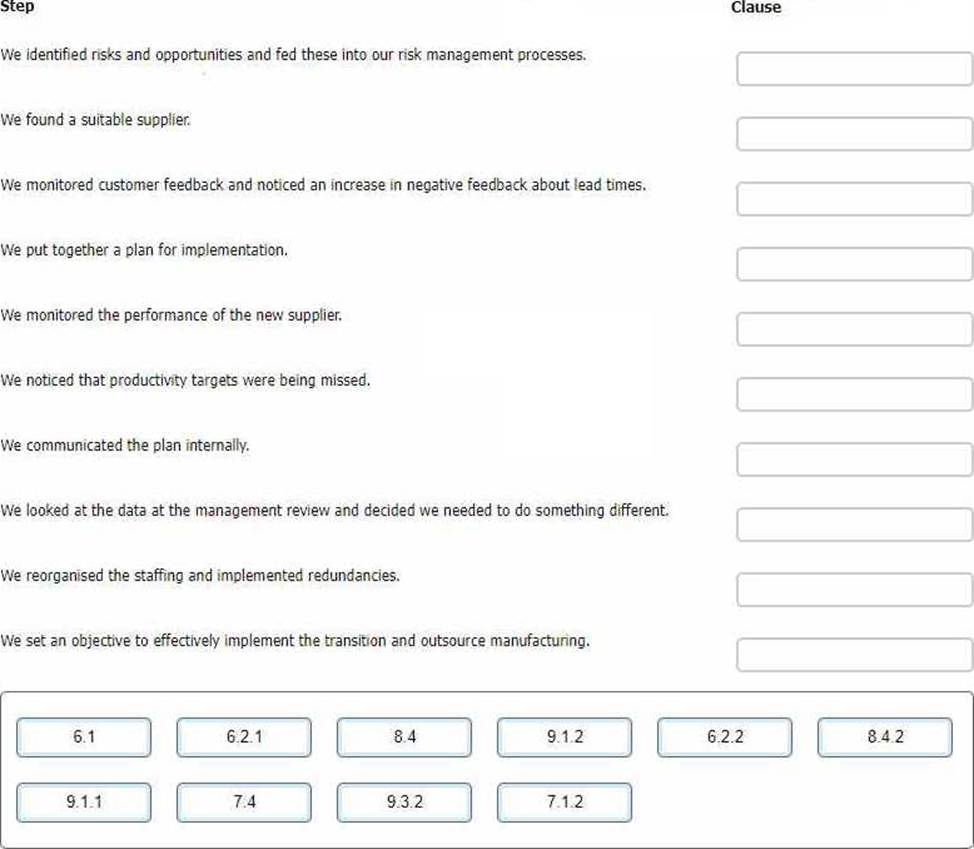
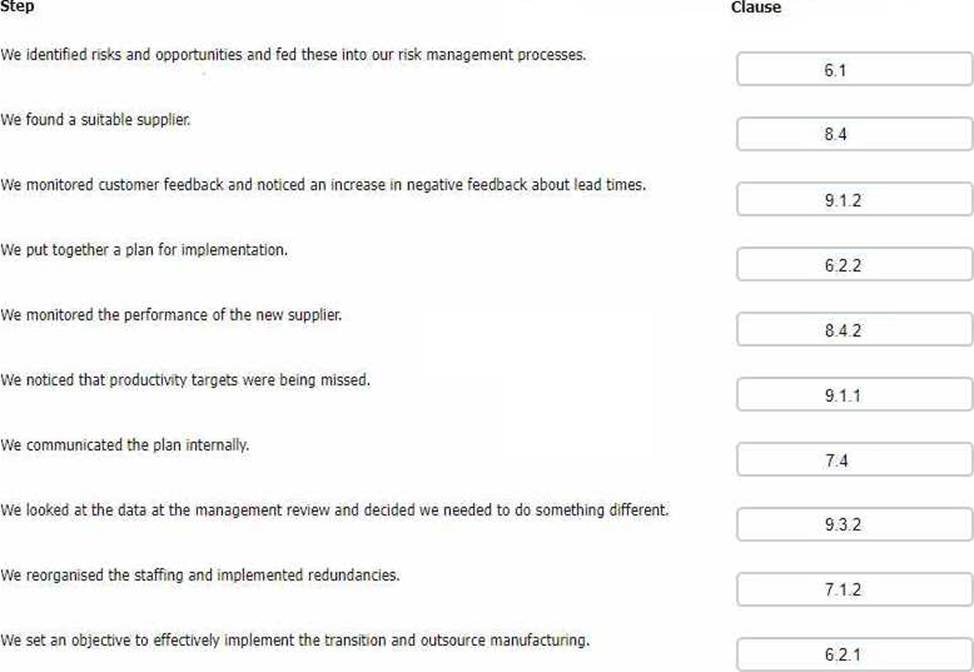
In relation to the auditor’s question about how the change was managed, the auditee mentions the steps listed below. Match the ISO 9001 clauses to the steps.
To complete the table, click on the blank section you want to complete so it is highlighted in red and then click on the ISO 9001 clauses listed below. Alternatively, drag and drop each clause to show which step the requirement applies to.
Takitup is a small fabrication organisation that manufactures steel fencing, stairs and platforms for the construction sector. It has been certified to ISO 9001 for some time and has appointed a new Quality Manager. The audit plan during a surveillance audit covers the organisation’s improvement actions and the auditor asks to see the most recent management review meeting minutes.
The auditor finds that the management review report records that none of the improvement actions set by the previous review has been realised for a second time. A new Quality Manager has been brought in at the middle management level to rectify the situation as the organisation is concerned that it might lose its certification.
Select three options that would provide evidence of conformance with clause 10.3 of ISO 9001.
- A . Outsource more processes to external providers
- B . Removing expensive external providers from the database.
- C . An increase in the number of quality staff.
- D . A quality objective to achieve lower reject rates by quality control.
- E . Considering results from the analysis of the effectiveness of corrective actions to determine improvement opportunities.
- F . The certification body auditor reporting fewer nonconformities.
- G . An enhanced customer satisfaction survey score than in the previous year.
- H . Automate the fabrication process to increase profitability.