
PECB ISO-9001 Lead Auditor Practice Exams
Last updated on Oct 21,2026- Exam Code: ISO-9001 Lead Auditor
- Exam Name: QMS ISO 9001:2015 Lead Auditor
- Certification Provider: PECB
- Latest update: Oct 21,2026
You are conducting a Stage 1 audit at an organisation that services refrigeration equipment for a large customer base.
The scope of certification is "Provision of refrigeration equipment maintenance and repair services". You are interviewing the Managing Director to learn more about the organisation and to explore how the requirements for policy, objectives, and risks and opportunities in ISO 9001 are addressed.
The Managing Director explains that they only use sub-contract refrigeration engineers and do not have any full-time refrigeration engineers, which helps to optimise overhead costs. The full-time staff employed are essentially a small team of office staff who process customer enquiries, schedule jobs and process invoices.
The Managing Director adds that the ISO 9001 requirements for competence of personnel extends to both sub-contract and full-time staff. He also states that the full-time staff are aware of the Quality Policy, objectives and plans to address risk and opportunities.
You ask if the sub-contract engineers have been informed of the Quality Policy, objectives and plans to address risks and opportunities, to which the Managing Director replies that this is not applicable as they only use sub-contractors who operate ISO 9001 certificated quality management systems. The documented information provided to the auditor confirms this.
Which clause in ISO 9001 is most likely not to have been fulfilled in this instance?
- A . 7.2 Competence
- B . 7.3 Awareness
- C . 7.4 Communication
- D . 7.5 Documented information
‘XYZ’ has already sent to you a list with all documented procedures and work instructions related to the services provided to ‘ABC’ (a quality manual is not included in the list).
To complete the audit planning which additional information would you ask to XYZ to submit? Select four.
- A . XYZ’s organisational structure
- B . The quality manual
- C . A description of responsibilities and authorities of the key roles of XYZ
- D . The number of personnel involved in activities related to the quality management system
- E . Information to understand XYZ’s operations
- F . The results of XYZ’s last internal audit
- G . The results of the last two management reviews
- H . The list of risks and opportunities determined by XYZ
An audit team of three people is conducting a Stage 2 audit to ISO 9001 of an engineering organisation that manufactures sacrificial anodes for the oll and gas industry in marine environments. These are aluminium products designed to prevent corrosion of submerged steel structures. You, as one of the auditors, find that the organisation has shipped anodes for Project DK in the Gulf of Mexico before the galvanic efficiency test results for the anodes have been fully analysed and reported as required by the customer. The Quality
Manager explains that the Managing Director authorised release of the anodes to avoid late delivery as penalties would be imposed. The customer was not informed since the tests very rarely fall below the required efficiency. You raise a nonconformity against clause 8.6 of ISO 9001.
Which of the following options for the best description of the nonconformity?
- A . A retrospective concession was not sought from the customer once the test results had been approved by the Quality Manager.
- B . Release of the product without acceptable test results has been accepted by the customer for Project DK.
- C . Products for Project DK have been released before product approval through the quality control process.
- D . The untested product was not recalled until the galvanic efficiency of the anodes was verified.
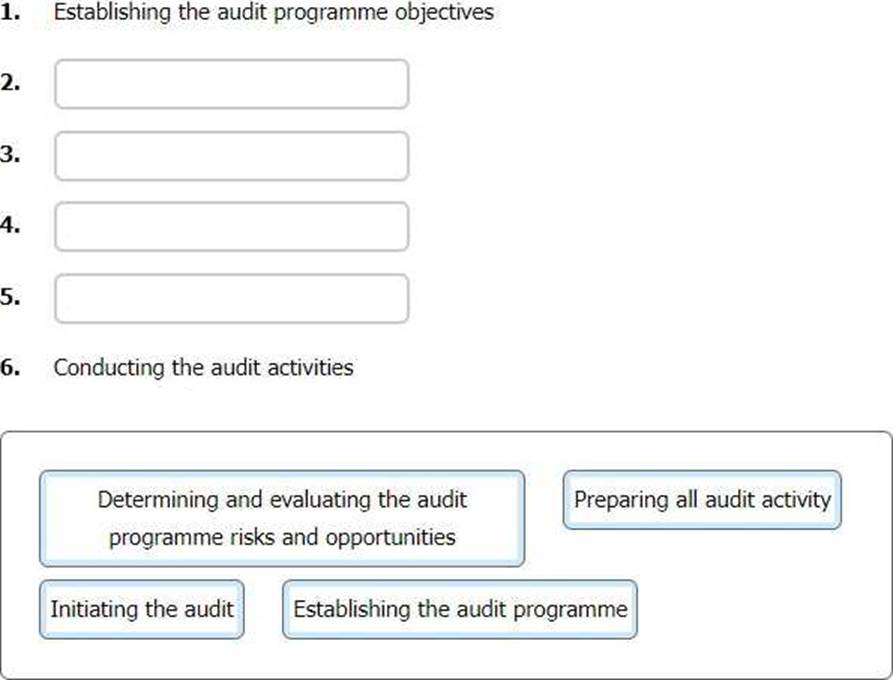
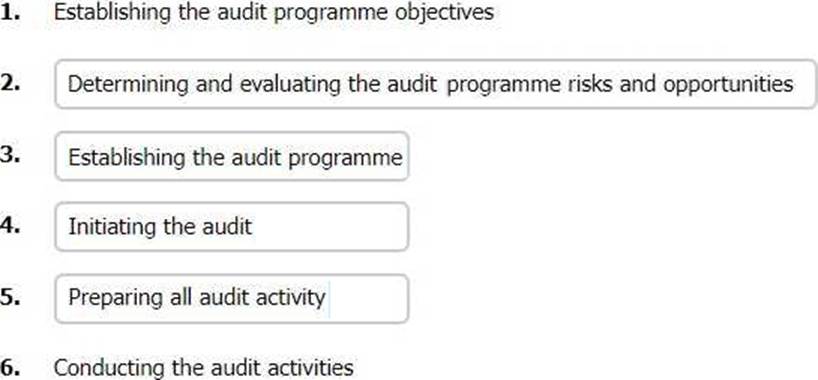
DRAG DROP
The following are stages of an audit, put them in the order they would be conducted.
The first and last stages have been done for you
To complete the sequence click on the bank section you want to complete so it is highlighted in red and then click on the applicable text from the options below.
Select six of the activities that are specifically required by ISO 17021-1 as part third-party (Certification Body) surveillance audit processes.
- A . Audit use of certification marks on marketing materials.
- B . Review changes to the QMS since last visit.
- C . Confirm effectiveness of internal audit and management review.
- D . Complete a full document review of the quality management system.
- E . Failing to meet financial responsibilities.
- F . Review the status of previously raised findings and audit effectiveness of any outstanding findings.
- G . Review the calibration status of the instrumentation.
- H . Verify legal compliance.
- I . Handling of customer complaints since last visit.
- J . Conduct a minimum number of annual surveillance audits during the certification period.
Select the two statements that are true.
- A . The audit team leader shall only communicate any concerns to the auditee during the closing meeting.
- B . Inform the general manager if the auditor finds uncontrolled documents.
- C . Where the available audit evidence indicates that the audit objectives are unattainable, the individual(s) managing the audit programme shall be immediately informed.
- D . Changes to the audit scope, which become apparent during the audit, shall be approved with the auditee.
- E . During the audit, the audit team leader shall periodically assess audit progress.
- F . An immediate and significant risk to the audit shall be informed to the auditee and if possible to the certification body.
You are conducting a third-party audit to ISO 9001 and the next item on your audit plan is ‘internal auditing’.
When reviewing a sample of audit records up to 5 years previously, you find that many contain non-conformance reports and no actions have been taken. You interview the Quality Manager.
You: "I have noted that many of the older files contain non-conformances that have not had any corrective action taken."
Quality Manager: "Because the business is always changing, the departmental managers tell me that the non-conformances are no longer applicable. I made a decision that any non-conformance over 3 years old is automatically closed"
You: "Do you obtain any confirmation beforehand from the appropriate departments that the non-conformances are no longer applicable."
Quality Manager: " No, because they are so old I consider that they are no longer appropriate. Please remember that we take a risk-based approach which means we audit where and when it is considered important to do so.
Select one course of action you would now take from the options.
- A . Interview Top management to determine whether they were aware of and agreed the actions of the Quality Manager
- B . Review all non-conformances reports related to clause 9.2 of ISO 9001
- C . Interview relevant Departmental managers to assess whether the older non-conformances are still valid.
- D . Raise a non-conformance report against clause 9.2.2.e of ISO 9001
In the context of a third-party management system certification audit, which two of the following statements are correct?
- A . The purpose of a Stage 2 audit is to certify an organisation to ISO 9001.
- B . The Stage 2 audit must be conducted by auditors who have never worked for the auditee
- C . The purpose of a Stage 2 audit is to evaluate the implementation of the auditee’s management system.
- D . A Stage 2 audit evaluates how efficiently the organisation is implementing its management system
- E . The Stage 2 audit cannot include remote access to electronic site(s) that contain information relevant to the audit of the management system.
- F . The Stage 2 audit should include an opening meeting at the start of the audit and a closing meeting at the conclusion of the audit.
The following actions need to be carried out during a third-party audit planning stage.
Which two actions correspond to the individual(s) managing the audit program before the involvement of the audit team leader?
- A . Prepare the audit plan
- B . Assign responsibilities within the audit team
- C . Prepare the checklists
- D . Provide the resources needed
- E . Review the reports of previous audits
- F . Select the audit team members