
Payroll FPC-REMOTE Practice Exams
Last updated on Oct 21,2026- Exam Code: FPC-REMOTE
- Exam Name: Fundamental Payroll Certification
- Certification Provider: Payroll
- Latest update: Oct 21,2026
Employees may report tips to the employer using:
- A . Form 940
- B . Form 941
- C . Form 4070
- D . Form 8027
C
Explanation:
Employees report tips using IRS Form 4070 to their employer.
Form 940 reports FUTA taxes, not tips.
Form 941 reports quarterly payroll taxes, not tips.
Form 8027 is used by large employers to report tip allocation, NOT individual reporting.
Reference: IRS Publication 531 (Reporting Tip Income)
Which of the following statements about payments made under workers’ compensation benefits is FALSE?
- A . They are not included in the employee’s gross income
- B . They are received for injuries or illnesses suffered on the job
- C . They are subject to FUTA if they do not exceed the employee’s benefits
- D . They are not subject to FICA if payments are made under state regulations
C
Explanation:
Workers’ compensation benefits are NOT subject to FUTA (Federal Unemployment Tax Act) as long as they are paid under a workers’ compensation law.
Option A (Not included in gross income) is correct because workers’ compensation is tax-exempt under IRS rules.
Option B (Received for work-related injuries/illnesses) is correct because these payments replace lost wages due to job-related incidents.
Option D (Not subject to FICA under state laws) is correct because workers’ compensation payments are exempt from Social Security & Medicare taxes if they are made under a state-approved program.
Option C is incorrect because workers’ compensation payments are NOT subject to FUTA, regardless of the amount paid.
Reference: IRS Publication 525 C Taxability of Workers’ Compensation
Payroll.org C Payroll Taxation of Disability and Workers’ Compensation Benefits
Which of the following master file components is NOT part of the employment data?
- A . Shift Premium
- B . Workweek
- C . Hire Date
- D . Net Pay
D
Explanation:
An employee master file contains employment-related data such as:
Shift Premium (A): Used to calculate earnings.
Workweek (B): Defines payroll schedules.
Hire Date (C): Essential for tenure and benefit eligibility.
However, Net Pay (D) is NOT part of employment data because it is a payroll outcome, not an employment record.
Reference: Payroll.org C Employee Master File Data Requirements
IRS C Payroll Recordkeeping Guidelines
Which of the following situations does NOT reflect constructive receipt of wages?
- A . Check is in the employee’s possession.
- B . Direct deposit funds are made available to the employee.
- C . Employer mails paycheck through the United States Postal Service.
- D . Payment has been set aside in the Payroll Department for employee pickup.
C
Explanation:
Constructive receipt means income is available to the employee even if not physically received.
Option C is correct because when a paycheck is mailed, it is not immediately available, delaying constructive receipt.
Reference: IRS Publication 15 (Employer’s Tax Guide)
Payroll Tax Compliance Guide (Payroll.org)
Which of the following documents listed on Form I-9 can be used to establish both an employee’s identity and employment eligibility?
- A . Social Security Card
- B . U.S. Passport
- C . Voter’s Registration Card
- D . Driver’s License
B
Explanation:
According to Form I-9, Employment Eligibility Verification, an unexpired U.S. passport is a List A document that establishes both an employee’s identity and work authorization.
A Social Security card (Option A) is a List C document, which only proves employment authorization but not identity.
A Voter’s Registration Card (Option C) is not an acceptable I-9 document for identity or work authorization.
A Driver’s License (Option D) is a List B document, which only proves identity but not employment eligibility.
Reference: U.S. Citizenship and Immigration Services (USCIS) C Form I-9 Instructions Payroll.org C Employment Eligibility Verification Guidelines
Using the following information, calculate the employer’s total FICA tax liability for the first payroll of the year.
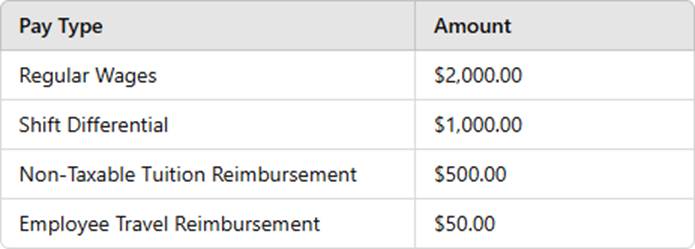
- A . $459.00
- B . $466.66
- C . $535.50
- D . $543.16
A
Explanation:
Step 1: Determine taxable wages
Regular wages: $2,000.00
Shift differential: $1,000.00
Total taxable wages = $3,000.00 (Non-taxable tuition reimbursement and travel are excluded.) Step 2: Calculate Social Security tax
$3,000 × 6.2% = $186.00 (Employer portion)
Step 3: Calculate Medicare tax
$3,000 × 1.45% = $43.50 (Employer portion)
Step 4: Total employer FICA tax
Social Security + Medicare = $186.00 + $43.50 = $229.50
Employer’s share = $229.50 × 2 = $459.00
Reference: IRS Publication 15 (Employer’s Tax Guide)
Social Security and Medicare Tax Rates (IRS)
A company has engaged an individual to write a sales contract. The individual receives a flat amount for the task and has an assigned time frame for completion.
This individual is classified as a(n):
- A . Leased Employee
- B . Administrative Employee
- C . Independent Contractor
- D . Commissioned Salesperson
C
Explanation:
An independent contractor is an individual who:
Works on a per-project basis
Is not under direct employer control
Provides services to multiple clients
Option A (Leased Employee) refers to employees hired through a staffing agency.
Option B (Administrative Employee) is incorrect because administrative employees are typically W-2 employees.
Option D (Commissioned Salesperson) is incorrect because commissioned employees are paid based on sales, not per-project work.
Reference: IRS C Independent Contractor vs. Employee Guidelines
Payroll.org C Worker Classification Compliance
A state’s minimum wage is $0.60 higher than the federal minimum wage. Under the FLSA, for an employee age 20, what is the MINIMUM hourly rate an employer can pay the employee?
- A . $4.25
- B . $4.85
- C . $7.25
- D . $7.85
D
Explanation:
The federal minimum wage is $7.25 per hour.
A state’s minimum wage is $0.60 higher, so $7.25 + $0.60 = $7.85.
FLSA requires the higher of state or federal minimum wage.
Reference: FLSA Minimum Wage Provisions (Department of Labor)
The process used to verify and validate payroll system edits or warnings is called:
- A . Gap analysis.
- B . Balancing and reconciliation.
- C . Evaluating system performance.
- D . Periodic data auditing and sampling.
B
Explanation:
Balancing and reconciliation ensures payroll data is accurate, consistent, and matches financial records.
Gap analysis (A) is used to compare actual vs. expected performance. Evaluating system performance (C) focuses on efficiency, not data verification. Periodic auditing (D) is important but not the primary method of payroll validation.
Reference: Payroll Balancing & Reconciliation Guidelines (Payroll.org)
An upgrade to a payroll system can impact all of the following documentation within the payroll department EXCEPT:
- A . User manuals
- B . Union contracts
- C . Business continuity plans
- D . Standard operating procedures
B
Explanation:
A payroll system upgrade affects documentation related to payroll processing but does not change union contracts.
Option A (User manuals): Correct C New system features require updated manuals for payroll staff.
Option C (Business continuity plans): Correct C System changes must be included in disaster recovery plans.
Option D (Standard operating procedures C SOPs): Correct C Payroll procedures need updates for new workflows.
However, union contracts (Option B) remain unchanged unless a new agreement is negotiated.
Reference: Payroll.org C Payroll System Implementation Best Practices IRS C Payroll System Compliance Requirements