
Payroll FPC-REMOTE Practice Exams
Last updated on Oct 21,2026- Exam Code: FPC-REMOTE
- Exam Name: Fundamental Payroll Certification
- Certification Provider: Payroll
- Latest update: Oct 21,2026
Examples of positive active listening through body language include all of the following actions
EXCEPT:
- A . Avoiding slouching posture.
- B . Shrugging your shoulders.
- C . Making eye contact.
- D . Nodding your head.
B
Explanation:
Shrugging shoulders (B) is a sign of uncertainty or disinterest, making it negative body language. Making eye contact (C), nodding (D), and avoiding slouching (A) are positive active listening cues.
Reference: Effective Communication in Payroll Training Guide (Payroll.org)
When an employer allocates tips, which of the following statements is TRUE?
- A . Allocated tips are subject to federal income tax withholding
- B . The employer is not liable for amounts incorrectly allocated
- C . Report the allocated amount on the employee’s Form W-2
- D . No allocation is made for any reported tips
C
Explanation:
Employers must allocate tips if the total reported tips are less than 8% of gross receipts for establishments where tipping is customary.
Allocated tips are reported on Form W-2, Box 8 (Option C) but are NOT subject to withholding.
Option A is incorrect because allocated tips are not subject to automatic withholding unless voluntarily reported by the employee.
Option B is incorrect because employers are responsible for accurate tip reporting. Option D is incorrect because tip allocation rules require reporting when applicable.
Reference: IRS Publication 531 C Reporting Tip Income
Payroll.org C Employer Tip Allocation Rules
All of the following plans are deferred compensation plans EXCEPT:
- A . 401(k)
- B . 403(b)
- C . 457(b)
- D . 501(c)
D
Explanation:
Deferred compensation plans allow employees to defer income taxation until retirement. These include:
401(k) (Option A) C A private-sector retirement savings plan.
403(b) (Option B) C A similar plan for nonprofits and schools.
457(b) (Option C) C A nonqualified deferred compensation plan for government employees.
Option D (501(c)) is incorrect because it refers to tax-exempt organizations under the IRS code, not a deferred compensation plan.
Reference: IRS C Tax Treatment of Deferred Compensation Plans
Payroll.org C Retirement Plan Payroll Compliance
What information is reported to the IRS on Form 1094-C?
- A . Basic employer information and number of employees
- B . Employee FITW
- C . FUTA wages
- D . Payments made to the beneficiary of a deceased employee
A
Explanation:
Form 1094-C is used by employers under the Affordable Care Act (ACA) to report employer health coverage information.
It includes basic employer details, employee counts, and ACA compliance data.
Employee FITW (B), FUTA wages (C), and deceased employee payments (D) are NOT reported on Form 1094-C.
Reference: IRS Form 1094-C Instructions
ACA Compliance Guidelines (Payroll.org)
A paycheck that is never collected by the employee is considered:
- A . Voided.
- B . Written off.
- C . Accounts payable.
- D . Abandoned property.
D
Explanation:
Unclaimed wages are classified as abandoned property under escheatment laws. Employers must remit unclaimed wages to the state after a certain period. Voiding (A) and writing off (B) apply only when payroll errors occur.
Reference: Unclaimed Property Laws (State Escheatment Regulations)
Payroll Compliance Guide (Payroll.org)
Which of the following forms is used by an employer to file an annual return of withheld FIT from nonwage payments?
- A . Form 940
- B . Form 941
- C . Form 944
- D . Form 945
D
Explanation:
Form 945 is used for reporting federal income tax withheld from nonwage payments, such as:
Pension distributions
Gambling winnings
Certain annuities
Form 941 (B) is for employment taxes on wages.
Form 940 (A) is for FUTA taxes.
Reference: IRS Form 945 Instructions
IRS Withholding Rules
When an employee fails to cash a payroll check and the employer cannot locate the employee, the Payroll Department should:
- A . Void the check and process a Form W-2c for the employee.
- B . Make a journal entry to post to a cash account as forfeited earnings.
- C . Use company policy and federal law to determine the process of submitting the unclaimed wages to the IRS.
- D . Use company policy and state law to determine the process of submitting the unclaimed wages to the state agency.
D
Explanation:
Unclaimed wages (also known as escheat wages) must be handled according to state escheatment laws. Each state has its own rules about how long employers must hold unclaimed wages before remitting them to the state’s unclaimed property division.
Option A is incorrect because voiding the check does not resolve the issue of unclaimed wages, and Form W-2c is used for correcting tax information, not handling unclaimed wages.
Option B is incorrect because unclaimed wages cannot be posted as forfeited earnings without proper reporting to the state.
Option C is incorrect because escheatment laws are governed at the state level, not federal.
Reference: Payroll.org C Unclaimed Wages and Escheatment Guidelines State Escheatment Laws and Compliance Regulations
Using the following schedule for an employee who earns $9.00 per hour, calculate the overtime premium required under the FLSA.
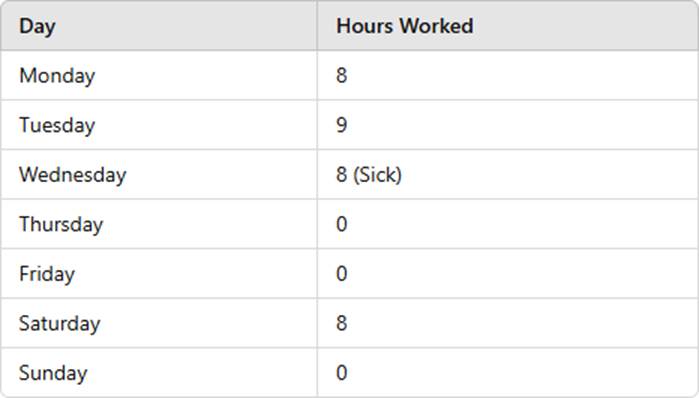
- A . $0.00
- B . $4.50
- C . $9.00
- D . $13.50
A
Explanation:
Under the Fair Labor Standards Act (FLSA):
Overtime is required only when an employee works more than 40 hours in a workweek.
The total worked hours (excluding sick leave) = 25 hours (below 40).
No overtime is due.
Reference: FLSA Overtime Rules (Department of Labor)
When an employer allocates tips, which of the following statements is TRUE?
- A . Allocated tips are subject to federal income tax withholding
- B . The employer is not liable for amounts incorrectly allocated
- C . Report the allocated amount on the employee’s Form W-2
- D . No allocation is made for any reported tips
C
Explanation:
Employers must allocate tips if the total reported tips are less than 8% of gross receipts for establishments where tipping is customary.
Allocated tips are reported on Form W-2, Box 8 (Option C) but are NOT subject to withholding.
Option A is incorrect because allocated tips are not subject to automatic withholding unless voluntarily reported by the employee.
Option B is incorrect because employers are responsible for accurate tip reporting. Option D is incorrect because tip allocation rules require reporting when applicable.
Reference: IRS Publication 531 C Reporting Tip Income
Payroll.org C Employer Tip Allocation Rules
The types of accounts used by businesses to classify transactions are:
- A . Asset, Expense, Revenue, Inventory, and Equity
- B . Asset, Liability, Expense, Revenue, and Equity
- C . Inventory, Revenue, Equity, and Cash
- D . Revenue, Expense, Cash, and Net Income
B
Explanation:
Business transactions are classified using five main types of accounts:
Asset C Resources owned (e.g., cash, equipment, accounts receivable).
Liability C Amounts owed (e.g., payroll taxes, loans).
Expense C Costs incurred to operate the business (e.g., payroll expenses).
Revenue C Income earned (e.g., sales, service fees).
Equity C Owner’s interest in the business (e.g., retained earnings).
Option A is incorrect because "Inventory" is a type of asset, not a separate category.
Option C is incorrect because "Cash" is a subcategory of assets, not a primary account type.
Option D is incorrect because "Net Income" is the result of revenues minus expenses, not a separate account category.
Reference: GAAP Accounting Principles C Types of Accounts
Payroll.org C Payroll Accounting Classification