
Payroll FPC-REMOTE Practice Exams
Last updated on Oct 21,2026- Exam Code: FPC-REMOTE
- Exam Name: Fundamental Payroll Certification
- Certification Provider: Payroll
- Latest update: Oct 21,2026
The journal is commonly referred to as the record of:
- A . Cross-reference
- B . Final entry
- C . Original entry
- D . Secondary entry
C
Explanation:
A journal is known as the "original entry" because transactions are first recorded here before posting to the ledger.
The general ledger is the final entry (B), not the journal.
Reference: Payroll Accounting Standards (Payroll.org)
Which of the following plans may be treated as a nonqualified plan?
- A . 401(k)
- B . 403(b)
- C . 408(p)
- D . 457(b)
D
Explanation:
A 457(b) plan is a nonqualified deferred compensation plan offered primarily to government and tax-exempt employees.
Option A (401(k)) and Option B (403(b)) are qualified retirement plans under ERISA. Option C (408(p)) refers to a SIMPLE IRA, which is also a qualified plan.
Reference: IRS C 457(b) Plan Rules and Compliance
Payroll.org C Qualified vs. Nonqualified Retirement Plans
Where should a firm’s business transactions FIRST be recorded?
- A . Balance Sheet
- B . General Ledger
- C . Journal
- D . Trial Balance
C
Explanation:
A Journal (Option C) is the first place where business transactions are recorded in chronological order before posting to the General Ledger.
Option A (Balance Sheet) is incorrect because it is a financial statement, not a transaction log.
Option B (General Ledger) is incorrect because transactions must first be recorded in a journal before being posted.
Option D (Trial Balance) is incorrect because it is a summary of ledger balances used for reconciliation.
Reference: GAAP Accounting Principles C Transaction Recording Process Payroll.org C Payroll Accounting Workflow
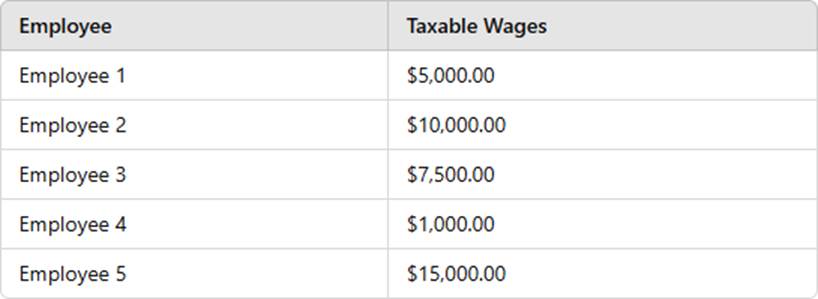
Using the table of taxable wages below, calculate the employer’s FICA tax liability on the first check of the year:
- A . $2,387.00
- B . $2,945.25
- C . $5,890.50
- D . $11,415.25
B
Explanation:
Total Taxable Wages:
$5,000 + $10,000 + $7,500 + $1,000 + $15,000 = $38,500
Social Security Tax (6.2%)
$38,500 × 6.2% = $2,387.00
Medicare Tax (1.45%)
$38,500 × 1.45% = $558.25
Total FICA Tax (Employer’s share)
$2,387.00 + $558.25 = $2,945.25
Reference: IRS Publication 15 (Employer’s Tax Guide)
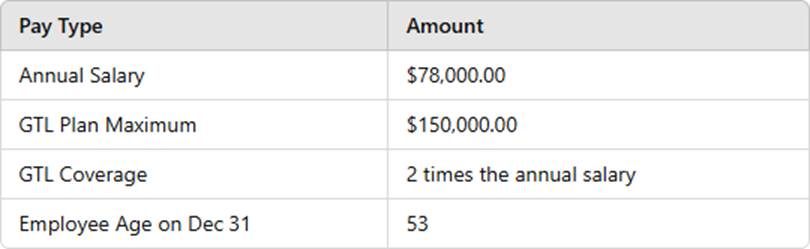
Using the following information, calculate the imputed income that MUST be included in the employee’s monthly gross pay.
- A . $6.44
- B . $23.00
- C . $24.38
- D . $34.50
C
Explanation:
Step 1: Calculate excess GTL coverage
Employee GTL coverage = $78,000 × 2 = $156,000
Excludable amount = $50,000
Taxable excess = $156,000 – $50,000 = $106,000
Step 2: Use IRS Table for GTL Taxable Rates (for age 53: $0.23 per $1,000 of coverage)
$106 × $0.23 = $24.38 per month
Reference: IRS Publication 15-B (Taxable Group Term Life Insurance)
A semiweekly depositor accumulates a payroll tax liability of $49,000.00 on Thursday. The next day, the company has bonus payroll with a tax liability of $120,200.00. Calculate the amount of tax deposit and its due date.
- A . $120,200.00 on the following Friday; $49,000.00 on the following Wednesday
- B . $120,200.00 on the following Monday; $49,000.00 on the following Wednesday
- C . $169,200.00 on the following Monday
- D . $169,200.00 on the following Wednesday
C
Explanation:
As a semiweekly depositor, if the tax liability exceeds $100,000 in a single day, the employer must deposit the full amount by the next business day.
The combined liability of $169,200 must be deposited on Monday.
Reference: IRS Publication 15 (Federal Deposit Rules)
All of the following resources are available to help a Payroll Professional stay abreast of regulatory changes EXCEPT the:
- A . PAYO
- B . DOL
- C . FTC
- D . IRS
C
Explanation:
Payroll professionals must stay updated on tax laws, wage regulations, and compliance
requirements. Key resources include:
A (PAYO C Payroll.org) → Provides training, updates, and compliance resources.
B (DOL C Department of Labor) → Oversees wage & hour laws (FLSA).
D (IRS C Internal Revenue Service) → Issues payroll tax regulations.
Option C (FTC C Federal Trade Commission) is incorrect because the FTC does not regulate payroll laws. The FTC primarily monitors consumer protection laws.
Reference: Payroll.org C Payroll Compliance Updates
IRS & DOL C Payroll Tax and Wage Regulations
Employers who properly repay over-withheld amounts to employees can claim a credit against taxes due by making an adjustment on:
- A . Form 941
- B . Form 941-X
- C . Form W-2
- D . Form W-4
B
Explanation:
If an employer over-withholds federal taxes from an employee’s paycheck, the employer can file an adjustment using Form 941-X (Adjusted Employer’s Quarterly Federal Tax Return).
Form 941 (Option A) is incorrect because it is used to report current payroll taxes, not to correct past errors.
Form W-2 (Option C) is incorrect because it reports wages and taxes withheld but does not allow corrections.
Form W-4 (Option D) is incorrect because it is used by employees to adjust withholding allowances.
Reference: IRS C Instructions for Form 941-X
Payroll.org C Payroll Tax Adjustments and Corrections
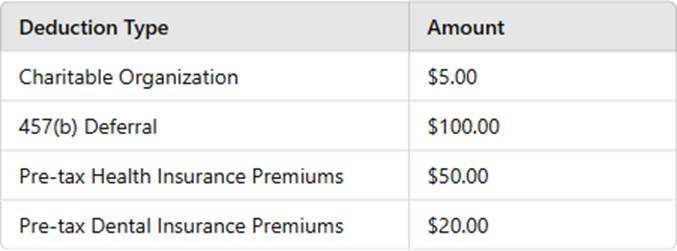
During open enrollment, the employee elects the following deductions.
What is the total of the Section 125 Cafeteria Plan deductions?
- A . $70.00
- B . $75.00
- C . $100.00
- D . $175.00
A
Explanation:
Section 125 Cafeteria Plan deductions include only pre-tax health and dental insurance contributions.
Eligible Pre-Tax Deductions:
Health Insurance Premiums: $50.00
Dental Insurance Premiums: $20.00
Total Section 125 Deductions: $70.00
Non-Eligible Deductions:
Charitable Contributions ($5.00) → Not pre-tax.
457(b) Deferral ($100.00) → Retirement savings, not a Section 125 deduction.
Thus, the correct answer is A. $70.00.
Reference: IRS C Section 125 Cafeteria Plan Guidelines
Payroll.org C Employee Benefit Deduction Compliance
Which test is used to determine if an employer-employee relationship exists?
- A . Time Test
- B . Substantial Presence Test
- C . Permanent Resident Test
- D . Common Law Test
D
Explanation:
The Common Law Test is used by the IRS to determine whether a worker is classified as an employee or an independent contractor. The test evaluates factors related to:
Behavioral control (Does the employer control what and how the worker performs tasks?)
Financial control (Are business expenses reimbursed? Is the worker making an independent profit or loss?)
Type of relationship (Are there benefits like paid time off? Is the relationship expected to be long-term?)
Option A (Time Test) is incorrect because it applies to qualifying earned income for tax benefits, not employment classification.
Option B (Substantial Presence Test) is incorrect because it determines resident alien tax status.
Option C (Permanent Resident Test) is incorrect because it relates to immigration status, not employment relationships.
Reference: IRS Publication 15-A C Employer’s Guide to Worker Classification Payroll.org C Independent Contractor vs. Employee Compliance