
Payroll FPC-REMOTE Practice Exams
Last updated on Oct 21,2026- Exam Code: FPC-REMOTE
- Exam Name: Fundamental Payroll Certification
- Certification Provider: Payroll
- Latest update: Oct 21,2026
An independent contractor status is indicated if the worker:
- A . Receives a Form W-2.
- B . Completes a Form W-4.
- C . Is not required to complete Form I-9.
- D . Is not required to complete Form W-9.
C
Explanation:
Independent contractors DO NOT complete Form I-9, as they are not employees under IRCA (Immigration Reform and Control Act).
Employees receive Form W-2 and complete Form W-4. Independent contractors complete Form W-9 for tax reporting.
Reference: IRS Independent Contractor Guidelines (Publication 1779)
The FINAL phase of the accounting process involves the:
- A . Transactions
- B . Journal entries
- C . General ledger
- D . Financial statements
D
Explanation:
The final phase of the accounting process is generating financial statements (D), which summarize all accounting activities.
Transactions (A), journal entries (B), and general ledger (C) occur earlier in the process.
Reference: Payroll Accounting Standards (Payroll.org)
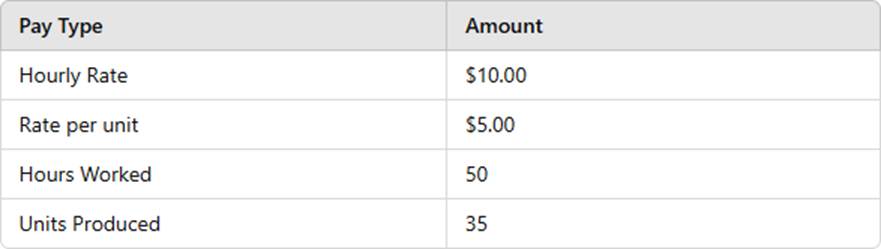
Based on the following information, calculate the employee’s gross wages for the workweek under the FLSA.
- A . $692.50
- B . $742.50
- C . $810.00
- D . $825.00
B
Explanation:
Step 1: Calculate regular wages
40 hours × $10.00 = $400.00
Step 2: Calculate overtime wages
10 hours × ($10.00 × 1.5) = $150.00
Step 3: Calculate piece-rate earnings
35 units × $5.00 = $175.00
Step 4: Total gross pay
$400.00 + $150.00 + $175.00 = $742.50
Reference: FLSA Overtime Calculation Guide (DOL)
All of the following standards demonstrate effective communication techniques EXCEPT:
- A . Empathy.
- B . Listening.
- C . Feedback.
- D . Measurability.
D
Explanation:
Effective communication techniques involve empathy (A), active listening (B), and providing constructive feedback (C).
Measurability (D) is NOT a communication technique; it refers to performance evaluation metrics.
Reference: Payroll Leadership and Communication Guide (Payroll.org)
Which account type is used to classify accrued, but not yet taken, paid leave that is carried over from one year to the next?
- A . Current assets
- B . Deferred assets
- C . Expenses
- D . Long-term liabilities
B
Explanation:
Accrued leave is classified as a deferred asset because it represents an obligation to employees in the future.
Reference: Payroll Accounting Standards (Payroll.org)
All of the following activities are examples of an internal control EXCEPT:
- A . Storing backup files on-site
- B . Segregating job duties
- C . Rotating job duties
- D . Restricting access to the system
A
Explanation:
Internal controls are processes used to ensure accuracy, security, and compliance in payroll operations. Effective internal controls include:
Option B (Segregating job duties) → Prevents fraud by ensuring no one person has full control over payroll.
Option C (Rotating job duties) → Reduces fraud risk and enhances cross-training.
Option D (Restricting system access) → Protects sensitive payroll data.
Option A (Storing backup files on-site) is incorrect because internal control best practices recommend off-site or cloud backups to protect against data loss from disasters.
Reference: Payroll.org C Payroll Internal Control Procedures
IRS C Best Practices for Payroll Security
The due date for filing Form 941 is the:
- A . Last day of the current quarter
- B . 15th of the month following the end of the quarter
- C . Last day of the month following the end of the quarter
- D . First day of the month following the end of the quarter
C
Explanation:
Form 941 is due on the last day of the month following the end of the quarter.
Example:
Q1 (JanCMar) due: April 30
Q2 (AprCJun) due: July 31
Reference: IRS Form 941 Instructions
On June 1st, the Payroll Department received an SUI rate change notice indicating a new rate effective January 1st of the current year. The system was not updated with the new rate until October 1st. SUI contribution recalculation will need to be done for:
- A . 2nd quarter only.
- B . 3rd quarter only.
- C . 2nd and 3rd quarters only.
- D . 1st, 2nd, and 3rd quarters only.
D
Explanation:
SUI (State Unemployment Insurance) rate changes are often retroactive to January 1st.
Since the system was not updated until October, payroll must recalculate all affected quarters (1st, 2nd, and 3rd).
Reference: SUI Tax Compliance Guide (Payroll.org)
IRS Publication 15 (Employer’s Tax Guide)
A mechanism which facilitates local tax withholding for an employee who is working abroad, but remains on the home country’s payroll system and is paid under a tax equalization plan, is called a(n):
- A . Certified Payroll
- B . Shadow Payroll
- C . Off-Cycle Payroll
- D . Supplemental Payroll
B
Explanation:
A shadow payroll is a mechanism used for employees on international assignments who remain on the home country’s payroll but must comply with host country tax withholding.
The home country employer processes payroll normally, while the host country imposes local tax liabilities.
The shadow payroll ensures compliance with both home and host country tax regulations.
Option A (Certified Payroll) applies to government contracts.
Option C (Off-Cycle Payroll) refers to out-of-schedule payments.
Option D (Supplemental Payroll) refers to bonus or commission payrolls.
Reference: IRS C International Payroll and Tax Compliance
Payroll.org C Shadow Payroll and Global Taxation Guidelines
The purpose of the prenotification process for direct deposit is to ensure that the transaction is:
- A . Authorized by the company
- B . Authorized by the employee
- C . Acceptable to the receiving bank
- D . Acceptable to the originating financial institution
C
Explanation:
Prenotification ensures that the receiving bank (C) accepts and properly routes the direct deposit transaction before funds are sent.
Reference: NACHA Direct Deposit Standards