
Payroll FPC-REMOTE Practice Exams
Last updated on Oct 22,2026- Exam Code: FPC-REMOTE
- Exam Name: Fundamental Payroll Certification
- Certification Provider: Payroll
- Latest update: Oct 22,2026
As of December 31, 2024, what is the MAXIMUM amount, if any, a 49-year-old employee can contribute to a 401(k) plan?
- A . $7,500.00
- B . $23,000.00
- C . $30,500.00
- D . No Limit
B
Explanation:
For 2024, the 401(k) contribution limit is:
$23,000.00 for employees under 50 years old.
$30,500.00 for employees 50 and older (includes $7,500 catch-up contribution).
Since the employee is 49 years old, they do not qualify for the catch-up contribution, so the maximum contribution is $23,000.00.
Reference: IRS C 401(k) Contribution Limits for 2024
Payroll.org C Retirement Plan Payroll Compliance
The best practice is to start the annual reconciliation after the:
- A . W-2 audit is complete
- B . End of the first quarter
- C . End of the calendar year
- D . First payroll of the current year
A
Explanation:
Annual payroll reconciliation ensures that payroll records match tax filings. The best practice is to start reconciliation after completing the W-2 audit, as this verifies:
Employee earnings and tax withholdings
Federal and state tax deposits
Year-end adjustments
Option B is incorrect because quarterly reconciliation is separate from annual reconciliation.
Option C is incorrect because reconciliation should start after verifying W-2s, not just at the year-end.
Option D is incorrect because reconciliation should be based on the prior year, not the first payroll of the new year.
Reference: IRS C Year-End Payroll Reporting Guide
Payroll.org C Annual Reconciliation Best Practices
To optimize customer service, policies should include attributes which are:
- A . Reliable
- B . Fluctuating
- C . Interchangeable
- D . Intangible
A
Explanation:
Good payroll customer service policies should be:
Reliable (Option A) C Consistent and dependable for employees.
Accurate C Ensuring payroll is error-free.
Responsive C Quick resolution of inquiries.
Option B (Fluctuating) is incorrect because inconsistent policies confuse employees.
Option C (Interchangeable) is incorrect because policies must be specific to payroll needs.
Option D (Intangible) is incorrect because customer service policies should be well-defined and enforceable.
Reference: Payroll.org C Payroll Customer Service Best Practices
HR Compliance Guide C Employee Service Expectations
Under the FLSA, failure to pay overtime to employees may result in all of the following consequences
EXCEPT:
- A . Back pay
- B . Settlement pay
- C . A USCIS audit
- D . A DOL investigation
C
Explanation:
USCIS audits (C) are related to immigration compliance, not overtime violations.
DOL investigations (D) and back pay requirements (A) are common FLSA enforcement actions.
Settlement pay (B) may be required in legal resolutions of wage disputes.
Reference: FLSA Overtime Enforcement Guidelines (DOL)
Payroll Compliance Guide (Payroll.org)
An employer who takes the tip credit has an employee who worked 25 hours and received $100.00 in tips. Calculate the employee’s gross pay.
- A . $81.25
- B . $153.25
- C . $181.25
- D . $281.25
B
Explanation:
Under the FLSA tip credit rules, the employer may pay a reduced cash wage of $2.13 per hour, as long as tips bring the total wage to at least $7.25 per hour.
Cash Wage Calculation:
$2.13 × 25 hours = $53.25
Tips Received:
$100.00
Total Gross Pay:
$53.25 + $100.00 = $153.25
Thus, the correct answer is
B. $153.25.
Reference: FLSA C Tip Credit Rules and Minimum Wage Compliance
Payroll.org C Employer Guidelines for Tip Reporting
Which of the following circumstances would cause a breach of confidentiality?
- A . Furnishing payment history on a written authorization to a mortgage company
- B . Providing benefit election information to an employee’s spouse
- C . Sharing general ledger costing data with the accounting department
- D . Supplying payroll records to the company’s legal department
B
Explanation:
Payroll confidentiality ensures employee information is only disclosed with proper authorization.
Option A (Payment history with written authorization) is NOT a breach because the employee provided consent.
Option C (General ledger costing shared with accounting) is NOT a breach since accounting requires financial data for compliance.
Option D (Payroll records to legal department) is NOT a breach as legal teams need data for investigations.
Option B (Providing benefit election information to a spouse) is a breach unless the employee has explicitly authorized their spouse to receive this information.
Reference: Payroll.org C Payroll Data Privacy Guidelines
HIPAA & Confidentiality in Payroll Recordkeeping
Based on the following information, using the percentage method, calculate the employee’s net pay:
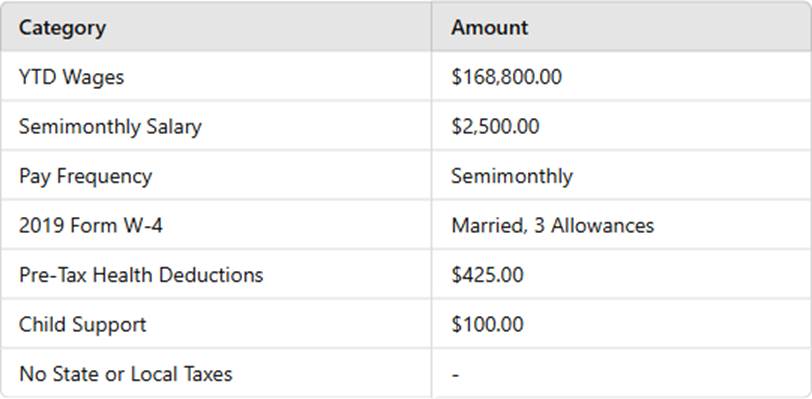
- A . $1,649.01
- B . $1,730.36
- C . $1,804.01
B
Explanation:
Using the IRS Percentage Method for Married Filing Jointly (2019 W-4):
Calculate taxable wages:
Gross pay: $2,500.00
Less pre-tax deductions: -$425.00
Taxable wages: $2,075.00
Federal Income Tax (from IRS tax tables):
Using 2019 IRS Percentage Method for Married, Semimonthly Pay:
First $1,640.00 taxed at 10% = $164.00
Remaining $435.00 taxed at 12% = $52.20
Total FIT = $216.20
Social Security Tax (6.2%):
$2,500.00 × 6.2% = $155.00
Medicare Tax (1.45%):
$2,500.00 × 1.45% = $36.25
Other deductions:
Child Support: $100.00
Total Taxes and Deductions:
Examples of active listening include all of the following actions EXCEPT:
- A . Affirming verbally
- B . Interjecting an opinion
- C . Paraphrasing the discussion
- D . Asking open-ended questions
B
Explanation:
Active listening is an essential payroll communication skill that ensures employees receive accurate information.
Option A (Affirming verbally) → Shows understanding and engagement.
Option C (Paraphrasing the discussion) → Ensures clarity and accuracy.
Option D (Asking open-ended questions) → Encourages better dialogue.
Option B (Interjecting an opinion) is incorrect because it can disrupt communication and cause misunderstandings.
Reference: Payroll.org C Customer Service and Communication Best Practices HR Compliance Training C Effective Workplace Communication
All of the following statements are correct regarding independent contractors EXCEPT that they:
- A . Receive a salary
- B . Risk profit or loss
- C . Can hire assistants
- D . Can end the relationship at any time
A
Explanation:
Independent contractors do NOT receive a salary. They:
Invoice for services rendered rather than receiving fixed wages.
Risk profit or loss (Option B) based on how they manage expenses.
Can hire assistants (Option C) to help complete tasks.
Can end the relationship at any time (Option D) unless bound by a contract.
Option A (Receive a salary) is incorrect because salaries are paid only to employees, not independent contractors.
Reference: IRS C Independent Contractor vs. Employee Classification Payroll.org C Guidelines for Contractor Payments and Taxation
The MAXIMUM amount a 52-year-old employee can contribute to their 401(k) plan is:
- A . $22,500.00
- B . $23,000.00
- C . $30,000.00
- D . $30,500.00
C
Explanation:
In 2024, the 401(k) contribution limit for employees under 50 is $22,500.
For employees age 50 or older, an additional "catch-up" contribution of $7,500 is allowed.
Total maximum contribution = $22,500 + $7,500 = $30,000.
Reference: IRS 401(k) Contribution Limits for 2024