
Payroll FPC-REMOTE Practice Exams
Last updated on Oct 22,2026- Exam Code: FPC-REMOTE
- Exam Name: Fundamental Payroll Certification
- Certification Provider: Payroll
- Latest update: Oct 22,2026
Which of the following amounts is subject to federal income tax withholding?
- A . 401(k) Deferral
- B . Salary Advance
- C . Military-Related Moving Expenses
- D . Health Savings Account (HSA) Contribution
B
Explanation:
Federal income tax withholding applies to most forms of employee compensation, but some benefits are tax-exempt.
Option A (401(k) Deferral) is incorrect because pre-tax contributions to a traditional 401(k) are not subject to federal income tax (but are subject to FICA).
Option C (Military Moving Expenses) is incorrect because qualified military moving expenses are excluded from taxable income under the Tax Cuts and Jobs Act (TCJA).
Option D (HSA Contribution) is incorrect because pre-tax HSA contributions made through payroll deduction are tax-exempt.
Option B (Salary Advance) is correct because any advance on future wages is treated as taxable compensation when paid, and income tax must be withheld.
Reference: IRS Publication 15 C Taxable and Non-Taxable Compensation Payroll.org C Payroll Taxable Income Guidelines
A payroll employee has just entered a group of timecards for one of their 25 retail stores.
What is the BEST way to verify that the data was entered accurately?
- A . Review a few employees from the batch
- B . Check totals on the check register
- C . Review earnings report after payroll is processed
- D . Run a batch total report
D
Explanation:
The best way to verify payroll accuracy is to run a batch total report (Option D) because it:
Compares actual payroll totals to expected amounts
Identifies discrepancies before payroll processing
Option A (Review a few employees) is insufficient because errors in other records might be missed.
Option B (Check Register) occurs after payroll is processed.
Option C (Earnings Report) is useful but is generated after payroll is processed, making corrections harder.
Reference: Payroll.org C Payroll Data Verification Best Practices
IRS C Payroll Accuracy and Compliance Guidelines
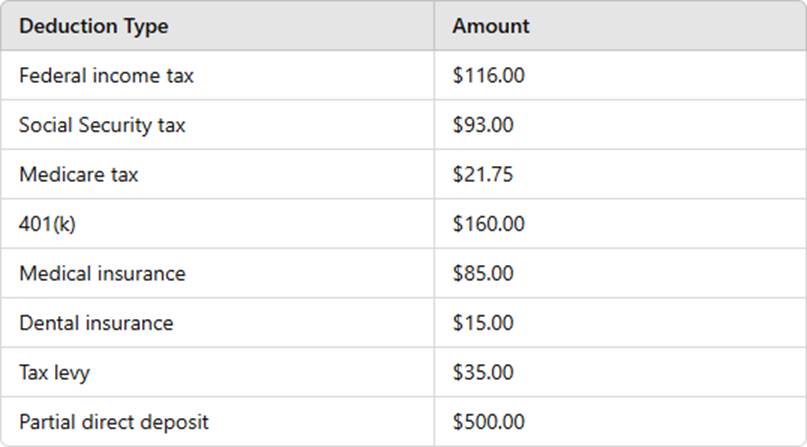
An employee receives $1,600.00 biweekly from their employer. Using the following information, calculate the total amount of voluntary deductions.
- A . $760.00
- B . $660.00
- C . $205.00
- D . $260.00
B
Explanation:
Voluntary deductions include:
401(k): $160.00
Medical insurance: $85.00
Dental insurance: $15.00
Total voluntary deductions:
$160 + $85 + $15 = $260.00
Federal income tax, Social Security, Medicare, and tax levies are mandatory deductions, so they are NOT included in voluntary deductions.
Reference: IRS Publication 15 (Circular E)
Payroll Source®, Payroll.org
Depositors that fail to deposit the entire amount of tax required by the due date, without reasonable cause for the failure, are subject to a failure-to-deposit penalty of 5% of the undeposited amount if it is:
- A . Deposited within 5 days of the due date.
- B . Deposited within 6-15 days of the due date.
- C . Deposited more than 15 days after the due date.
- D . Not paid within 10 days after the employer receives its first IRS delinquency notice.
B
Explanation:
The IRS assesses failure-to-deposit penalties based on the length of the delay:
1-5 days late: 2% penalty
6-15 days late: 5% penalty (Correct Answer)
More than 15 days: 10% penalty
After delinquency notice: 15% penalty
Reference: IRS Deposit Penalty Guidelines (Publication 15)
Which of the following general ledger accounts should normally maintain a credit balance?
- A . Accounts Payable
- B . Cash
- C . Office Equipment
- D . Prepaid Expenses
A
Explanation:
A credit balance means an account normally holds a liability or revenue amount.
Accounts Payable (Option A) represents amounts owed to vendors, which is a liability account and normally has a credit balance.
Option B (Cash) is incorrect because cash is an asset account and typically has a debit balance.
Option C (Office Equipment) is incorrect because it is a fixed asset and also has a debit balance.
Option D (Prepaid Expenses) is incorrect because prepaid expenses are assets that are debited when paid.
Reference: GAAP Accounting Principles C Chart of Accounts
Payroll.org C Payroll Accounting Fundamentals
The purpose of grossing-up an amount to an employee is to:
- A . Calculate and withhold taxes from payment per Form W-4
- B . Treat payment as tax-exempt
- C . Calculate and pay taxes on behalf of the employee
- D . Treat payment as a non-taxable benefit
C
Explanation:
Grossing up means increasing the payment amount so that the employee receives a specific net amount after taxes are withheld. Employers pay the taxes on behalf of the employee in such cases.
This is commonly used for:
Relocation reimbursements
Bonus payments
Tax equalization for expatriates
Option A is incorrect because grossing up is done to cover taxes, not to determine withholdings.
Option B is incorrect because grossed-up amounts are taxable, not tax-exempt.
Option D is incorrect because grossed-up payments are always taxable.
Formula:
Reference: IRS Publication 15 C Employer’s Tax Guide
Payroll.org C Gross-Up Calculation Methods
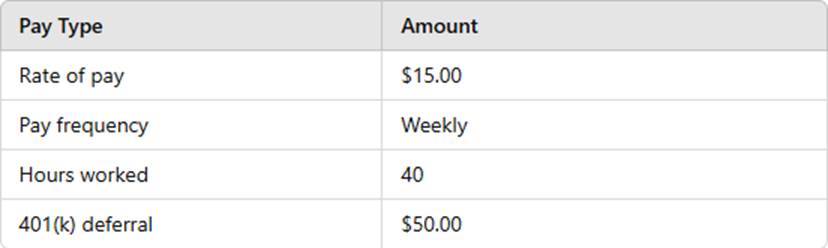
Using the wage bracket method, calculate the employee’s net pay.
The employee’s W-4 was completed in 2019 or earlier.
- A . $589.70
- B . $651.45
- C . $685.45
- D . $686.45
B
Explanation:
Step 1: Calculate gross pay
$15 × 40 hours = $600.00
Step 2: Deduct 401(k) deferral
$600 – $50 = $550.00 taxable income
Step 3: Apply IRS wage bracket tax method (for a single employee, 2019 W-4)
FIT withholding: $35.00 (estimated from IRS tax tables)
Social Security: $600 × 6.2% = $37.20
Medicare: $600 × 1.45% = $8.70
Step 4: Net Pay Calculation
$550 – ($35 + $37.20 + $8.70) = $651.45
Reference: IRS Publication 15-T (Federal Income Tax Withholding Tables)
Exempt employee master file data should include all of the following elements EXCEPT:
- A . Minimum Wage
- B . Payment Dates
- C . Work Location
- D . Rate of Pay
A
Explanation:
The employee master file for an exempt employee should include:
Payment Dates (B) C To ensure timely payroll processing.
Work Location (C) C For tax and compliance purposes.
Rate of Pay (D) C Required for salary calculations.
Option A (Minimum Wage) is incorrect because exempt employees are not subject to minimum wage laws under FLSA.
Reference: Fair Labor Standards Act (FLSA) C Exempt Employee Requirements Payroll.org C Employee Master File Best Practices
All of the following workflow mapping descriptions are correct EXCEPT:
- A . Logical thought processes must include every step with nothing assumed
- B . Depictions and descriptions of sequences of operations of connected steps
- C . Where each step follows the last without delay or gap and ends just prior to the next
- D . When specifications detail the quality and level to be performed by one group for another
D
Explanation:
Workflow mapping is a visual representation of payroll processes to ensure efficiency and accuracy.
Option A (Logical thought processes) ensures clarity and eliminates assumptions.
Option B (Depictions of sequences) accurately describes workflow design.
Option C (Steps follow without delay) ensures process efficiency.
Option D is incorrect because it describes Service Level Agreements (SLA), not workflow mapping.
Reference: Payroll.org C Payroll Workflow Mapping Guide
Process Improvement Standards C Payroll System Optimization