
Payroll FPC-REMOTE Practice Exams
Last updated on Oct 22,2026- Exam Code: FPC-REMOTE
- Exam Name: Fundamental Payroll Certification
- Certification Provider: Payroll
- Latest update: Oct 22,2026
An order for unpaid federal taxes is an example of a:
- A . Bankruptcy Order
- B . Creditor Garnishment
- C . Voluntary Deduction
- D . Wage Attachment
D
Explanation:
A wage attachment (also called a wage levy) is a legal withholding from an employee’s paycheck to satisfy an outstanding debt.
IRS tax levies are a type of wage attachment used to collect unpaid federal taxes directly from an employee’s wages.
Employers must comply immediately when notified by the IRS.
Option A (Bankruptcy Order) is incorrect because bankruptcy payments are handled by court-appointed trustees, not wage levies.
Option B (Creditor Garnishment) is incorrect because IRS tax levies do not require a court order like private creditor garnishments.
Option C (Voluntary Deduction) is incorrect because IRS wage levies are mandatory, not voluntary.
Reference: IRS Publication 1494 C Wage Levy Exemptions and Employer Responsibilities Payroll.org C Wage Attachments and Tax Levies
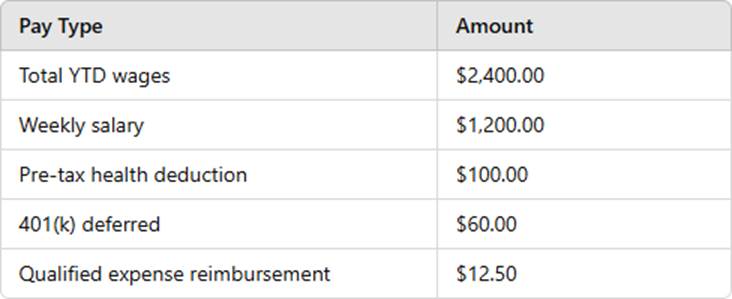
Using the following information, calculate the FUTA tax liability:
- A . $6.24
- B . $6.60
- C . $6.68
- D . $6.77
B
Explanation:
Step 1: Determine taxable wages
FUTA tax applies to the first $7,000 of an employee’s wages annually.
Step 2: Calculate FUTA tax
FUTA rate: 0.6% (after state credit)
FUTA-taxable wages: $1,200.00
FUTA tax: $1,200 × 0.006 = $6.60
Reference: IRS Publication 15 (Employer’s Tax Guide)
FUTA Tax Calculation Guide (Payroll.org)
When an employee does not answer an unclaimed wage inquiry, the employer should:
- A . Refer to state laws for final resolution of the wages
- B . Maintain listings of the unclaimed wages indefinitely
- C . Reissue the payment and mail it to the last known address
- D . Convert the wages to reportable income and remove the liability balance
A
Explanation:
Unclaimed wages must be handled according to state escheatment laws (A), which determine how long wages must be held before being turned over to the state.
Reference: State Unclaimed Property Laws
Payroll staff should be aware of all of the following potential warning signs of a data breach EXCEPT:
- A . Excessive system security reset requests
- B . Requests for large amounts of payroll data
- C . An employee email request for a reprinted W-2 form
- D . Payroll system activity occurring outside normal work hours
C
Explanation:
Payroll security professionals must monitor for potential payroll fraud or data breaches.
A (Excessive security reset requests) → Could indicate a hacker attempting unauthorized access.
B (Large payroll data requests) → Could signal attempted data theft.
D (Activity outside normal hours) → Could be an external breach or insider threat.
Option C (Reprinting a W-2) is NOT necessarily suspicious, as employees frequently request reprints during tax season.
Reference: Payroll.org C Payroll Data Security Best Practices
IRS C Data Breach Prevention in Payroll
Which organization should be contacted when placing a stop payment on a check?
- A . FDIC
- B . NACHA
- C . ODFI
- D . RDFI
C
Explanation:
ODFI (Originating Depository Financial Institution) is responsible for initiating payroll transactions, including stop payments.
RDFI (Receiving Depository Financial Institution) receives funds but does not control stop payments.
NACHA (National Automated Clearing House Association) sets ACH rules but does not process transactions.
FDIC (Federal Deposit Insurance Corporation) insures bank deposits but does not handle payment stops.
Reference: NACHA Operating Rules & Guidelines
Payroll Banking & ACH Processing Guide (Payroll.org)
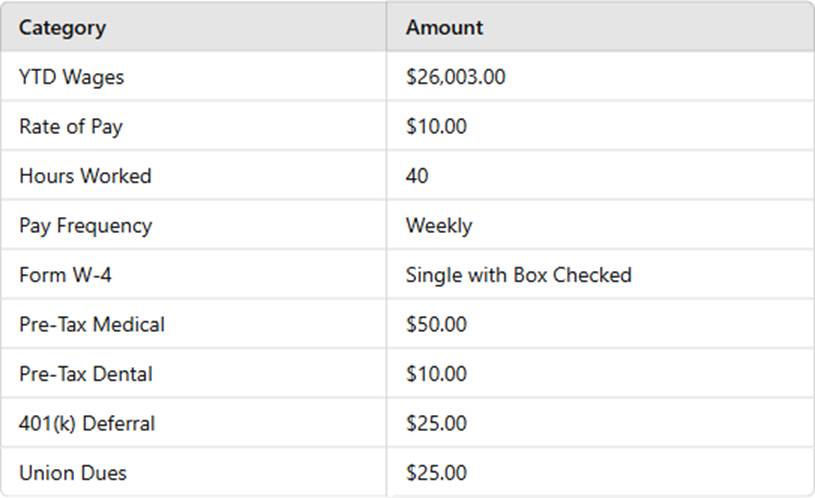
Using the wage bracket method and the information below, calculate the employee’s weekly net pay.
- A . $230.40
- B . $244.99
- C . $246.90
- D . $259.99
D
Explanation:
Gross Pay Calculation:
Hourly Rate × Hours Worked = $10.00 × 40 = $400.00
Taxable Wages:
Gross Pay: $400.00
Pre-Tax Deductions: $50 (Medical) + $10 (Dental) + $25 (401k) = $85.00
Taxable Wages = $400 – $85 = $315.00
Federal Income Tax Withholding (Wage Bracket Method):
Based on IRS tables for single filers, FIT = approx. $20.00
Social Security & Medicare Taxes:
Social Security (6.2%) = $400 × 6.2% = $24.80
Medicare (1.45%) = $400 × 1.45% = $5.80
Total Deductions:
$20.00 (FIT) + $24.80 (SS) + $5.80 (Medicare) + $25.00 (Union Dues) = $75.60
Net Pay:
$400 – $75.60 = $259.99
Thus, the correct answer is
D. $259.99.
Reference: IRS Publication 15-T C Wage Bracket Withholding Method Payroll.org C Payroll Tax Calculation Guidelines
The FLSA is enforced by which of the following entities?
- A . DOL
- B . ICE
- C . IRS
- D . SSA
A
Explanation:
The Fair Labor Standards Act (FLSA) is enforced by the Department of Labor (DOL) through its Wage and Hour Division (WHD).
ICE (Immigration and Customs Enforcement) handles immigration-related work issues, not wage enforcement.
IRS (Internal Revenue Service) enforces tax laws, not labor standards.
SSA (Social Security Administration) manages Social Security benefits, not wage laws.
Reference: FLSA Compliance and Enforcement (DOL)
Payroll Compliance Guidelines (Payroll.org)
Specifying a defined response time for an employee’s payroll-related question is a component of a
Payroll Department’s:
- A . General Service Contract
- B . Service Level Agreement
- C . Standards of Excellence
- D . Time Management
B
Explanation:
A Service Level Agreement (SLA) (Option B) outlines the expected response times and resolution times for payroll inquiries. This ensures that payroll staff provide timely assistance to employees.
Option A (General Service Contract) applies to external service providers, not internal payroll departments.
Option C (Standards of Excellence) refers to broad performance benchmarks, but it does not include specific response times.
Option D (Time Management) relates to personal efficiency, not defined service expectations.
Reference: Payroll.org C Payroll Service Level Agreements Best Practices HR Compliance Guide C Payroll Inquiry Handling
Documentation on legislative changes to Forms W-2 and W-3 is initiated by which of the following organizations?
- A . IRS
- B . OCSS
- C . SSA
- D . USCIS
A
Explanation:
The Internal Revenue Service (IRS) is responsible for issuing updates related to Forms W-2 and W-3 under federal tax laws.
SSA (Social Security Administration) processes W-2s but does not initiate changes.
OCSS (Office of Child Support Services) and USCIS (U.S. Citizenship and Immigration Services) are not involved in payroll tax forms.
Reference: IRS Publication 15 (Employer’s Tax Guide)
IRS Form W-2 & W-3 Guidelines
An example of an interface into a payroll system is a(n):
- A . Check print file.
- B . ACH payment file.
- C . Time and attendance system file.
- D . Transmission of general ledger transactions.
C
Explanation:
A time and attendance system file is an example of an interface into a payroll system because:
It captures employee work hours and sends data to payroll for accurate calculations.
Payroll interfaces ensure automated and accurate payment processing.
Other options explained:
Check print file (A) is an output, not an interface.
ACH payment file (B) is used to process payments, not interface data.
General ledger transactions (D) are accounting-related, not payroll input.
Reference: Payroll System Integration Guide (Payroll.org)