
Payroll FPC-REMOTE Practice Exams
Last updated on Oct 22,2026- Exam Code: FPC-REMOTE
- Exam Name: Fundamental Payroll Certification
- Certification Provider: Payroll
- Latest update: Oct 22,2026
Which of the following wage attachments has the highest priority for withholding?
- A . Bankruptcy
- B . Child Support
- C . State Tax Levy
- D . Wage Assignment
A
Explanation:
The priority order for wage attachments is as follows:
Bankruptcy orders (Option A) C Court-ordered payments under the U.S. Bankruptcy Code take top priority over all other wage deductions.
Child support (Option B) C The second-highest priority under federal law, governed by the Consumer Credit Protection Act (CCPA).
State tax levies (Option C) C Third in priority, varies by state.
Wage assignments (Option D) C Lowest priority, usually voluntary agreements by employees.
Reference: Consumer Credit Protection Act (CCPA) C Wage Garnishment Priorities Payroll.org C Wage Garnishment Guidelines
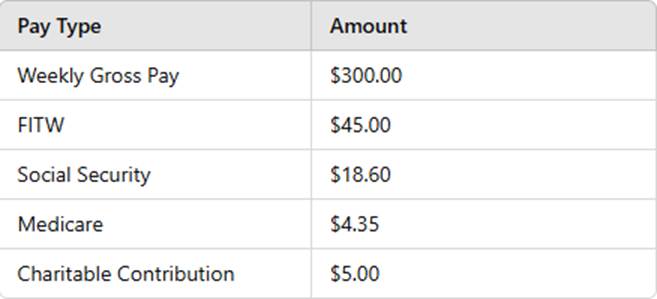
Under the CCPA, use the following information to calculate the MAXIMUM deduction for the child support order for an employee who is not supporting another family and not in arrears.
- A . $113.53
- B . $116.03
- C . $136.23
- D . $139.23
D
Explanation:
Step 1: Calculate disposable earnings
$300.00 – ($45.00 + $18.60 + $4.35) = $232.05
Step 2: Apply CCPA withholding limit
60% of $232.05 = $139.23
Reference: Consumer Credit Protection Act (CCPA) – Federal Child Support Withholding Limits Payroll Withholding Compliance Guide (Payroll.org)
An employee receives a total of $200.10 in cash tips in July. Determine the latest date the employee MUST report tip income to the employer.
- A . August 10
- B . September 10
- C . September 30
- D . December 31
A
Explanation:
Under IRS regulations, employees must report tips totaling $20 or more per month to their employer by the 10th day of the following month.
Employee received $200.10 in tips in July.
Tip income must be reported by August 10.
Option B (September 10), Option C (September 30), and Option D (December 31) are incorrect because the IRS mandates monthly reporting.
Reference: IRS Publication 531 C Reporting Tip Income
Payroll.org C Employer Tip Withholding Responsibilities
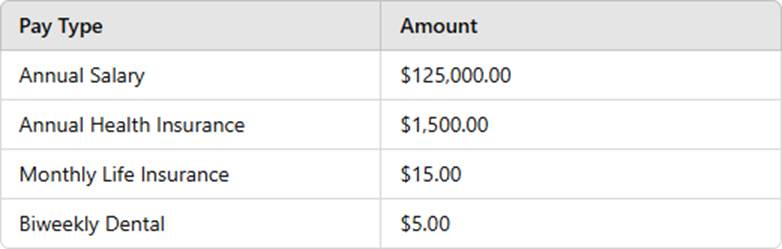
Based on the following Section 125 Cafeteria Plan contributions, calculate the employee’s biweekly deductions.
- A . $69.61
- B . $75.42
- C . $77.69
- D . $82.92
A
Explanation:
Health Insurance (Biweekly) = ($1,500 ÷ 26) = $57.69
Life Insurance (Biweekly) = ($15 × 12 ÷ 26) = $6.92
Dental Insurance = $5.00
Total Biweekly Deduction = $57.69 + $6.92 + $5.00 = $69.61
Reference: IRS Section 125 Cafeteria Plan Rules
Report backup withholding to the IRS using:
- A . Form W-9
- B . Form W-2
- C . Form 945
- D . Form 941
C
Explanation:
Form 945 is used by employers to report federal income tax withheld from non-payroll payments, including backup withholding on:
Payments to independent contractors (when no valid W-9 is provided)
Certain gambling winnings
Dividend and interest payments subject to IRS backup withholding rules
Option A (Form W-9) is incorrect because Form W-9 is used by payees to provide taxpayer identification numbers (TINs), not for reporting withholding.
Option B (Form W-2) is incorrect because Form W-2 is used for employee wages and withholding, not backup withholding.
Option D (Form 941) is incorrect because Form 941 reports payroll tax withholdings, not backup withholding.
Reference: IRS Form 945 Instructions C Annual Return of Withheld Federal Income Tax Payroll.org C Reporting Backup Withholding
When an information return is filed after August 1st of the same year, the penalty amount per form is:
- A . $60.00
- B . $120.00
- C . $310.00
- D . $630.00
C
Explanation:
According to the IRS penalty schedule for late-filed information returns, the penalty per form depends on how late it is filed:
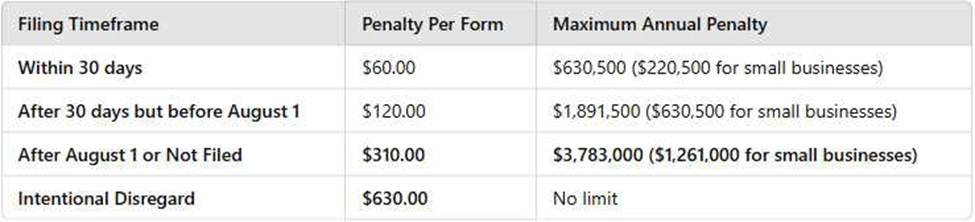
Option A ($60.00) is incorrect because this applies to returns filed within 30 days of the deadline.
Option B ($120.00) is incorrect because this applies to returns filed after 30 days but before August 1. Option D ($630.00) is incorrect because this applies to cases of intentional non-compliance.
Reference: IRS Instructions for Forms W-2 & 1099 C Late Filing Penalties Payroll.org C Compliance with Information Return Filing Deadlines
An employee has YTD wages in the amount of $250,000.00 and receives a $1,753.00 bonus payment. Using the optional flat rate method, calculate the federal income tax withholding from the bonus payment.
- A . $385.00
- B . $420.13
- C . $534.63
- D . $647.50
A
Explanation:
Under IRS guidelines, supplemental wages such as bonuses are subject to a flat federal tax rate of 22% if paid separately.
Federal Tax Calculation:
$1,753.00 × 22% = $385.66
Rounded to the nearest cent, the closest answer is $385.00.
Thus, the correct answer is A. $385.00.
Reference: IRS Publication 15-T C Federal Income Tax Withholding Methods Payroll.org C Supplemental Wage Withholding Rules
Under the FMLA, employers MUST maintain related leave records for how many years?
- A . 1
- B . 3
- C . 4
- D . 5
B
Explanation:
The Family and Medical Leave Act (FMLA) requires employers to keep FMLA-related records for at least 3 years.
These records include:
Employee leave requests
Employer responses
Payroll and benefits records
Medical certifications
The DOL may audit these records to ensure FMLA compliance.
Reference: FMLA Recordkeeping Requirements (DOL)
Payroll Record Retention Guidelines (Payroll.org)
Which form is used by third-party administrators to report sick pay paid on behalf of an employer?
- A . Form 941
- B . Form 1099
- C . Form 8922
- D . Form 1095-B
C
Explanation:
Form 8922, Third-Party Sick Pay Recap, is used when a third-party administrator (TPA) pays sick pay on behalf of an employer and needs to report taxable wages properly.
This ensures that Social Security, Medicare, and FUTA taxes are correctly allocated between the employer and third party.
Sick pay is subject to FICA taxes, but not always subject to FUTA if paid directly by an insurer.
Option A (Form 941) is incorrect because it is used for quarterly payroll tax filings. Option B (Form 1099) is incorrect because sick pay is reported on W-2, not 1099. Option D (Form 1095-B) is incorrect because it relates to health coverage reporting.
Reference: IRS Form 8922 Instructions C Third-Party Sick Pay Recap
Payroll.org C Sick Pay Taxation Guidelines
Workers’ compensation payments are excluded from gross income and employment taxes EXCEPT when the amounts received:
- A . Are related to injuries suffered on the job.
- B . Are not related to illnesses suffered on the job.
- C . Do not exceed the benefits provided under the state workers’ compensation law.
- D . Do not exceed the benefits provided under the federal workers’ compensation law.
B
Explanation:
Workers’ compensation benefits are tax-exempt if they are paid for work-related injuries or illnesses. If payments are received for non-work-related illnesses (B), they become taxable. Amounts that do not exceed federal or state limits (C & D) remain tax-exempt.
Reference: IRS Publication 525 (Taxable and Nontaxable Income)