
Payroll FPC-REMOTE Practice Exams
Last updated on Oct 22,2026- Exam Code: FPC-REMOTE
- Exam Name: Fundamental Payroll Certification
- Certification Provider: Payroll
- Latest update: Oct 22,2026
The DOL can issue fines for all the following violations EXCEPT:
- A . Overtime
- B . Sick Leave
- C . Child Labor
- D . Minimum Wage
B
Explanation:
The Department of Labor (DOL) enforces violations related to:
Overtime (A) C Under the Fair Labor Standards Act (FLSA).
Child Labor (C) C Protecting workers under age 18.
Minimum Wage (D) C Enforcing the federal minimum wage.
Option B (Sick Leave) is incorrect because the DOL does not regulate paid sick leave at the federal level. Sick leave laws vary by state, but there is no federal mandate requiring paid sick leave.
Reference: FLSA C Wage and Hour Division (DOL) Enforcement
Payroll.org C Federal and State Payroll Compliance
All of the following preventative measures would help protect personally identifiable information EXCEPT:
- A . Locking files containing employee information.
- B . Signed confidentiality agreements for staff.
- C . Reviewing system security periodically.
- D . Limiting communications to e-mail.
D
Explanation:
E-mail is NOT a secure method for protecting sensitive payroll and HR data.
Best practices include data encryption, access control, and employee training.
Reference: Data Security Standards (Payroll.org)
IRS Data Protection Guidelines
The FIRST action an employer should take when a natural disaster occurs is:
- A . Access payroll and employee information files
- B . Determine the well-being of employees
- C . Find temporary housing for employees
- D . Secure interim office space
B
Explanation:
When a natural disaster occurs, the first priority of any employer should be to ensure the safety and well-being of employees.
Step 1: Confirm employee safety C Employers should account for all employees and provide immediate assistance if needed.
Step 2: Assess business operations impact C Once employees are safe, the employer can begin securing records and office space.
Option A is incorrect because accessing payroll records is important but secondary to employee safety.
Option C is incorrect because temporary housing is not the employer’s primary responsibility.
Option D is incorrect because securing office space is a later step in disaster recovery.
Reference: FEMA C Emergency Preparedness Guidelines for Businesses Payroll.org C Disaster Recovery for Payroll Operations
All of the following resources are available to help a Payroll Professional stay abreast of regulatory changes EXCEPT the:
- A . PAYO
- B . DOL
- C . FTC
- D . IRS
C
Explanation:
Payroll professionals must stay updated on tax laws, wage regulations, and compliance requirements. Key resources include:
A (PAYO C Payroll.org) → Provides training, updates, and compliance resources.
B (DOL C Department of Labor) → Oversees wage & hour laws (FLSA).
D (IRS C Internal Revenue Service) → Issues payroll tax regulations.
Option C (FTC C Federal Trade Commission) is incorrect because the FTC does not regulate payroll laws. The FTC primarily monitors consumer protection laws.
Reference: Payroll.org C Payroll Compliance Updates
IRS & DOL C Payroll Tax and Wage Regulations
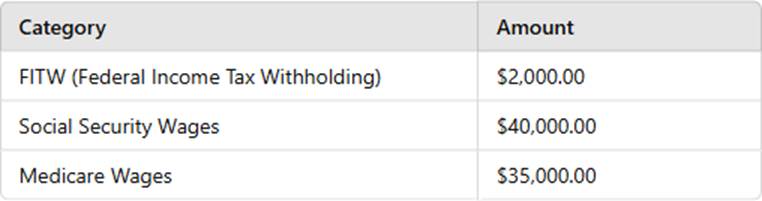
Using the following information from a payroll register, calculate the tax deposit liability for the
payroll.
- A . $7,975.00
- B . $4,987.50
- C . $4,480.00
- D . $2,507.50
A
Explanation:
The tax deposit liability includes federal income tax withholding (FITW), Social Security tax, and Medicare tax.
Social Security Tax:
Employer & Employee each pay 6.2% on $40,000
$40,000 × 6.2% × 2 = $4,960.00
Medicare Tax:
Employer & Employee each pay 1.45% on $35,000
$35,000 × 1.45% × 2 = $1,015.00
Total Tax Deposit Liability:
$2,000 (FITW) + $4,960 (Social Security) + $1,015 (Medicare) = $7,975.00 Thus, the correct answer is
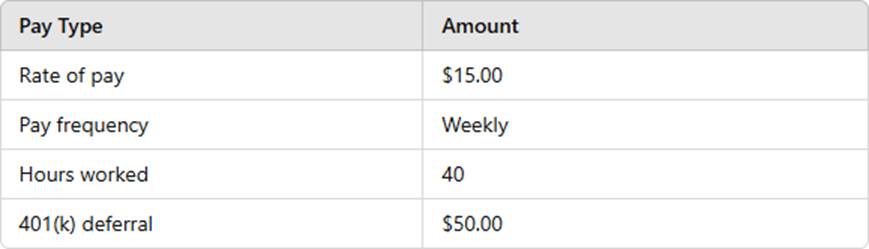
Using the wage bracket method, calculate the employee’s net pay. The employee’s W-4 was completed in 2019 or earlier.
- A . $589.70
- B . $651.45
- C . $685.45
- D . $686.45
B
Explanation:
Gross pay: $15 × 40 = $600.00
401(k) deduction: $50.00 (Pre-tax)
FITW, Social Security (6.2%), Medicare (1.45%) applied
Using the IRS Wage Bracket Method, net pay is $651.45
Reference: IRS Publication 15-T (Federal Income Tax Withholding Tables)
Which of the following simulations would NOT be performed when testing a disaster recovery plan?
- A . Validating the ability to create direct deposit and check print files
- B . Validating the record count on a daily new hire file
- C . Verifying access to online payroll processing documentation
- D . Verifying network connectivity from a remote location
B
Explanation:
A disaster recovery plan (DRP) ensures payroll continuity during emergencies. Key tests include:
Option A (Direct deposit & check printing) is correct because payroll must still be processed during a disaster.
Option C (Access to online payroll data) is necessary to ensure payroll can be processed remotely.
Option D (Network connectivity verification) is vital to confirm off-site payroll access.
Option B (Validating new hire record counts) is incorrect because it is a routine HR function, not part of disaster recovery. DRPs focus on ensuring payroll continues for existing employees rather than hiring functions.
Reference: Payroll.org C Payroll Disaster Recovery Planning
IRS C Business Continuity Guidelines for Payroll Processing
Which of the following forms of identification CANNOT be used in Section 2 of Form I-9?
- A . Driver’s license
- B . Employee badge
- C . School ID card with photo
- D . Voter’s registration card
B
Explanation:
Employee badges (B) are NOT acceptable as proof of identity for Form I-9.
Acceptable IDs include passports, driver’s licenses, and other government-issued documents.
Reference: USCIS Form I-9 Acceptable Documents List
When an employee does not answer an unclaimed wage inquiry, the employer should:
- A . Refer to state laws for final resolution of the wages
- B . Maintain listings of the unclaimed wages indefinitely
- C . Reissue the payment and mail it to the last known address
- D . Convert the wages to reportable income and remove the liability balance
A
Explanation:
State unclaimed property (escheat) laws govern how unclaimed wages must be handled.
Employers must report and transfer unclaimed wages to the state treasury after a specified period.
Maintaining wages indefinitely (B) is not compliant, and reissuing payments (C) without confirmation could lead to payroll errors.
Reference: State Escheatment Laws (National Association of Unclaimed Property Administrators – NAUPA) IRS Payroll Compliance Guidelines
Which of the following data elements is needed to calculate an employee’s net pay from gross pay?
- A . Rate of pay
- B . Hours worked
- C . Shift differential
- D . Withholding status
D
Explanation:
Withholding status (D) affects federal income tax deductions and is essential for calculating net pay.
Rate of pay (A), hours worked (B), and shift differentials (C) impact gross pay but NOT net pay calculation.
Reference: IRS Form W-4 Withholding Guidelines
Payroll Calculation Standards (Payroll.org)