
Netskope NSK300 Practice Exams
Last updated on Oct 22,2026- Exam Code: NSK300
- Exam Name: Netskope Certified Cloud Security Architect Exam
- Certification Provider: Netskope
- Latest update: Oct 22,2026
You have enabled CASB traffic steering using the Netskope Client, but have not yet enabled a Real-time Protection policy.
What is the default behavior of the traffic in this scenario?
- A . Traffic will be blocked and logged.
- B . Traffic will be allowed and logged.
- C . Traffic will be blocked, but not logged.
- D . Traffic will be allowed, but not logged.
B
Explanation:
In the scenario where CASB traffic steering is enabled using the Netskope Client without a Real-time Protection policy being activated, the default behavior of the traffic is to allow and log it (B). This means that the traffic will not be blocked; instead, it will be permitted to pass through and will be recorded for monitoring and analysis purposes. This default setting ensures visibility into the traffic and user activities without immediately enforcing a block, allowing for a period of observation and policy tuning before potentially more restrictive actions are taken1.
Reference: The default behavior of traffic steering in Netskope, including the logging of allowed traffic, is detailed in Netskope’s best practices and community discussions on Real-time Protection policies1.
You are the network architect for a company using Netskope Private Access. Multiple users are reporting that they are unable to access an application using Netskope Private Access that was working previously. You have verified that the Real-time Protection policy allows access to the application, private applications are steered for the users, and the application is reachable from internal machines.
You must verify that the application is reachable through Netskope Publisher In this scenario, which two tools in the Netskope Ul would you use to accomplish this task? (Choose two.)
- A . Reachability Via Publisher in the App Definitions page
- B . Troubleshooter tool in the App Definitions page
- C . Applications in Skope IT
- D . Clear Private App Auth under Users in Skope IT
AB
Explanation:
In the scenario where users are unable to access an application through Netskope Private Access, and after verifying that the Real-time Protection policy allows access, the application is steered for the users, and it is reachable from internal machines, the next step is to verify the application’s reachability through the Netskope Publisher.
The two tools in the Netskope UI that would be used to accomplish this task are:
Review the exhibit.
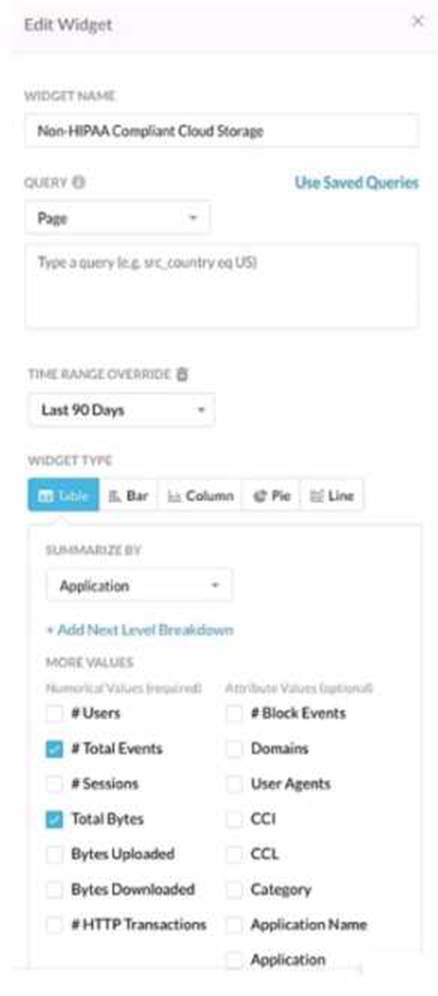
You work for a medical insurance provider. You have Netskope Next Gen Secure Web Gateway deployed to all managed user devices with limited block policies. Your manager asks that you begin blocking Cloud Storage applications that are not HIPAA compliant Prior to implementing this policy, you want to verity that no business or departmental applications would be blocked by this policy.
Referring to the exhibit, which query would you use in the Edit Widget window to narrow down the results?
- A . app-ccl-compliance-cert neq ‘HIPAA’ and category eq ‘Cloud Storage’
- B . Cloud Confidence Compliance neq HIPAA and Cloud Confidence Category is Cloud Storage
- C . SELECT application WHERE ‘HIPAA’ NOT IN app-cci-compliance AND WHERE ‘Cloud Storage’ IN category
- D . app-compliance does not contain HIPAA and category must equal Cloud Storage
A
Explanation:
The correct query to use in the Edit Widget window to narrow down the results is option A: “app-ccl-compliance-cert neq ‘HIPAA’ and category eq ‘Cloud Storage’”. This query filters out applications that are not HIPAA compliant and belong to the Cloud Storage category, ensuring that only non-HIPAA compliant cloud storage applications are displayed in the results. This helps in identifying and blocking such applications as per the manager’s request without affecting business or departmental applications. It aligns with Netskope’s capabilities to enforce controls and restrictions on high-risk cloud services to help address HIPAA and HITECH compliance, as well as to audit suspected violations with a full cloud and web activity trail1.
Reference: The reference for constructing such queries can be found in Netskope’s official documentation, which provides detailed information on filtering application data to manage compliance findings and view security posture compliance2. Additionally, Netskope’s resources on HIPAA Cloud Compliance and Risk Insights can be used to understand the compliance and data center certifications related to HIPAA
You want customers to configure Real-time Protection policies.
In which order should the policies be placed in this scenario?
- A . Threat, CASB, RBI, Web
- B . RBI, CASB, Web, Threat
- C . Threat, RBI, CASB, Web
- D . CASB, RBI, Threat, Web
B
Explanation:
When configuring Real-time Protection policies in Netskope, the recommended order is as follows: RBI (Risk-Based Index) Policies: These policies focus on risk assessment and prioritize actions based on risk scores. They help identify high-risk activities and users.
CASB (Cloud Access Security Broker) Policies: These policies address cloud-specific security requirements, such as controlling access to cloud applications, enforcing data loss prevention (DLP) rules, and managing shadow IT.
Web Policies: These policies deal with web traffic, including URL filtering, web categories, and threat prevention.
Threat Policies: These policies focus on detecting and preventing threats, such as malware, phishing, and malicious URLs.
Placing the policies in this order ensures that risk assessment and cloud-specific controls are applied before addressing web and threat-related issues.
Reference: Netskope Security Cloud Introductory Online Technical Training
Netskope Security Cloud Operation & Administration (NSCO&A) – Classroom Training
Netskope Certification Description
Netskope Architectural Advantage Features
A company wants to capture and maintain sensitive Pll data in a relational database to help their customers. There are many employees and contractors that need access to sensitive customer data to perform their duties The company wants to prevent the exfiltration of sensitive customer data by their employees and contractors.
In this scenario. what would satisfy this requirement?
- A . fingerprinting
- B . exact data match
- C . regular expression
- D . machine learning
A
Explanation:
Fingerprinting would satisfy the requirement to prevent the exfiltration of sensitive Personally Identifiable Information (PII) data by employees and contractors. Fingerprinting is a data protection technique that involves creating a unique digital representation of sensitive data. This allows for the detection of any exact or partial matches of the fingerprinted data leaving the company’s environment, thereby preventing unauthorized data exfiltration. It is particularly effective in scenarios where multiple individuals require access to sensitive data, as it can protect against both inadvertent and malicious attempts to move data outside of authorized channels1.
Reference: Netskope’s Data Loss Prevention (DLP) capabilities include fingerprinting as a method to secure sensitive data consistently across the enterprise1. The Netskope Knowledge Portal provides further information on how to enable and configure fingerprinting and other DLP settings to protect sensitive PII data2.
Review the exhibit.
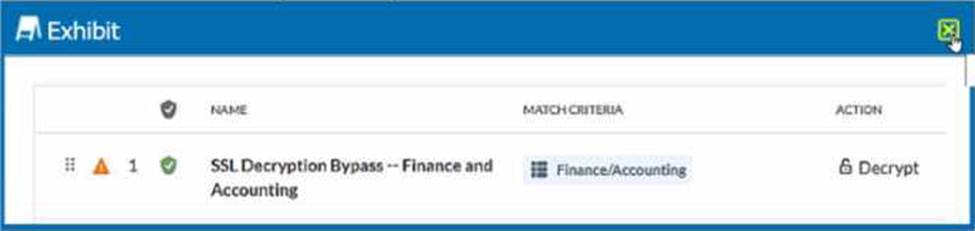
You created an SSL decryption policy to bypass the inspection of financial and accounting Web categories. However, you still see banking websites being inspected.
What are two possible causes of this behavior? (Choose two.)
- A . The policy is in a "disabled" state.
- B . An incorrect category has been selected
- C . The policy is in a "pending changes" state.
- D . An incorrect action has been specified.
B, D
Explanation:
The issue described in the exhibit is that banking websites are still being inspected despite creating an SSL decryption policy to bypass the inspection of financial and accounting web categories. Possible Causes:
An incorrect category has been selected (Option B):
If the SSL decryption policy is configured to bypass the wrong category (e.g., not the actual financial and accounting category), it won’t effectively exclude banking websites from inspection. An incorrect action has been specified (Option D):
If the action specified in the policy is not set to “Bypass,” it won’t achieve the desired behavior. The policy should explicitly bypass SSL inspection for the selected category.
Solution: Verify that the correct category (financial and accounting) is selected in the policy, and ensure that the action is set to “Bypass.”
Your customer is currently using Directory Importer with Active Directory (AD) to provision users to Nelskope. They have recently acquired three new companies (A. B. and C) and want to onboard users from the companies onto the NetsKope platform.
Information about the companies is shown below.
– Company A uses Active Directory.
— Company B uses Azure AD.
— Company C uses Okta Universal Directory.
Which statement is correct in this scenario?
- A . Users from Company B and Company C cannot be provisioned because the customer is already using AD Importer.
- B . Either Company B or Company C users cannot be provisioned because integration with only one SCIM solution is allowed.
- C . Users from Companies A. B, and C can be provisioned to Netskope by deploying additional AD Importers and integrating more than one SCIM solution.
- D . Company A users cannot be provisioned to Netskope because the customer is already using AD Importer to import users from another Active Directory environment.
C
Explanation:
Users from Companies A, B, and C can indeed be provisioned to Netskope. Company A, which uses Active Directory, can continue to use the existing AD Importer. For Company B that uses Azure AD and Company C that uses Okta Universal Directory, integration with SCIM (System for Cross-domain Identity Management) solutions is possible. Netskope supports provisioning users from multiple directories, including Active Directory and cloud-based identity providers like Azure AD and Okta, by using additional AD Importers and integrating more than one SCIM solution12.
Reference: The correct approach for provisioning users from different companies that use various directory services is supported by Netskope’s capabilities to integrate with multiple identity providers and directory services, as outlined in their documentation and community resources12.
What is the primary purpose of Netskope Threat Protection when deployed within an enterprise’s cloud environment?
- A . To monitor and optimize cloud storage
- B . To provide analytics on cloud usage
- C . To detect and respond to security threats
- D . To enhance cloud data migration processes
You are using Netskope CSPM for security and compliance audits across your multi-cloud environments. To decrease the load on the security operations team, you are researching how to auto-re mediate some of the security violations found in low-risk environments.
Which statement is correct in this scenario?
- A . Netskope does not support automatic remediation of security violation results due to the high risk associated with it.
- B . You can use Netskope API-enabled Protection for auto-remediation of security violation results.
- C . You can use Netskope Auto-remediation frameworks from the public Netskope GitHub Open Source repository for auto-re mediation of security violation results.
- D . You can use Netskope Cloud Exchange for auto-remediation of security violation results.
C
Explanation:
Netskope supports automatic remediation of security violations through its Auto-Remediation frameworks, which are available in the public Netskope GitHub Open Source repository. These frameworks allow for the automatic mitigation of risks associated with security misconfigurations in your cloud environment. The Netskope Auto-Remediation framework for AWS, for example, deploys a set of AWS Lambda functions that query the Netskope API at scheduled intervals and automatically mitigates supported violations1. Similarly, there are frameworks for GCP and other cloud environments that follow the same principle2. This capability is particularly useful for low-risk environments where the security operations team’s workload can be reduced by automating the remediation process.
Reference: The answer is based on the information provided by Netskope’s community resources and documentation, which detail the use of their Auto-Remediation frameworks for various cloud platforms