
Microsoft MD-102 Practice Exams
Last updated on Nov 16,2026- Exam Code: MD-102
- Exam Name: Endpoint Administrator
- Certification Provider: Microsoft
- Latest update: Nov 16,2026
Device1, Device2, and Device3
You have a Microsoft 365 subscription that includes Microsoft Intune.
You plan to use Windows Autopilot to deploy Windows 11 devices.
You need to meet the following requirements during Autopilot provisioning:
Display the app and profile configuration progress.

Block users from using the devices until all apps and profiles are installed
What should you configure?
– an app configuration policy
– an app protection policy
– an enrollment device platform restriction
– an enrollment status page
You have a Microsoft 365 subscription that includes Microsoft Intune.
You plan to use Windows Autopilot to deploy Windows 11 devices.
You need to meet the following requirements during Autopilot provisioning:
Display the app and profile configuration progress.
Block users from using the devices until all apps and profiles are installed
What should you configure?
– an app configuration policy
– an app protection policy
– an enrollment device platform restriction
– an enrollment status page
You have a Microsoft 365 subscription that includes Microsoft Intune.
You plan to use Windows Autopilot to deploy Windows 11 devices.
You need to meet the following requirements during Autopilot provisioning:
Display the app and profile configuration progress.
Block users from using the devices until all apps and profiles are installed
What should you configure?
– an app configuration policy
– an app protection policy
– an enrollment device platform restriction
– an enrollment status page
You have a Microsoft 365 subscription that includes Microsoft Intune.
You plan to use Windows Autopilot to deploy Windows 11 devices.
You need to meet the following requirements during Autopilot provisioning:
Display the app and profile configuration progress.
Block users from using the devices until all apps and profiles are installed
What should you configure?
– an app configuration policy
– an app protection policy
– an enrollment device platform restriction
– an enrollment status page
HOTSPOT
You have a Microsoft 365 E5 subscription that contains three Windows devices named Device1, Device2, and Device3.
Each device contains two apps named App1 and App2.
You manage the devices by using Microsoft Intune.
The subscription contains the groups shown in the following table.
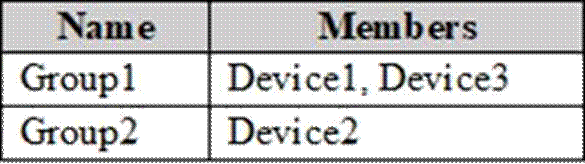
You have an Endpoint Privilege Management (EPM) elevation settings policy named Policy1 that has the following settings:
Endpoint Privilege Management: Enabled

Default elevation response: Require user confirmation
Validation: Windows authentication
Assignments: Group1, Group2
You create an Endpoint Privilege Management elevation rules policy named RulesPolicy1 that has the following settings:
Rule name: Rule1
Elevation type: Automatic
Child process behavior: Deny all
File name: App1.exe
Assignments: Group1
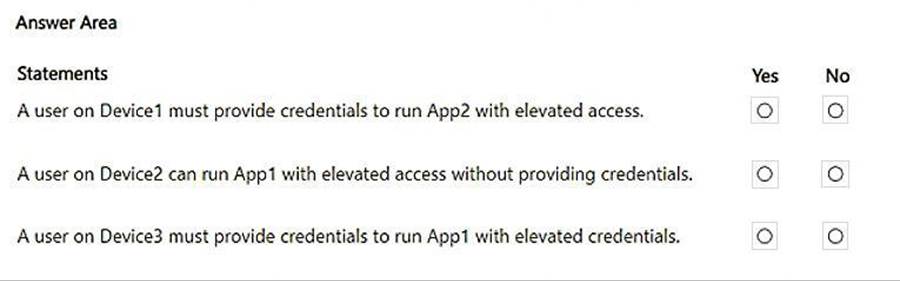
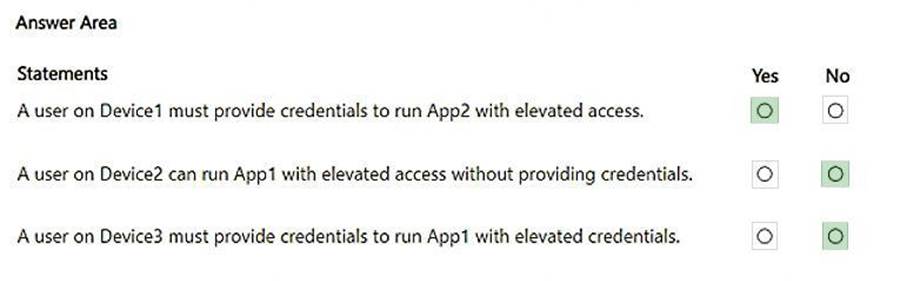
For each of the following statements, select Yes if the statement is true. Otherwise, select No. NOTE: Each correct selection is worth one point.
Hot Area:
HOTSPOT
You have a Microsoft 365 E5 subscription that contains three Windows devices named Device1, Device2, and Device3.
Each device contains two apps named App1 and App2.
You manage the devices by using Microsoft Intune.
The subscription contains the groups shown in the following table.
You have an Endpoint Privilege Management (EPM) elevation settings policy named Policy1 that has the following settings:
Endpoint Privilege Management: Enabled
Default elevation response: Require user confirmation
Validation: Windows authentication
Assignments: Group1, Group2
You create an Endpoint Privilege Management elevation rules policy named RulesPolicy1 that has the following settings:
Rule name: Rule1
Elevation type: Automatic
Child process behavior: Deny all
File name: App1.exe
Assignments: Group1
For each of the following statements, select Yes if the statement is true. Otherwise, select No. NOTE: Each correct selection is worth one point.
Hot Area:
HOTSPOT
You have a Microsoft 365 E5 subscription that contains three Windows devices named Device1, Device2, and Device3.
Each device contains two apps named App1 and App2.
You manage the devices by using Microsoft Intune.
The subscription contains the groups shown in the following table.
You have an Endpoint Privilege Management (EPM) elevation settings policy named Policy1 that has the following settings:
Endpoint Privilege Management: Enabled
Default elevation response: Require user confirmation
Validation: Windows authentication
Assignments: Group1, Group2
You create an Endpoint Privilege Management elevation rules policy named RulesPolicy1 that has the following settings:
Rule name: Rule1
Elevation type: Automatic
Child process behavior: Deny all
File name: App1.exe
Assignments: Group1
For each of the following statements, select Yes if the statement is true. Otherwise, select No. NOTE: Each correct selection is worth one point.
Hot Area:
HOTSPOT
You have a Microsoft 365 E5 subscription that contains three Windows devices named Device1, Device2, and Device3.
Each device contains two apps named App1 and App2.
You manage the devices by using Microsoft Intune.
The subscription contains the groups shown in the following table.
You have an Endpoint Privilege Management (EPM) elevation settings policy named Policy1 that has the following settings:
Endpoint Privilege Management: Enabled
Default elevation response: Require user confirmation
Validation: Windows authentication
Assignments: Group1, Group2
You create an Endpoint Privilege Management elevation rules policy named RulesPolicy1 that has the following settings:
Rule name: Rule1
Elevation type: Automatic
Child process behavior: Deny all
File name: App1.exe
Assignments: Group1
For each of the following statements, select Yes if the statement is true. Otherwise, select No. NOTE: Each correct selection is worth one point.
Hot Area:
You have 25 computers that run Windows 10 Pro.
You have a Microsoft 365 E5 subscription that uses Microsoft Intune.
You need to upgrade the computers to Windows 11 Enterprise by using an in-place upgrade. The solution must minimize administrative effort.
What should you use?
- A . Microsoft Deployment Toolkit (MDT) and a default image of Windows 11 Enterprise
- B . Microsoft Configuration Manager and a custom image of Windows 11 Enterprise
- C . Windows Autopilot
- D . Subscription Activation