
Microsoft DP-700 Practice Exams
Last updated on Nov 16,2026- Exam Code: DP-700
- Exam Name: Microsoft Fabric Data Engineer
- Certification Provider: Microsoft
- Latest update: Nov 16,2026
You have a Fabric workspace named Workspace1 that contains a warehouse named Warehouse1.
You plan to deploy Warehouse1 to a new workspace named Workspace2.
As part of the deployment process, you need to verify whether Warehouse1 contains invalid references. The solution must minimize development effort.
What should you use?
- A . a database project
- B . a deployment pipeline
- C . a Python script
- D . a T-SQL script
C
Explanation:
A deployment pipeline in Fabric allows you to deploy assets like warehouses, datasets, and reports between different workspaces (such as from Workspace1 to Workspace2). One of the key features of a deployment pipeline is the ability to check for invalid references before deployment. This can help identify issues with assets, such as broken links or dependencies, ensuring the deployment is successful without introducing errors. This is the most efficient way to verify references and manage the deployment with minimal development effort.
You have a Fabric workspace that contains a warehouse named Warehouse1. Data is loaded daily into Warehouse1 by using data pipelines and stored procedures. You discover that the daily data load takes longer than expected.
You need to monitor Warehouse1 to identify the names of users that are actively running queries.
Which view should you use?
- A . sys.dm_exec_connections
- B . sys.dm_exec_requests
- C . queryinsights.long_running_queries
- D . queryinsights.frequently_run_queries
- E . sys.dm_exec_sessions
E
Explanation:
sys.dm_exec_sessions provides real-time information about all active sessions, including the user, session ID, and status of the session. You can filter on session status to see users actively running queries.
You need to resolve the sales data issue. The solution must minimize the amount of data transferred.
What should you do?
- A . Spilt the dataflow into two dataflows.
- B . Configure scheduled refresh for the dataflow.
- C . Configure incremental refresh for the dataflow. Set Store rows from the past to 1 Month.
- D . Configure incremental refresh for the dataflow. Set Refresh rows from the past to 1 Year.
- E . Configure incremental refresh for the dataflow. Set Refresh rows from the past to 1 Month.
E
Explanation:
The sales data issue can be resolved by configuring incremental refresh for the dataflow. Incremental refresh allows for only the new or changed data to be processed, minimizing the amount of data transferred and improving performance.
The solution specifies that data older than one month never changes, so setting the refresh period to 1 Month is appropriate. This ensures that only the most recent month of data will be refreshed, reducing unnecessary data transfers.
HOTSPOT
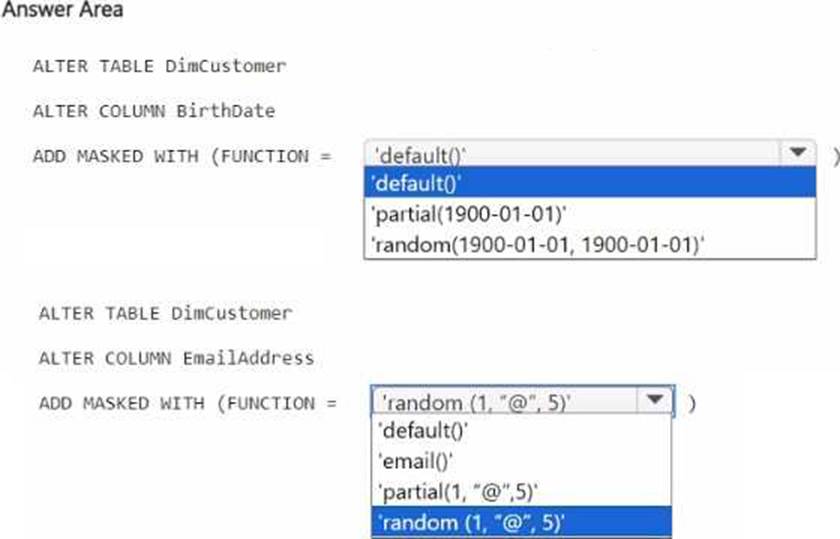
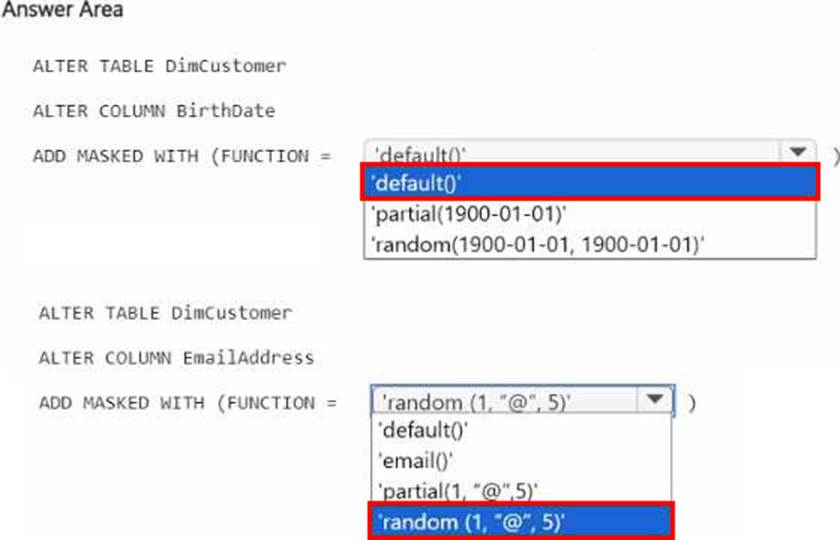
You have a Fabric workspace that contains a warehouse named Warehouse!. Warehousel contains a table named DimCustomers. DimCustomers contains the following columns:
• CustomerName
• CustomerlD
• BirthDate
• Email
You need to configure security to meet the following requirements:
• BirthDate in DimCustomer must be masked and display 1900-01-01.
• Email in DimCustomer must be masked and display only the first leading character and the last five characters.
How should you complete the statement? To answer, select the appropriate options in the answer area. NOTE: Each correct selection is worth one point.
DRAG DROP
You are implementing the following data entities in a Fabric environment:
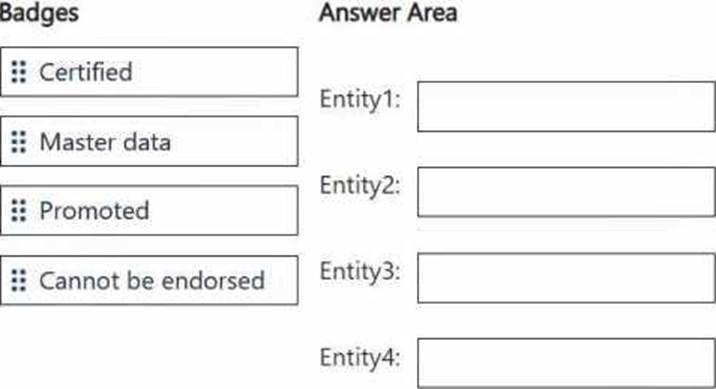
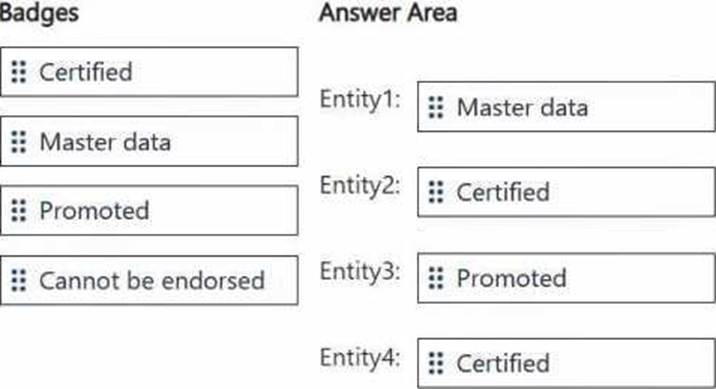
Entity1: Available in a lakehouse and contains data that will be used as a core organization entity
Entity2: Available in a semantic model and contains data that meets organizational standards
Entity3: Available in a Microsoft Power BI report and contains data that is ready for sharing and reuse Entity4: Available in a Power BI dashboard and contains approved data for executive-level decision making
Your company requires that specific governance processes be implemented for the data.
You need to apply endorsement badges to the entities based on each entity’s use case.
Which badge should you apply to each entity? To answer, drag the appropriate badges the correct entities. Each badge may be used once, more than once, or not at all. You may need to drag the split bar between panes or scroll to view content. NOTE: Each correct selection is worth one point.
You need to schedule the population of the medallion layers to meet the technical requirements.
What should you do?
- A . Schedule a data pipeline that calls other data pipelines.
- B . Schedule a notebook.
- C . Schedule an Apache Spark job.
- D . Schedule multiple data pipelines.
A
Explanation:
The technical requirements specify that:
Medallion layers must be fully populated sequentially (bronze → silver → gold). Each layer must be populated before the next.
If any step fails, the process must notify the data engineers.
Data imports should run simultaneously when possible.
Why Use a Data Pipeline That Calls Other Data Pipelines?
A data pipeline provides a modular and reusable approach to orchestrating the sequential population of medallion layers.
By calling other pipelines, each pipeline can focus on populating a specific layer (bronze, silver, or gold), simplifying development and maintenance.
A parent pipeline can handle:
– Sequential execution of child pipelines.
– Error handling to send email notifications upon failures.
– Parallel execution of tasks where possible (e.g., simultaneous imports into the bronze layer).
HOTSPOT
You have a Fabric workspace that contains a lakehouse named Lakehousel.
Lakehousel contains a table named Status_Target that has the following columns:
• Key
• Status
• LastModified
The data source contains a table named Status.Source that has the same columns as Status_Target.
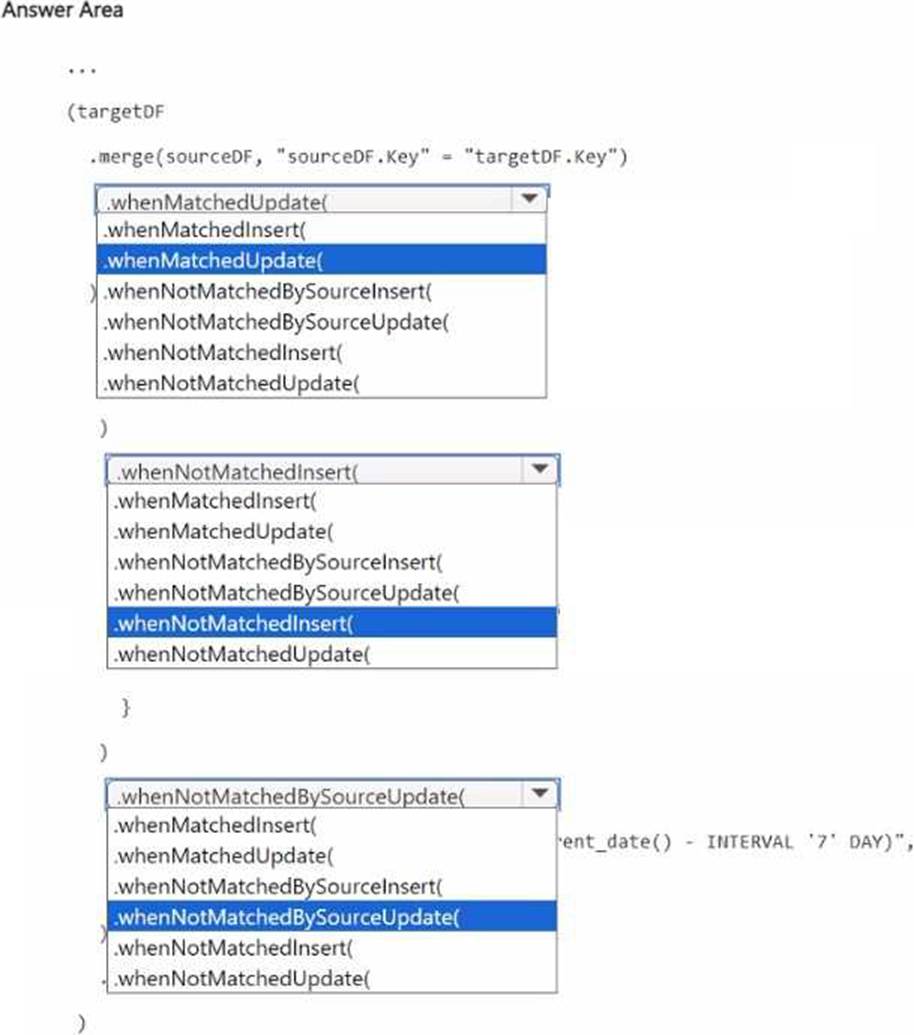
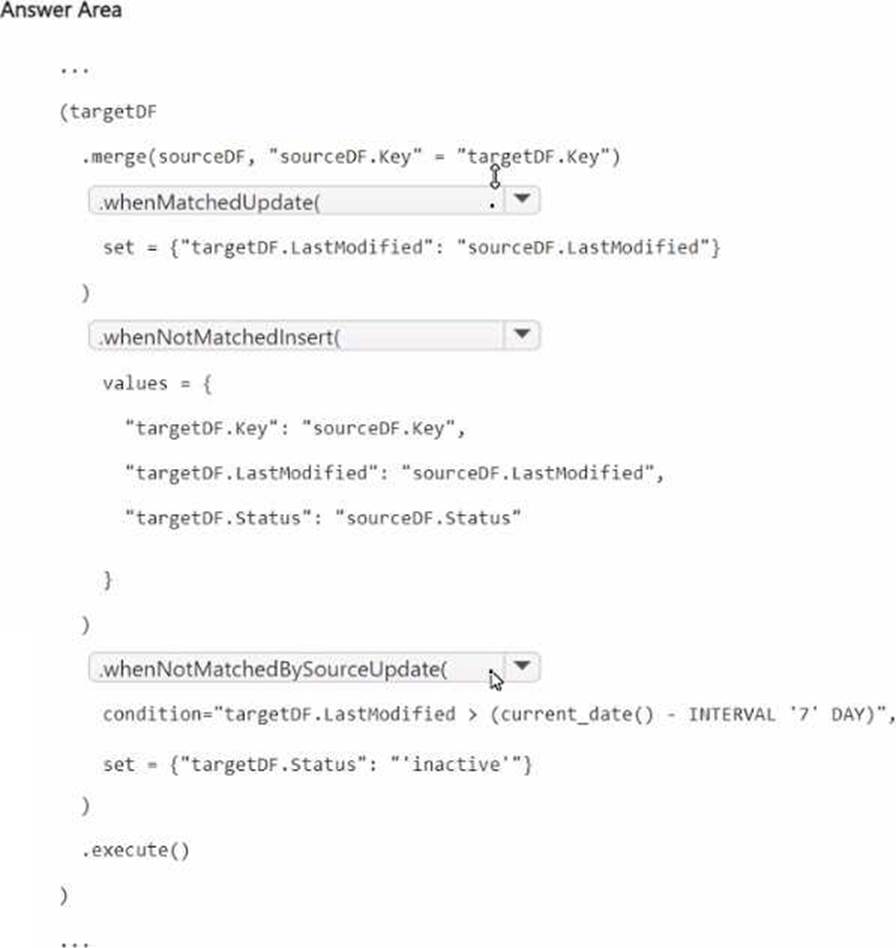
Status.Source is used to populate Status_Target. In a notebook name Notebook!, you load Status_Source to a DataFrame named sourceDF and Status_Target to a DataFrame named targetDF.
You need to implement an incremental loading pattern by using Notebook-!. The solution must meet
the following requirements:
• For all the matching records that have the same value of key, update the value of LastModified in Status_Target to the value of LastModified in Status_Source.
• Insert all the records that exist in Status_Source that do NOT exist in Status_Target.
• Set the value of Status in Status_Target to inactive for all the records that were last modified more than seven days ago and that do NOT exist in Status.Source.
How should you complete the statement? To answer, select the appropriate options in the answer area. NOTE: Each correct selection is worth one point.
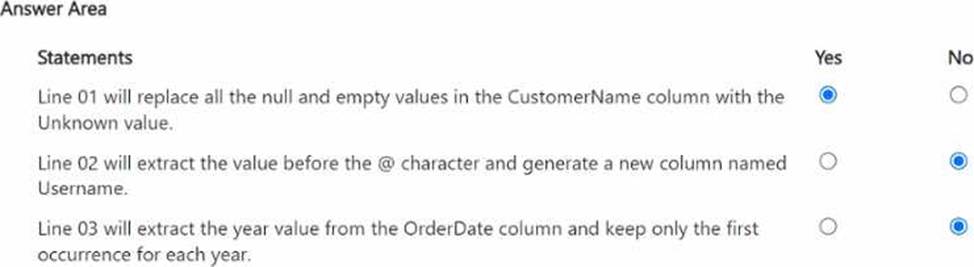
HOTSPOT
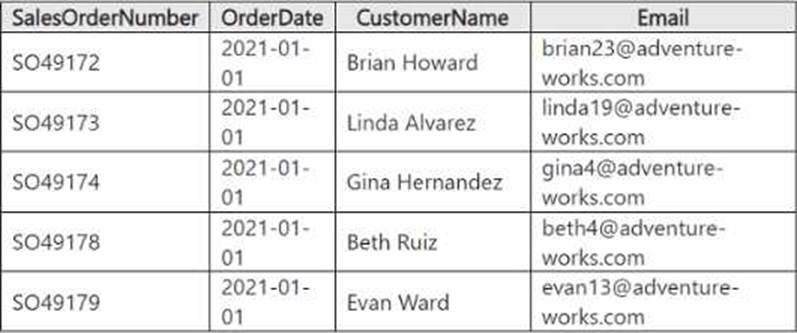
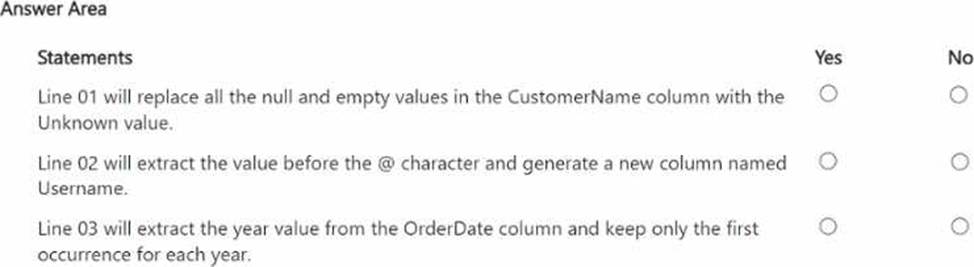
You have a table in a Fabric lakehouse that contains the following data.
You have a notebook that contains the following code segment.

For each of the following statements, select Yes if the statement is true. Otherwise, select No. NOTE: Each correct selection is worth one point.
You have an Azure event hub.
Each event contains the following fields:
– BikepointID
– Street
– Neighbourhood
– Latitude
– Longitude
– No_Bikes
– No_Empty_Docks
You need to ingest the events. The solution must only retain events that have a Neighbourhood value of Chelsea, and then store the retained events in a Fabric lakehouse.
What should you use?
- A . a KQL queryset
- B . an eventstream
- C . a streaming dataset
- D . Apache Spark Structured Streaming
B
Explanation:
An eventstream is the best solution for ingesting data from Azure Event Hub into Fabric, while applying filtering logic such as retaining only the events that have a Neighbourhood value of "Chelsea." Eventstreams in Microsoft Fabric are designed for handling real-time data streams and can apply transformation logic directly on incoming events. In this case, the eventstream can filter events based on the Neighbourhood field before storing the retained events in a Fabric lakehouse.
Eventstreams are well-suited for stream processing, such as this case where you need to filter out only specific data (events with a Neighbourhood of "Chelsea") before storing it in the lakehouse.
You have an Azure event hub.
Each event contains the following fields:
– BikepointID
– Street
– Neighbourhood
– Latitude
– Longitude
– No_Bikes
– No_Empty_Docks
You need to ingest the events. The solution must only retain events that have a Neighbourhood value of Chelsea, and then store the retained events in a Fabric lakehouse.
What should you use?
- A . a KQL queryset
- B . an eventstream
- C . a streaming dataset
- D . Apache Spark Structured Streaming
B
Explanation:
An eventstream is the best solution for ingesting data from Azure Event Hub into Fabric, while applying filtering logic such as retaining only the events that have a Neighbourhood value of "Chelsea." Eventstreams in Microsoft Fabric are designed for handling real-time data streams and can apply transformation logic directly on incoming events. In this case, the eventstream can filter events based on the Neighbourhood field before storing the retained events in a Fabric lakehouse.
Eventstreams are well-suited for stream processing, such as this case where you need to filter out only specific data (events with a Neighbourhood of "Chelsea") before storing it in the lakehouse.