
Microsoft DP-700 Practice Exams
Last updated on Nov 16,2026- Exam Code: DP-700
- Exam Name: Microsoft Fabric Data Engineer
- Certification Provider: Microsoft
- Latest update: Nov 16,2026
You have a Fabric workspace that contains a lakehouse named Lakehouse1. Data is ingested into Lakehouse1 as one flat table.
The table contains the following columns.
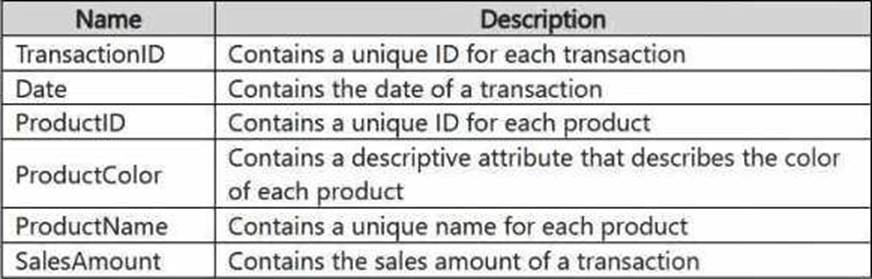
You plan to load the data into a dimensional model and implement a star schema. From the original flat table, you create two tables named FactSales and DimProduct. You will track changes in DimProduct.
You need to prepare the data.
Which three columns should you include in the DimProduct table? Each correct answer presents part of the solution. NOTE: Each correct selection is worth one point.
- A . Date
- B . ProductName
- C . ProductColor
- D . TransactionID
- E . SalesAmount
- F . ProductID
B,C,F
Explanation:
In a star schema, the DimProduct table serves as a dimension table that contains descriptive attributes about products. It will provide context for the FactSales table, which contains transactional data.
The following columns should be included in the DimProduct table:
ProductName: The ProductName is an important descriptive attribute of the product, which is needed for analysis and reporting in a dimensional model.
ProductColor: ProductColor is another descriptive attribute of the product. In a star schema, it makes sense to include attributes like color in the dimension table to help categorize products in the analysis.
ProductID: ProductID is the primary key for the DimProduct table, which will be used to join the FactSales table to the product dimension. It’s essential for uniquely identifying each product in the model.
Note: This question is part of a series of questions that present the same scenario. Each question in the series contains a unique solution that might meet the stated goals. Some question sets might have more than one correct solution, while others might not have a correct solution.
After you answer a question in this section, you will NOT be able to return to it. As a result, these questions will not appear in the review screen.
You have a KQL database that contains two tables named Stream and Reference. Stream contains streaming data in the following format.
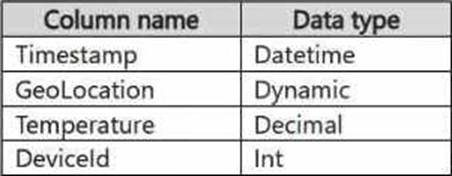
Reference contains reference data in the following format.
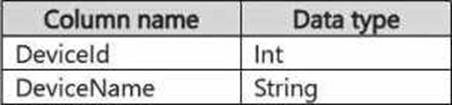
Both tables contain millions of rows.
You have the following KQL queryset.

You need to reduce how long it takes to run the KQL queryset.
Solution: You add the make_list() function to the output columns.
Does this meet the goal?
- A . Yes
- B . No
B
Explanation:
Adding an aggregation like make_list() would require additional processing and memory, which could make the query slower.
HOTSPOT
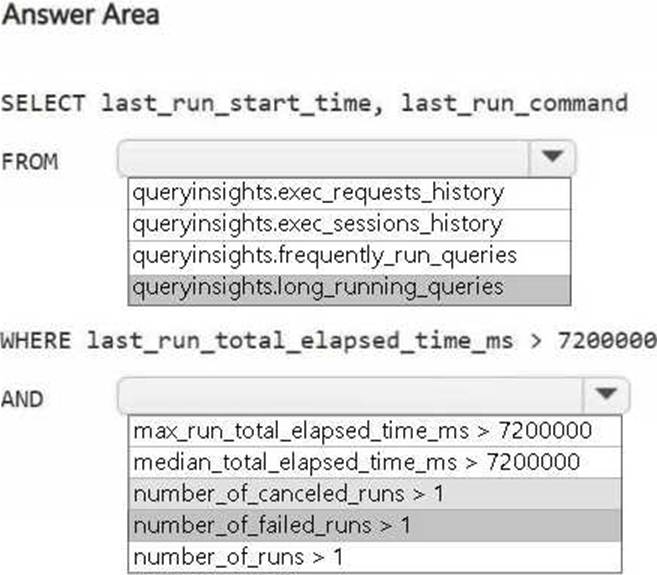
You need to troubleshoot the ad-hoc query issue.
How should you complete the statement? To answer, select the appropriate options in the answer area. NOTE: Each correct selection is worth one point.
Explanation:
A screenshot of a computer Description automatically generated
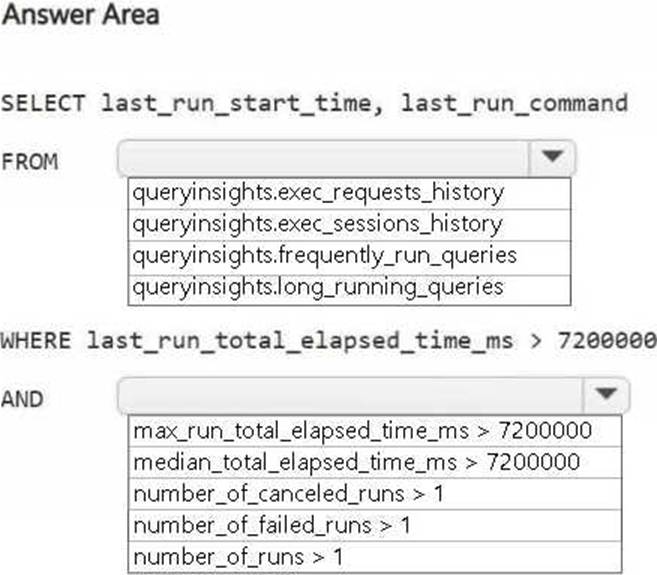
SELECT last_run_start_time, last_run_command: These fields will help identify the execution details of the long-running queries.
FROM queryinsights.long_running_queries: The correct solution is to check the long-running queries using the queryinsights.long_running_queries view, which provides insights into queries that take longer than expected to execute.
WHERE last_run_total_elapsed_time_ms > 7200000: This condition filters queries that took more than 2 hours to complete (7200000 milliseconds), which is relevant to the issue described.
AND number_of_failed_runs > 1: This condition is key for identifying queries that have failed more than once, helping to isolate the problematic queries that cause failures and need attention.
You have a Fabric workspace named Workspace1.
You plan to integrate Workspace1 with Azure DevOps.
You will use a Fabric deployment pipeline named deployPipeline1 to deploy items from Workspace1 to higher environment workspaces as part of a medallion architecture. You will run deployPipeline1 by using an API call from an Azure DevOps pipeline.
You need to configure API authentication between Azure DevOps and Fabric.
Which type of authentication should you use?
- A . service principal
- B . Microsoft Entra username and password
- C . managed private endpoint
- D . workspace identity
A
Explanation:
When integrating Azure DevOps with Fabric (Workspace1), using a service principal is the recommended authentication method. A service principal provides a way for applications (such as an Azure DevOps pipeline) to authenticate and interact with resources securely. It allows Azure DevOps to authenticate API calls to Fabric without requiring direct user credentials. This method is ideal for
automating tasks such as deploying items through a Fabric deployment pipeline.
DRAG DROP
You have a Fabric workspace that contains a warehouse named Warehouse1.
In Warehouse1, you create a table named DimCustomer by running the following statement.
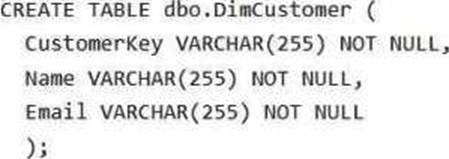
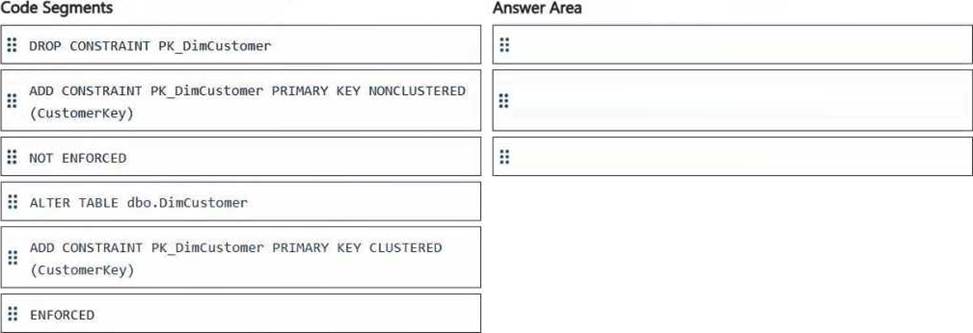
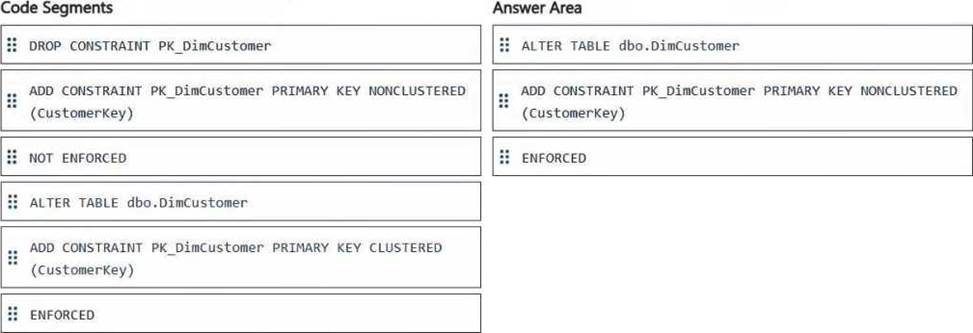
You need to set the Customerkey column as a primary key of the DimCustomer table.
Which three code segments should you run in sequence? To answer, move the appropriate code segments from the list of code segments to the answer area and arrange them in the correct order.
You are developing a data pipeline named Pipeline1.
You need to add a Copy data activity that will copy data from a Snowflake data source to a Fabric warehouse.
Which option from the Settings tab of the Copy data activity must you configure?
- A . Enable logging
- B . Fault tolerance
- C . Enable staging
- D . Degree of copy parallelism
Note: This question is part of a series of questions that present the same scenario. Each question in the series contains a unique solution that might meet the stated goals. Some question sets might have more than one correct solution, while others might not have a correct solution.
After you answer a question in this section, you will NOT be able to return to it. As a result, these questions will not appear in the review screen.
You have a Fabric eventstream that loads data into a table named Bike_Location in a KQL database.
The table contains the following columns:
– BikepointID
– Street
– Neighbourhood
– No_Bikes
– No_Empty_Docks
– Timestamp
You need to apply transformation and filter logic to prepare the data for consumption. The solution must return data for a neighbourhood named Sands End when No_Bikes is at least 15. The results must be ordered by No_Bikes in ascending order.
Solution: You use the following code segment:

Does this meet the goal?
- A . Yes
- B . no
B
Explanation:
This code does not meet the goal because it uses sort by without specifying the order, which defaults to ascending, but explicitly mentioning asc improves clarity.
Correct code should look like:

HOTSPOT
You are building a data orchestration pattern by using a Fabric data pipeline named Dynamic Data Copy as shown in the exhibit. (Click the Exhibit tab.)
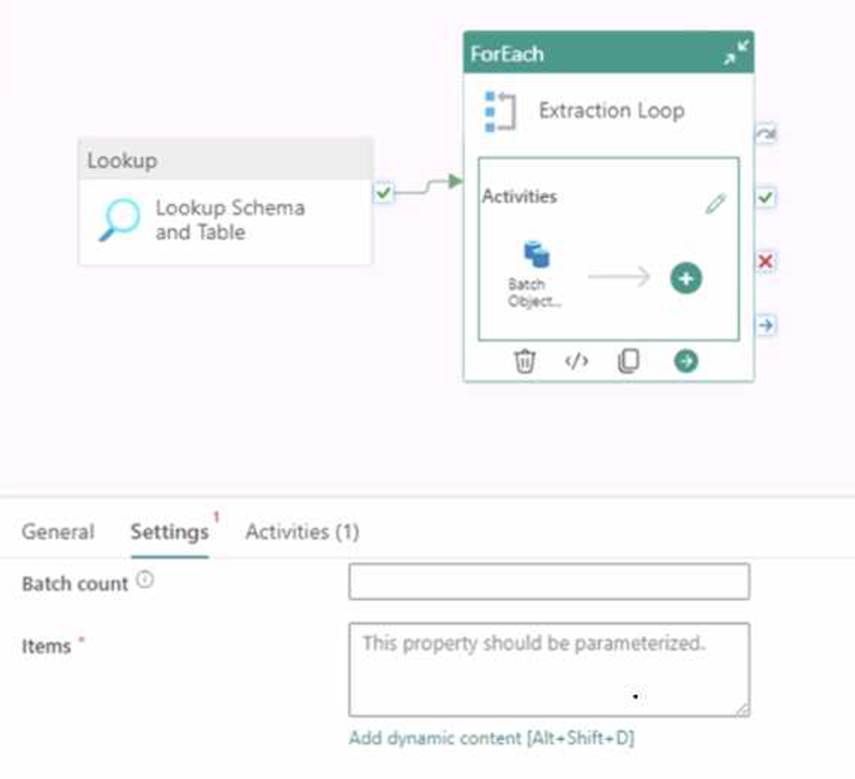
Dynamic Data Copy does NOT use parametrization.
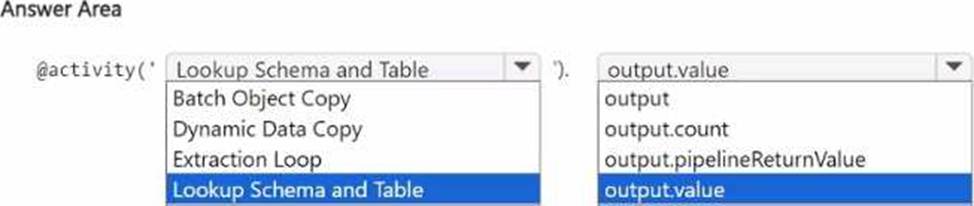
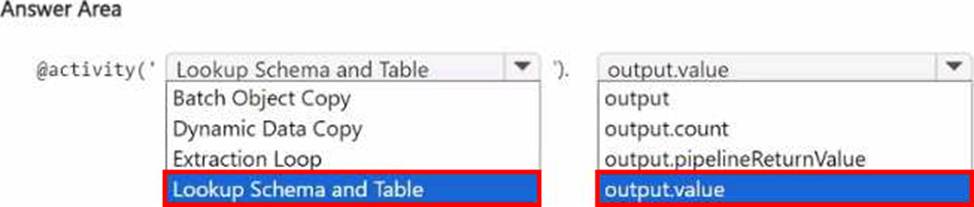
You need to configure the ForEach activity to receive the list of tables to be copied.
How should you complete the pipeline expression? To answer, select the appropriate options in the answer area. NOTE: Each correct selection is worth one point.
HOTSPOT
HOTSPOT
You have a Fabric workspace that contains a warehouse named Warehouse1. Warehouse1 contains the following tables and columns.
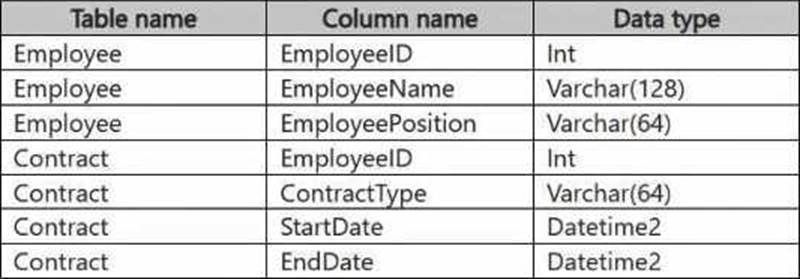
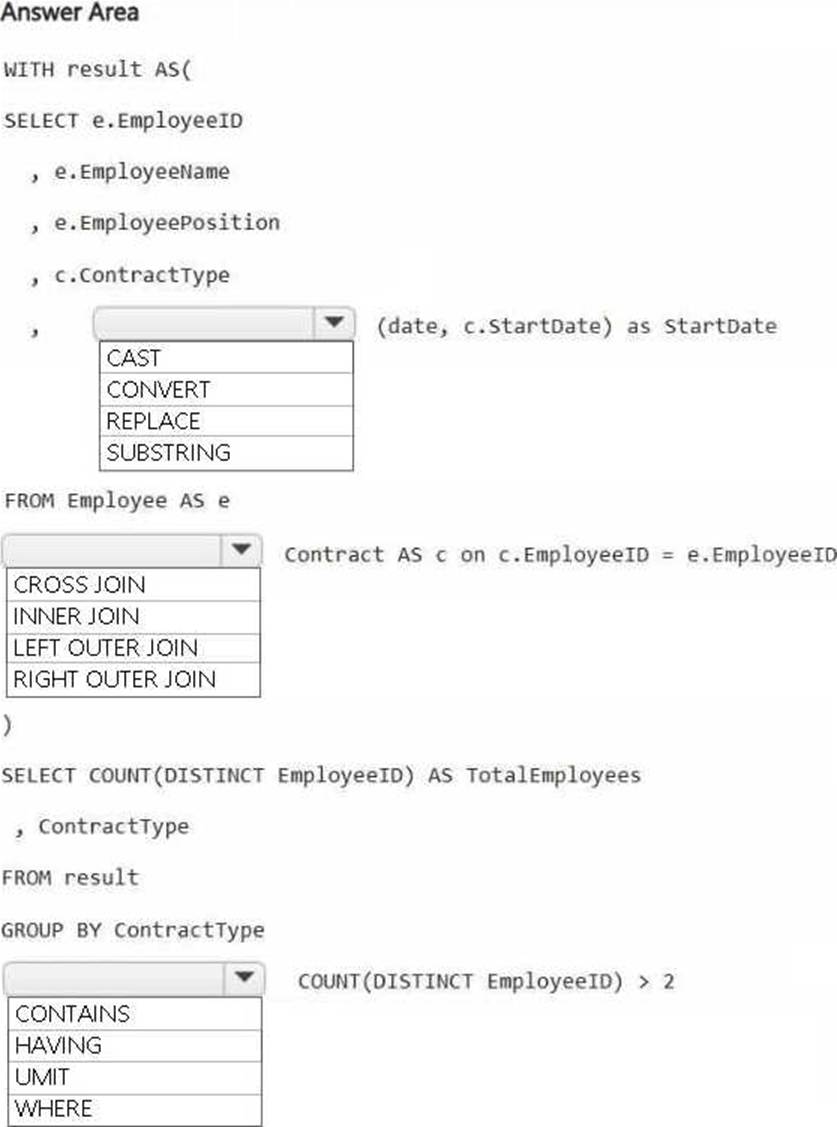
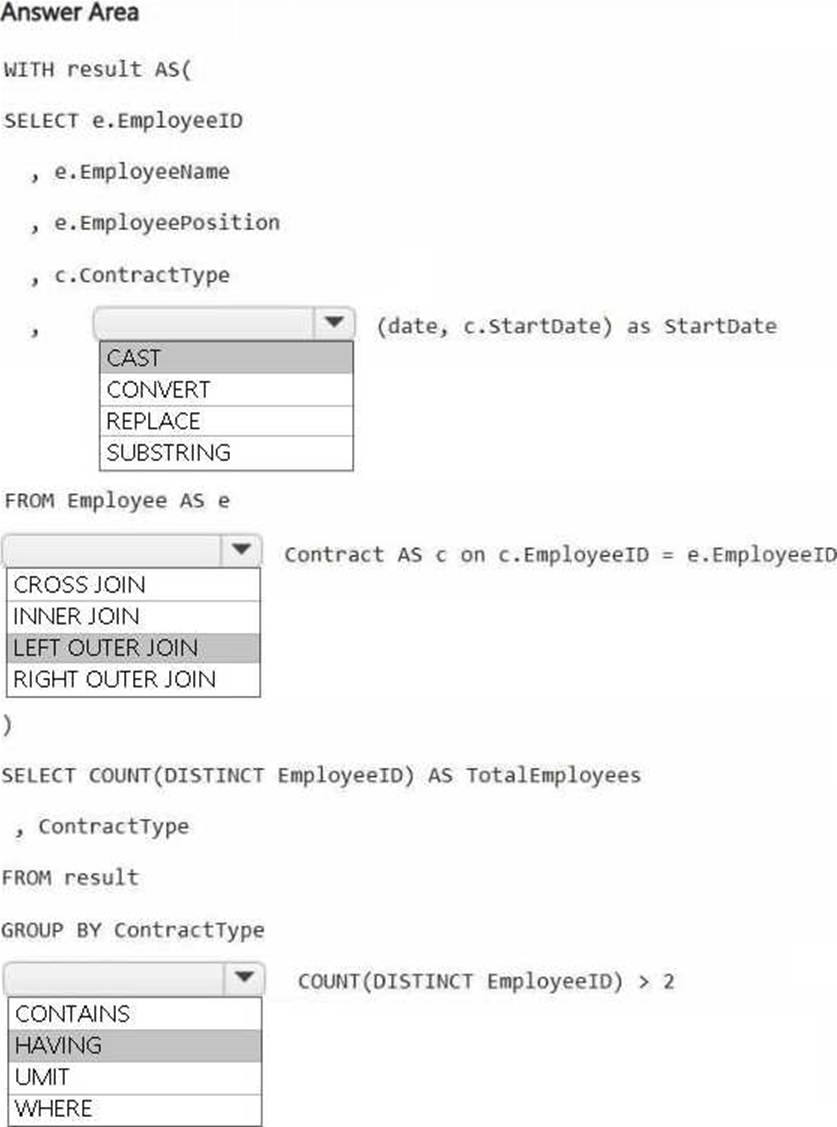
You need to denormalize the tables and include the ContractType and StartDate columns in the Employee table.
The solution must meet the following requirements:
– Ensure that the StartDate column is of the date data type.
– Ensure that all the rows from the Employee table are preserved and include any matching rows from the Contract table.
– Ensure that the result set displays the total number of employees per contract type for all the contract types that have more than two employees.
How should you complete the statement? To answer, select the appropriate options in the answer area. NOTE: Each correct selection is worth one point.
HOTSPOT
HOTSPOT
You have a Fabric workspace that contains a warehouse named Warehouse1. Warehouse1 contains the following tables and columns.
You need to denormalize the tables and include the ContractType and StartDate columns in the Employee table.
The solution must meet the following requirements:
– Ensure that the StartDate column is of the date data type.
– Ensure that all the rows from the Employee table are preserved and include any matching rows from the Contract table.
– Ensure that the result set displays the total number of employees per contract type for all the contract types that have more than two employees.
How should you complete the statement? To answer, select the appropriate options in the answer area. NOTE: Each correct selection is worth one point.