
Microsoft DP-700 Practice Exams
Last updated on Nov 16,2026- Exam Code: DP-700
- Exam Name: Microsoft Fabric Data Engineer
- Certification Provider: Microsoft
- Latest update: Nov 16,2026
You have a Fabric workspace that contains an eventstream named Eventstream1. Eventstream1 processes data from a thermal sensor by using event stream processing, and then stores the data in a lakehouse.
You need to modify Eventstream1 to include the standard deviation of the temperature.
Which transform operator should you include in the Eventstream1 logic?
- A . Expand
- B . Group by
- C . Union
- D . Aggregate
D
Explanation:
To compute the standard deviation of the temperature from the thermal sensor data, you would use the Aggregate transform operator in Eventstream1. The Aggregate operator allows you to apply functions like sum, average, count, and statistical functions like standard deviation across a group of rows or events. This operator is ideal for operations that require summarizing or computing statistics over a dataset, such as calculating the standard deviation.
HOTSPOT
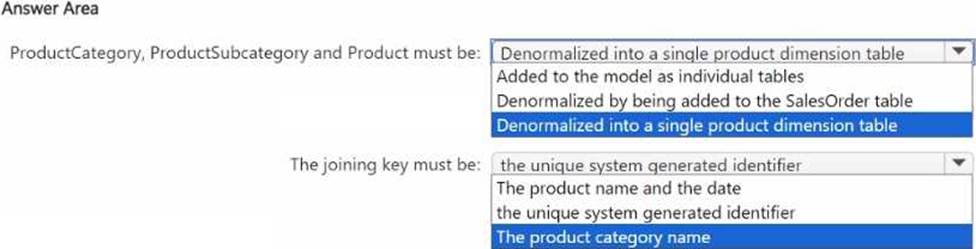
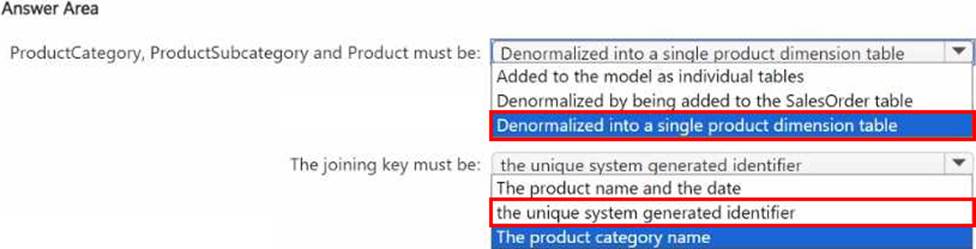
You have a Fabric warehouse named DW1 that contains four staging tables named ProductCategory, ProductSubcategory, Product, and SalesOrder. ProductCategory, ProductSubcategory, and Product are used often in analytical queries.
You need to implement a star schema for DW1. The solution must minimize development effort.
Which design approach should you use? To answer, select the appropriate options in the answer area. NOTE: Each correct selection is worth one point.
You have a Fabric workspace that contains a semantic model named Model1. You need to dynamically execute and monitor the refresh progress of Model1.
What should you use?
- A . dynamic management views in Microsoft SQL Server Management Studio
- B . Monitoring hub
- C . dynamic management views in Azure Data Studio
- D . a semantic link in a notebook
D
Explanation:
Semantic models in Microsoft Fabric are part of Power BI datasets and require refreshes to stay updated with the latest data.
Dynamically executing and monitoring the refresh progress requires a tool or approach that integrates with Fabric’s capabilities for semantic models.
You have a Fabric workspace named Workspace1 that contains a lakehouse named Lakehouse1.
Lakehouse1 contains the following tables:
Orders
Customer
Employee
The Employee table contains Personally Identifiable Information (PII).
A data engineer is building a workflow that requires writing data to the Customer table, however, the user does NOT have the elevated permissions required to view the contents of the Employee table. You need to ensure that the data engineer can write data to the Customer table without reading data from the Employee table.
Which three actions should you perform? Each correct answer presents part of the solution. NOTE: Each correct selection is worth one point.
- A . Share Lakehouse1 with the data engineer.
- B . Assign the data engineer the Contributor role for Workspace2.
- C . Assign the data engineer the Viewer role for Workspace2.
- D . Assign the data engineer the Contributor role for Workspace1.
- E . Migrate the Employee table from Lakehouse1 to Lakehouse2.
- F . Create a new workspace named Workspace2 that contains a new lakehouse named Lakehouse2.
- G . Assign the data engineer the Viewer role for Workspace1.
A,D,E
Explanation:
To meet the requirements of ensuring that the data engineer can write data to the Customer table without reading data from the Employee table (which contains Personally Identifiable Information, or PII), you can implement the following steps:
Share Lakehouse1 with the data engineer.
By sharing Lakehouse1 with the data engineer, you provide the necessary access to the data within the lakehouse. However, this access should be controlled through roles and permissions, which will allow writing to the Customer table but prevent reading from the Employee table.
Assign the data engineer the Contributor role for Workspace1.
Assigning the Contributor role for Workspace1 grants the data engineer the ability to perform actions such as writing to tables (e.g., the Customer table) within the workspace. This role typically allows users to modify and manage data without necessarily granting them access to view all data (e.g., PII data in the Employee table).
Migrate the Employee table from Lakehouse1 to Lakehouse2.
To prevent the data engineer from accessing the Employee table (which contains PII), you can migrate the Employee table to a separate lakehouse (Lakehouse2) or workspace (Workspace2). This separation of sensitive data ensures that the data engineer’s access is restricted to the Customer table in Lakehouse1, while the Employee table can be managed separately and protected under different access controls.
HOTSPOT
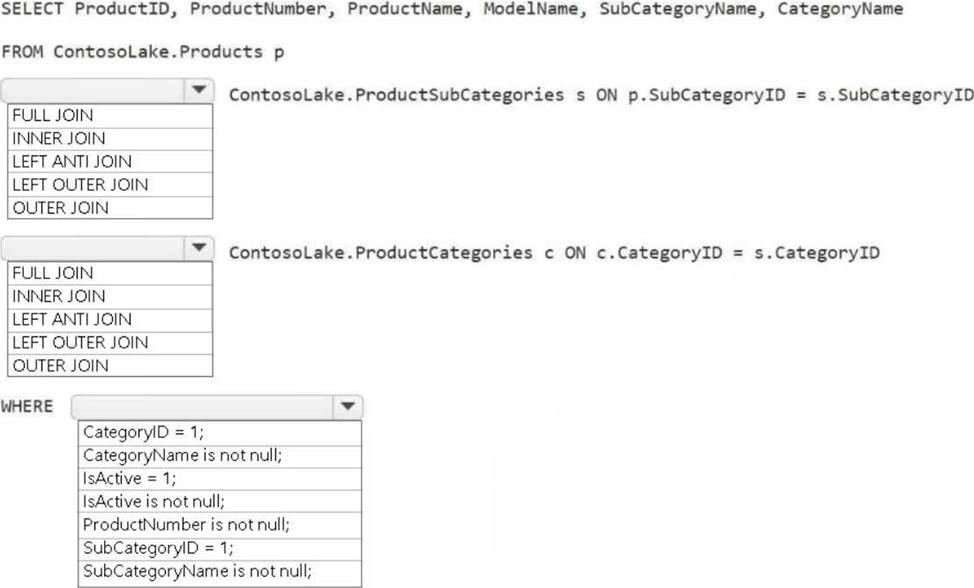
You need to create the product dimension.
How should you complete the Apache Spark SQL code? To answer, select the appropriate options in the answer area. NOTE: Each correct selection is worth one point.
Explanation:
A screenshot of a computer Description automatically generated
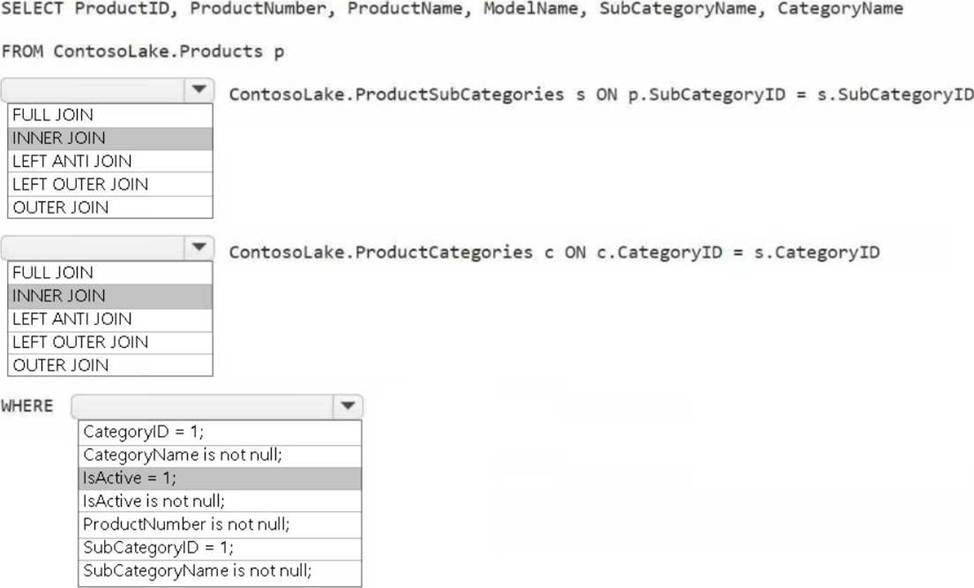
Join between Products and ProductSubCategories:
Use an INNER JOIN.
The goal is to include only products that are assigned to a subcategory. An INNER JOIN ensures that only matching records (i.e., products with a valid subcategory) are included.
Join between ProductSubCategories and ProductCategories:
Use an INNER JOIN.
Similar to the above logic, we want to include only subcategories assigned to a valid product category. An INNER JOIN ensures this condition is met.
WHERE Clause
Condition: IsActive = 1
Only active products (where IsActive equals 1) should be included in the gold layer. This filters out inactive products.
You have a Fabric workspace that contains a lakehouse named Lakehouse1.
In an external data source, you have data files that are 500 GB each. A new file is added every day. You need to ingest the data into Lakehouse1 without applying any transformations.
The solution must meet the following requirements
Trigger the process when a new file is added.
Provide the highest throughput.
Which type of item should you use to ingest the data?
- A . Event stream
- B . Dataflow Gen2
- C . Streaming dataset
- D . Data pipeline
A
Explanation:
To ingest large files (500 GB each) from an external data source into Lakehouse1 with high throughput and to trigger the process when a new file is added, an Eventstream is the best solution.
An Eventstream in Fabric is designed for handling real-time data streams and can efficiently ingest large files as soon as they are added to an external source. It is optimized for high throughput and can be configured to trigger upon detecting new files, allowing for fast and continuous ingestion of data with minimal delay.
HOTSPOT
You have a Fabric workspace.
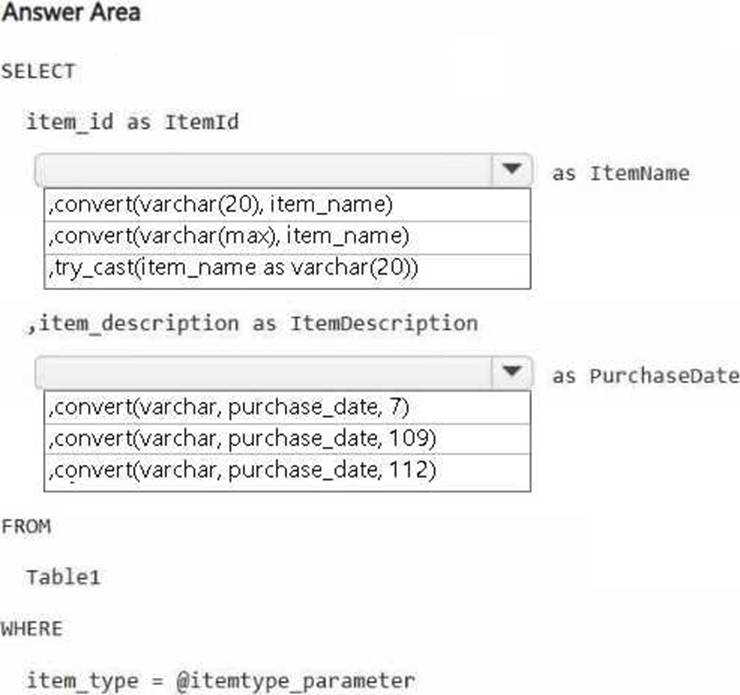
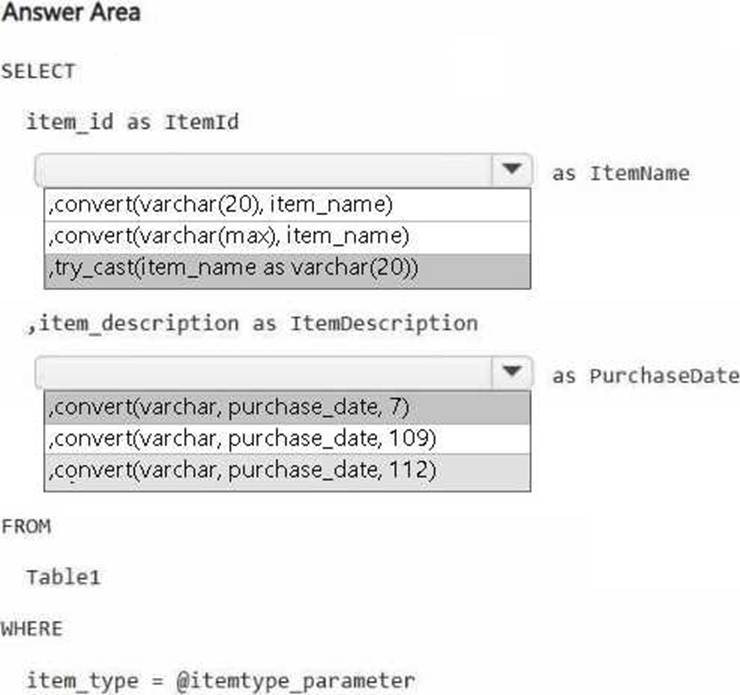
You are debugging a statement and discover the following issues:
– Sometimes, the statement fails to return all the expected rows.
– The PurchaseDate output column is NOT in the expected format of mmm dd, yy.
You need to resolve the issues. The solution must ensure that the data types of the results are retained. The results can contain blank cells.
How should you complete the statement? To answer, select the appropriate options in the answer area. NOTE: Each correct selection is worth one point.
Your company has a sales department that uses two Fabric workspaces named Workspace1 and Workspace2.
The company decides to implement a domain strategy to organize the workspaces.
You need to ensure that a user can perform the following tasks:
Create a new domain for the sales department.
Create two subdomains: one for the east region and one for the west region.
Assign Workspace1 to the east region subdomain.
Assign Workspace2 to the west region subdomain.
The solution must follow the principle of least privilege.
Which role should you assign to the user?
- A . workspace Admin
- B . domain admin
- C . domain contributor
- D . Fabric admin
B
Explanation:
To implement a domain strategy and manage subdomains within Fabric, the domain admin role is the appropriate role for the user. A domain admin has the permissions necessary to: Create a new domain (for the sales department).
Create subdomains (for the east and west regions).
Assign workspaces (such as Workspace1 and Workspace2) to the appropriate subdomains.
The domain admin role allows for managing the structure and organization of workspaces in the context of domains and subdomains while maintaining the principle of least privilege by limiting the user’s access to managing the domain structure specifically.
You have a Fabric workspace that contains a data pipeline named Pipeline! as shown in the exhibit.
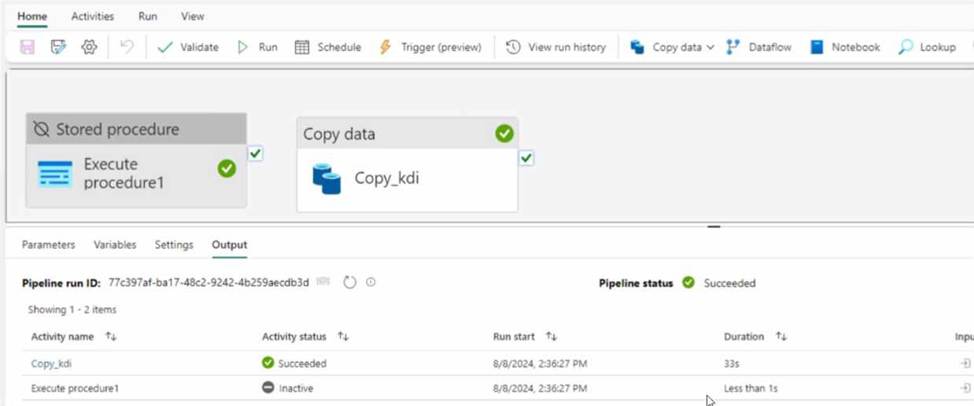
(Click the Exhibit tab.)
What will occur the next time Pipelinel tuns?
- A . Both activities will run simultaneously.
- B . Both activities will be skipped.
- C . Execute procedurel will run and Copy_kdi will be skipped.
- D . Copy.kdi will run and Execute procedurel will be skipped.
- E . Execute procedure1 will run first, and then Copy_kdi will run.
- F . Copy.kdi will run first, and then Execute procedurel will run.
You have a Fabric workspace named Workspace1 that contains a notebook named Notebook1.
In Workspace1, you create a new notebook named Notebook2.
You need to ensure that you can attach Notebook2 to the same Apache Spark session as Notebook1.
What should you do?
- A . Enable high concurrency for notebooks.
- B . Enable dynamic allocation for the Spark pool.
- C . Change the runtime version.
- D . Increase the number of executors.
A
Explanation:
To ensure that Notebook2 can attach to the same Apache Spark session as Notebook1, you need to enable high concurrency for notebooks. High concurrency allows multiple notebooks to share a Spark session, enabling them to run within the same Spark context and thus share resources like cached data, session state, and compute capabilities. This is particularly useful when you need notebooks to run in sequence or together while leveraging shared resources.