Microsoft DP-700 Practice Exams
Last updated on Nov 16,2026- Exam Code: DP-700
- Exam Name: Microsoft Fabric Data Engineer
- Certification Provider: Microsoft
- Latest update: Nov 16,2026
You have a Fabric workspace that contains a takehouse and a semantic model named Model1. You use a notebook named Notebook1 to ingest and transform data from an external data source. You need to execute Notebook1 as part of a data pipeline named Pipeline1.
The process must meet the following requirements:
• Run daily at 07:00 AM UTC.
• Attempt to retry Notebook1 twice if the notebook fails.
• After Notebook1 executes successfully, refresh Model1.
Which three actions should you perform? Each correct answer presents part of the solution. NOTE:
Each correct selection is worth one point.
- A . Set the Retry setting of the Notebook activity to 2.
- B . Place the Semantic model refresh activity after the Notebook activity and link the activities by using an On completion condition.
- C . Place the Semantic model refresh activity after the Notebook activity and link the activities by using the On success condition.
- D . From the Schedule settings of Notebook1, set the time zone to UTC.
- E . From the Schedule settings of Pipeline1, set the time zone to UTC.
- F . Set the Retry setting of the Semantic model refresh activity to 2.
HOTSPOT
You have three users named User1, User2, and User3.
You have the Fabric workspaces shown in the following table.
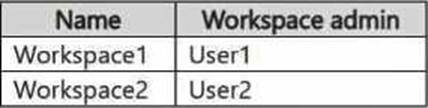
You have a security group named Group1 that contains User1 and User3.
The Fabric admin creates the domains shown in the following table.
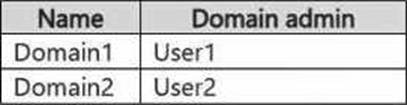
User1 creates a new workspace named Workspace3.
You add Group1 to the default domain of Domain1.
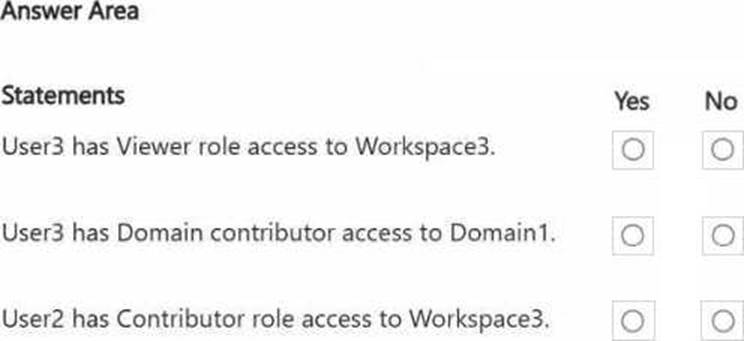
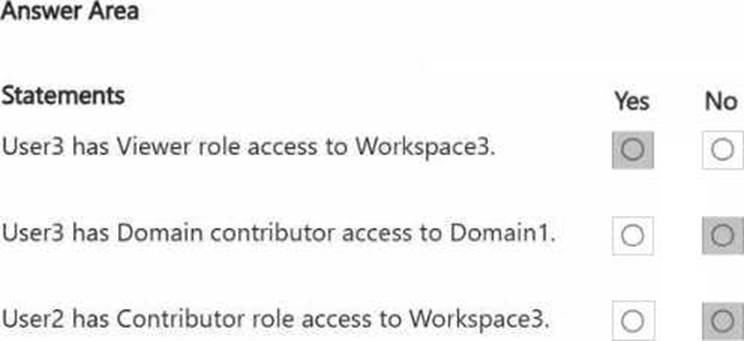
For each of the following statements, select Yes if the statement is true. Otherwise, select No. NOTE: Each correct selection is worth one point.
Note: This question is part of a series of questions that present the same scenario. Each question in the series contains a unique solution that might meet the stated goals. Some question sets might have more than one correct solution, while others might not have a correct solution.
After you answer a question in this section, you will NOT be able to return to it. As a result, these questions will not appear in the review screen.
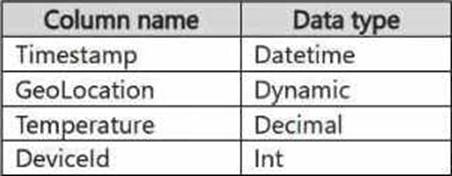
You have a KQL database that contains two tables named Stream and Reference. Stream contains streaming data in the following format.
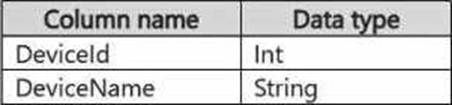
Reference contains reference data in the following format.
Both tables contain millions of rows.
You have the following KQL queryset.

You need to reduce how long it takes to run the KQL queryset.
Solution: You move the filter to line 02.
Does this meet the goal?
- A . Yes
- B . No
A
Explanation:
Moving the filter to line 02: Filtering the Stream table before performing the join operation reduces the number of rows that need to be processed during the join. This is an effective optimization technique for queries involving large datasets.
DRAG DROP
You have a Fabric eventhouse that contains a KQL database. The database contains a table named TaxiData.
The following is a sample of the data in TaxiData.
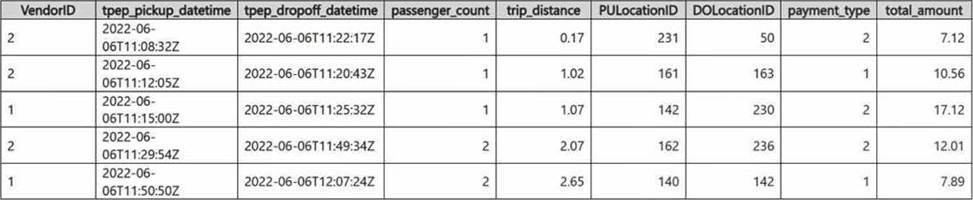
You need to build two KQL queries. The solution must meet the following requirements:
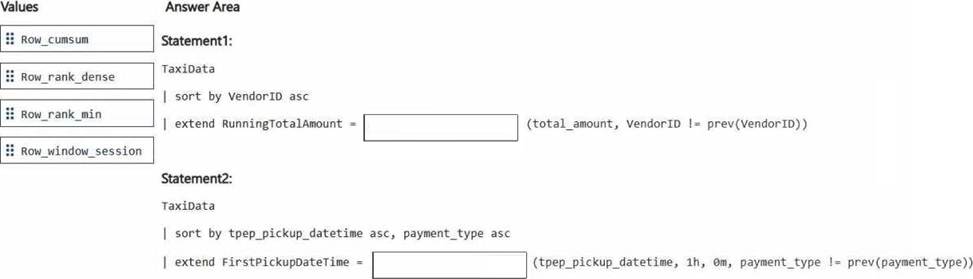
– One of the queries must partition RunningTotalAmount by VendorID.
– The other query must create a column named FirstPickupDateTime that shows the first value of each hour from tpep_pickup_datetime partitioned by payment_type.
How should you complete each query? To answer, drag the appropriate values the correct targets. Each value may be used once, more than once, or not at all. You may need to drag the split bar between panes or scroll to view content. NOTE: Each correct selection is worth one point.
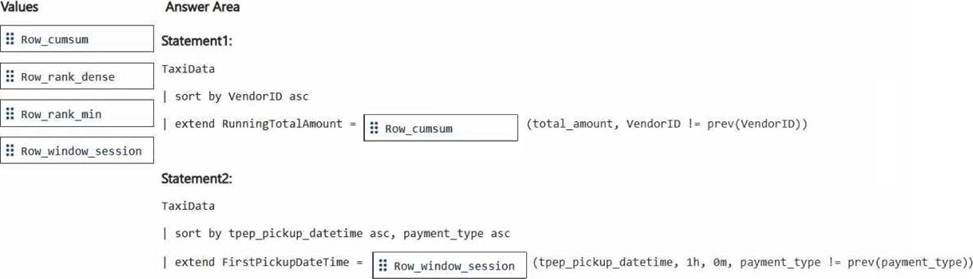
Explanation:
Partition the RunningTotalAmount by VendorID. – Row_cumsum
The Row_cumsum function computes the cumulative sum of a column while optionally restarting the accumulation based on a condition. In this case, it calculates the cumulative sum of total_amount for each VendorID, restarting when the VendorID changes (VendorID != prev(VendorID)).

Create a column FirstPickupDateTime that shows the first value of each hour from tpep_pickup_datetime, partitioned by payment_type – Row_window_session

DRAG DROP
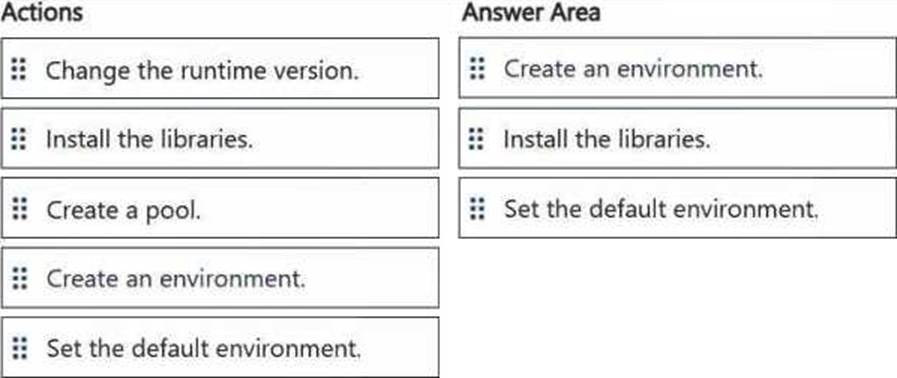
Your company has a team of developers. The team creates Python libraries of reusable code that is used to transform data.
You create a Fabric workspace name Workspace1 that will be used to develop extract, transform, and load (ETL) solutions by using notebooks.
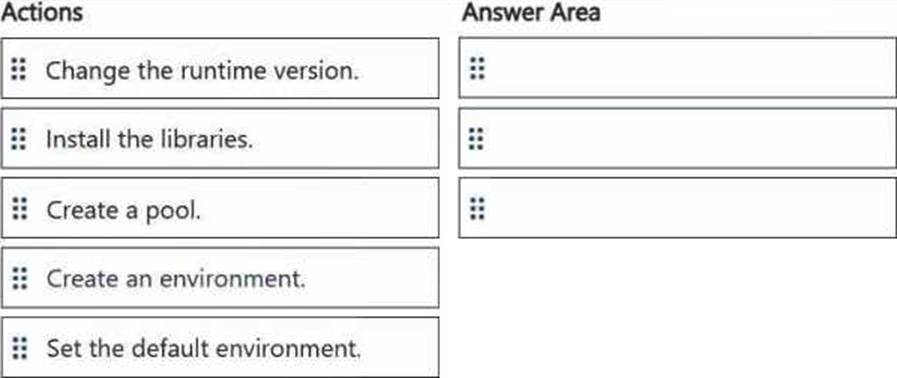
You need to ensure that the libraries are available by default to new notebooks in Workspace1.
Which three actions should you perform in sequence? To answer, move the appropriate actions from the list of actions to the answer area and arrange them in the correct order.
Note: This question is part of a series of questions that present the same scenario. Each question in the series contains a unique solution that might meet the stated goals. Some question sets might have more than one correct solution, while others might not have a correct solution.
After you answer a question in this section, you will NOT be able to return to it. As a result, these questions will not appear in the review screen.
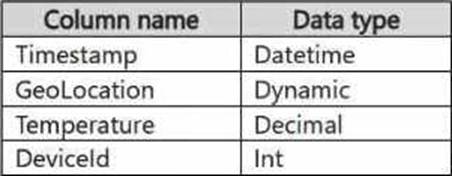
You have a KQL database that contains two tables named Stream and Reference. Stream contains streaming data in the following format.
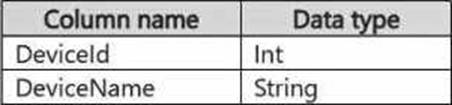
Reference contains reference data in the following format.
Both tables contain millions of rows.
You have the following KQL queryset.

You need to reduce how long it takes to run the KQL queryset.
Solution: You change the join type to kind=outer.
Does this meet the goal?
- A . Yes
- B . No
B
Explanation:
An outer join will include unmatched rows from both tables, increasing the dataset size and processing time. It does not improve query performance.
Note: This question is part of a series of questions that present the same scenario. Each question in the series contains a unique solution that might meet the stated goals. Some question sets might have more than one correct solution, while others might not have a correct solution.
After you answer a question in this section, you will NOT be able to return to it. As a result, these questions will not appear in the review screen.
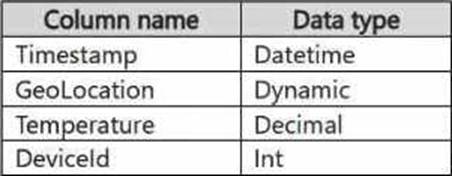
You have a KQL database that contains two tables named Stream and Reference. Stream contains streaming data in the following format.
Reference contains reference data in the following format.
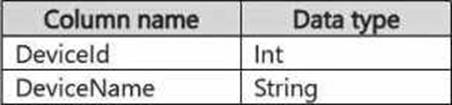
Both tables contain millions of rows.
You have the following KQL queryset.

You need to reduce how long it takes to run the KQL queryset.
Solution: You change project to extend.
Does this meet the goal?
- A . Yes
- B . No
B
Explanation:
Using extend retains all columns in the table, potentially increasing the size of the output unnecessarily. project is more efficient because it selects only the required columns.
HOTSPOT
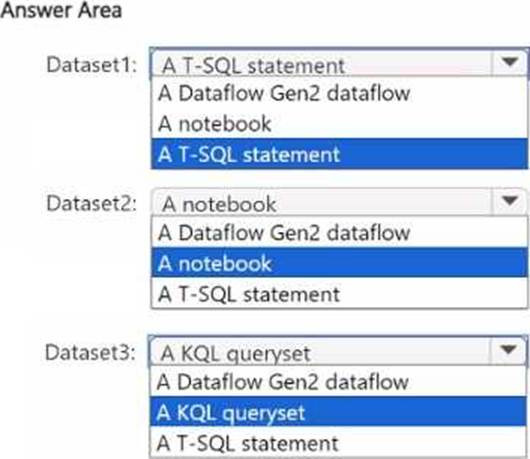
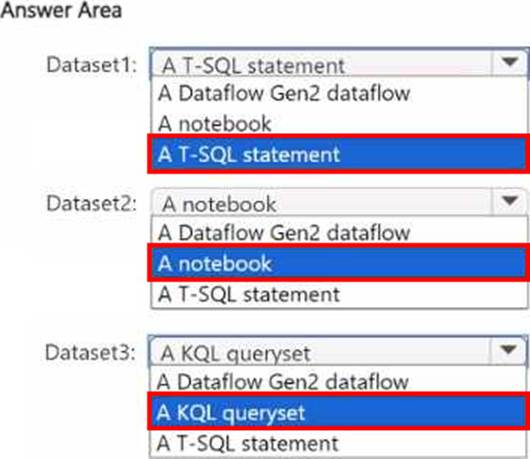
You plan to process the following three datasets by using Fabric:
• Dataset1: This dataset will be added to Fabric and will have a unique primary key between the source and the destination. The unique primary key will be an integer and will start from 1 and have an increment of 1.
• Dataset2: This dataset contains semi-structured data that uses bulk data transfer. The dataset must be handled in one process between the source and the destination. The data transformation process will include the use of custom visuals to understand and work with the dataset in development mode.
• Dataset3. This dataset is in a takehouse. The data will be bulk loaded. The data transformation process will include row-based windowing functions during the loading process.
You need to identify which type of item to use for the datasets. The solution must minimize development effort and use built-in functionality, when possible.
What should you identify for each dataset? To answer, select the appropriate options in the answer area. NOTE: Each correct selection is worth one point.
You have an Azure SQL database named DB1.
In a Fabric workspace, you deploy an eventstream named EventStreamDBI to stream record changes from DB1 into a lakehouse.
You discover that events are NOT being propagated to EventStreamDBI. You need to ensure that the events are propagated to EventStreamDBI.
What should you do?
- A . Create a read-only replica of DB1.
- B . Create an Azure Stream Analytics job.
- C . Enable Extended Events for DB1.
- D . Enable change data capture (CDC) for DB1.
HOTSPOT
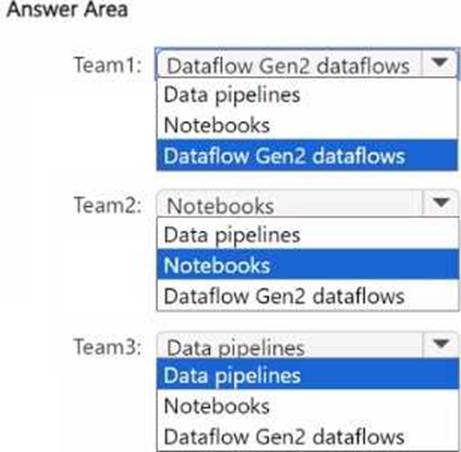
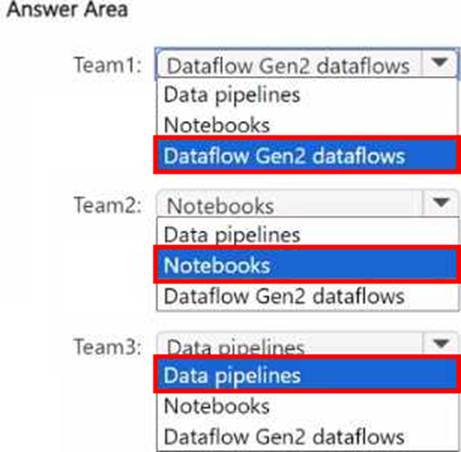
Your company has three newly created data engineering teams named Team1, Team2, and Team3 that plan to use Fabric.
The teams have the following personas:
• Team1 consists of members who currently use Microsoft Power BI. The team wants to transform data by using by a low-code approach.
• Team2 consists of members that have a background in Python programming. The team wants to use PySpark code to transform data.
• Team3 consists of members who currently use Azure Data Factory. The team wants to move data between source and sink environments by using the least amount of effort.
You need to recommend tools for the teams based on their current personas.
What should you recommend for each team? To answer, select the appropriate options in the answer area. NOTE: Each correct selection is worth one point.