
Microsoft DP-600 Practice Exams
Last updated on Oct 01,2026- Exam Code: DP-600
- Exam Name: Implementing Analytics Solutions Using Microsoft Fabric
- Certification Provider: Microsoft
- Latest update: Oct 01,2026
HOTSPOT
You have a Fabric tenant that contains a warehouse named Warehouse1. Warehouse1 contains a fact table named FactSales that has one billion rows.
You run the following T-SQL statement.
CREATE TABLE test.FactSales AS CLONE OF dbo.FactSales;
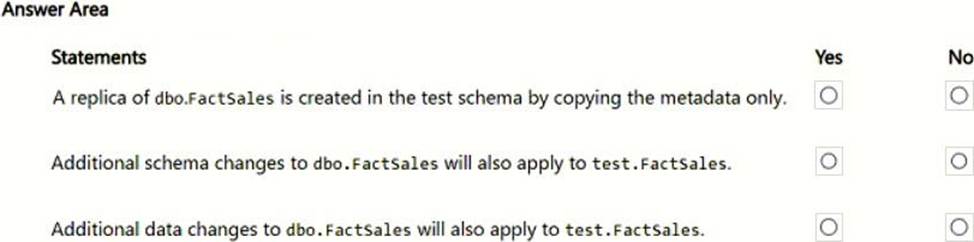
For each of the following statements, select Yes if the statement is true. Otherwise, select No. NOTE: Each correct selection is worth one point. Hot Area:
Explanation:
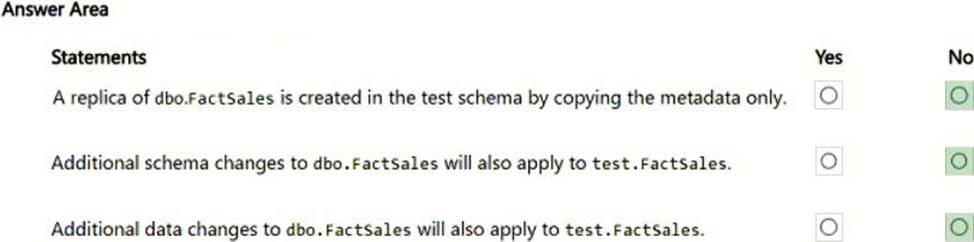
A replica of dbo.FactSales is created in the test schema by copying the metadata only. – No
The clone operation creates a full copy of both the schema and the data, not just the metadata.
Additional schema changes to dbo.FactSales will also apply to test.FactSales. – No
Once the clone is created, it is an independent copy. Any subsequent schema changes to the original table will not affect the cloned table.
Additional data changes to dbo.FactSales will also apply to test.FactSales. – No
Similarly, the data in dbo.FactSales and test.FactSales are independent after the cloning process.
Changes in one will not reflect in the other.
HOTSPOT
You have a Fabric tenant that contains a warehouse named Warehouse1. Warehouse1 contains a fact table named FactSales that has one billion rows.
You run the following T-SQL statement.
CREATE TABLE test.FactSales AS CLONE OF dbo.FactSales;
For each of the following statements, select Yes if the statement is true. Otherwise, select No. NOTE: Each correct selection is worth one point. Hot Area:
Explanation:
A replica of dbo.FactSales is created in the test schema by copying the metadata only. – No
The clone operation creates a full copy of both the schema and the data, not just the metadata.
Additional schema changes to dbo.FactSales will also apply to test.FactSales. – No
Once the clone is created, it is an independent copy. Any subsequent schema changes to the original table will not affect the cloned table.
Additional data changes to dbo.FactSales will also apply to test.FactSales. – No
Similarly, the data in dbo.FactSales and test.FactSales are independent after the cloning process.
Changes in one will not reflect in the other.
You have a Fabric tenant named Tenant1 that contains a lakehouse named Lakehouse1.
You need to add data to Lakehouse1 from a CSV file in an Azure Storage account outside of Fabric. The solution must minimize development effort.
What should you use to add the data?
- A . copy job
- B . shortcut
- C . pipeline
- D . Dataflow Gen2
B
Explanation:
A shortcut in Microsoft Fabric allows you to reference data stored in an external Azure Storage account (such as ADLS Gen2 or Azure Blob Storage) without physically copying or duplicating the data. This minimizes development effort because it eliminates the need for data ingestion, transformation, and storage replication.
When using a shortcut, Fabric users can directly access the external data in its original location while treating it as part of their Lakehouse. This provides a seamless integration without the need for extra data processing or movement.
Note: This question is part of a series of questions that present the same scenario. Each question in the series contains a unique solution that might meet the stated goals. Some question sets might have more than one correct solution, while others might not have a correct solution.
After you answer a question in this section, you will NOT be able to return to it. As a result, these questions will not appear in the review screen.
You have a Fabric tenant that contains a semantic model named Model1.
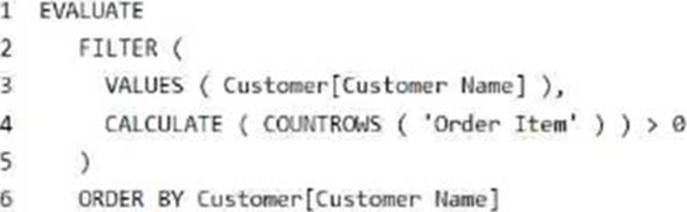
You discover that the following query performs slowly against Model1.
You need to reduce the execution time of the query.
Solution: You replace line 4 by using the following code:
CALCULATE (COUNTROWS (‘Order Item’)) >= 0
Does this meet the goal?
- A . Yes
- B . No
B
Explanation:
Correct: NOT ISEMPTY (CALCULATETABLE (‘Order Item ‘))
Just check if it is empty or not.
Note: ISEMPTY
Checks if a table is empty.
Syntax
ISEMPTY(<table_expression>)
Parameters
table_expression – A table reference or a DAX expression that returns a table.
Return value – True if the table is empty (has no rows), if else, False.
Incorrect:
* CALCULATE (COUNTROWS (‘Order Item’)) >= 0
* ISEMPTY (RELATEDTABLE (‘Order Item’))
Reference: https://learn.microsoft.com/en-us/dax/isempty-function-dax
DRAG DROP
You have a Fabric warehouse named Warehouse1 that contains a table named dbo.Product.
dbo.Product contains the following columns.

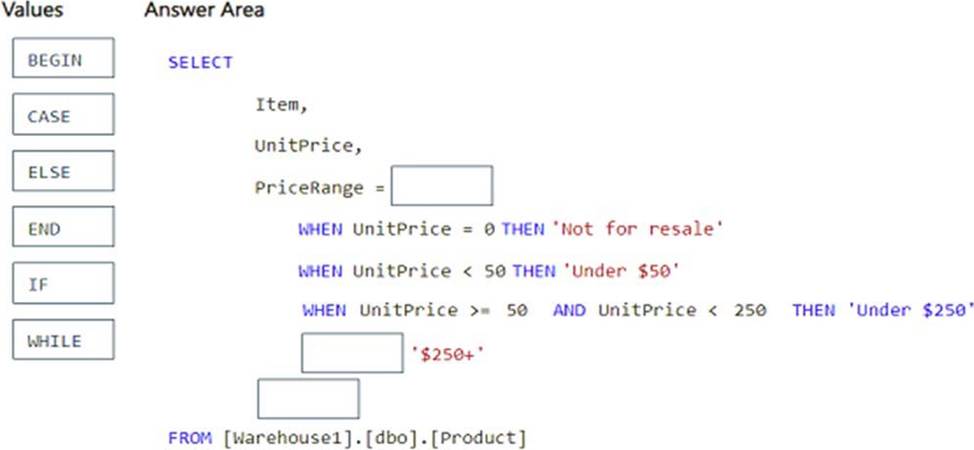
You need to use a T-SQL query to add a column named PriceRange to dbo.Product. The column must categorize each product based on UnitPrice.
The solution must meet the following requirements:
– If UnitPrice is 0, PriceRange is "Not for resale".
– If UnitPrice is less than 50, PriceRange is "Under $50".
– If UnitPrice is between 50 and 250, PriceRange is "Under $250“.
– In all other instances, PriceRange is "$250+".
How should you complete the query? To answer, drag the appropriate values to the correct targets. Each value may be used once, more than once, or not at all. You may need to drag the split bar between panes or scroll to view content. NOTE: Each correct selection is worth one point.
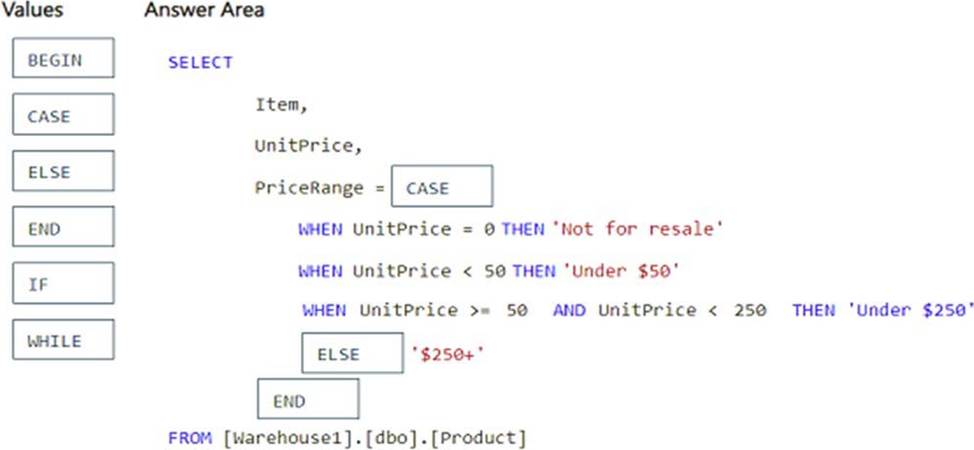
Explanation:
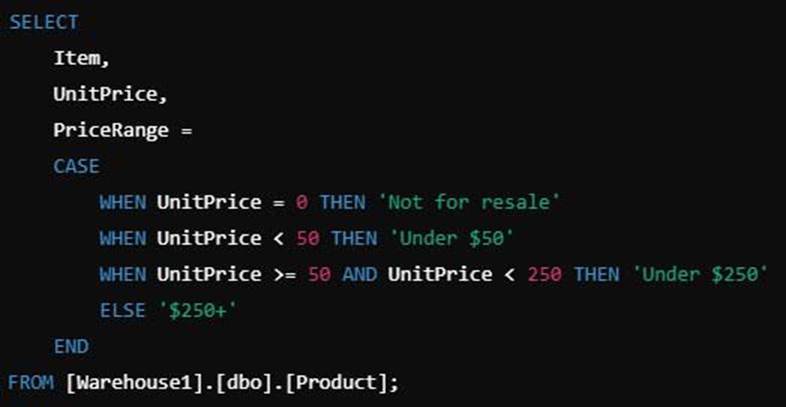
Using CASE for Conditional Logic:
– The CASE statement is used to categorize values based on conditions.
– It allows us to define multiple conditions for PriceRange based on UnitPrice.
Defining Conditions in Order of Priority:
– UnitPrice = 0 → ‘Not for resale’ (Ensuring products not for sale are labeled correctly)
– UnitPrice < 50 → ‘Under $50’ (Categorizing low-priced products)
– UnitPrice between 50 and 250 → ‘Under $250’ (Using >= 50 AND < 250 ensures the correct range)
– All other prices → ‘$250+’ (Handled by the ELSE clause)
You have a Fabric tenant that contains a warehouse named DW1 and a lakehouse named LH1. DW1 contains a table named Sales.Product. LH1 contains a table named Sales.Orders.
You plan to schedule an automated process that will create a new point-in-time (PIT) table named Sales.ProductOrder in DW1. Sales.ProductOrder will be built by using the results of a query that will join Sales.Product and Sales.Orders.
You need to ensure that the types of columns in Sales.ProductOrder match the column types in the source tables. The solution must minimize the number of operations required to create the new table.
Which operation should you use?
- A . INSERT INTO
- B . CREATE TABLE AS SELECT (CTAS)
- C . CREATE TABLE AS CLONE OF
- D . CREATE MATERIALIZED VIEW AS SELECT
B
Explanation:
The CREATE TABLE AS SELECT (CTAS) statement allows you to create a new table based on the result of a SELECT query. This method automatically defines the new table’s columns with the same names and data types as those in the result set of the query, ensuring consistency with the source tables.
You have a Microsoft Power BI semantic model that contains measures. The measures use multiple CALCULATE functions and a FILTER function.
You are evaluating the performance of the measures.
In which use case will replacing the FILTER function with the KEEPFILTERS function reduce execution time?
- A . when the FILTER function uses a nested calculate function
- B . when the FILTER function references a measure
- C . when the FILTER function references columns from multiple tables
- D . when the FILTER function references a column from a single table that uses Import mode
You have a Microsoft Power BI semantic model that contains measures. The measures use multiple CALCULATE functions and a FILTER function.
You are evaluating the performance of the measures.
In which use case will replacing the FILTER function with the KEEPFILTERS function reduce execution time?
- A . when the FILTER function uses a nested calculate function
- B . when the FILTER function references a measure
- C . when the FILTER function references columns from multiple tables
- D . when the FILTER function references a column from a single table that uses Import mode
You need to recommend a solution to prepare the tenant for the PoC.
Which two actions should you recommend performing from the Fabric Admin portal? Each correct answer presents part of the solution. NOTE: Each correct answer is worth one point.
- A . Enable the Users can try Microsoft Fabric paid features option for the entire organization.
- B . Enable the Users can try Microsoft Fabric paid features option for specific security groups.
- C . Enable the Allow Azure Active Directory guest users to access Microsoft Fabric option for specific security groups.
- D . Enable the Users can create Fabric items option and exclude specific security groups.
- E . Enable the Users can create Fabric items option for specific security groups.
BE
Explanation:
B: Fabric trial capacity for the analytics team.
Scenario: Planned Changes
Litware plans to enable Fabric features in the existing tenant. The analytics team will create a new data store as a proof of concept (PoC). The remaining Litware users will only get access to the Fabric features once the PoC is complete. The PoC will be completed by using a Fabric trial capacity.
E: Enable the Users can create Fabric items option for the data engineers.
Scenario: The data engineers will create data pipelines to load data to OneLake either hourly or daily depending on the data source. The analytics engineers will create processes to ingest, transform, and load the data to the data store in the AnalyticsPOC workspace daily. Whenever possible, the data engineers will use low-code tools for data ingestion. The choice of which data cleansing and transformation tools to use will be at the data engineers’ discretion.
You have a Microsoft Power BI report named Report1 that uses a Fabric semantic model.
Users discover that Report1 renders slowly.
You open Performance analyzer and identify that a visual named Orders By Date is the slowest to render.
The duration breakdown for Orders By Date is shown in the following table.
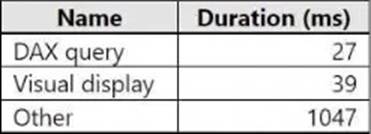
What will provide the greatest reduction in the rendering duration of Report1?
- A . Enable automatic page refresh.
- B . Optimize the DAX query of Orders By Date by using DAX Studio.
- C . Change the visual type of Orders By Date.
- D . Reduce the number of visuals in Report1.
D
Explanation:
Use Performance Analyzer to examine report element performance in Power BI Desktop
Each visual’s log information includes the time spent (duration) to complete the following categories of tasks:
DAX query – if a DAX query was required, this is the time between the visual sending the query, and for Analysis Services to return the results.
Visual display – time required for the visual to draw on the screen, including time required to retrieve any web images or geocoding.
Other – time required by the visual for preparing queries, waiting for other visuals to complete, or performing other background processing.
Reference: https://learn.microsoft.com/en-us/power-bi/create-reports/desktop-performance-analyzer