
Microsoft DP-600 Practice Exams
Last updated on Oct 01,2026- Exam Code: DP-600
- Exam Name: Implementing Analytics Solutions Using Microsoft Fabric
- Certification Provider: Microsoft
- Latest update: Oct 01,2026
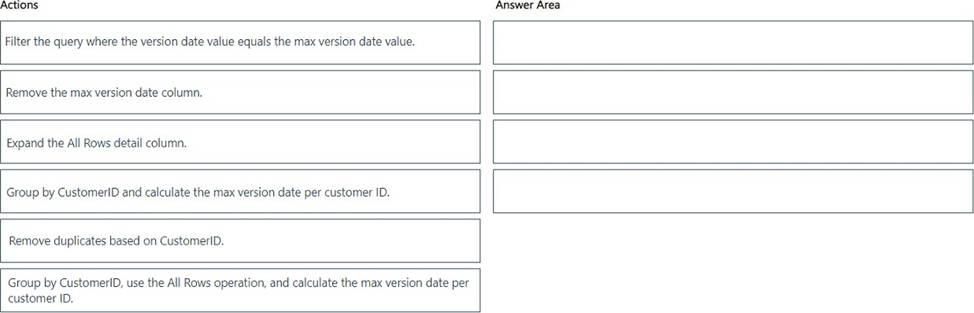
DRAG DROP
You have a Fabric workspace that contains a Dataflow Gen2 query. The query returns the following data.

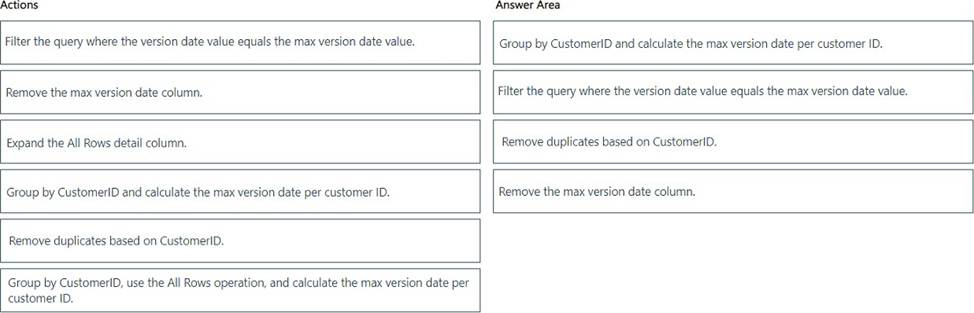
You need to filter the results to ensure that only the latest version of each customer’s record is retained.
The solution must ensure that no new columns are loaded to the semantic model.
Which four actions should you perform in sequence in Power Query Editor? To answer, move the appropriate actions from the list of actions to the answer area and arrange them in the correct order.
Explanation:
Your company has a finance department.
You have a Fabric tenant, an Azure Storage account named storage1, and a Microsoft Entra group named Group1. Group1 contains the users in the finance department.
You need to create a new workspace named Workspace1 in the tenant.
The solution must meet the following requirements:
– Ensure that the finance department users can create and edit items in Workspace1.
– Ensure that Workspace1 can securely access storage1 to read and write data.
– Ensure that you are the only admin of Workspace1.
– Minimize administrative effort.
You create Workspace1.
Which two actions should you perform next? Each correct answer presents part of the solution. NOTE: Each correct selection is worth one point.
- A . Assign the Contributor role to Group1.
- B . Create a workspace identity.
- C . Assign the Admin role to yourself.
- D . Assign the Contributor role to each finance department user.
AB
Explanation:
A: Ensure that the finance department users can create and edit items in Workspace1. Group1 contains the users in the finance department.
B: Ensure that Workspace1 can securely access storage1 to read and write data.
A Fabric workspace identity is an automatically managed service principal that can be associated with a Fabric workspace. Fabric workspaces with a workspace identity can securely read or write to firewall-enabled Azure Data Lake Storage Gen2 accounts through trusted workspace access for OneLake shortcuts. Fabric items can use the identity when connecting to resources that support Microsoft Entra authentication. Fabric uses workspace identities to obtain Microsoft Entra tokens without the customer having to manage any credentials.
Workspace identities can be created in the workspace settings of any workspace except My workspaces. A workspace identity is automatically assigned the workspace contributor role and has access to workspace items.
Incorrect:
Not D: More administrative effort.
Reference: https://learn.microsoft.com/en-us/fabric/security/workspace-identity
HOTSPOT
You have a Fabric tenant.
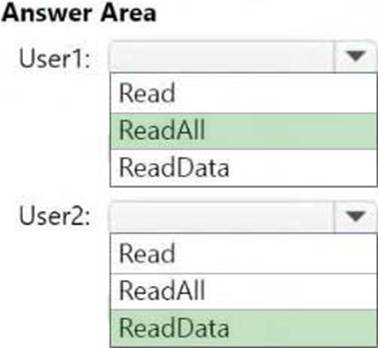
You need to configure OneLake security for users shown in the following table.
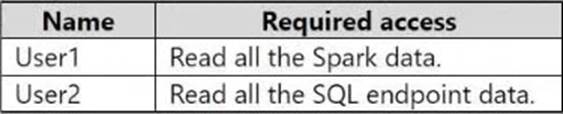
The solution must follow the principle of least privilege.
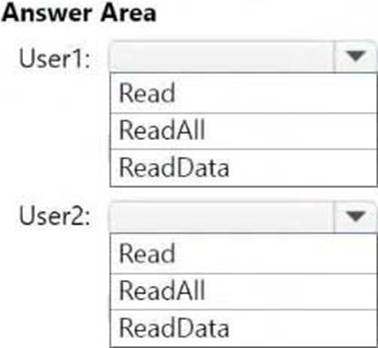
Which permission should you assign to each user? To answer, select the appropriate options in the answer area. NOTE: Each correct selection is worth one point.
Explanation:
Box 1: ReadAll
User1, Read all the Spark data
If the “Read all Apache Spark” box is checked, users will be given ReadAll. This permission allows users to access data in OneLake. This could be through direct OneLake access, Apache Spark queries, or the lakehouse UX.
Box 2: ReadData
User2, Read all the SQL endpoint data
If the “Read all SQL endpoint data” is checked, users will be given the ReadData permission. ReadData gives access to all Tables in the item when accessing through the SQL Endpoint. Users will not be able to access OneLake directly.
Reference: https://support.fabric.microsoft.com/en-us/blog/building-common-data-architectures-with-onelake-in-microsoft-fabric
Note: This section contains one or more sets of questions with the same scenario and problem. Each question presents a unique solution to the problem. You must determine whether the solution meets the stated goals. More than one solution in the set might solve the problem. It is also possible that none of the solutions in the set solve the problem.
After you answer a question in this section, you will NOT be able to return. As a result, these questions do not appear on the Review Screen.
Your network contains an on-premises Active Directory Domain Services (AD DS) domain named contoso.com that syncs with a Microsoft Entra tenant by using Microsoft Entra Connect.
You have a Fabric tenant that contains a semantic model.
You enable dynamic row-level security (RLS) for the model and deploy the model to the Fabric service.
You query a measure that includes the USERNAME() function, and the query returns a blank result.
You need to ensure that the measure returns the user principal name (UPN) of a user.
Solution: You create a role in the model.
Does this meet the goal?
- A . Yes
- B . No
B
Explanation:
No, creating a role in the model alone does not ensure that the USERNAME() function returns the user’s
User Principal Name (UPN). To achieve this, you should use the USERPRINCIPALNAME() function in your measure, as it consistently returns the user’s UPN across different environments.
You need to create a Microsoft Power BI file that will be used to create multiple reports.
The solution must meet the following requirements:
– The file must include predefined data source connections.
– The file must include the report structure and formatting.
– The file must NOT contain any data.
Which file format should you use?
- A . PBIT
- B . PBIDS
- C . PBIX
- D . PBIP
B
Explanation:
Use PBIDS files to get data
PBIDS files are Power BI Desktop files that have a specific structure and a .pbids extension to identify them as Power BI data source files.
You can create a PBIDS file to streamline the Get Data experience for new or beginner report creators in your organization. If you create the PBIDS file from existing reports, it’s easier for beginning report authors to build new reports from the same data.
Note: How to create a PBIDS connection file
If you have an existing Power BI Desktop PBIX file already connected to the data you’re interested in, you can export the connection files from within Power BI Desktop. This method is recommended, since the PBIDS file can be autogenerated from Desktop. You can also still edit or manually create the file in a text editor.
You need to create a Microsoft Power BI file that will be used to create multiple reports.
The solution must meet the following requirements:
– The file must include predefined data source connections.
– The file must include the report structure and formatting.
– The file must NOT contain any data.
Which file format should you use?
- A . PBIT
- B . PBIDS
- C . PBIX
- D . PBIP
B
Explanation:
Use PBIDS files to get data
PBIDS files are Power BI Desktop files that have a specific structure and a .pbids extension to identify them as Power BI data source files.
You can create a PBIDS file to streamline the Get Data experience for new or beginner report creators in your organization. If you create the PBIDS file from existing reports, it’s easier for beginning report authors to build new reports from the same data.
Note: How to create a PBIDS connection file
If you have an existing Power BI Desktop PBIX file already connected to the data you’re interested in, you can export the connection files from within Power BI Desktop. This method is recommended, since the PBIDS file can be autogenerated from Desktop. You can also still edit or manually create the file in a text editor.
You need to create a Microsoft Power BI file that will be used to create multiple reports.
The solution must meet the following requirements:
– The file must include predefined data source connections.
– The file must include the report structure and formatting.
– The file must NOT contain any data.
Which file format should you use?
- A . PBIT
- B . PBIDS
- C . PBIX
- D . PBIP
B
Explanation:
Use PBIDS files to get data
PBIDS files are Power BI Desktop files that have a specific structure and a .pbids extension to identify them as Power BI data source files.
You can create a PBIDS file to streamline the Get Data experience for new or beginner report creators in your organization. If you create the PBIDS file from existing reports, it’s easier for beginning report authors to build new reports from the same data.
Note: How to create a PBIDS connection file
If you have an existing Power BI Desktop PBIX file already connected to the data you’re interested in, you can export the connection files from within Power BI Desktop. This method is recommended, since the PBIDS file can be autogenerated from Desktop. You can also still edit or manually create the file in a text editor.
Note: This question is part of a series of questions that present the same scenario. Each question in the series contains a unique solution that might meet the stated goals. Some question sets might have more than one correct solution, while others might not have a correct solution.
After you answer a question in this section, you will NOT be able to return to it. As a result, these questions will not appear in the review screen.
You have a Fabric tenant that contains a semantic model named Model1.
You discover that the following query performs slowly against Model1.
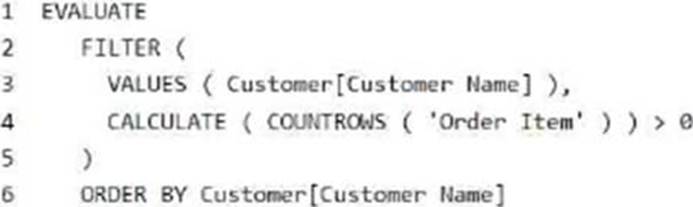
You need to reduce the execution time of the query.
Solution: You replace line 4 by using the following code:
ISEMPTY (RELATEDTABLE (‘Order Item’))
Does this meet the goal?
- A . Yes
- B . No
B
Explanation:
Correct: NOT ISEMPTY (CALCULATETABLE (‘Order Item ‘))
Just check if it is empty or not.
Note: ISEMPTY
Checks if a table is empty.
Syntax
ISEMPTY(<table_expression>)
Parameters
table_expression – A table reference or a DAX expression that returns a table.
Return value – True if the table is empty (has no rows), if else, False.
Incorrect:
* CALCULATE (COUNTROWS (‘Order Item’)) >= 0
* ISEMPTY (RELATEDTABLE (‘Order Item’))
Reference: https://learn.microsoft.com/en-us/dax/isempty-function-dax
You have a Fabric tenant that contains two workspaces named Workspace1 and Workspace2 and a user named User1.
You need to ensure that User1 can perform the following tasks:
– Create a new domain.
– Create two subdomains named subdomain1 and subdomain2.
– Assign Workspace1 to subdomain1.
– Assign Workspace2 to subdomain2.
The solution must follow the principle of least privilege.
Which role should you assign to User1?
- A . domain admin
- B . domain contributor
- C . Fabric admin
- D . workspace Admin
A
Explanation:
To achieve the tasks described, User1 needs permissions to manage domains and assign workspaces to subdomains. Here’s a breakdown of the required tasks and the permissions needed:
You are the administrator of a Fabric workspace that contains a lakehouse named Lakehouse1.
Lakehouse1 contains the following tables:
– Table1: A Delta table created by using a shortcut
– Table2: An external table created by using Spark
– Table3: A managed table
You plan to connect to Lakehouse1 by using its SQL endpoint.
What will you be able to do after connecting to Lakehouse1?
- A . Read Table3.
- B . Update the data Table3.
- C . Read Table2.
- D . Update the data in Table1.