
Microsoft DP-600 Practice Exams
Last updated on Oct 02,2026- Exam Code: DP-600
- Exam Name: Implementing Analytics Solutions Using Microsoft Fabric
- Certification Provider: Microsoft
- Latest update: Oct 02,2026
HOTSPOT
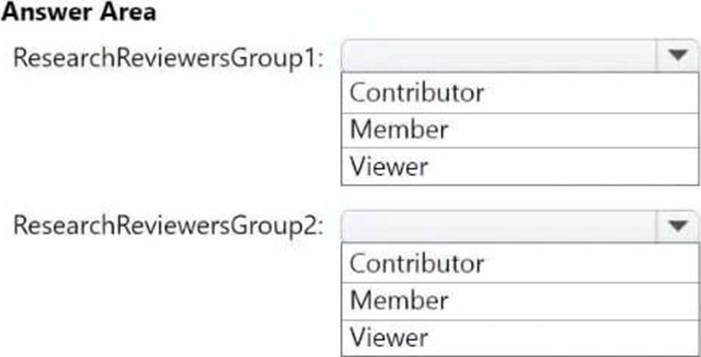
Which workspace role assignments should you recommend for ResearchReviewersGroup1 and ResearchReviewersGroup2? To answer, select the appropriate options in the answer area. NOTE: Each correct selection is worth one point.
Explanation:
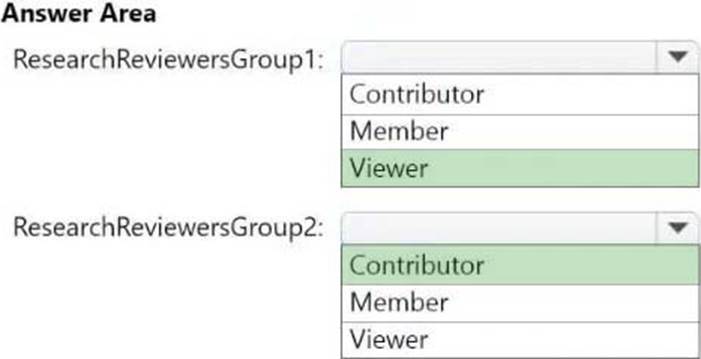
Box 1: Viewer
ResearchReviewersGroup1
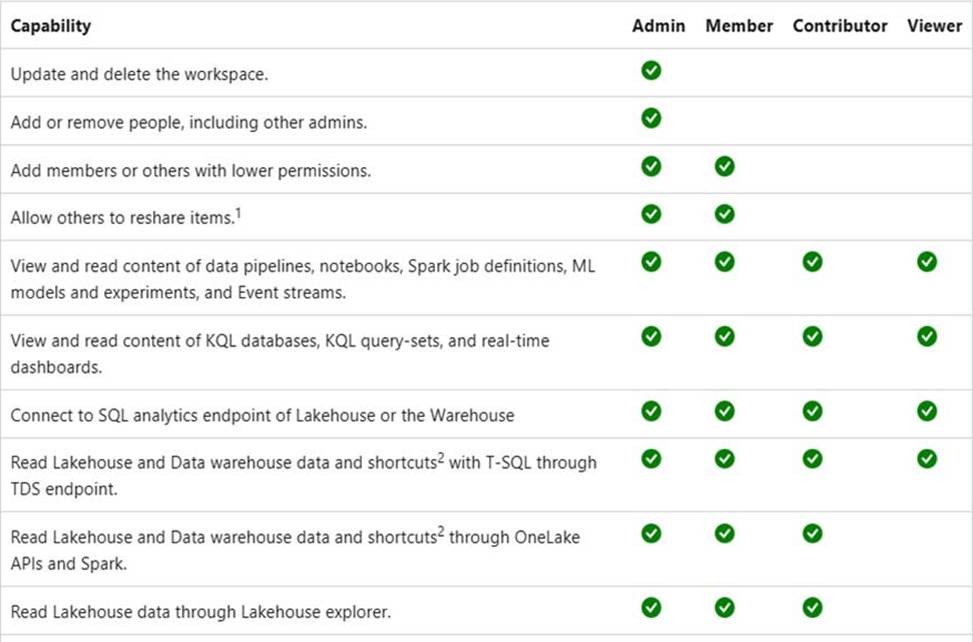
For the Research division workspaces, the members of ResearchReviewersGroup1 must be able to read lakehouse and warehouse data and shortcuts by using SQL endpoints.
Workspace roles in Lakehouse
Workspace roles define what user can do with Microsoft Fabric items. Roles can be assigned to individuals or security groups from workspace view. See, Give users access to workspaces.
The user can be assigned to the following roles:
Admin
Member
Contributor
Viewer
In a lakehouse the users with Admin, Member, and Contributor roles can perform all CRUD (CREATE, READ, UPDATE and DELETE) operations on all data. A user with Viewer role can only read data stored in Tables using the SQL analytics endpoint.
Box 2: Contributor
ResearchReviewersGroup2
For the Research division workspaces, the members of ResearchReviewersGroup2 must be able to read lakehouse data by using Lakehouse explorer.
Microsoft Fabric workspace roles
Etc.
Incorrect:
* Member
More permissions compared to Contributor
Scenario:
Identity Environment
Contoso has a Microsoft Entra tenant named contoso.com. The tenant contains two groups named ResearchReviewersGroup1 and ResearchReviewersGroup2.
Reference: https://learn.microsoft.com/en-us/fabric/data-engineering/workspace-roles-lakehouse
https://learn.microsoft.com/en-us/fabric/get-started/roles-workspaces
HOTSPOT
Which workspace role assignments should you recommend for ResearchReviewersGroup1 and ResearchReviewersGroup2? To answer, select the appropriate options in the answer area. NOTE: Each correct selection is worth one point.
Explanation:
Box 1: Viewer
ResearchReviewersGroup1
For the Research division workspaces, the members of ResearchReviewersGroup1 must be able to read lakehouse and warehouse data and shortcuts by using SQL endpoints.
Workspace roles in Lakehouse
Workspace roles define what user can do with Microsoft Fabric items. Roles can be assigned to individuals or security groups from workspace view. See, Give users access to workspaces.
The user can be assigned to the following roles:
Admin
Member
Contributor
Viewer
In a lakehouse the users with Admin, Member, and Contributor roles can perform all CRUD (CREATE, READ, UPDATE and DELETE) operations on all data. A user with Viewer role can only read data stored in Tables using the SQL analytics endpoint.
Box 2: Contributor
ResearchReviewersGroup2
For the Research division workspaces, the members of ResearchReviewersGroup2 must be able to read lakehouse data by using Lakehouse explorer.
Microsoft Fabric workspace roles
Etc.
Incorrect:
* Member
More permissions compared to Contributor
Scenario:
Identity Environment
Contoso has a Microsoft Entra tenant named contoso.com. The tenant contains two groups named ResearchReviewersGroup1 and ResearchReviewersGroup2.
Reference: https://learn.microsoft.com/en-us/fabric/data-engineering/workspace-roles-lakehouse
https://learn.microsoft.com/en-us/fabric/get-started/roles-workspaces
You have a Fabric tenant that contains a workspace named Workspace1. Workspace1 contains a data pipeline named Pipeline1 and a lakehouse named Lakehouse1.
You perform the following actions:
– Create a workspace named Workspace2.
– Create a deployment pipeline named DeployPipeline1 that will deploy items from Workspace1 to Workspace2.
– Add a folder named Folder1 to Workspace1.
– Move Lakehouse1 to Folder1.
– Run DeployPipeline1.
Which structure will Workspace2 have when DeployPipeline1 is complete?
- A . Folder1Pipeline1
Folder1Lakehouse1 - B . Pipeline1
Lakehouse1 - C . Pipeline1
Folder1Lakehouse1 - D . Folder1Lakehouse1
D
Explanation:
The folder structure is copied.
Note 1:
Folders in deployment pipelines
Folders enable users to efficiently organize and manage workspace items in a familiar way. When you deploy content that contains folders to a different stage, the folder hierarchy of the applied items is automatically applied.
In Deployment pipelines, folders are considered part of an item’s name (an item name includes its full path).
Note 2: Microsoft Fabric, The deployment pipelines process
The deployment process lets you clone content from one stage in the deployment pipeline to another, typically from development to test, and from test to production.
During deployment, Microsoft Fabric copies the content from the source stage to the target stage. The connections between the copied items are kept during the copy process.
Deploying content from a working production pipeline to a stage that has an existing workspace, includes the following steps:
Deploying new content as an addition to the content already there.
Deploying updated content to replace some of the content already there.
Reference:
https://learn.microsoft.com/en-us/fabric/cicd/deployment-pipelines/understand-the-deployment-process
https://learn.microsoft.com/en-us/fabric/cicd/deployment-pipelines/understand-the-deployment-process
Note: This question is part of a series of questions that present the same scenario. Each question in the series contains a unique solution that might meet the stated goals. Some question sets might have more than one correct solution, while others might not have a correct solution.
After you answer a question in this section, you will NOT be able to return to it. As a result, these questions will not appear in the review screen.
You have a Fabric tenant that contains a new semantic model in OneLake.
You use a Fabric notebook to read the data into a Spark DataFrame.
You need to evaluate the data to calculate the min, max, mean, and standard deviation values for all the
string and numeric columns.
Solution: You use the following PySpark expression:
df.show()
Does this meet the goal?
- A . Yes
- B . No
B
Explanation:
Correct Solution: You use the following PySpark expression:
df.summary()
summary(*statistics)[source]
Computes specified statistics for numeric and string columns. Available statistics are: – count – mean – stddev – min – max – arbitrary approximate percentiles specified as a percentage (eg, 75%)
If no statistics are given, this function computes count, mean, stddev, min, approximate quartiles (percentiles at 25%, 50%, and 75%), and max.
Note This function is meant for exploratory data analysis, as we make no guarantee about the backward compatibility of the schema of the resulting DataFrame.
>>> df.summary().show() +——-+——————+—–+
| stddev|2.1213203435596424| null|
Incorrect:
* df.show()
* df.explain().show()
* df.explain()
explain(extended=False)[source]
Prints the (logical and physical) plans to the console for debugging purpose.
Parameters: extended C boolean, default False. If False, prints only the physical plan.
>>> df.explain()
== Physical Plan ==
Scan ExistingRDD[age#0,name#1]
>>> df.explain(True)
== Parsed Logical Plan ==
…
== Analyzed Logical Plan ==
…
== Optimized Logical Plan ==
…
== Physical Plan ==
Reference: https://spark.apache.org/docs/2.3.0/api/python/pyspark.sql.html
You have a Fabric tenant that contains a lakehouse.
You plan to query sales data files by using the SQL endpoint. The files will be in an Amazon Simple Storage Service (Amazon S3) storage bucket.
You need to recommend which file format to use and where to create a shortcut.
Which two actions should you include in the recommendation? Each correct answer presents part of the solution. NOTE: Each correct answer is worth one point.
- A . Create a shortcut in the Files section.
- B . Use the Parquet format
- C . Use the CSV format.
- D . Create a shortcut in the Tables section.
- E . Use the delta format.
HOTSPOT
You have a Fabric warehouse that contains the following data.
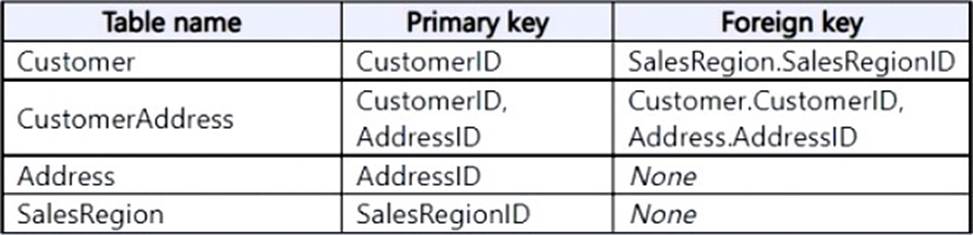
The data has the following characteristics:
– Each customer is assigned a unique CustomerID value.
– Each customer is associated to a single SalesRegion value.
– Each customer is associated to a single CustomerAddress value.
– The Customer table contains 5 million rows.
– All foreign key values are non-null.
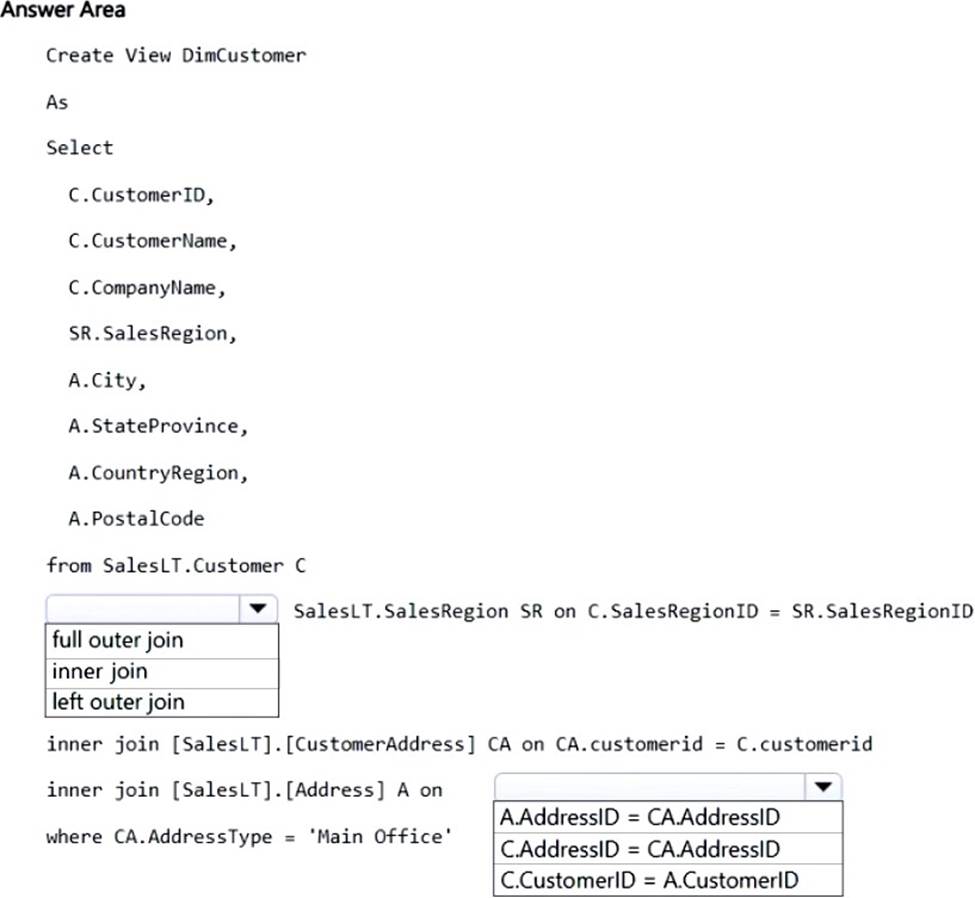
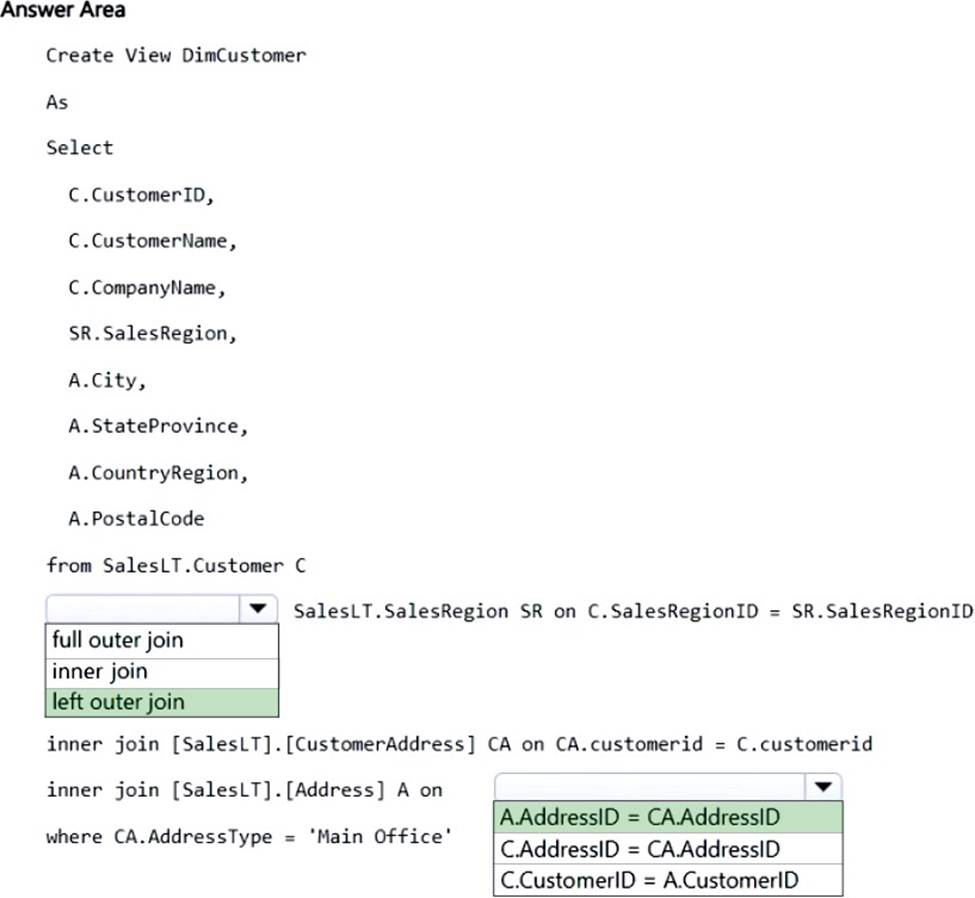
You need to create a view to denormalize the data into a customer dimension that contains one row per distinct CustomerID value. The solution must minimize query processing time and resources.
How should you complete the T-SQL statement? To answer, select the appropriate options in the answer area. NOTE: Each correct selection is worth one point.
Explanation:
Box 1: left outer join
A join between the Customer table and the SalesRegion table.
We denormalize with a left out join.
Incorrect:
* Inner join
Box 2: A.AdressID = CA.AddressID
The Address Table, abbreviated A, and the CustomerAddress table, abbreviated CA, both have AddressID columns.
HOTSPOT
You have a Fabric warehouse that contains the following data.
The data has the following characteristics:
– Each customer is assigned a unique CustomerID value.
– Each customer is associated to a single SalesRegion value.
– Each customer is associated to a single CustomerAddress value.
– The Customer table contains 5 million rows.
– All foreign key values are non-null.
You need to create a view to denormalize the data into a customer dimension that contains one row per distinct CustomerID value. The solution must minimize query processing time and resources.
How should you complete the T-SQL statement? To answer, select the appropriate options in the answer area. NOTE: Each correct selection is worth one point.
Explanation:
Box 1: left outer join
A join between the Customer table and the SalesRegion table.
We denormalize with a left out join.
Incorrect:
* Inner join
Box 2: A.AdressID = CA.AddressID
The Address Table, abbreviated A, and the CustomerAddress table, abbreviated CA, both have AddressID columns.
HOTSPOT
You have a Fabric tenant that contains a workspace named Workspace1. Workspace1 contains a lakehouse named Lakehouse1 and a warehouse named Warehouse1.
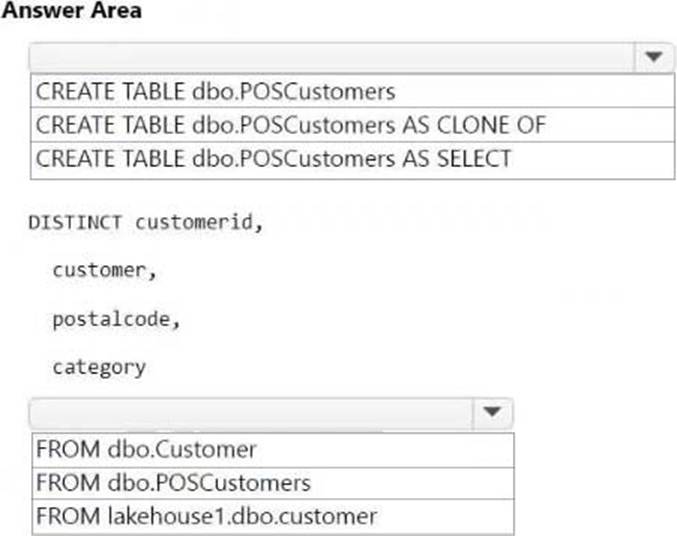
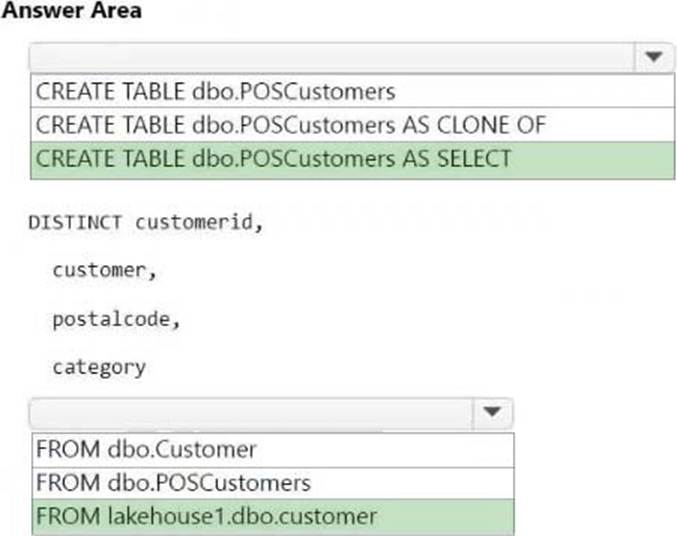
You need to create a new table in Warehouse1 named POSCustomers by querying the customer table in Lakehouse1.
How should you complete the T-SQL statement? To answer, select the appropriate options in the answer area. NOTE: Each correct selection is worth one point.
Explanation:
Box 1: CREATE TABLE dbo.POSCustomers as SELECT
Box 2: FROM lakehous1.dbo.customer
Specify the lakehouse and the table within the lakehouse.
You have a Fabric tenant that contains a warehouse. The warehouse uses row-level security (RLS).
You create a Direct Lake semantic model that uses the Delta tables and RLS of the warehouse.
When users interact with a report built from the model, which mode will be used by the DAX queries?
- A . DirectQuery
- B . Dual
- C . Direct Lake
- D . Import
You have a Fabric workspace named Workspace1.
Workspace1 contains multiple semantic models, including a model named Model1. Model1 is updated by using an XMLA endpoint.
You need to increase the speed of the write operations of the XMLA endpoint.
What should you do?
- A . Delete any unused semantic models from Workspace1.
- B . Select Large semantic model storage format for Workspace1.
- C . Configure Model 1 to use the Direct Lake storage format.
- D . Delete any unused columns from Model1.
C
Explanation:
The Direct Lake storage format in Microsoft Fabric allows semantic models to read data directly from OneLake without requiring data movement or import. This significantly improves the performance of write operations when updating a model via the XMLA endpoint by eliminating the need for data duplication or transformation.