Microsoft DP-100 Practice Exams
Last updated on Nov 16,2026- Exam Code: DP-100
- Exam Name: Designing and Implementing a Data Science Solution on Azure
- Certification Provider: Microsoft
- Latest update: Nov 16,2026
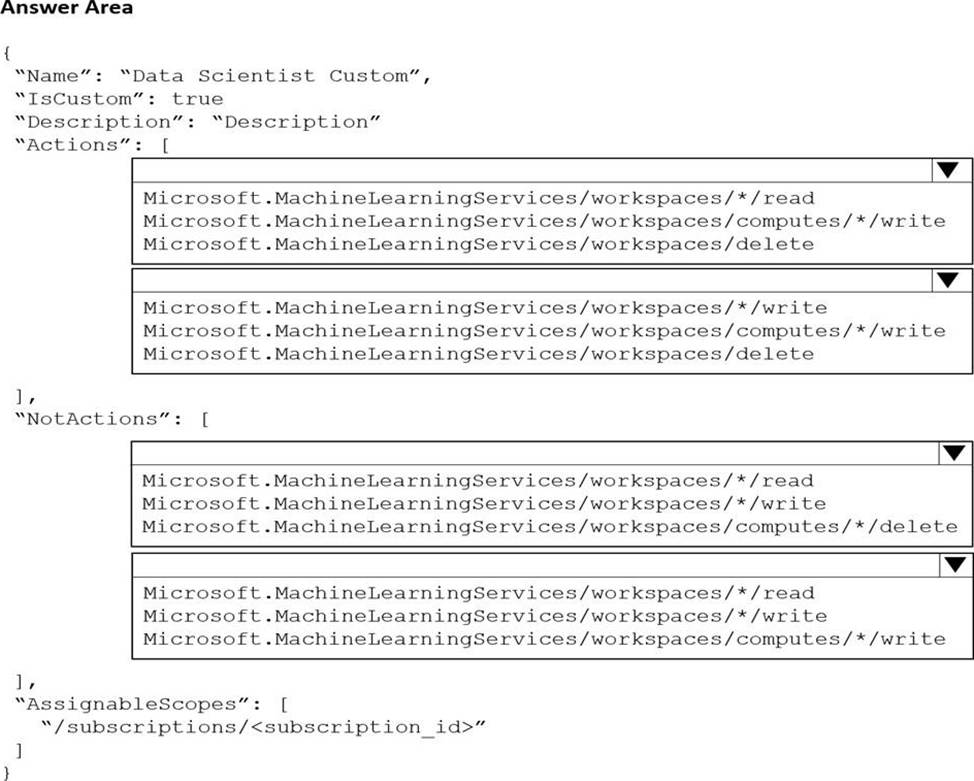
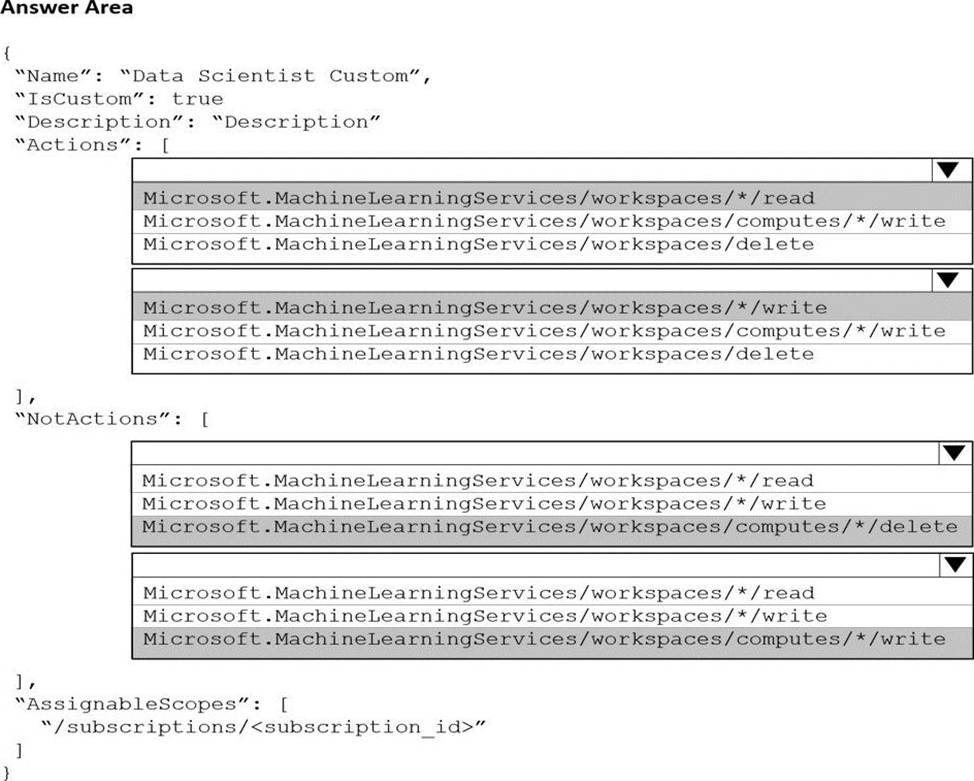
HOTSPOT
You are the owner of an Azure Machine Learning workspace.
You must prevent the creation or deletion of compute resources by using a custom role. You must allow all other operations inside the workspace.
You need to configure the custom role.
How should you complete the configuration? To answer, select the appropriate options in the answer area. NOTE: Each correct selection is worth one point.
Topic 1, Case Study 1
Overview
You are a data scientist in a company that provides data science for professional sporting events.
Models will be global and local market data to meet the following business goals:
• Understand sentiment of mobile device users at sporting events based on audio from crowd reactions.
• Access a user’s tendency to respond to an advertisement.
• Customize styles of ads served on mobile devices.
• Use video to detect penalty events.
Current environment
Requirements
• Media used for penalty event detection will be provided by consumer devices. Media may include images and videos captured during the sporting event and snared using social media. The images and videos will have varying sizes and formats.
• The data available for model building comprises of seven years of sporting event media. The sporting event media includes: recorded videos, transcripts of radio commentary, and logs from related social media feeds feeds captured during the sporting events.
• Crowd sentiment will include audio recordings submitted by event attendees in both mono and stereo Formats.
Advertisements
• Ad response models must be trained at the beginning of each event and applied during the sporting event.
• Market segmentation nxxlels must optimize for similar ad resporr.r history.
• Sampling must guarantee mutual and collective exclusivity local and global segmentation models that share the same features.
• Local market segmentation models will be applied before determining a user’s propensity to respond to an advertisement.
• Data scientists must be able to detect model degradation and decay.
• Ad response models must support non linear boundaries features.
• The ad propensity model uses a cut threshold is 0.45 and retrains occur if weighted Kappa deviates from 0.1 +/-5%.
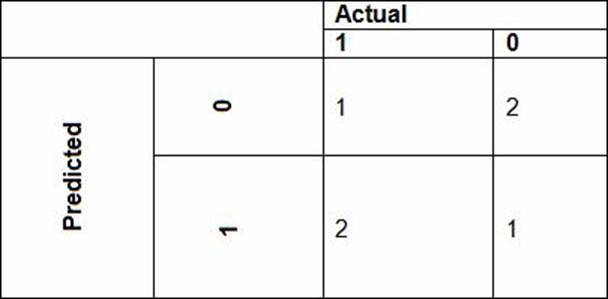
• The ad propensity model uses cost factors shown in the following diagram:
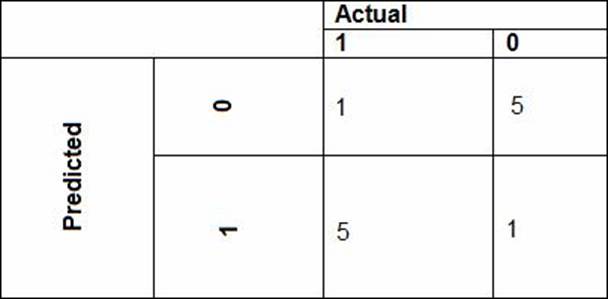
• The ad propensity model uses proposed cost factors shown in the following diagram:
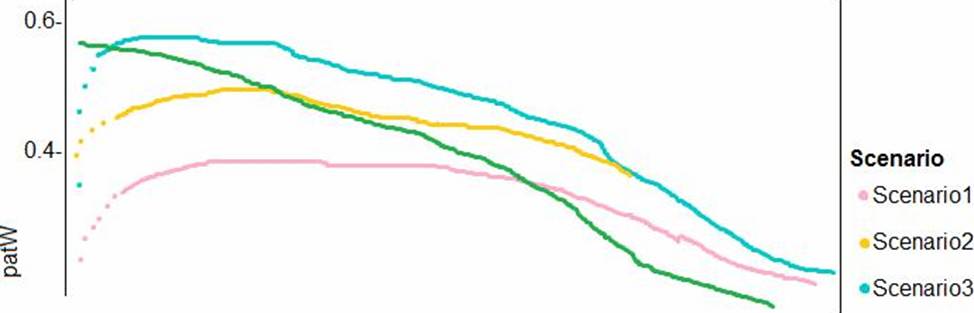
Performance curves of current and proposed cost factor scenarios are shown in the following diagram:
Penalty detection and sentiment
Findings
• Data scientists must build an intelligent solution by using multiple machine learning models for penalty event detection.
• Data scientists must build notebooks in a local environment using automatic feature engineering and model building in machine learning pipelines.
• Notebooks must be deployed to retrain by using Spark instances with dynamic worker allocation
• Notebooks must execute with the same code on new Spark instances to recode only the source of the data.
• Global penalty detection models must be trained by using dynamic runtime graph computation during training.
• Local penalty detection models must be written by using BrainScript.
• Experiments for local crowd sentiment models must combine local penalty detection data.
• Crowd sentiment models must identify known sounds such as cheers and known catch phrases. Individual crowd sentiment models will detect similar sounds.
• All shared features for local models are continuous variables.
• Shared features must use double precision. Subsequent layers must have aggregate running mean and standard deviation metrics Available.
segments
During the initial weeks in production, the following was observed:
• Ad response rates declined.
• Drops were not consistent across ad styles.
• The distribution of features across training and production data are not consistent.
Analysis shows that of the 100 numeric features on user location and behavior, the 47 features that come from location sources are being used as raw features. A suggested experiment to remedy the bias and variance issue is to engineer 10 linearly uncorrected features.
Penalty detection and sentiment
• Initial data discovery shows a wide range of densities of target states in training data used for crowd sentiment models.
• All penalty detection models show inference phases using a Stochastic Gradient Descent (SGD) are running too stow.
• Audio samples show that the length of a catch phrase varies between 25%-47%, depending on region.
• The performance of the global penalty detection models show lower variance but higher bias when comparing training and validation sets. Before implementing any feature changes, you must confirm the bias and variance using all training and validation cases.
You need to resolve the local machine learning pipeline performance issue.
What should you do?
- A . Increase Graphic Processing Units (GPUs).
- B . Increase the learning rate.
- C . Increase the training iterations,
- D . Increase Central Processing Units (CPUs).
Topic 1, Case Study 1
Overview
You are a data scientist in a company that provides data science for professional sporting events.
Models will be global and local market data to meet the following business goals:
• Understand sentiment of mobile device users at sporting events based on audio from crowd reactions.
• Access a user’s tendency to respond to an advertisement.
• Customize styles of ads served on mobile devices.
• Use video to detect penalty events.
Current environment
Requirements
• Media used for penalty event detection will be provided by consumer devices. Media may include images and videos captured during the sporting event and snared using social media. The images and videos will have varying sizes and formats.
• The data available for model building comprises of seven years of sporting event media. The sporting event media includes: recorded videos, transcripts of radio commentary, and logs from related social media feeds feeds captured during the sporting events.
• Crowd sentiment will include audio recordings submitted by event attendees in both mono and stereo Formats.
Advertisements
• Ad response models must be trained at the beginning of each event and applied during the sporting event.
• Market segmentation nxxlels must optimize for similar ad resporr.r history.
• Sampling must guarantee mutual and collective exclusivity local and global segmentation models that share the same features.
• Local market segmentation models will be applied before determining a user’s propensity to respond to an advertisement.
• Data scientists must be able to detect model degradation and decay.
• Ad response models must support non linear boundaries features.
• The ad propensity model uses a cut threshold is 0.45 and retrains occur if weighted Kappa deviates from 0.1 +/-5%.
• The ad propensity model uses cost factors shown in the following diagram:
• The ad propensity model uses proposed cost factors shown in the following diagram:
Performance curves of current and proposed cost factor scenarios are shown in the following diagram:
Penalty detection and sentiment
Findings
• Data scientists must build an intelligent solution by using multiple machine learning models for penalty event detection.
• Data scientists must build notebooks in a local environment using automatic feature engineering and model building in machine learning pipelines.
• Notebooks must be deployed to retrain by using Spark instances with dynamic worker allocation
• Notebooks must execute with the same code on new Spark instances to recode only the source of the data.
• Global penalty detection models must be trained by using dynamic runtime graph computation during training.
• Local penalty detection models must be written by using BrainScript.
• Experiments for local crowd sentiment models must combine local penalty detection data.
• Crowd sentiment models must identify known sounds such as cheers and known catch phrases. Individual crowd sentiment models will detect similar sounds.
• All shared features for local models are continuous variables.
• Shared features must use double precision. Subsequent layers must have aggregate running mean and standard deviation metrics Available.
segments
During the initial weeks in production, the following was observed:
• Ad response rates declined.
• Drops were not consistent across ad styles.
• The distribution of features across training and production data are not consistent.
Analysis shows that of the 100 numeric features on user location and behavior, the 47 features that come from location sources are being used as raw features. A suggested experiment to remedy the bias and variance issue is to engineer 10 linearly uncorrected features.
Penalty detection and sentiment
• Initial data discovery shows a wide range of densities of target states in training data used for crowd sentiment models.
• All penalty detection models show inference phases using a Stochastic Gradient Descent (SGD) are running too stow.
• Audio samples show that the length of a catch phrase varies between 25%-47%, depending on region.
• The performance of the global penalty detection models show lower variance but higher bias when comparing training and validation sets. Before implementing any feature changes, you must confirm the bias and variance using all training and validation cases.
You need to resolve the local machine learning pipeline performance issue.
What should you do?
- A . Increase Graphic Processing Units (GPUs).
- B . Increase the learning rate.
- C . Increase the training iterations,
- D . Increase Central Processing Units (CPUs).
An organization creates and deploys a multi-class image classification deep learning model that uses
a set of labeled photographs.
The software engineering team reports there is a heavy inferencing load for the prediction web services during the summer. The production web service for the model fails to meet demand despite having a fully-utilized compute cluster where the web service is deployed.
You need to improve performance of the image classification web service with minimal downtime and minimal administrative effort.
What should you advise the IT Operations team to do?
- A . Increase the minimum node count of the compute cluster where the web service is deployed.
- B . Create a new compute cluster by using larger VM sizes for the nodes, redeploy the web service to that cluster, and update the DNS registration for the service endpoint to point to the new cluster.
- C . Increase the VM size of nodes in the compute cluster where the web service is deployed.
- D . Increase the node count of the compute cluster where the web service is deployed.
You have an Azure Machine Learning workspace.
You plan to use the workspace to set up automated machine learning training for an image classification model.
You need to choose the primary metric to optimize the model training.
Which primary metric should you choose?
- A . r2_score
- B . mean_absolute_error
- C . accuracy
- D . root_mean_squared_log_error
You create an Azure Machine Learning workspace.
You must use the Python SDK v2 to implement an experiment from a Jupyter notebook in the workspace. The experiment must log string metrics. You need to implement the method to log the string metrics.
Which method should you use?
- A . mlflowlog_metrk()
- B . mlflow.log.dict()
- C . mlflow.log text()
- D . mlflow.log_artifact()
Note: This question is part of a series of questions that present the same scenario. Each question in the series contains a unique solution that might meet the stated goals. Some question sets might have more than one correct solution, while others might not have a correct solution.
After you answer a question in this section, you will NOT be able to return to it. As a result, these questions will not appear in the review screen.
An IT department creates the following Azure resource groups and resources:
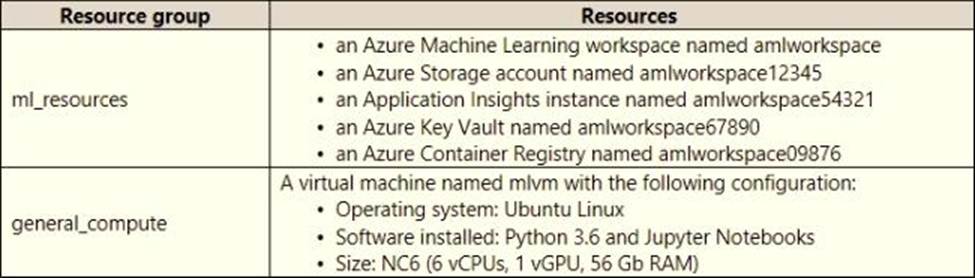
The IT department creates an Azure Kubernetes Service (AKS)-based inference compute target named aks-cluster in the Azure Machine Learning workspace.
You have a Microsoft Surface Book computer with a GPU. Python 3.6 and Visual Studio Code are installed.
You need to run a script that trains a deep neural network (DNN) model and logs the loss and accuracy metrics.
Solution: Install the Azure ML SDK on the Surface Book. Run Python code to connect to the workspace and then run the training script as an experiment on local compute.
- A . Yes
- B . No
You create an Azure Machine Learning workspace named ML-workspace. You also create an Azure Databricks workspace named DB-workspace. DB-workspace contains a cluster named DB-cluster.
You must use DB-cluster to run experiments from notebooks that you import into DB-workspace.
You need to use ML-workspace to track MLflow metrics and artifacts generated by experiments running on DB-cluster. The solution must minimize the need for custom code.
What should you do?
- A . From DB-cluster, configure the Advanced Logging option.
- B . From DB-workspace. configure the Link Azure ML workspace option.
- C . From ML-workspace. create an attached compute.
- D . From ML-workspace. create a compute cluster.
You create a training pipeline by using the Azure Machine Learning designer. You need to load data into a machine learning pipeline by using the Import Data component.
Which two data sources could you use? Each correct answer presents a complete solution. NOTE: Each correct selection is worth one point
- A . Azure Blob storage container through a registered datastore
- B . Azure SQL Database
- C . URL via HTTP
- D . Azure Data Lake Storage Gen2
- E . Registered dataset
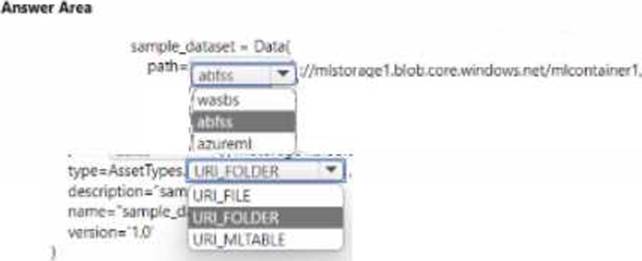
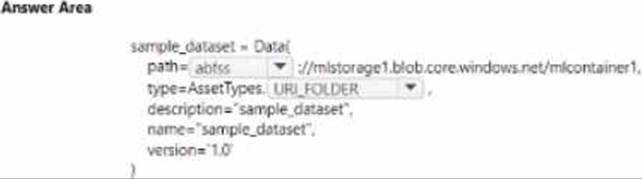
HOTSPOT
You manage an Azure Machine Learning won pace named workspace 1 by using the Python SDK v2. You create a Gene-al Purpose v2 Azure storage account named mlstorage1. The storage account includes a pulley accessible container name micOTtalnerl. The container stores 10 blobs with files in the CSV format.
You must develop Python SDK v2 code to create a data asset referencing all blobs in the container named mtcontamer1.
You need to complete the Python SDK v2 code.
How should you complete the code? To answer select the appropriate options in the answer area. NOTE: Each correct selection is worth one point.