Microsoft DP-100 Practice Exams
Last updated on Nov 16,2026- Exam Code: DP-100
- Exam Name: Designing and Implementing a Data Science Solution on Azure
- Certification Provider: Microsoft
- Latest update: Nov 16,2026
Note: This question is part of a series of questions that present the same scenario. Each question in the series contains a unique solution that might meet the stated goals. Some question sets might have more than one correct solution, while others might not have a correct solution.
After you answer a question in this section, you will NOT be able to return to it. As a result, these questions will not appear in the review screen.
You are analyzing a numerical dataset which contains missing values in several columns.
You must clean the missing values using an appropriate operation without affecting the dimensionality of the feature set.
You need to analyze a full dataset to include all values.
Solution: Calculate the column median value and use the median value as the replacement for any missing value in the column.
Does the solution meet the goal?
- A . Yes
- B . No
You use Azure Machine Learning designer to create a real-time service endpoint. You have a single Azure Machine Learning service compute resource. You train the model and prepare the real-time pipeline for deployment You need to publish the inference pipeline as a web service.
Which compute type should you use?
- A . HDInsight
- B . Azure Databricks
- C . Azure Kubernetes Services
- D . the existing Machine Learning Compute resource
- E . a new Machine Learning Compute resource
You use the Azure Machine Learning service to create a tabular dataset named training.dat a. You plan to use this dataset in a training script.
You create a variable that references the dataset using the following code:
training_ds = workspace.datasets.get("training_data")
You define an estimator to run the script.
You need to set the correct property of the estimator to ensure that your script can access the training.data dataset
Which property should you set?
A)

B)

C)

D)

- A . Option A
- B . Option B
- C . Option C
- D . Option D
HOTSPOT
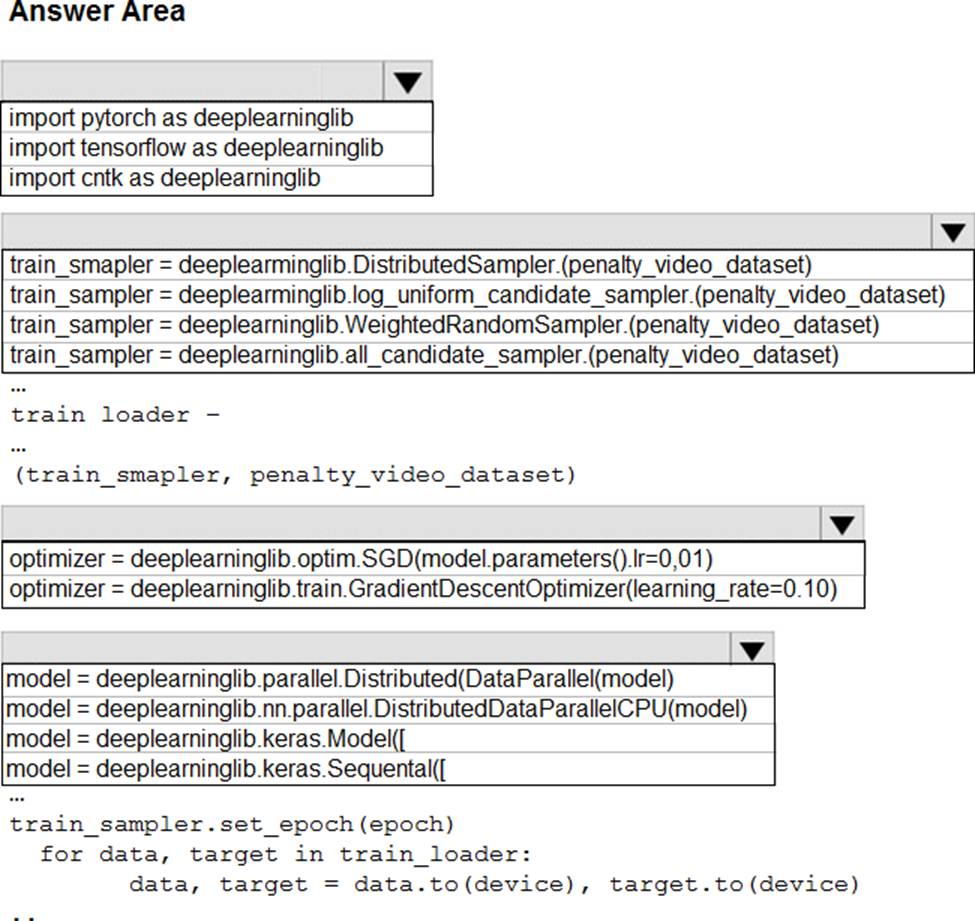
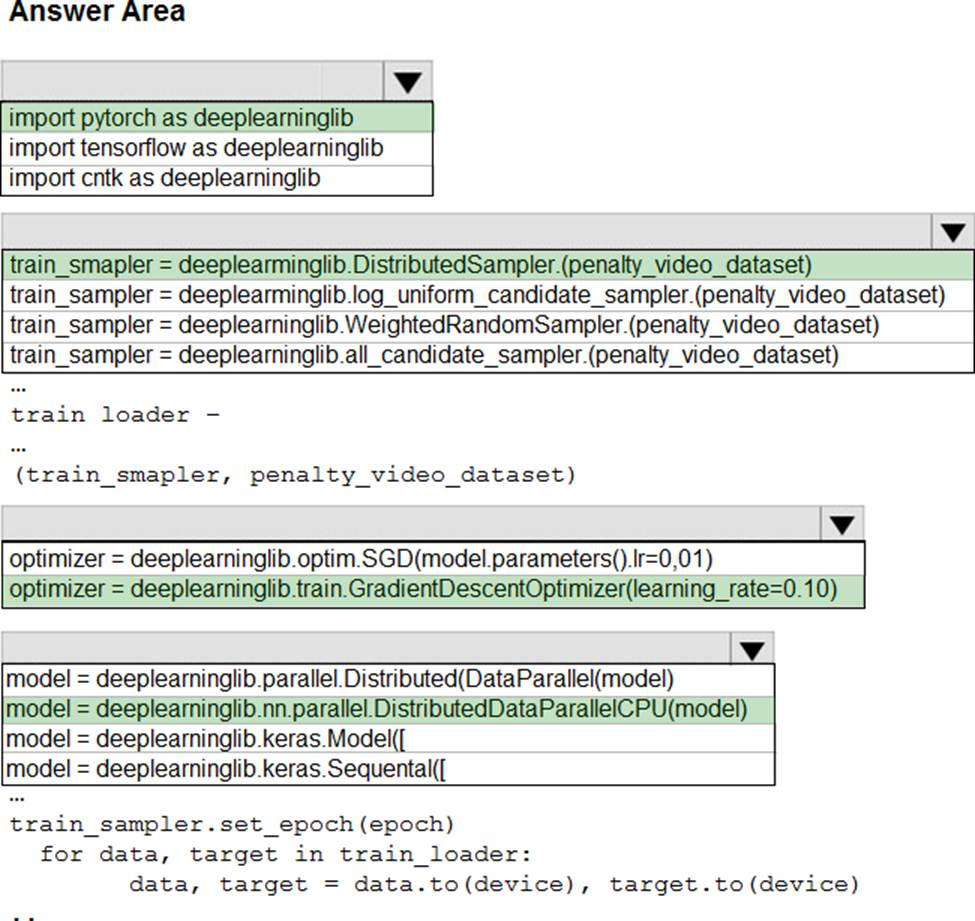
You need to use the Python language to build a sampling strategy for the global penalty detection models.
How should you complete the code segment? To answer, select the appropriate options in the answer area. NOTE: Each correct selection is worth one point.
HOTSPOT
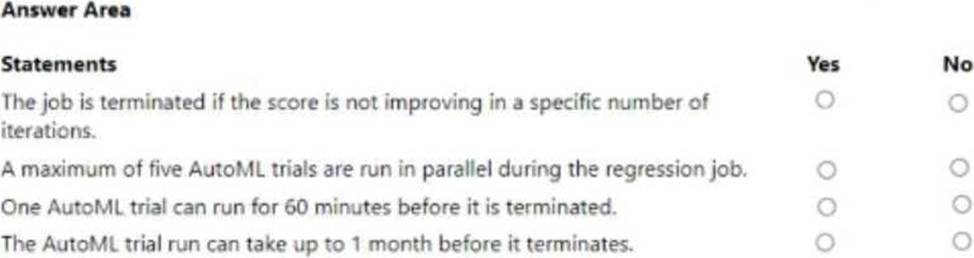
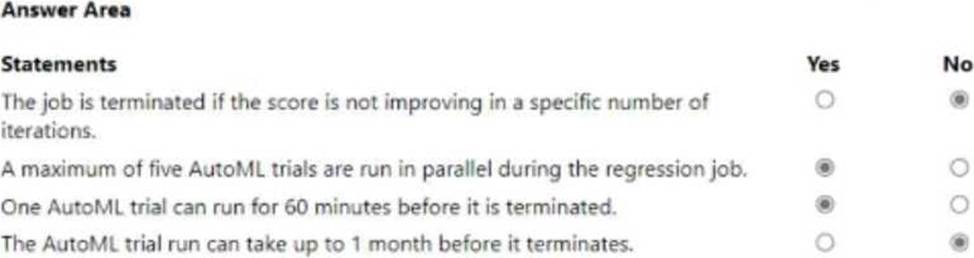
You manage an Azure Machine Learning workspace. You configure an automated machine learning regression training job by using the Azure Machine Learning Python SDK v2.
You configure the regression job by using the following script:
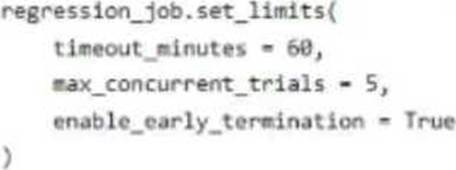
For each of the following statements, select Yes if the statement is true. Otherwise, select No.
You plan to build a team data science environment. Data for training models in machine learning pipelines will be over 20 GB in size.
You have the following requirements:
✑ Models must be built using Caffe2 or Chainer frameworks.
✑ Data scientists must be able to use a data science environment to build the machine learning pipelines and train models on their personal devices in both connected and disconnected network environments.
✑ Personal devices must support updating machine learning pipelines when connected to a network.
You need to select a data science environment.
Which environment should you use?
- A . Azure Machine Learning Service
- B . Azure Machine Learning Studio
- C . Azure Databricks
- D . Azure Kubernetes Service (AKS)
You need to select a feature extraction method.
Which method should you use?
- A . Mutual information
- B . Mood’s median test
- C . Kendall correlation
- D . Permutation Feature Importance
You need to implement a scaling strategy for the local penalty detection data.
Which normalization type should you use?
- A . Streaming
- B . Weight
- C . Batch
- D . Cosine
You use the Azure Machine Learning Python SDK to define a pipeline to train a model.
The data used to train the model is read from a folder in a datastore.
You need to ensure the pipeline runs automatically whenever the data in the folder changes.
What should you do?
- A . Set the regenerate_outputs property of the pipeline to True
- B . Create a ScheduleRecurrance object with a Frequency of auto. Use the object to create a Schedule for the pipeline
- C . Create a PipelineParameter with a default value that references the location where the training data is stored
- D . Create a Schedule for the pipeline. Specify the datastore in the datastore property, and the folder containing the training data in the path_on_datascore property
HOTSPOT
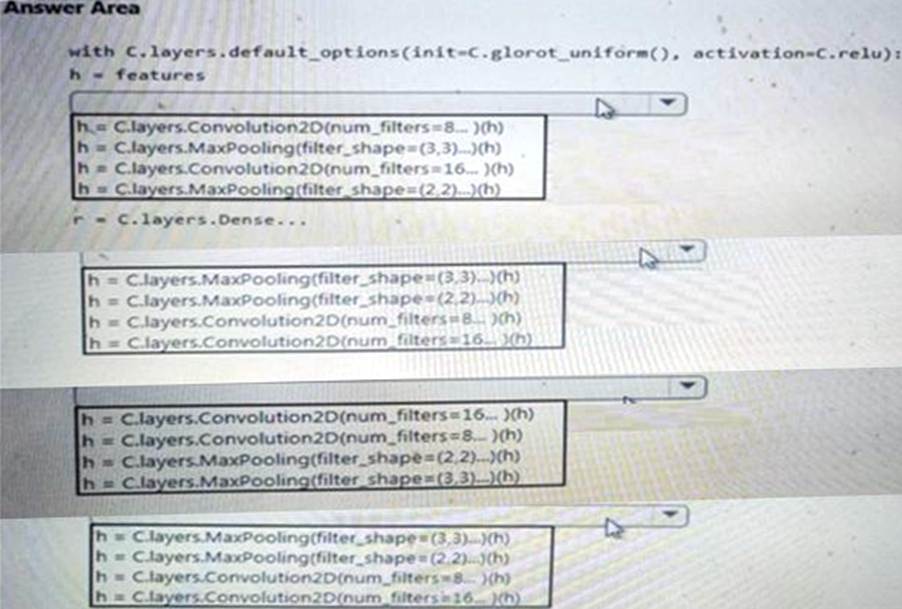
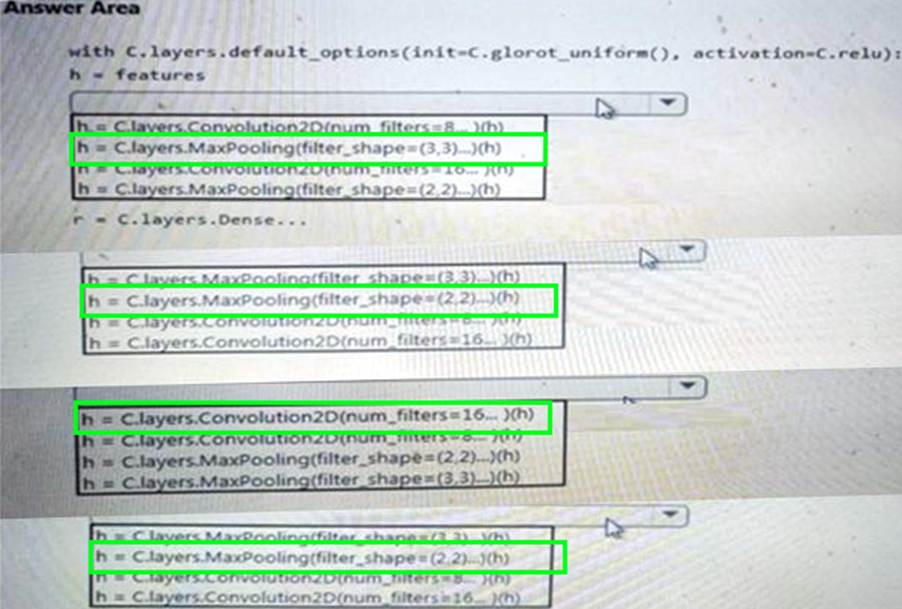
You need to build a feature extraction strategy for the local models.
How should you complete the code segment? To answer, select the appropriate options in the answer area. NOTE: Each correct selection is worth one point.