Microsoft DP-100 Practice Exams
Last updated on Nov 16,2026- Exam Code: DP-100
- Exam Name: Designing and Implementing a Data Science Solution on Azure
- Certification Provider: Microsoft
- Latest update: Nov 16,2026
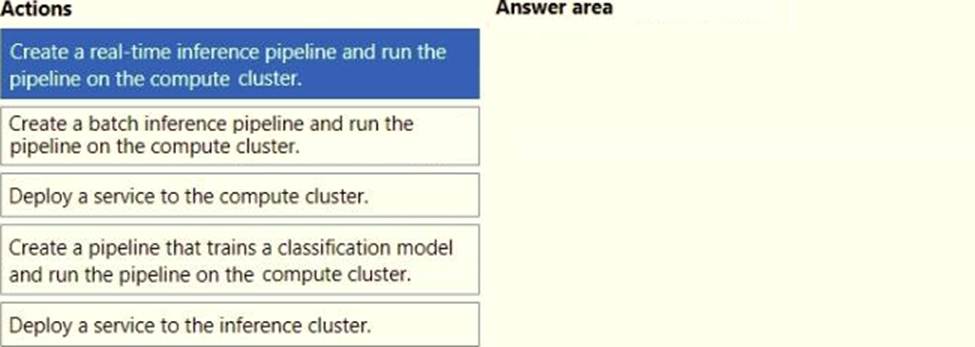
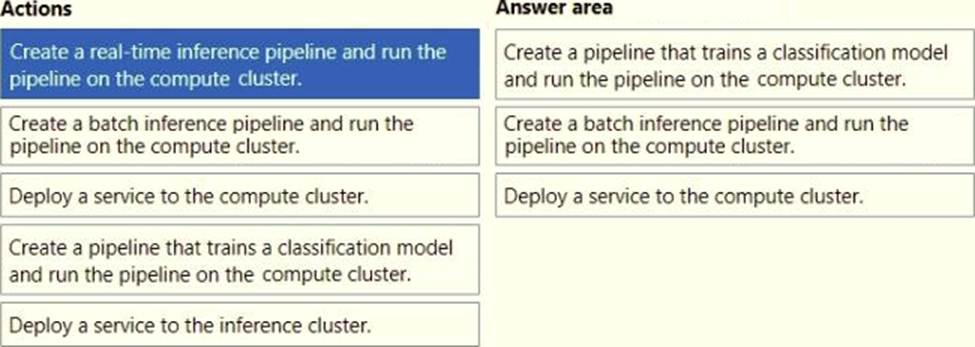
DRAG DROP
You have an Azure Machine Learning workspace that contains a training cluster and an inference cluster.
You plan to create a classification model by using the Azure Machine Learning designer.
You need to ensure that client applications can submit data as HTTP requests and receive predictions as responses.
Which three actions should you perform in sequence? To answer, move the appropriate actions from the list of actions to the answer area and arrange them in the correct order.
HOTSPOT
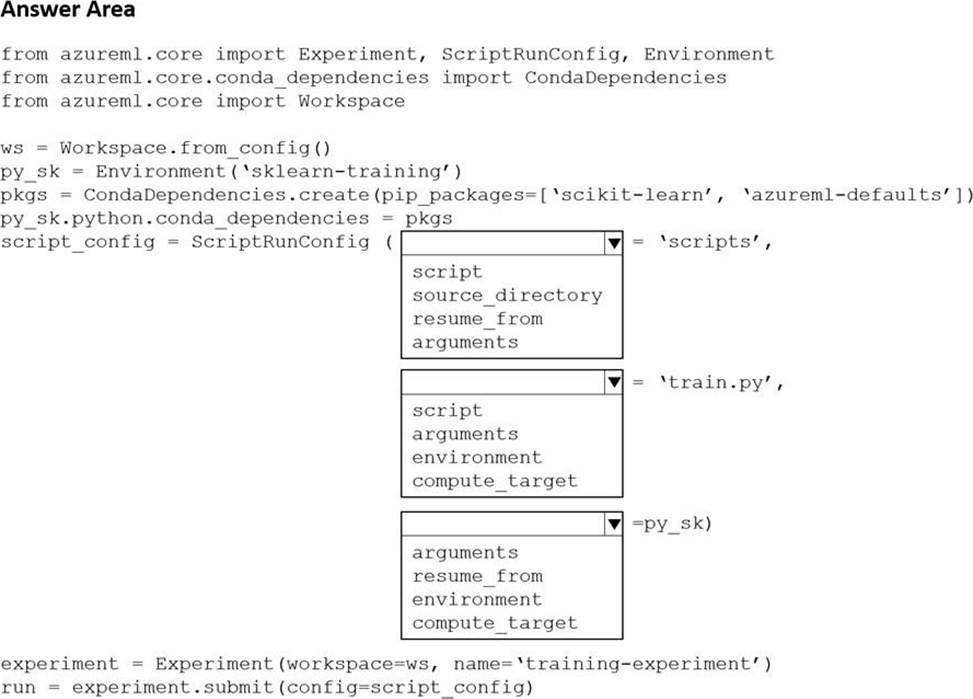
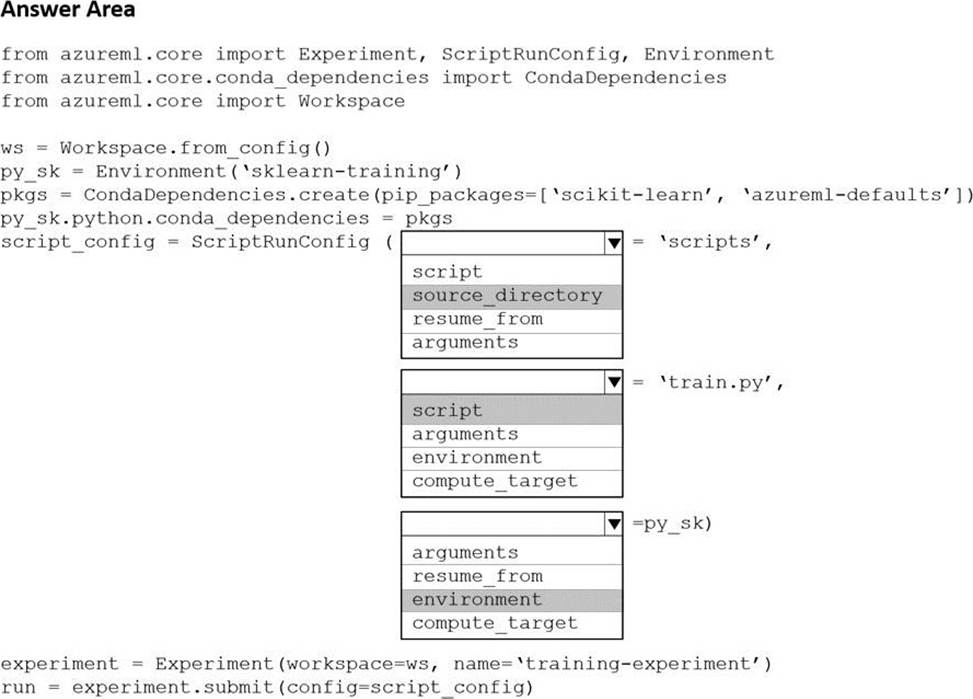
You create a Python script named train.py and save it in a folder named scripts. The script uses the scikit-learn framework to train a machine learning model.
You must run the script as an Azure Machine Learning experiment on your local workstation.
You need to write Python code to initiate an experiment that runs the train.py script.
How should you complete the code segment? To answer, select the appropriate options in the answer area. NOTE: Each correct selection is worth one point.
HOTSPOT
You create a Python script named train.py and save it in a folder named scripts. The script uses the scikit-learn framework to train a machine learning model.
You must run the script as an Azure Machine Learning experiment on your local workstation.
You need to write Python code to initiate an experiment that runs the train.py script.
How should you complete the code segment? To answer, select the appropriate options in the answer area. NOTE: Each correct selection is worth one point.
HOTSPOT
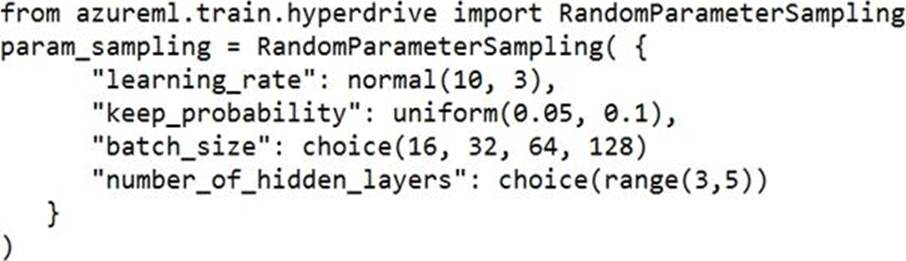
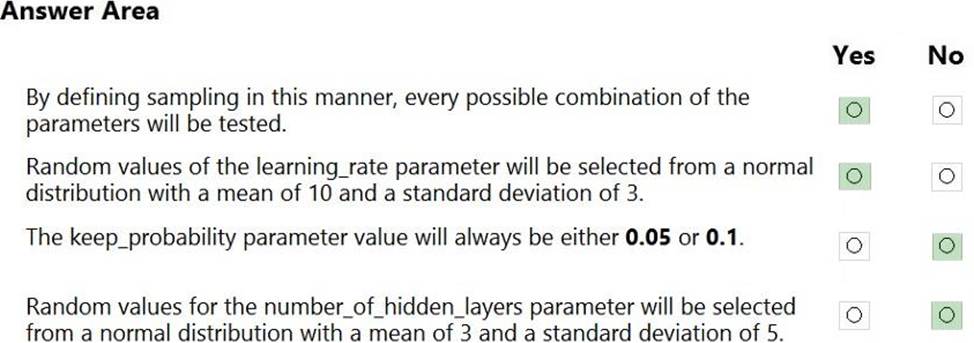
You are using the Hyperdrive feature in Azure Machine Learning to train a model.
You configure the Hyperdrive experiment by running the following code:
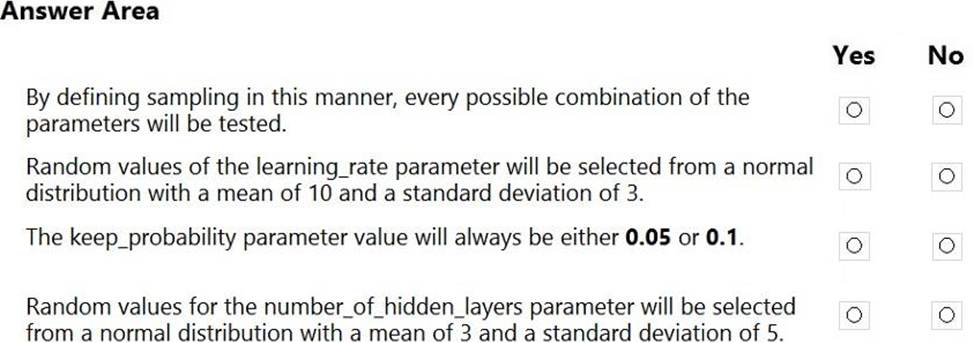
For each of the following statements, select Yes if the statement is true. Otherwise, select No. NOTE: Each correct selection is worth one point.
Note: This question is part of a series of questions that present the same scenario. Each question in the series contains a unique solution that might meet the stated goals. Some question sets might have more than one correct solution, while others might not have a correct solution.
After you answer a question in this section, you will NOT be able to return to it. As a result, these questions will not appear in the review screen.
You are creating a model to predict the price of a student’s artwork depending on the following variables: the student’s length of education, degree type, and art form.
You start by creating a linear regression model.
You need to evaluate the linear regression model.
Solution: Use the following metrics: Relative Squared Error, Coefficient of Determination, Accuracy, Precision, Recall, F1 score, and AUC.
Does the solution meet the goal?
- A . Yes
- B . No
You are training machine learning models in Azure Machine Learning. You use Hyperdrive to tune the hyperparameters. In previous model training and tuning runs, many models showed similar performance. You need to select an early termination policy that meets the following requirements:
• accounts for the performance of all previous runs when evaluating the current run
• avoids comparing the current run with only the best performing run to date
Which two early termination policies should you use? Each correct answer presents part of the solution. NOTE: Each correct selection is worth one point.
- A . Bandit
- B . Median stopping
- C . Default
- D . Truncation selection
HOTSPOT
You create an Azure Machine Learning workspace.
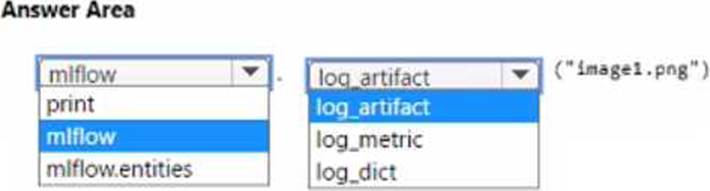
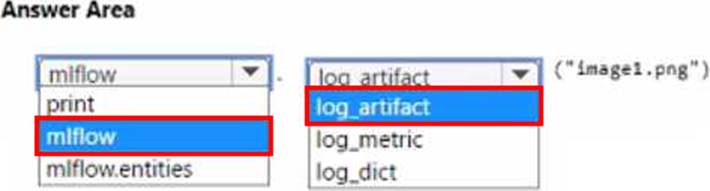
You plan to write an Azure Machine Learning SDK for Python v2 script that logs an image for an experiment. The logged image must be available from the images tab in Azure Machine Learning Studio.
You need to complete the script.
Which code segments should you use? To answer, select the appropriate options in the answer area. NOTE: Each correct selection is worth one point.
You write a Python script that processes data in a comma-separated values (CSV) file.
You plan to run this script as an Azure Machine Learning experiment.
The script loads the data and determines the number of rows it contains using the following code:
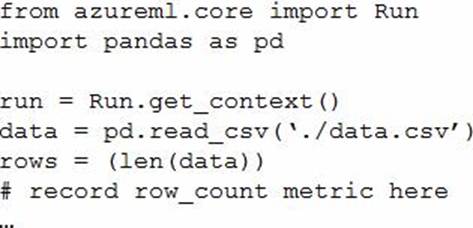
You need to record the row count as a metric named row_count that can be returned using the get_metrics method of the Run object after the experiment run completes.
Which code should you use?
- A . run.upload_file(‘row_count’, ‘./data.csv’)
- B . run.log(‘row_count’, rows)
- C . run.tag(‘row_count’, rows)
- D . run.log_table(‘row_count’, rows)
- E . run.log_row(‘row_count’, rows)
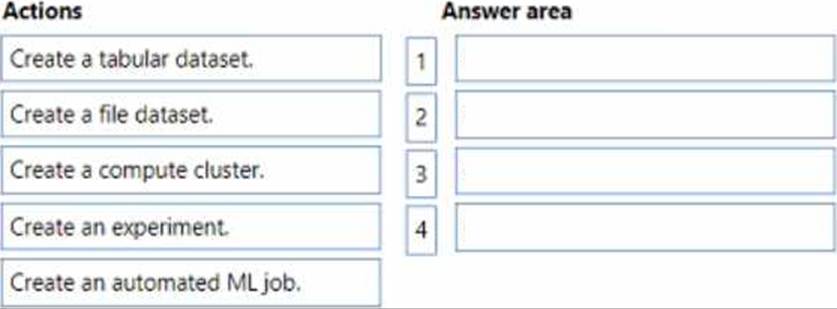
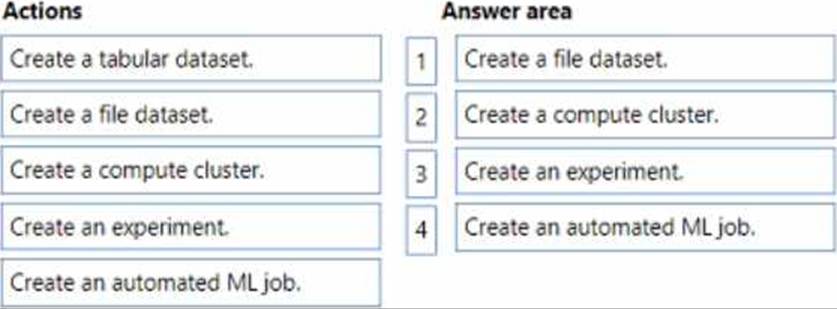
DRAG DROP
You create an Azure Machine Learning workspace. You are training a classification model with no-code AutoML in Azure Machine Learning studio.
The model must predict if a client of a financial institution will subscribe to a fixed-term deposit. You must preview the data profile in Azure Machine Learning studio once the dataset is created.
You need to train the model.
Which four actions should you perform in sequence? To answer, move the appropriate actions from the list of actions to the answer area and arrange them in the correct order.
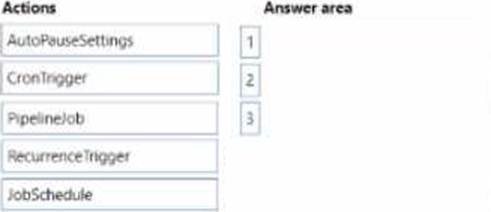
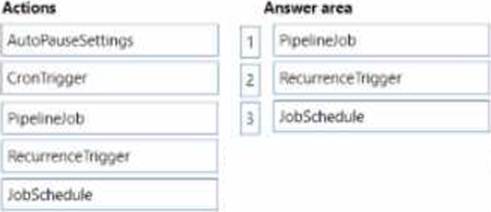
DRAG DROP
You create a multi-class image classification deep learning model.
The model must be retrained monthly with the new image data fetched from a public web portal. You create an Azure Machine Learning pipeline to fetch new data, standardize the size of images and retrain the model.
You need to use the Azure Machine Learning Python SEX v2 to configure the schedule for the pipeline. The schedule should be defined by using the frequency and interval properties with frequency set to month’ and interval set to "1:
Which three classes should you instantiate in sequence"’ To answer, move the appropriate actions from the list of actions to the answer area and arrange them in the correct order.