
Microsoft AZ-204 Practice Exams
Last updated on Nov 16,2026- Exam Code: AZ-204
- Exam Name: Developing Solutions for Microsoft Azure
- Certification Provider: Microsoft
- Latest update: Nov 16,2026
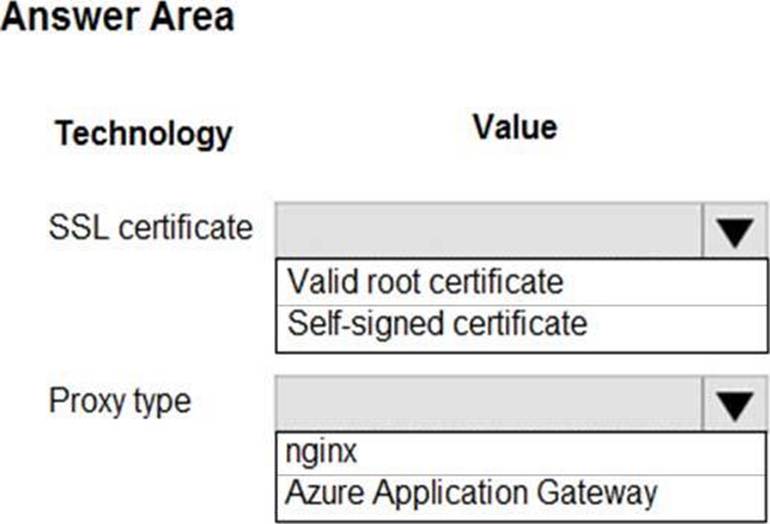
HOTSPOT
You need to ensure that network security policies are met.
How should you configure network security? To answer, select the appropriate options in the answer area. NOTE: Each correct selection is worth one point.
Explanation:
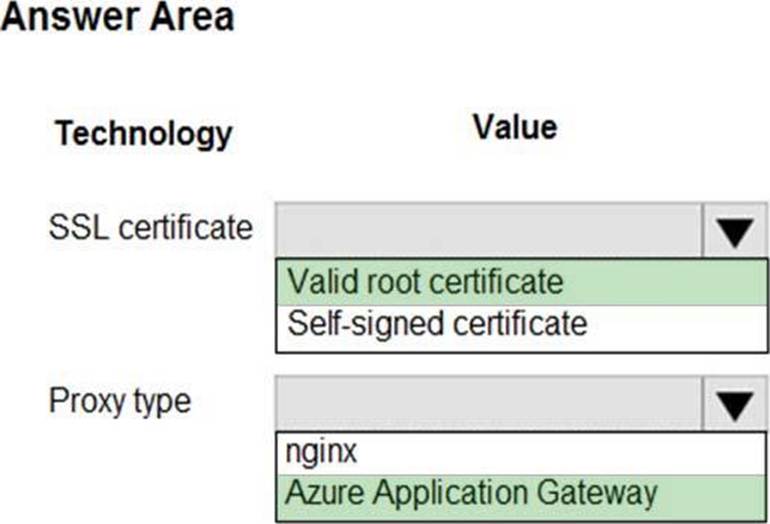
Box 1: Valid root certificate
Scenario: All websites and services must use SSL from a valid root certificate authority.
Box 2: Azure Application Gateway
Scenario:
Any web service accessible over the Internet must be protected from cross site scripting attacks.
All Internal services must only be accessible from Internal Virtual Networks (VNets)
All parts of the system must support inbound and outbound traffic restrictions.
Azure Web Application Firewall (WAF) on Azure Application Gateway provides centralized protection of your web applications from common exploits and vulnerabilities. Web applications are increasingly targeted by malicious attacks that exploit commonly known vulnerabilities. SQL injection and cross-site scripting are among the most common attacks.
Application Gateway supports autoscaling, SSL offloading, and end-to-end SSL, a web application firewall (WAF), cookie-based session affinity, URL path-based routing, multisite hosting, redirection, rewrite HTTP headers and other features.
Note: Both Nginx and Azure Application Gateway act as a reverse proxy with Layer 7 loadbalancing features plus a WAF to ensure strong protection against common web vulnerabilities and exploits.
You can modify Nginx web server configuration/SSL for X-XSS protection. This helps to prevent cross-site scripting exploits by forcing the injection of HTTP headers with X-XSS protection.
Reference: https://docs.microsoft.com/en-us/azure/web-application-firewall/ag/ag-overview
https://www.upguard.com/articles/10-tips-for-securing-your-nginx-deployment
Topic 6, Coho Winery
Case study
Overview
This is a case study. Case studies are not timed separately. You can use as much exam time as you would like to complete each case. However, there may be additional case studies and sections on this exam. You must manage your time to ensure that you are able to complete all questions included on this exam in the time provided.
To answer the questions included in a case study, you will need to reference information that is provided in the case study. Case studies might contain exhibits and other resources that provide more information about the scenario that is described in the case study. Each question is independent of the other questions in this case study.
At the end of this case study, a review screen will appear. This screen allows you to review your answers and to make changes before you move to the next section of the exam. After you begin a new section, you cannot return to this section.
To start the case study
To display the first question in this case study, click the Next button. Use the buttons in the left pane to explore the content of the case study before you answer the questions. Clicking these buttons displays information such as business requirements, existing environment, and problem statements. When you are ready to answer a question, click the Question button to return to the question.
LabelMaker app
Coho Winery produces, bottles, and distributes a variety of wines globally. You are a developer implementing highly scalable and resilient applications to support online order processing by using Azure solutions.
Coho Winery has a LabelMaker application that prints labels for wine bottles. The application sends data to several printers. The application consists of five modules that run independently on virtual machines (VMs). Coho Winery plans to move the application to Azure and continue to support label creation.
External partners send data to the LabelMaker application to include artwork and text for custom label designs.
Requirements. Data
You identify the following requirements for data management and manipulation:
✑ Order data is stored as nonrelational JSON and must be queried using SQL.
✑ Changes to the Order data must reflect immediately across all partitions. All reads to the Order data must fetch the most recent writes.
Requirements. Security
You have the following security requirements:
✑ Users of Coho Winery applications must be able to provide access to documents, resources, and applications to external partners.
✑ External partners must use their own credentials and authenticate with their organization’s identity management solution.
✑ External partner logins must be audited monthly for application use by a user account administrator to maintain company compliance.
✑ Storage of e-commerce application settings must be maintained in Azure Key Vault.
✑ E-commerce application sign-ins must be secured by using Azure App Service authentication and Azure Active Directory (AAD).
✑ Conditional access policies must be applied at the application level to protect company content.
✑ The LabelMaker application must be secured by using an AAD account that has full access to all namespaces of the Azure Kubernetes Service (AKS) cluster.
Requirements. LabelMaker app
Azure Monitor Container Health must be used to monitor the performance of workloads that are deployed to Kubernetes environments and hosted on Azure Kubernetes Service (AKS).
You must use Azure Container Registry to publish images that support the AKS deployment.
Architecture
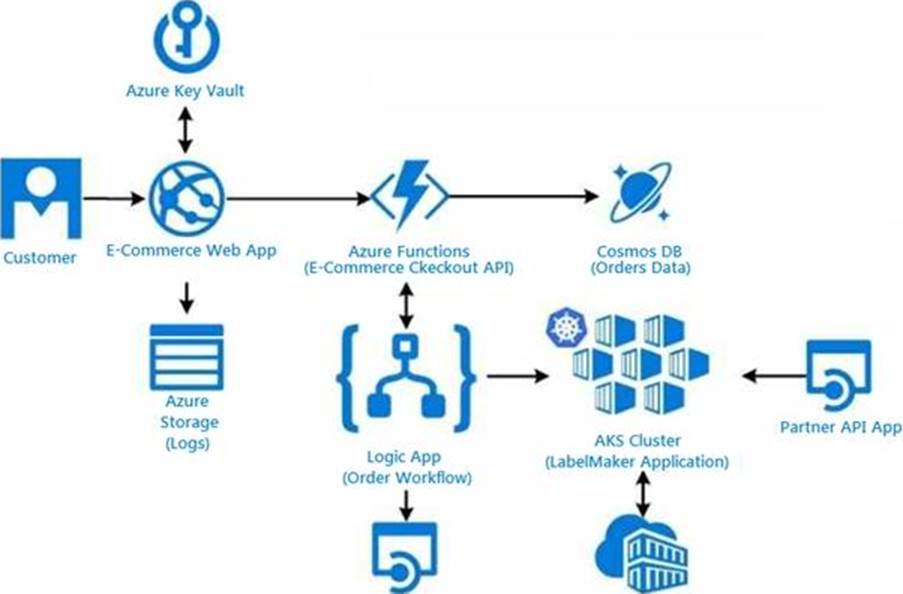
Issues
Calls to the Printer API App fail periodically due to printer communication timeouts.
Printer communication timeouts occur after 10 seconds. The label printer must only receive up to 5 attempts within one minute.
The order workflow fails to run upon initial deployment to Azure.
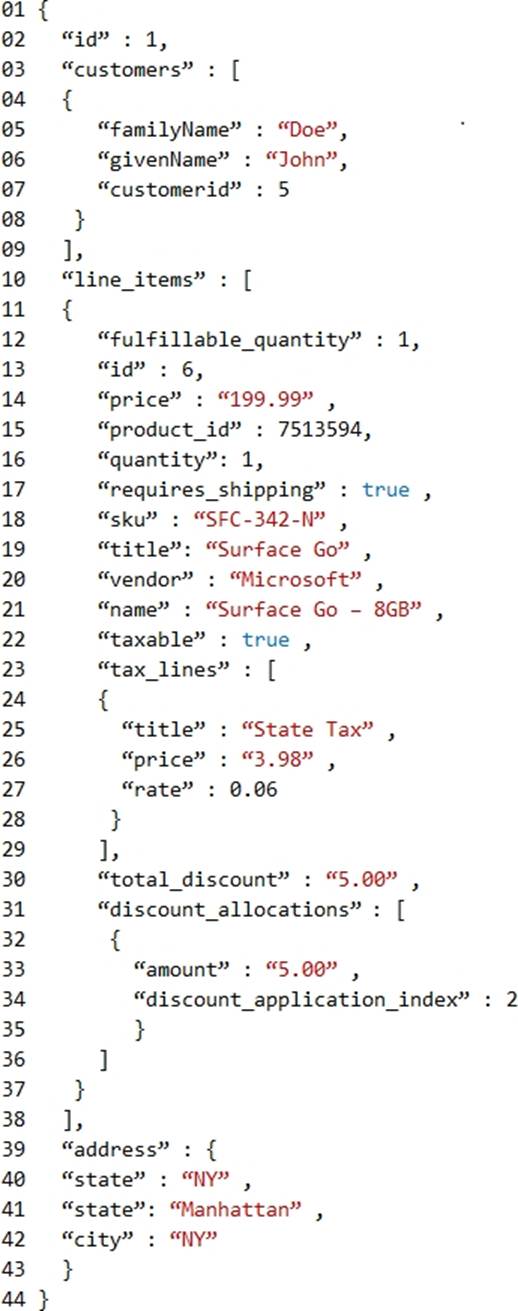
Order.json
Relevant portions of the app files are shown below. Line numbers are included for reference only.
This JSON file contains a representation of the data for an order that includes a single item.
Order.json
DRAG DROP
You need to deploy a new version of the LabelMaker application to ACR.
Which three actions should you perform in sequence? To answer, move the appropriate actions from the list of actions to the answer area and arrange them in the correct order.
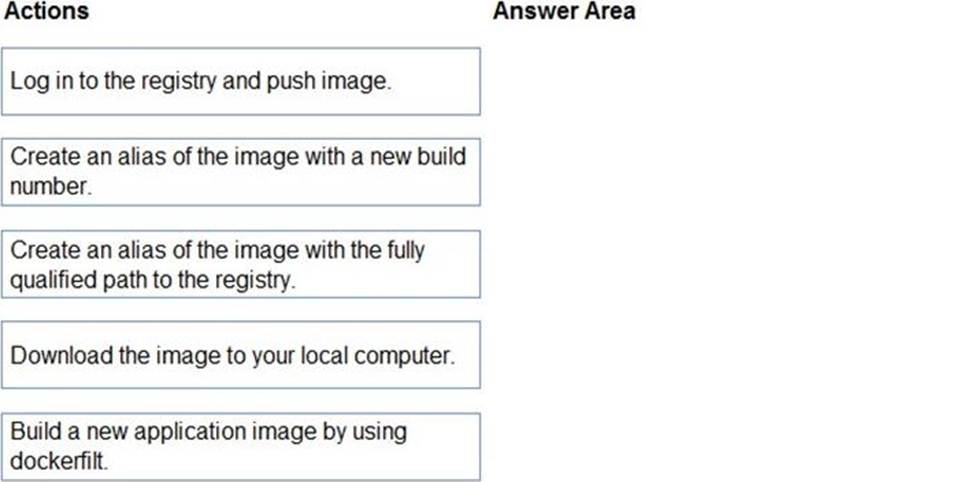
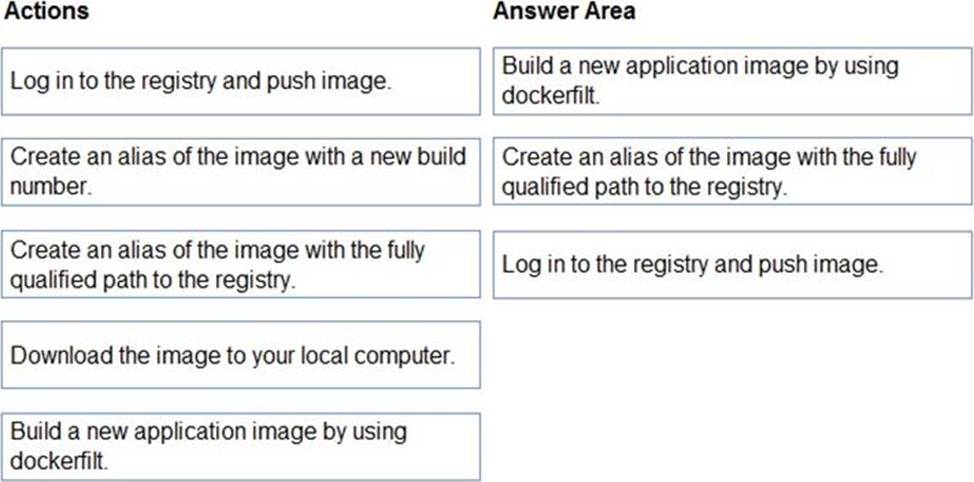
Explanation:
Step 1: Build a new application image by using dockerfile
Step 2: Create an alias if the image with the fully qualified path to the registry
Before you can push the image to a private registry, you’ve to ensure a proper image name. This can be achieved using the docker tag command. For demonstration purpose, we’ll use Docker’s hello world image, rename it and push it to ACR.
# pulls hello-world from the public docker hub $ docker pull hello-world
# tag the image in order to be able to push it to a private registry $ docker tag hello-word <REGISTRY_NAME>/hello-world
# push the image
$ docker push <REGISTRY_NAME>/hello-world
Step 3: Log in to the registry and push image
In order to push images to the newly created ACR instance, you need to login to ACR form the Docker CLI. Once logged in, you can push any existing docker image to your ACR instance.
Scenario:
Coho Winery plans to move the application to Azure and continue to support label creation.
LabelMaker app
Azure Monitor Container Health must be used to monitor the performance of workloads that are deployed to Kubernetes environments and hosted on Azure Kubernetes Service (AKS).
You must use Azure Container Registry to publish images that support the AKS deployment.
Reference:
https://thorsten-hans.com/how-to-use-a-private-azure-container-registry-with-kubernetes-9b86e67b93b6
https://docs.microsoft.com/en-us/azure/container-registry/container-registry-tutorial-quick-task
You need to store the user agreements.
Where should you store the agreement after it is completed?
- A . Azure Storage queue
- B . Azure Event Hub
- C . Azure Service Bus topic
- D . Azure Event Grid topic
B
Explanation:
Azure Event Hub is used for telemetry and distributed data streaming.
This service provides a single solution that enables rapid data retrieval for real-time processing as well as repeated replay of stored raw data. It can capture the streaming data into a file for processing and analysis.
It has the following characteristics:
low latency
capable of receiving and processing millions of events per second
at least once delivery
Reference: https://docs.microsoft.com/en-us/azure/event-grid/compare-messaging-services
You develop a REST API. You implement a user delegation SAS token to communicate with Azure Blob storage.
The token is compromised.
You need to revoke the token.
What are two possible ways to achieve this goal? Each correct answer presents a complete solution. NOTE: Each correct selection is worth one point.
- A . Revoke the delegation keys
- B . Delete the stored access policy.
- C . Regenerate the account key.
- D . Remove the role assignment for the security principle.
AB
Explanation:
A: Revoke a user delegation SAS
To revoke a user delegation SAS from the Azure CLI, call the az storage account revoke-delegation-keys command. This command revokes all of the user delegation keys associated with the specified storage account. Any shared access signatures associated with those keys are invalidated.
B: To revoke a stored access policy, you can either delete it, or rename it by changing the signed identifier.
Changing the signed identifier breaks the associations between any existing signatures and the stored access policy. Deleting or renaming the stored access policy immediately effects all of the shared access signatures associated with it.
Reference:
https://github.com/MicrosoftDocs/azure-docs/blob/master/articles/storage/blobs/storage-blob-user-delegationsas-create-cli.md
https://docs.microsoft.com/en-us/rest/api/storageservices/define-stored-access-policy#modifying-or-revoking-astored-access-policy
HOTSPOT
You are developing an ASP.NET Core time sheet application that runs as an Azure Web App. Users of the application enter their time sheet information on the first day of every month.
The application uses a third-party web service to validate data.
The application encounters periodic server errors due to errors that result from calling a third-party web server. Each request to the third-party server has the same chance of failure.
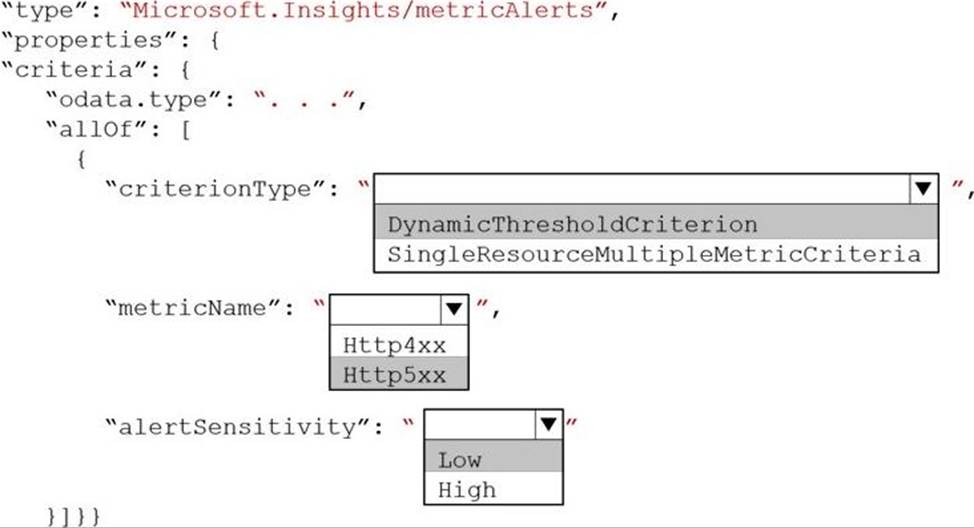
You need to configure an Azure Monitor alert to detect server errors unrelated to the third-party service. You must minimize false-positive alerts.
How should you complete the Azure Resource Manager template? To answer, select the appropriate options in the answer area. NOTE: Each correct selection is worth one point.
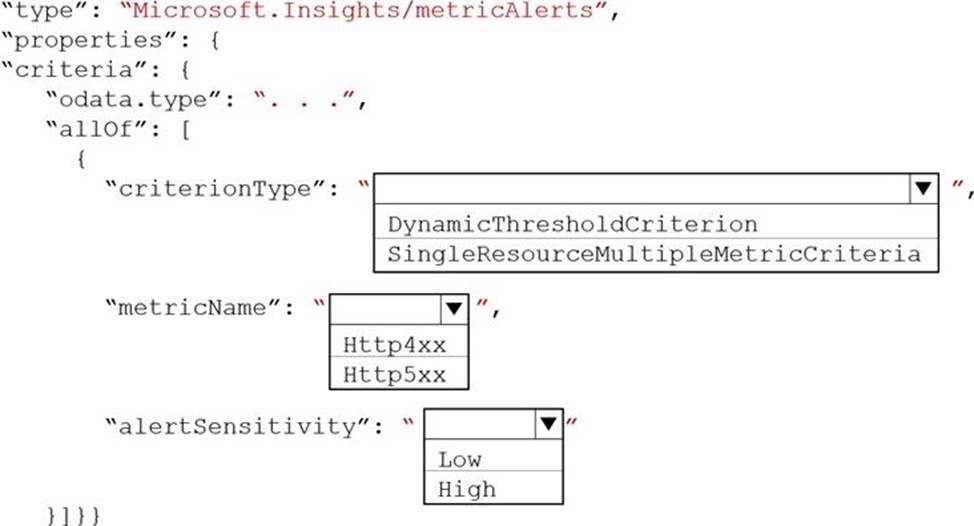
Explanation:
Box 1: DynamicThresholdCriterion
Box 2: Http5xx
Server errors are in the 5xx range.
Client errors are in the 4xx range
Box 3: Low
Reference: https://docs.microsoft.com/en-us/azure/azure-monitor/alerts/alerts-dynamic-thresholds
HOTSPOT
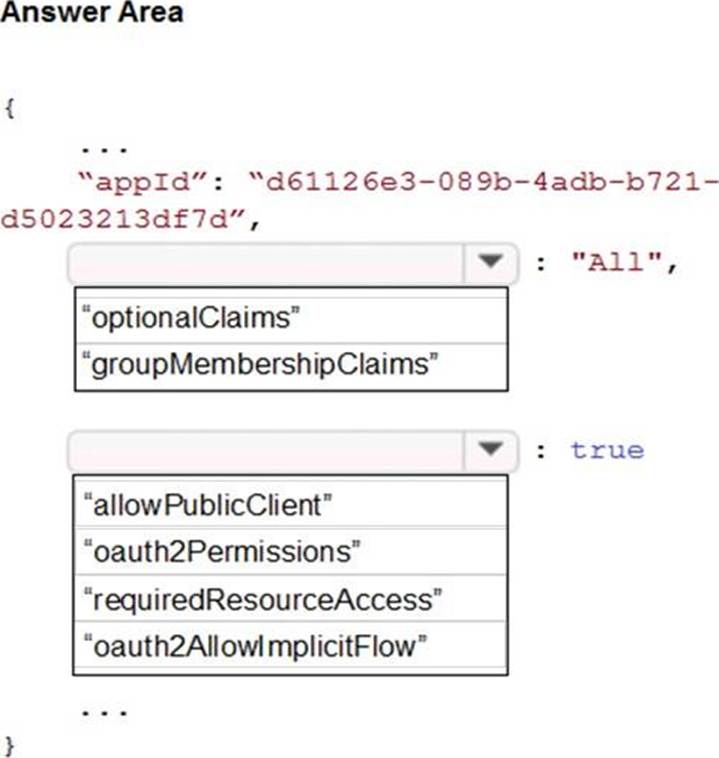
You are building a website to access project data related to terms within your organization. The website does not allow anonymous access. Authentication performed using an Azure Active Directory (Azure AD) app named internal.
The website has the following authentication requirements:
• Azure AD users must be able to login to the website.
• Personalization of the website must be based on membership in Active Directory groups.
You need to configure the application’s manifest to meet the authentication requirements.
How should you configure the manifest? To answer, select the appropriate options in the answer area. NOTE: Each correct selection is worth one point.
Explanation:
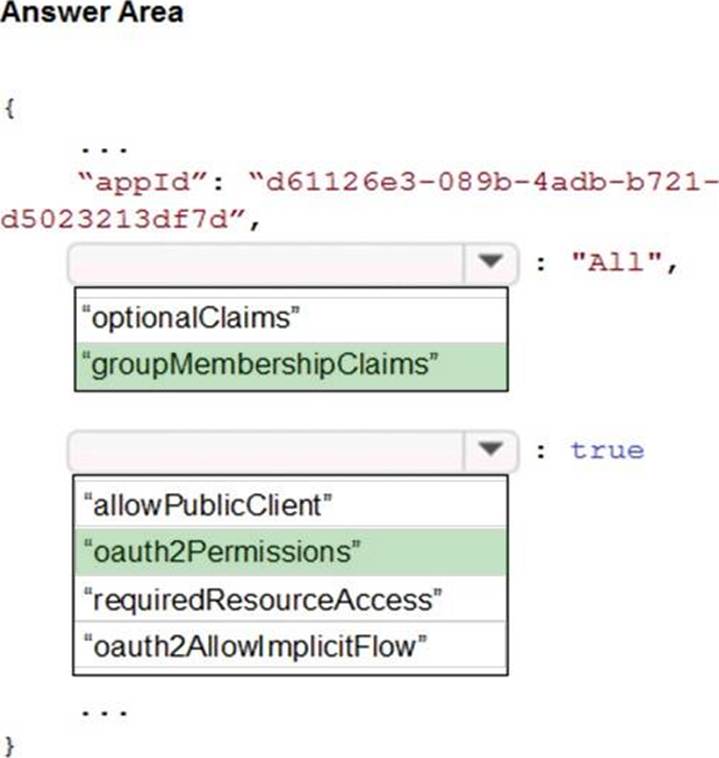
Box 1: groupMembershipClaims
Personalization of the website must be based on membership in Active Directory groups.
Group claims can also be configured in the Optional Claims section of the Application Manifest. Enable group membership claims by changing the groupMembershipClaim
The valid values are:
– "All"
– "SecurityGroup"
– "DistributionList"
– "DirectoryRole"
Here we need to mention that we want to get the groups for the users. Hence we need to mention to set the groupMembershipClaims property to All.
Box 2: oauth2AllowImplicitFlow
Azure AD users must be able to login to the website.
auth2Permissions can only accept collections value like an array, not a boolean.
oauth2AllowImplicitFlow accepts boolean value.
Here from the list of options given, if we want the application to fetch the required tokens , we would need to allow Implicit Flow.
HOTSPOT
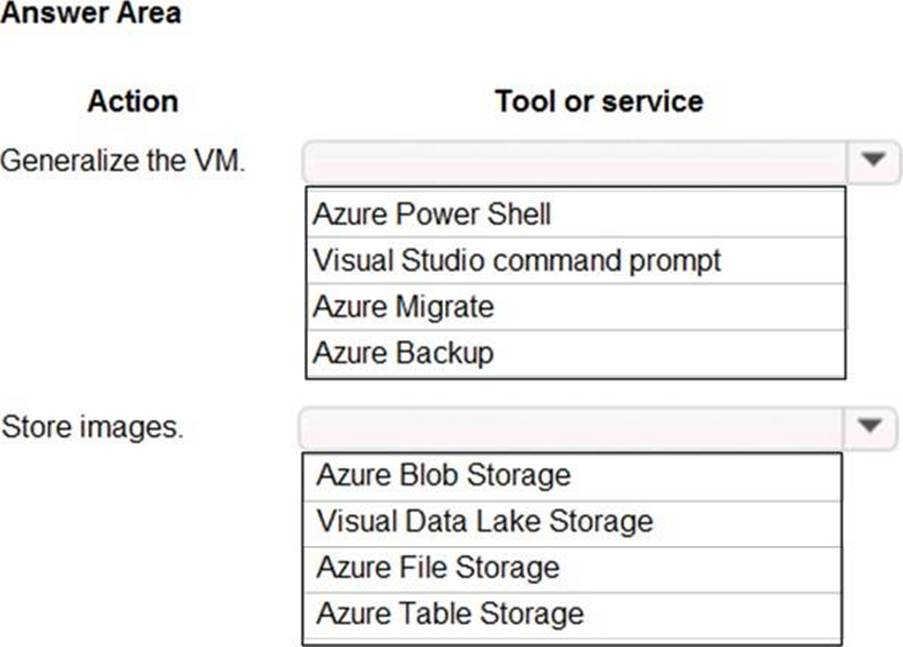
You are configuring a development environment for your team. You deploy the latest Visual Studio image from the Azure Marketplace to your Azure subscription.
The development environment requires several software development kits (SDKs) and third-party components to support application development across the organization. You install and customize the deployed virtual machine (VM) for your development team. The customized VM must be saved to allow provisioning of a new team member development environment.
You need to save the customized VM for future provisioning.
Which tools or services should you use? To answer, select the appropriate options in the answer area. NOTE: Each correct selection is worth one point.
Explanation:
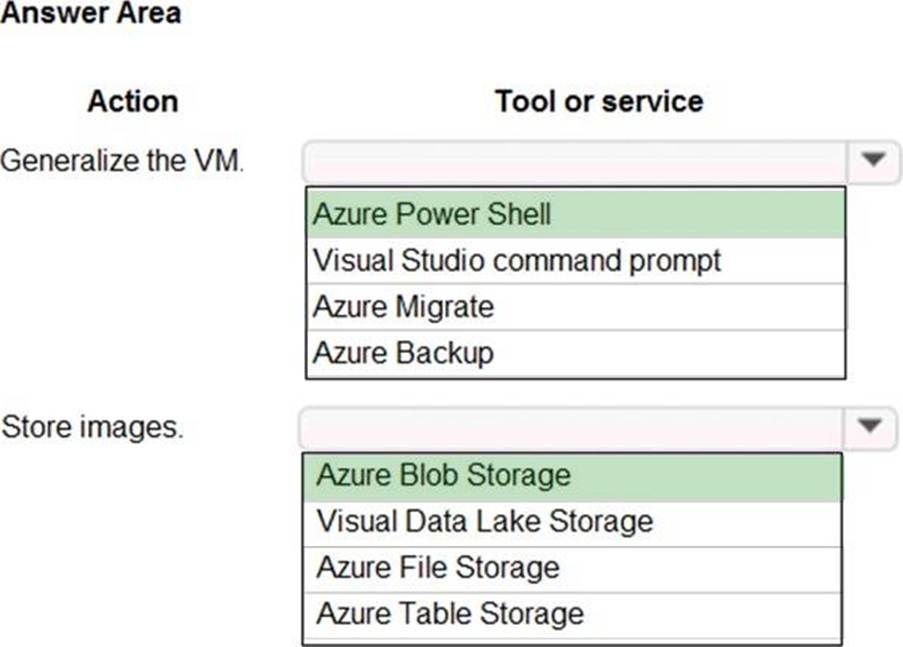
Box 1: Azure Powershell
Creating an image directly from the VM ensures that the image includes all of the disks associated with the VM, including the OS disk and any data disks.
Before you begin, make sure that you have the latest version of the Azure PowerShell module.
You use Sysprep to generalize the virtual machine, then use Azure PowerShell to create the image.
Box 2: Azure Blob Storage
Reference: https://docs.microsoft.com/en-us/azure/virtual-machines/windows/capture-image-resource#create-an-image-of-a-vm-using-powershell
DRAG DROP
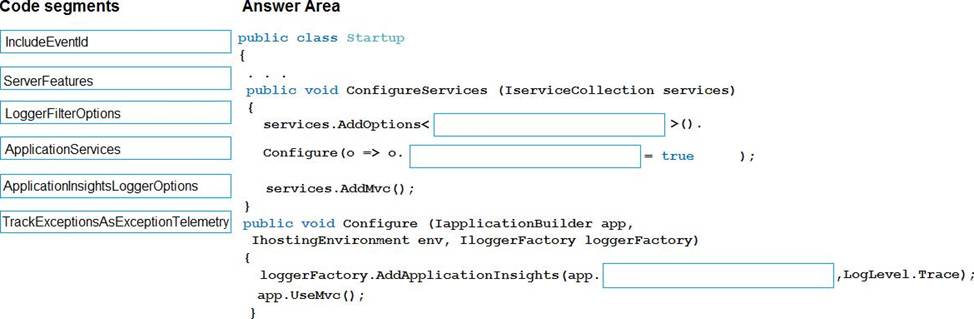
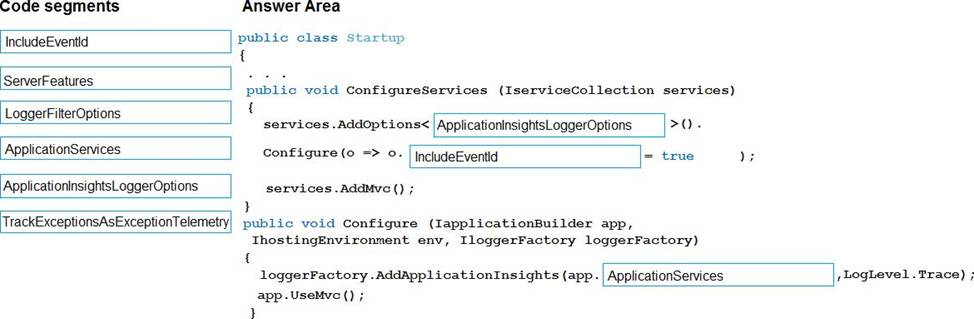
You are developing an ASP.NET Core Web API web service that uses Azure Application Insights to monitor performance and track events.
You need to enable logging and ensure that log messages can be correlated to events tracked by Application Insights.
How should you complete the code? To answer, drag the appropriate code segments to the correct locations. Each code segment may be used once, more than once, or not at all. You may need to drag the split bar between panes or scroll to view content. NOTE: Each correct selection is worth one point.
Explanation:
Box 1: ApplicationInsightsLoggerOptions
If you want to include the EventId and EventName properties, then add the following to the ConfigureServices method:
services
.AddOptions<ApplicationInsightsLoggerOptions>()
.Configure(o => o.IncludeEventId = true);
Box 2: IncludeEventID
Box 3: ApplicationServices
In Asp.Net core apps it turns out that trace logs do not show up in Application Insights out of the box.
We need to add the following code snippet to our Configure method in Startup.cs:
loggerFactory.AddApplicationInsights(app.ApplicationServices, logLevel);
Reference: https://blog.computedcloud.com/enabling-application-insights-trace-logging-in-asp-net-core/
HOTSPOT
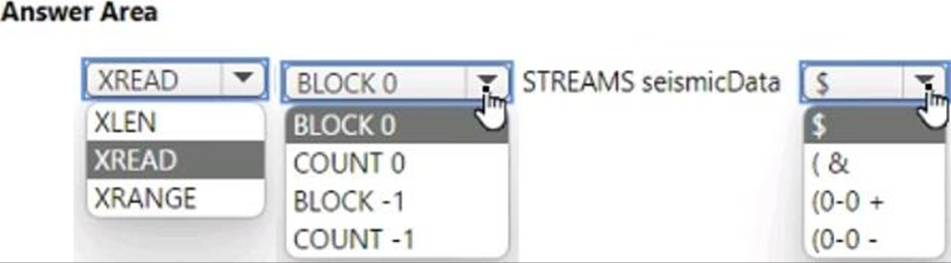
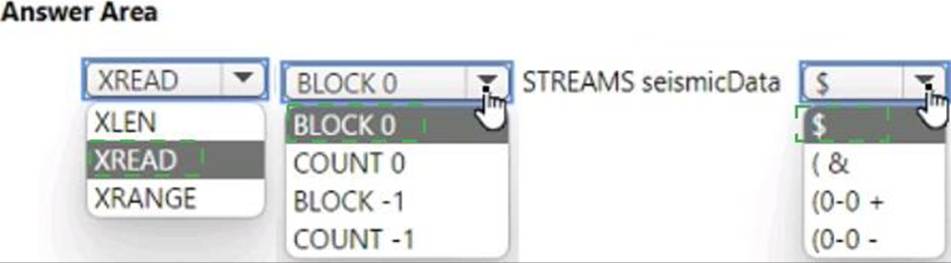
You develop new functionality in a web application for a company that provides access to seismic data from around the world. The seismic data is stored in Redis Streams within an Azure Cache for Redis instance.
The new functionality includes a real-time display of seismic events as they occur.
You need to implement the Azure Cache for Redis command to receive seismic data.
How should you complete the command? To answer, select the appropriate options in the answer area. NOTE: Each correct selection is worth one point.
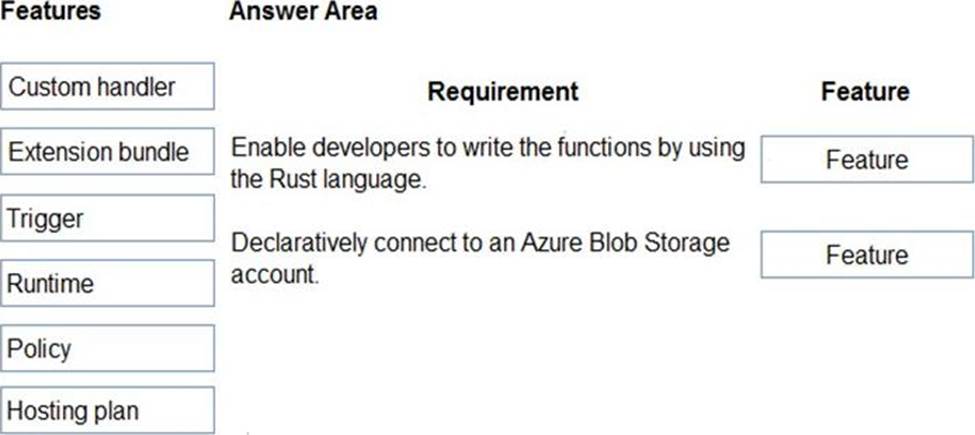
DRAG DROP
You are developing an Azure Function app.
The app must meet the following requirements:
✑ Enable developers to write the functions by using the Rust language.
✑ Declaratively connect to an Azure Blob Storage account.
You need to implement the app.
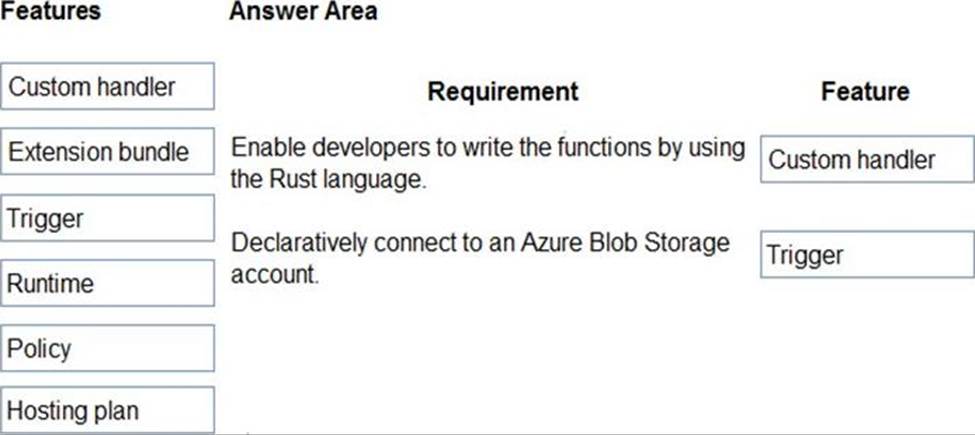
Which Azure Function app features should you use? To answer, drag the appropriate features to the correct requirements. Each feature may be used once, more than once, or not at all. You may need to drag the split bar between panes or scroll to view content. NOTE: Each correct selection is worth one point.
Explanation:
Box 1: Custom handler
Custom handlers can be used to create functions in any language or runtime by running an HTTP server process, for example Go or Rust.
Box 2: Trigger
Functions are invoked by a trigger and can have exactly one. In addition to invoking the function, certain triggers also serve as bindings. You may also define multiple bindings in addition to the trigger. Bindings provide a declarative way to connect data to your code.
Reference:
https://docs.microsoft.com/en-us/azure/azure-functions/create-first-function-vs-code-other
https://docs.microsoft.com/en-us/dotnet/architecture/serverless/azure-functions