
Microsoft AZ-204 Practice Exams
Last updated on Nov 16,2026- Exam Code: AZ-204
- Exam Name: Developing Solutions for Microsoft Azure
- Certification Provider: Microsoft
- Latest update: Nov 16,2026
HOTSPOT
You are implementing a software as a service (SaaS) ASP.NET Core web service that will run as an Azure Web App. The web service will use an on-premises SQL Server database for storage. The web service also includes a WebJob that processes data updates.
Four customers will use the web service.
✑ Each instance of the WebJob processes data for a single customer and must run as a singleton instance.
✑ Each deployment must be tested by using deployment slots prior to serving production data.
✑ Azure costs must be minimized.
✑ Azure resources must be located in an isolated network.
You need to configure the App Service plan for the Web App.
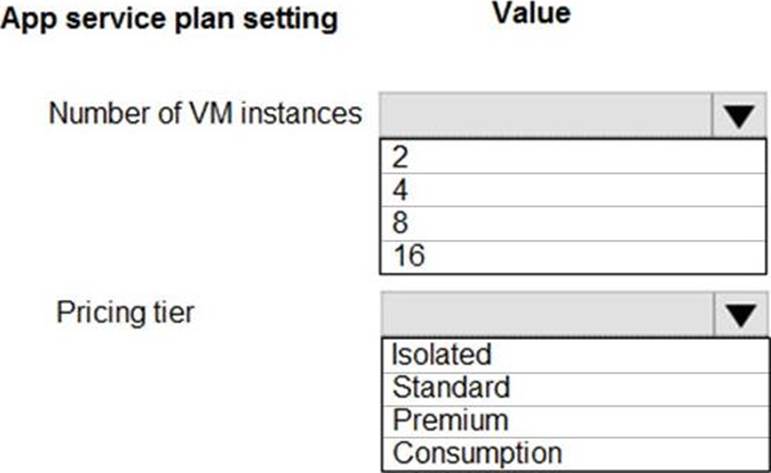
How should you configure the App Service plan? To answer, select the appropriate settings in the answer area. NOTE: Each correct selection is worth one point.
Explanation:
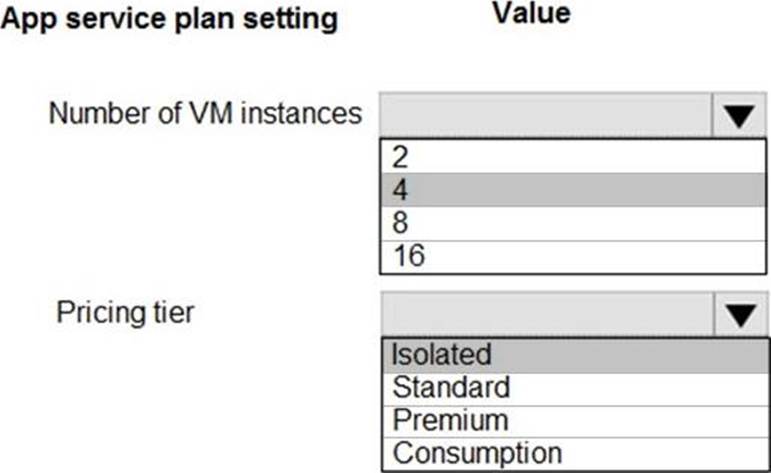
Number of VM instances: 4
You are not charged extra for deployment slots.
Pricing tier: Isolated
The App Service Environment (ASE) is a powerful feature offering of the Azure App Service that gives network isolation and improved scale capabilities. It is essentially a deployment of the Azure App Service into a subnet of a customer’s Azure Virtual Network (VNet).
Reference: https://azure.microsoft.com/sv-se/blog/announcing-app-service-isolated-more-power-scale-and-ease-of-use/
Set the DataSource property of the SearchServiceCIient
Does the solution meet the goal?
- A . Yes
- B . No
B
Explanation:
Use the following method:
Note: This question is part of a series of questions that present the same scenario. Each question in the series contains a unique solution that might meet the stated goals. Some question sets might have more than one correct solution, while others might not have a correct solution.
After you answer a question in this section, you will NOT be able to return to it. As a result, these
questions will not appear in the review screen.
You develop Azure solutions.
You must grant a virtual machine (VM) access to specific resource groups in Azure Resource Manager.
You need to obtain an Azure Resource Manager access token.
Solution: Use the Reader role-based access control (RBAC) role to authenticate the VM with Azure Resource Manager.
Does the solution meet the goal?
- A . Yes
- B . No
B
Explanation:
Instead run the Invoke-RestMethod cmdlet to make a request to the local managed identity for Azure resources endpoint.
Reference: https://docs.microsoft.com/en-us/azure/active-directory/managed-identities-azure-resources/tutorial-windows-vm-access-arm
Note: This question is part of a series of questions that present the same scenario. Each question in the series contains a unique solution that might meet the stated goals. Some question sets might have more than one correct solution, while others might not have a correct solution.
After you answer a question in this section, you will NOT be able to return to it. As a result, these questions will not appear on the review screen.
You are implementing an application by using Azure Event Grid to push near-real-time information to customers.
You have the following requirements:
• You must send events to thousands of customers that include hundreds of various event types.
• The events must be filtered by event type before processing.
• Authentication and authorization must be handled by using Microsoft Entra ID.
• The events must be published to a single endpoint
You need to implement Azure Event Gnd.
Solution: Publish events to a system topic. Create an event subscription for each customer.
Does the solution meet the goal?
- A . Yes
- B . No
HOTSPOT
You develop a news and blog content app for Windows devices.
A notification must arrive on a user’s device when there is a new article available for them to view.
You need to implement push notifications.
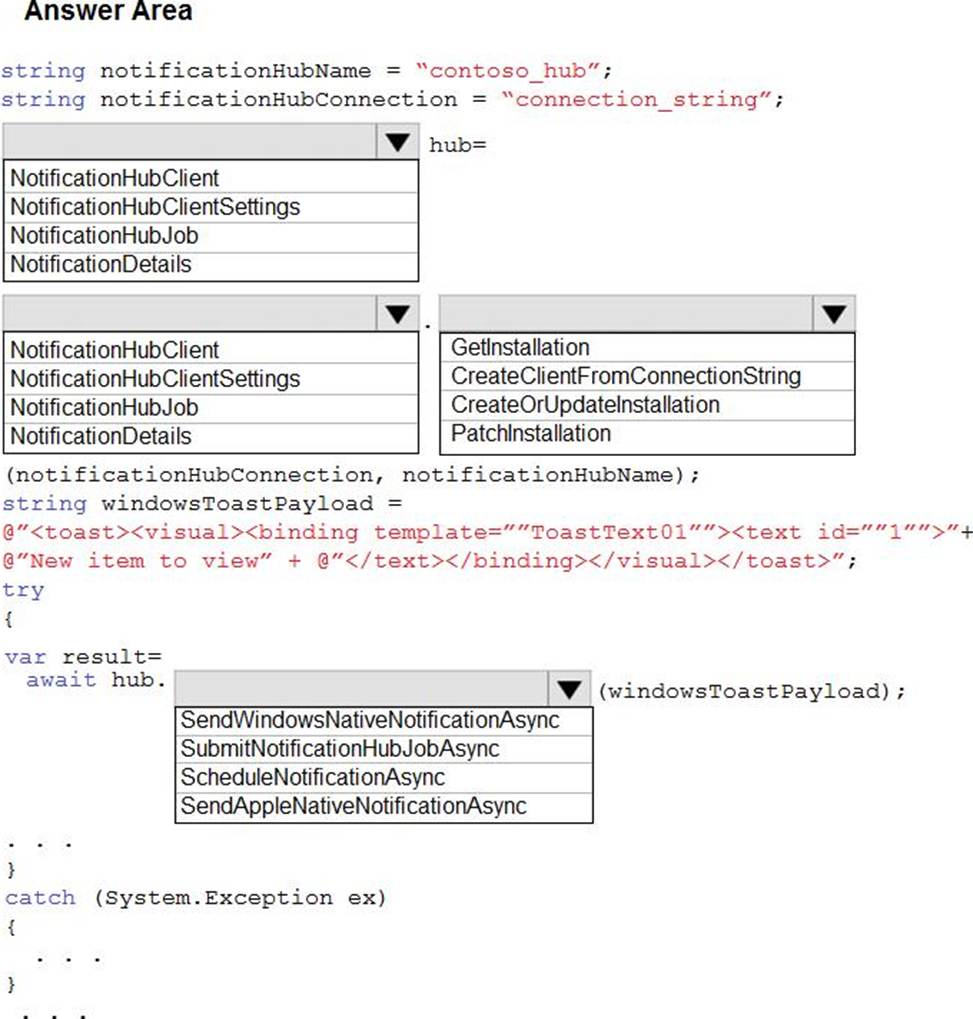
How should you complete the code segment? To answer, select the appropriate options in the answer area. NOTE: Each correct selection is worth one point.
Explanation:
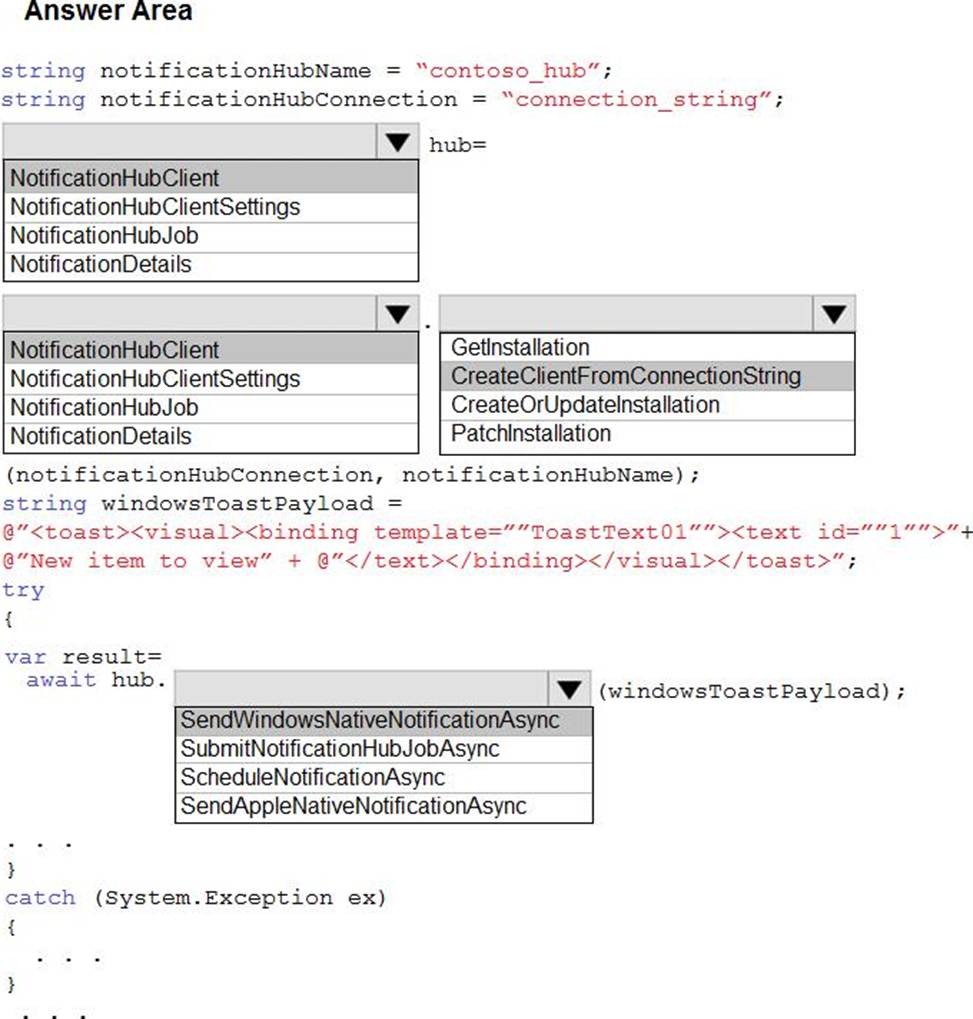
Box 1: NotificationHubClient
Box 2: NotificationHubClient
Box 3: CreateClientFromConnectionString
// Initialize the Notification Hub
NotificationHubClient hub =
NotificationHubClient.CreateClientFromConnectionString(listenConnString, hubName);
Box 4: SendWindowsNativeNotificationAsync
Send the push notification.
var result = await hub.SendWindowsNativeNotificationAsync(windowsToastPayload);
Reference: https://docs.microsoft.com/en-us/azure/notification-hubs/notification-hubs-push-notification-registration-management
https://github.com/MicrosoftDocs/azure-docs/blob/master/articles/app-service-mobile/app-service-mobile-windows-store-dotnet-get-started-push.md
DRAG DROP
You develop a web app that uses tier D1 app service plan by using the Web Apps feature of Microsoft Azure App Service.
Spikes in traffic have caused increases in page load times.
You need to ensure that the web app automatically scales when CPU load is about 85 percent and minimize costs.
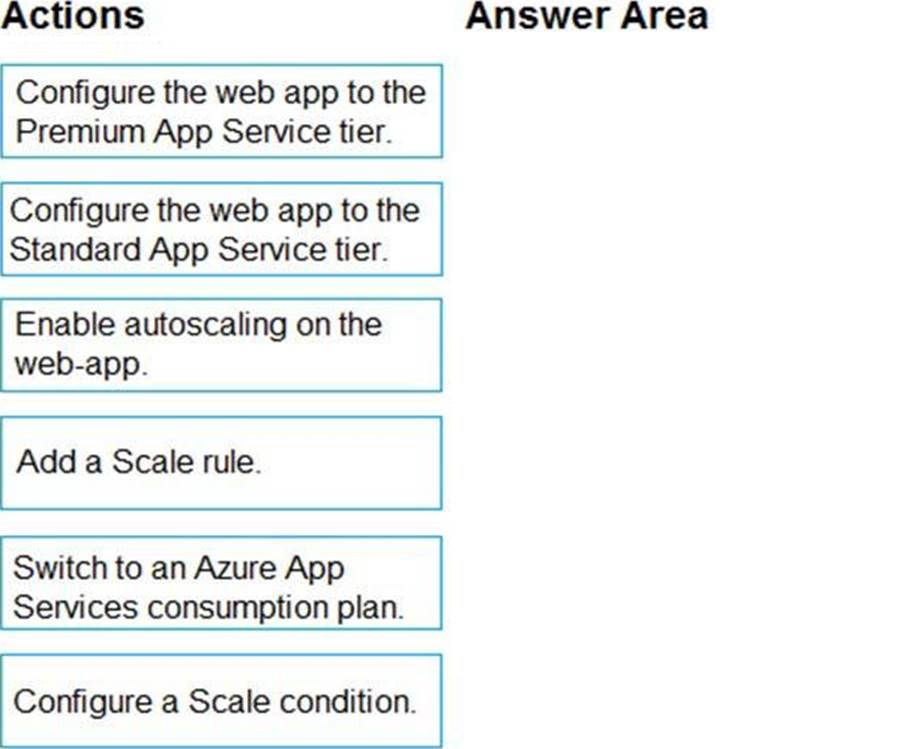
Which four actions should you perform in sequence? To answer, move the appropriate actions from the list of actions to the answer area and arrange them in the correct order. NOTE: More than one order of answer choices is correct. You will receive credit for any of the correct orders you select.
Explanation:
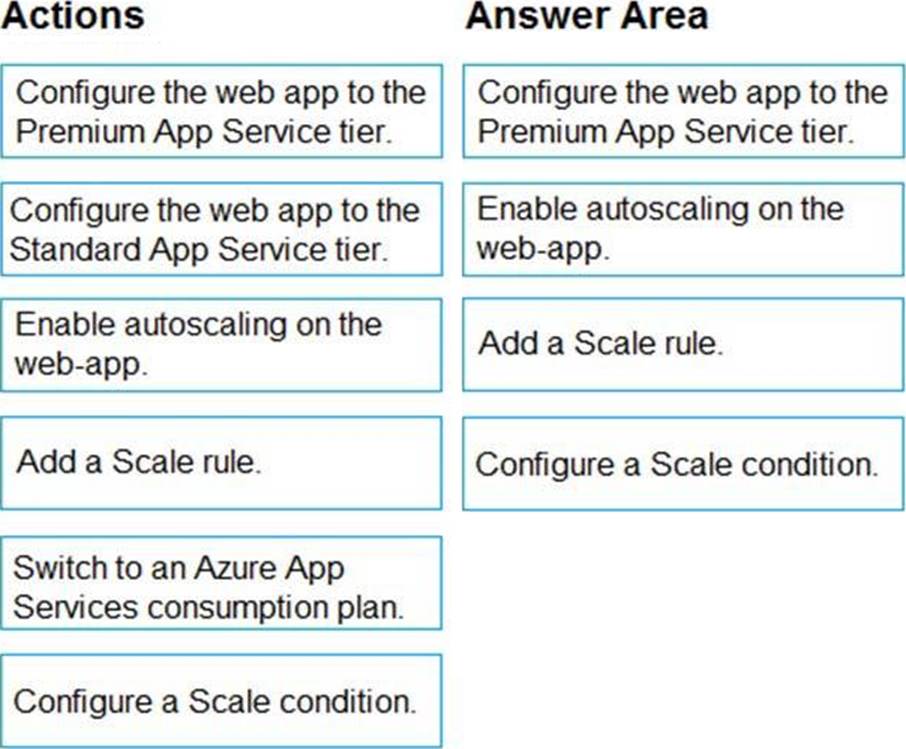
Step 1: Configure the web app to the Standard App Service Tier
The Standard tier supports auto-scaling, and we should minimize the cost.
Step 2: Enable autoscaling on the web app
First enable autoscale
Step 3: Add a scale rule
Step 4: Add a Scale condition
Reference: https://docs.microsoft.com/en-us/azure/monitoring-and-diagnostics/monitoring-autoscale-get-started
DRAG DROP
You plan to create a Docker image that runs as ASP.NET Core application named ContosoApp. You have a setup script named setupScript.ps1 and a series of application files including ContosoApp.dll.
You need to create a Dockerfile document that meets the following requirements:
• Call setupScript.ps1 when the container is built.
• Run ContosoApp.dll when the container starts.
The Docker document must be created in the same folder where ContosoApp.dll and setupScript.ps1 are stored.
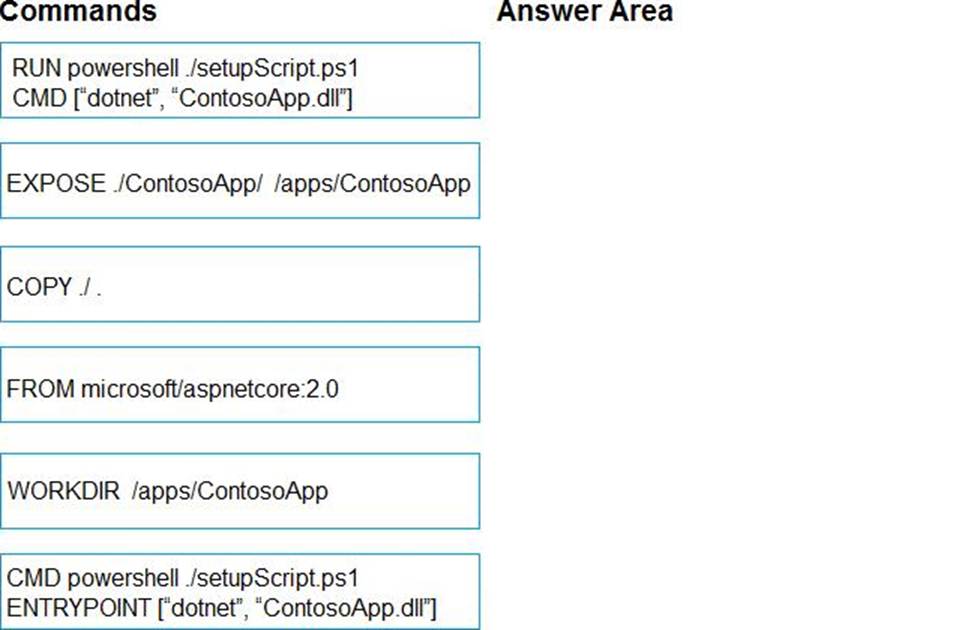
Which four commands should you use to develop the solution? To answer, move the appropriate commands from the list of commands to the answer area and arrange them in the correct order.
Explanation:
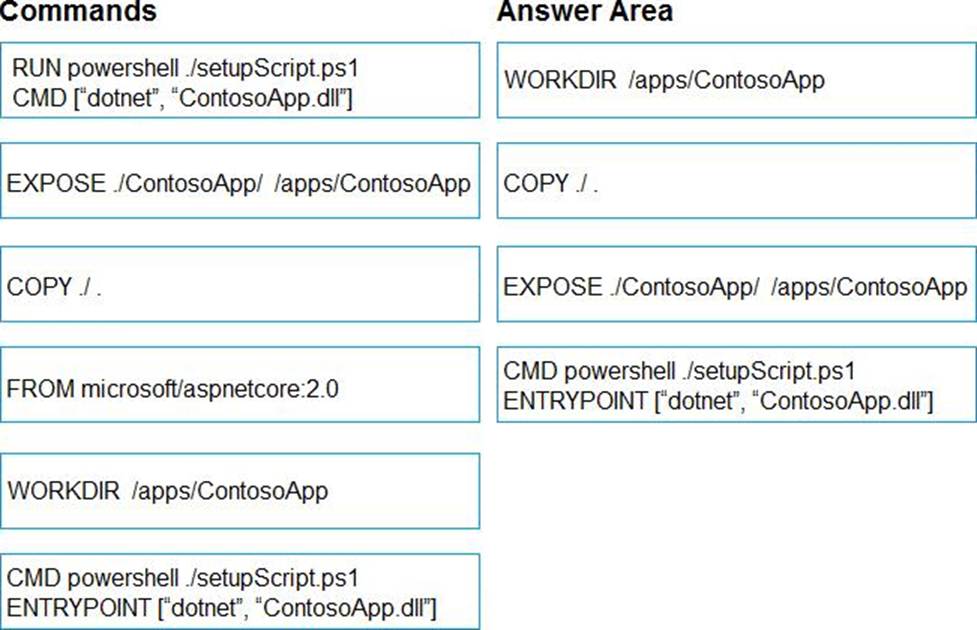
Step 1: WORKDIR /apps/ContosoApp
Step 2: COPY ./-
The Docker document must be created in the same folder where ContosoApp.dll and setupScript.ps1 are stored.
Step 3: EXPOSE ./ContosApp/ /app/ContosoApp
Step 4: CMD powershell ./setupScript.ps1
ENTRYPOINT ["dotnet", "ContosoApp.dll"]
You need to create a Dockerfile document that meets the following requirements:
Call setupScript.ps1 when the container is built.
Run ContosoApp.dll when the container starts.
Reference: https://docs.microsoft.com/en-us/azure/app-service/containers/tutorial-custom-docker-image
HOTSPOT
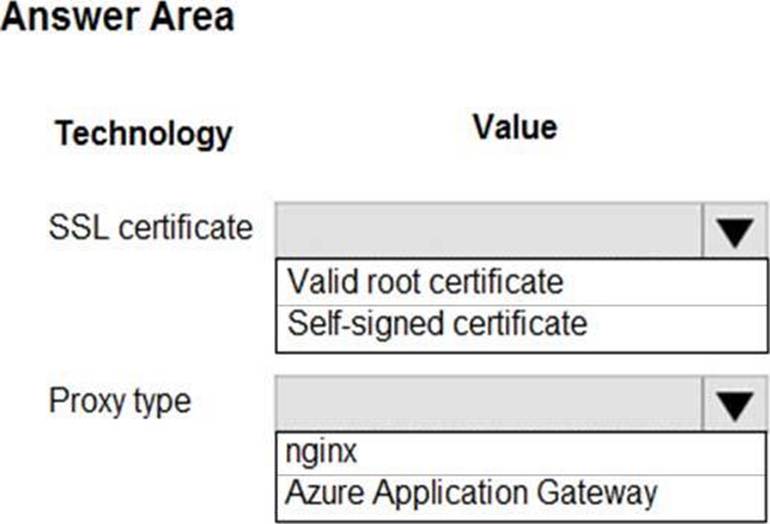
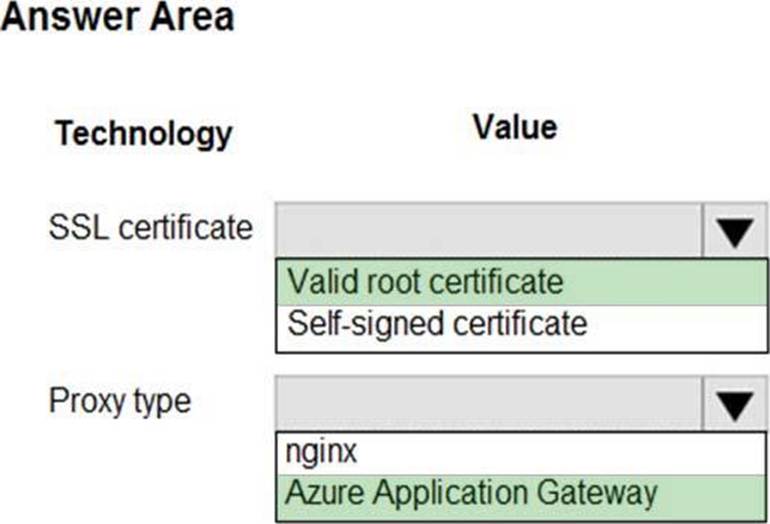
You need to ensure that network security policies are met.
How should you configure network security? To answer, select the appropriate options in the answer area. NOTE: Each correct selection is worth one point.
Explanation:
Box 1: Valid root certificate
Scenario: All websites and services must use SSL from a valid root certificate authority.
Box 2: Azure Application Gateway
Scenario:
Any web service accessible over the Internet must be protected from cross site scripting attacks.
All Internal services must only be accessible from Internal Virtual Networks (VNets)
All parts of the system must support inbound and outbound traffic restrictions.
Azure Web Application Firewall (WAF) on Azure Application Gateway provides centralized protection of your web applications from common exploits and vulnerabilities. Web applications are increasingly targeted by malicious attacks that exploit commonly known vulnerabilities. SQL injection and cross-site scripting are among the most common attacks.
Application Gateway supports autoscaling, SSL offloading, and end-to-end SSL, a web application firewall (WAF), cookie-based session affinity, URL path-based routing, multisite hosting, redirection, rewrite HTTP headers and other features.
Note: Both Nginx and Azure Application Gateway act as a reverse proxy with Layer 7 loadbalancing features plus a WAF to ensure strong protection against common web vulnerabilities and exploits.
You can modify Nginx web server configuration/SSL for X-XSS protection. This helps to prevent cross-site scripting exploits by forcing the injection of HTTP headers with X-XSS protection.
Reference: https://docs.microsoft.com/en-us/azure/web-application-firewall/ag/ag-overview
https://www.upguard.com/articles/10-tips-for-securing-your-nginx-deployment