
Microsoft AZ-204 Practice Exams
Last updated on Nov 16,2026- Exam Code: AZ-204
- Exam Name: Developing Solutions for Microsoft Azure
- Certification Provider: Microsoft
- Latest update: Nov 16,2026
You are a developing a SaaS application that stores data as key value pairs.
You must make multiple editions of the application available. In the lowest cost edition, the performance must be best-effort, and there is no regional failover.
In higher cos! editions customers must be able to select guaranteed performance and support for multiple regions. Azure costs must be minimized.
Which Azure Cosmos OB API should you use for the application?
- A . Core
- B . MongoDB
- C . Cassandra
- D . Table API
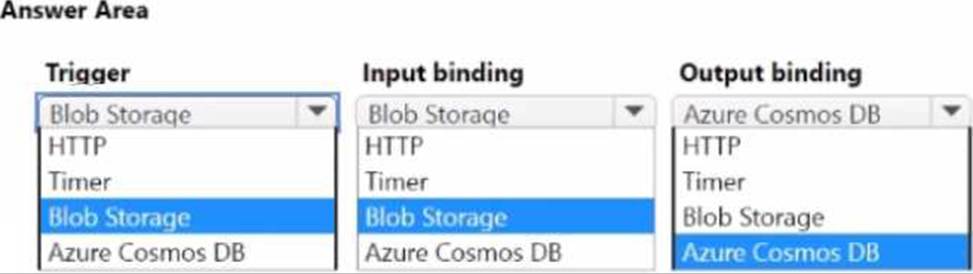
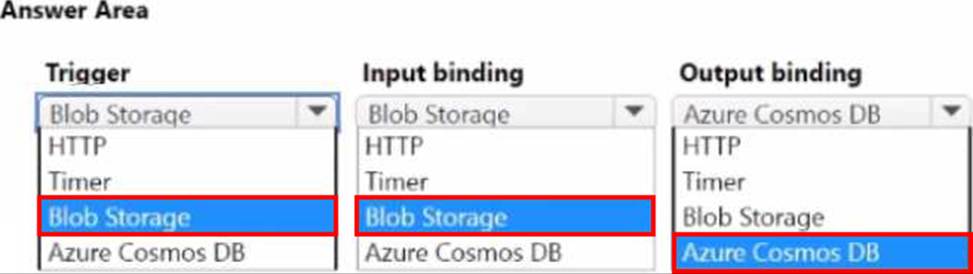
HOTSPOT
You are developing an Azure Function app.
The Azure Function app must enable a WebHook to read an image from Azure Blob Storage and create a new Azure Cosmos DB document.
You need to implement the Azure Function app.
Which configuration should you use? To answer, select the appropriate options in the answer area. NOTE: Each correct selection is worth one point.
DRAG DROP
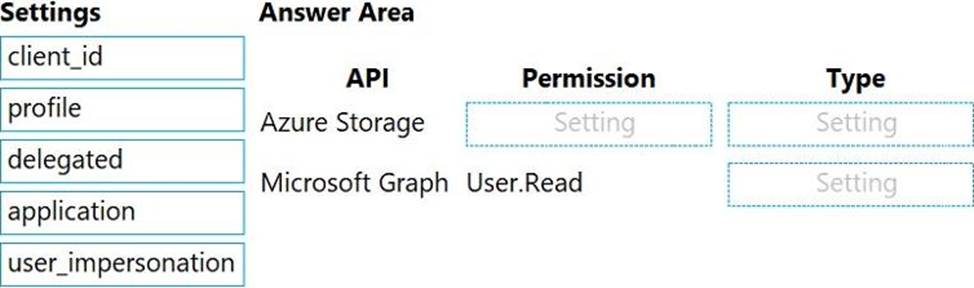
You are developing an ASP.NET Core website that can be used to manage photographs which are stored in Azure Blob Storage containers.
Users of the website authenticate by using their Azure Active Directory (Azure AD) credentials.
You implement role-based access control (RBAC) role permission on the containers that store photographs. You assign users to RBAC role.
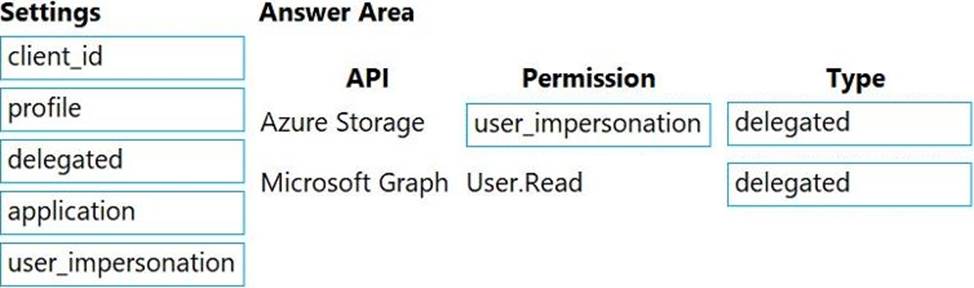
You need to configure the website’s Azure AD Application so that user’s permissions can be used with the Azure Blob containers.
How should you configure the application? To answer, drag the appropriate setting to the correct location. Each setting may be used once, more than once, or not at all. You may need to drag the split bar between panes or scroll to view content. NOTE: Each correct selection is worth one point.
Explanation:
Box 1: user_impersonation
Box 2: delegated
Example:
DRAG DROP
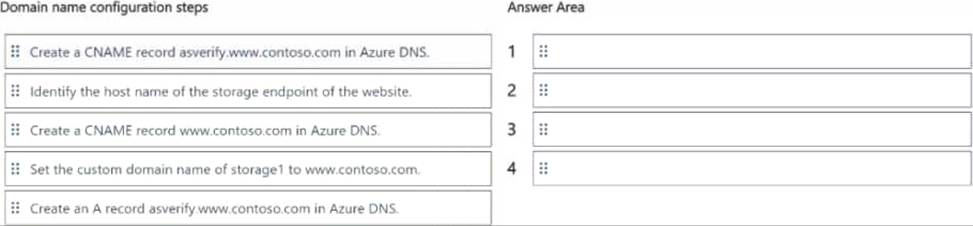
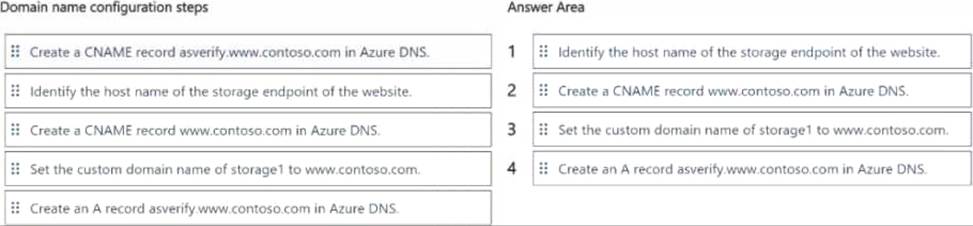
You have a static website hosted in an Azure Storage account named storage1. You access the website by using a URL that ends with the web.core.windows.net suffix.
You plan to configure the website to be accessible through the URL www.contoso.com. The website must be accessible during configuration.
The contoso.com zone is hosted in Azure DNS.
You need to complete the website configuration
Which four actions should you perform in sequence? To answer, move the appropriate domain name configuration steps from the list of domain name configuration steps to the answer area and arrange them in the correct order.
A company uses an Azure Blob Storage for archiving.
The company requires that data in the Blob Storage is only in the archive tier.
You need to ensure data copied to the Blob Storage is moved to the archive tier.
What should you do?
- A . Use a Put Block List operation with a request header of x-ms-immutability-policy-mode.
- B . Create a lifecycle policy with an action of tierToArchive and configure daysAftenModificationGreaterThan for 0.
- C . Use a Put Blob operation with a request header of x-ms-immutability-policy-unrjl-date.
- D . Create a lifecycle policy with an action of tierToArchive and configure a filter for bloblndexMatch.
DRAG DROP
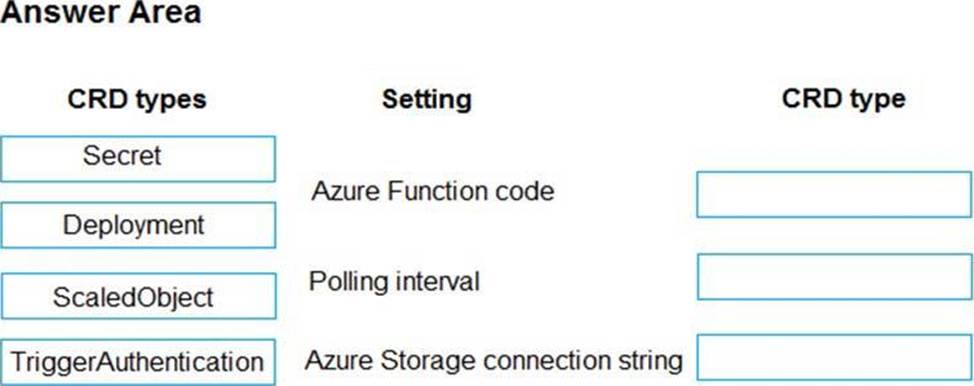
You are a developer for a software as a service (SaaS) company that uses an Azure Function to process orders. The Azure Function currently runs on an Azure Function app that is triggered by an Azure Storage queue.
You are preparing to migrate the Azure Function to Kubernetes using Kubernetes-based Event Driven Autoscaling (KEDA).
You need to configure Kubernetes Custom Resource Definitions (CRD) for the Azure Function.
Which CRDs should you configure? To answer, drag the appropriate CRD types to the correct locations. Each CRD type may be used once, more than once, or not at all. You may need to drag the split bar between panes or scroll to view content. NOTE: Each correct selection is worth one point.
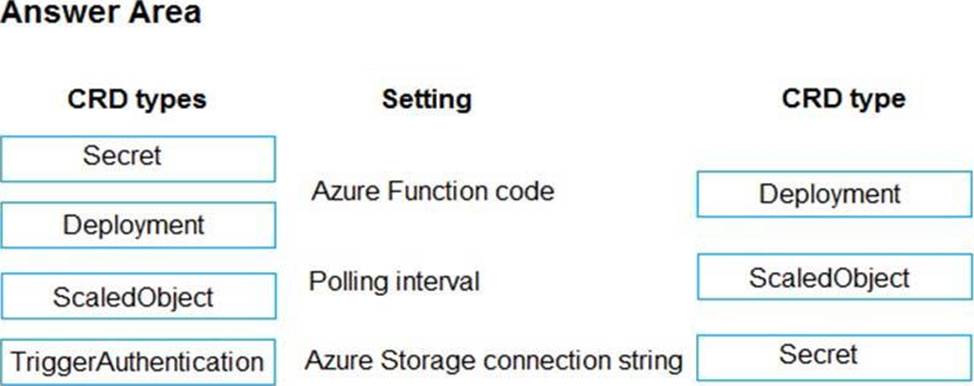
Explanation:
Box 1: Deployment
To deploy Azure Functions to Kubernetes use the func kubernetes deploy command has several attributes that directly control how our app scales, once it is deployed to Kubernetes.
Box 2: ScaledObject
With –polling-interval, we can control the interval used by KEDA to check Azure Service Bus Queue for messages.
Example of ScaledObject with polling interval
apiVersion: keda.k8s.io/v1alpha1
kind: ScaledObject
metadata:
name: transformer-fn
namespace: tt
labels:
deploymentName: transformer-fn
spec:
scaleTargetRef:
deploymentName: transformer-fn
pollingInterval: 5
minReplicaCount: 0
maxReplicaCount: 100
Box 3: Secret
Store connection strings in Kubernetes Secrets.
Example: to create the Secret in our demo Namespace:
# create the k8s demo namespace
kubectl create namespace tt
# grab connection string from Azure Service Bus
KEDA_SCALER_CONNECTION_STRING=$(az servicebus queue authorization-rule keys list
-g $RG_NAME
–namespace-name $SBN_NAME
–queue-name inbound
-n keda-scaler
–query "primaryConnectionString"
-o tsv)
# create the kubernetes secret
kubectl create secret generic tt-keda-auth
–from-literal KedaScaler=$KEDA_SCALER_CONNECTION_STRING
–namespace tt
Reference: https://www.thinktecture.com/en/kubernetes/serverless-workloads-with-keda/
DRAG DROP
You are a developer for a software as a service (SaaS) company that uses an Azure Function to process orders. The Azure Function currently runs on an Azure Function app that is triggered by an Azure Storage queue.
You are preparing to migrate the Azure Function to Kubernetes using Kubernetes-based Event Driven Autoscaling (KEDA).
You need to configure Kubernetes Custom Resource Definitions (CRD) for the Azure Function.
Which CRDs should you configure? To answer, drag the appropriate CRD types to the correct locations. Each CRD type may be used once, more than once, or not at all. You may need to drag the split bar between panes or scroll to view content. NOTE: Each correct selection is worth one point.
Explanation:
Box 1: Deployment
To deploy Azure Functions to Kubernetes use the func kubernetes deploy command has several attributes that directly control how our app scales, once it is deployed to Kubernetes.
Box 2: ScaledObject
With –polling-interval, we can control the interval used by KEDA to check Azure Service Bus Queue for messages.
Example of ScaledObject with polling interval
apiVersion: keda.k8s.io/v1alpha1
kind: ScaledObject
metadata:
name: transformer-fn
namespace: tt
labels:
deploymentName: transformer-fn
spec:
scaleTargetRef:
deploymentName: transformer-fn
pollingInterval: 5
minReplicaCount: 0
maxReplicaCount: 100
Box 3: Secret
Store connection strings in Kubernetes Secrets.
Example: to create the Secret in our demo Namespace:
# create the k8s demo namespace
kubectl create namespace tt
# grab connection string from Azure Service Bus
KEDA_SCALER_CONNECTION_STRING=$(az servicebus queue authorization-rule keys list
-g $RG_NAME
–namespace-name $SBN_NAME
–queue-name inbound
-n keda-scaler
–query "primaryConnectionString"
-o tsv)
# create the kubernetes secret
kubectl create secret generic tt-keda-auth
–from-literal KedaScaler=$KEDA_SCALER_CONNECTION_STRING
–namespace tt
Reference: https://www.thinktecture.com/en/kubernetes/serverless-workloads-with-keda/
You are developing a medical records document management website. The website is used to store scanned copies of patient intake forms. If the stored intake forms are downloaded from storage by a third party, the content of the forms must not be compromised.
You need to store the intake forms according to the requirements.
Solution:
✑ Create a Azure Key Vault key named skey.
✑ Encrypt the intake forms using the public key portion of skey.
✑ Store the encrypted data in Azure Blob storage
Does the solution meet the goal?
- A . Yes
- B . No
DRAG DROP
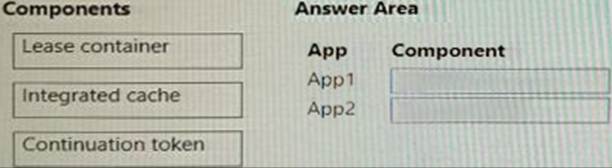
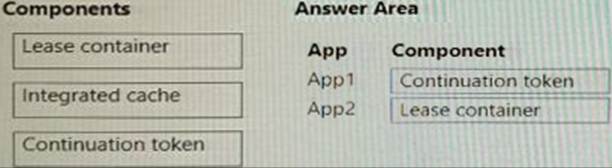
You have an Azure Cosmos DB for NoSQL account.
You plan to develop two apps named App1 and App2 that will use the change feed functionality to track changes to containers.
App1 will use the pull model and App2 will use the push model.
You need to choose the method to track the most recently processed change in App1 and App2.
Which component should you use? To answer, drag the appropriate components to the correct apps. Each component may be used once, more than once, or not at all. You may need to drag the split bar between panes or scroll to view content. NOTE: Each correct selection is worth one point.
You provide an Azure API Management managed web service lo clients. The back end web service implements HTTP Strict Transport Security (HSTS).
Every request to the backend service must include a valid HTTP authorization header.
You need to configure the Azure API Management instance with an authentication policy.
Which two policies can you uses? Each correct answer presents a complete solution. NOTE: Each correct selection is worth one point.
- A . Certificate Authentication
- B . Basic Authentication
- C . OAuth Client Credential Grant
- D . Digest Authentication