
Microsoft AZ-204 Practice Exams
Last updated on Nov 16,2026- Exam Code: AZ-204
- Exam Name: Developing Solutions for Microsoft Azure
- Certification Provider: Microsoft
- Latest update: Nov 16,2026
You develop and deploy a web application to Azure App Service. The application accesses data stored in an Azure Storage account. The account contains several containers with several blobs with large amounts of data. You deploy all Azure resources to a single region.
You need to move the Azure Storage account to the new region. You must copy all data to the new region.
What should you do first?
- A . Export the Azure Storage account Azure Resource Manager template
- B . Initiate a storage account failover
- C . Configure object replication for all blobs
- D . Use the AzCopy command line tool
- E . Create a new Azure Storage account in the current region
- F . Create a new subscription in the current region
A
Explanation:
To move a storage account, create a copy of your storage account in another region. Then, move your data to that account by using AzCopy, or another tool of your choice and finally, delete the resources in the source region.
To get started, export, and then modify a Resource Manager template.
Reference: https://docs.microsoft.com/en-us/azure/storage/common/storage-account-move?tabs=azure-portal
HOTSPOT
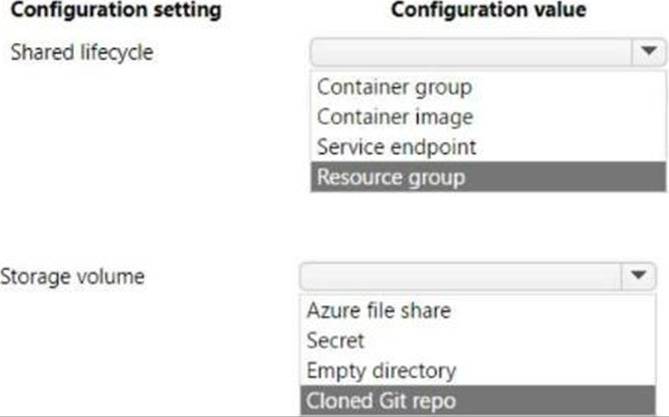
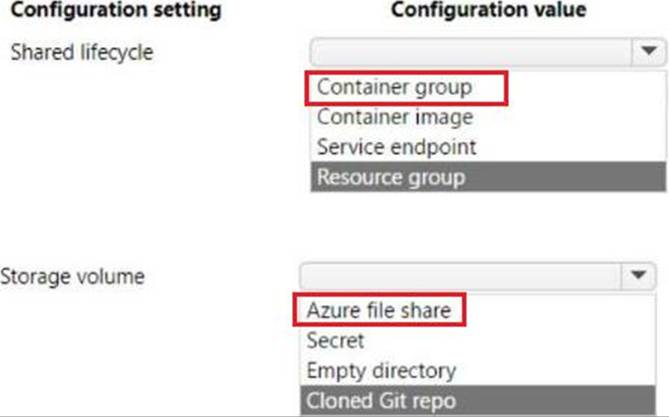
You are developing an application that includes two Docker containers.
The application must meet the following requirements
✑ The containers must not run as root.
✑ The containers must be deployed to Azure Container Instances by using a YAML file.
✑ The containers must share a lifecycle, resources, local network and storage volume.
✑ The storage volume must persist through container crashes.
✑ The storage volume must be destroyed on stop or restart of the containers.
You need to configure Azure Container Instances for the application.
HOTSPOT
You are developing an application that includes two Docker containers.
The application must meet the following requirements
✑ The containers must not run as root.
✑ The containers must be deployed to Azure Container Instances by using a YAML file.
✑ The containers must share a lifecycle, resources, local network and storage volume.
✑ The storage volume must persist through container crashes.
✑ The storage volume must be destroyed on stop or restart of the containers.
You need to configure Azure Container Instances for the application.
You need to mitigate the Azure Cache for Redis issue.
What are two possible ways to achieve this goal? Each correct answer presents part of the solution. NOTE: Each correct selection is worth one point.
- A . Increase the maxmemory-reserved and maxfragmenTationmemory-reserved values
- B . Modify the maxmemory policy to evict the least frequently used keys out of all keys.
- C . Configure client connections to retry commands with exponential backoff.
- D . Test application code by purging the cache in the test environment.
- E . Test application code by rebooting all nodes in the test environment.
You are developing an Azure-based web application. The application goes offline periodically to
perform offline data processing. While the application is offline, numerous Azure Monitor alerts fire which result in the on-call developer being paged.
The application must always log when the application is offline for any reason.
You need to ensure that the on-call developer is not paged during offline processing.
What should you do?
- A . Add Azure Monitor alert processing rules to suppress notifications.
- B . Create an Azure Monitor Metric Alert.
- C . Build an Azure Monitor action group that suppresses the alerts.
- D . Disable Azure Monitor Service Health Alerts during offline processing.
HOTSPOT
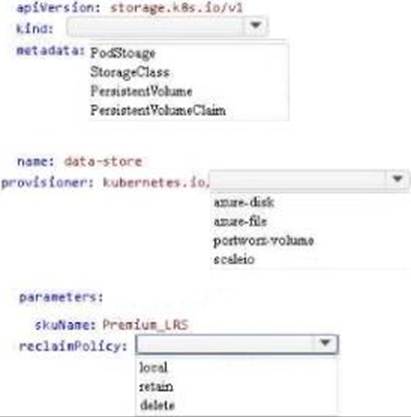
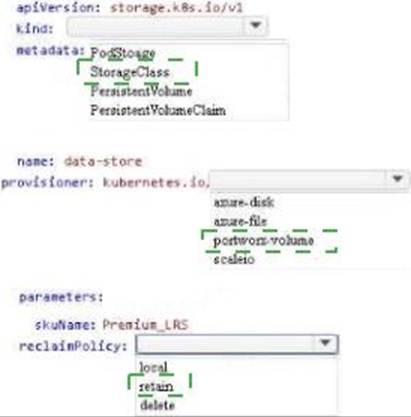
You are developing an application that runs in several customer Azure Kubernetes Service clusters, within each cluster, a pod runs that collects performance data to be analyzed later, a large amount of data is collected so saving latency must be minimized
The performance data must be stored so that pod restarts do not impact the stored data. Write latency should be minimized.
You need to configure blob storage.
How should you complete the YAML configuration? To answer, select the appropriate options in the answer area.
A company is implementing a publish-subscribe (Pub/Sub) messaging component by using Azure Service Bus. You are developing the first subscription application.
In the Azure portal you see that messages are being sent to the subscription for each topic. You create and initialize a subscription client object by supplying the correct details, but the subscription application is still not consuming the messages.
You need to complete the source code of the subscription client
What should you do?
- A . await subscriptionClient.CloseAsync();
- B . await subscriptionClient.AddRuleAsync(new RuleDescription(RuleDescription.DefaultRuleName, new TrueFilter()));
- C . subscriptionClient.RegisterMessageHandler(ProcessMessagesAsync, messageHandlerOptions);
- D . subscriptionClient = new SubscriptionClient(ServiceBusConnectionString, TopicName, SubscriptionName);
C
Explanation:
Using topic client, call RegisterMessageHandler which is used to receive messages continuously from the entity. It registers a message handler and begins a new thread to receive messages. This handler is waited on every time a new message is received by the receiver.
subscriptionClient.RegisterMessageHandler(ReceiveMessagesAsync, messageHandlerOptions);
Reference: https://www.c-sharpcorner.com/article/azure-service-bus-topic-and-subscription-pub-sub/
HOTSPOT
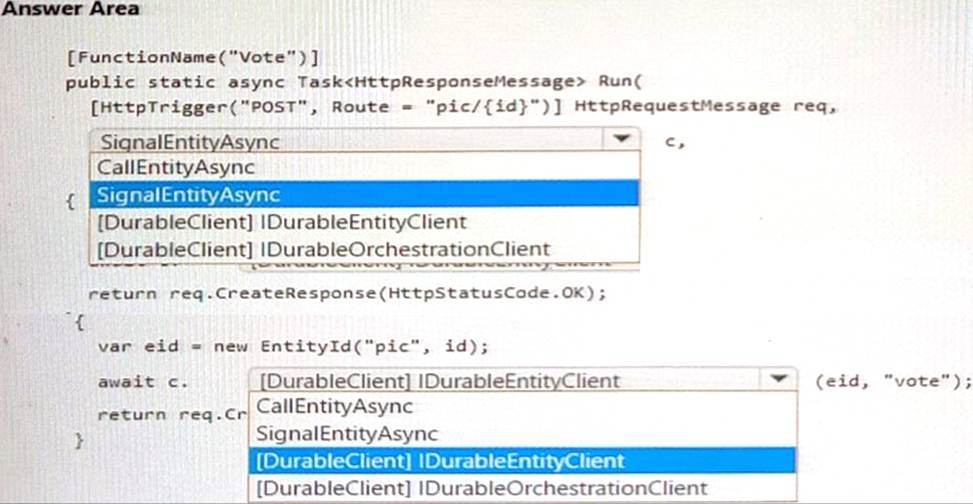
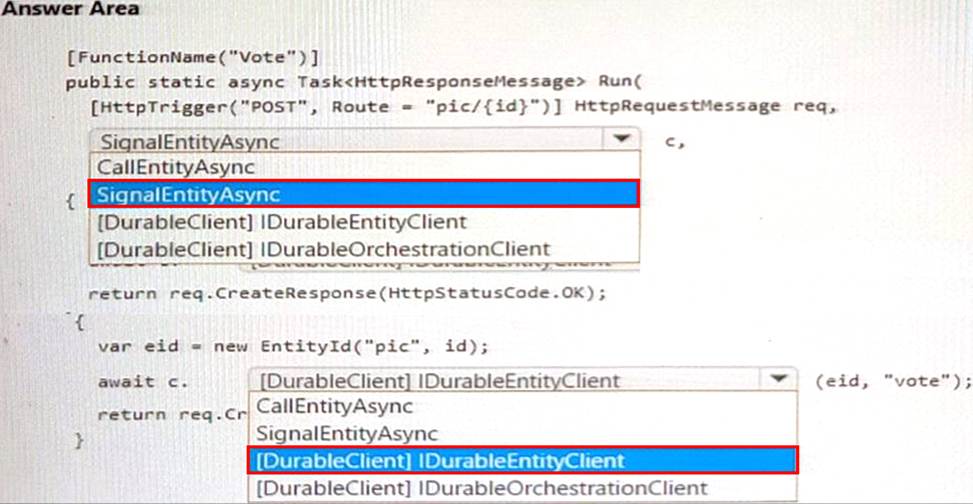
You are developing an online game that allows players to vote for their favorite photo that illustrates a word. The game is built by using Azure Functions and uses durable entities to track the vote count
The voting window is 30 seconds. You must minimize latency.
You need to implement the Azure Function for voting.
How should you complete the code? To answer, select the appropriate options in the answer area.
You are building a web application that performs image analysis on user photos and returns metadata containing objects identified. The image analysis is very costly in terms of time and compute resources. You are planning to use Azure Redo Cache so Cache uploads do not need to be reprocessed.
In case of an Azure data center outage metadata loss must be kept to a minimum.
You need to configure the Azure Redis cache instance.
Which two actions should you perform? Each correct answer presents part of the solution. NOTE: Each correct selection in worth one point.
- A . Configure Azure Redis with persistence
- B . Configure second storage account for persistence
- C . Set backup frequency to the minimum value
- D . Configure Azure Redis with RDS persistence
DRAG DROP
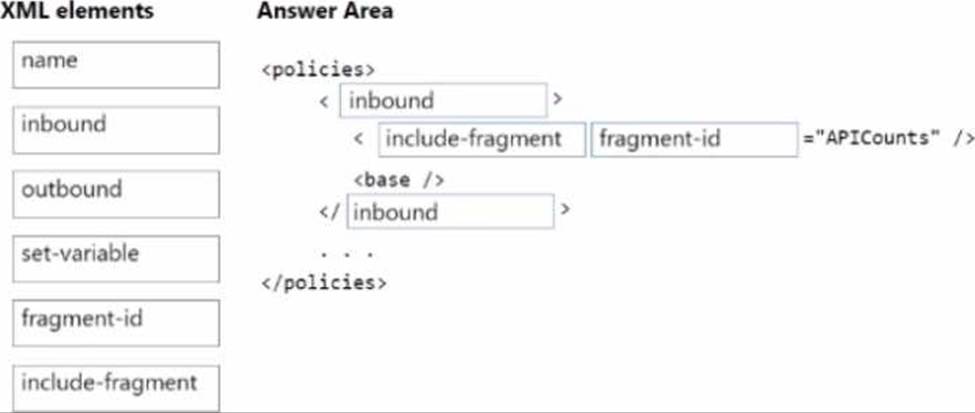
You develop and deploy several APIs to Azure API Management.
You create the following policy fragment named APICounts:
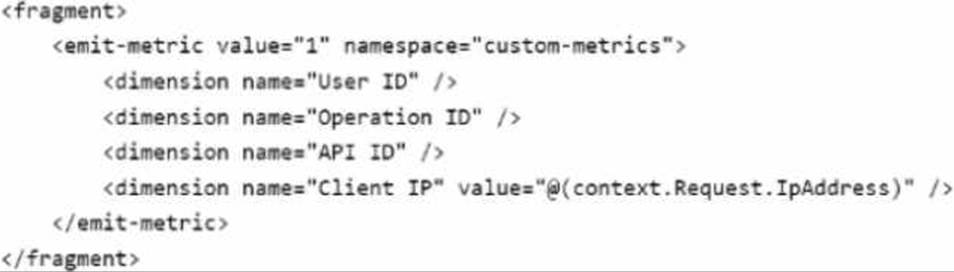
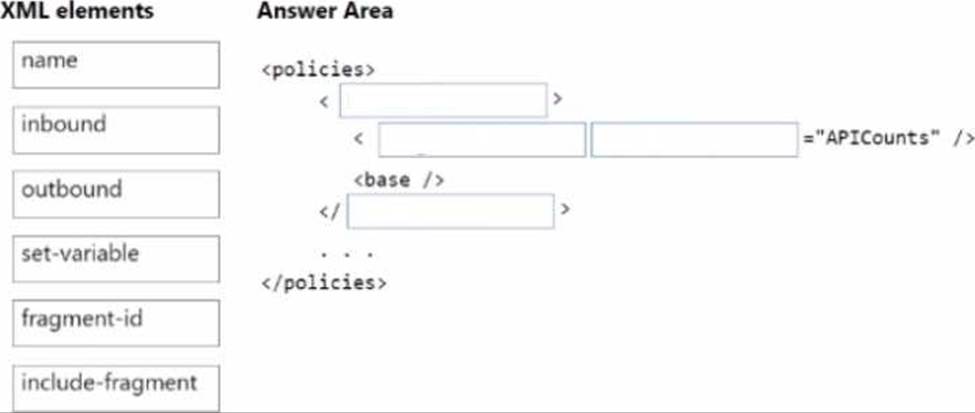
The policy fragment must be reused across various scopes and APIs. The policy fragment must be applied to all APIs and run when a calling system invokes any API.
You need to implement the policy fragment.
How should you complete the policy segment? To answer, drag the appropriate XML elements to the correct targets. Each XML element may be used once, more than once, or not at all. You may need to drag the split bar between panes or scroll to view content. NOTE: Each correct selection is worth one point.
Explanation:
https://learn.microsoft.com/en-us/azure/api-management/include-fragment-policy