
Microsoft AZ-204 Practice Exams
Last updated on Nov 16,2026- Exam Code: AZ-204
- Exam Name: Developing Solutions for Microsoft Azure
- Certification Provider: Microsoft
- Latest update: Nov 16,2026
You manage an Azure subscription associated with a Microsoft Entra tenant named contoso.com. The subscription contains an Azure Bl account has the Contributor Azure role-based access control (RBAC) role within the scope of the subscription.
You plan to implement secure access to containers and blobs in storage 1.
Your solution must satisfy the following requirements:
• Authorization requests to access storage! content must be authenticated by using Microsoft Entra credentials.
• Authorized access to storage1 content must be time-limited based on arbitrary values specified when requests are raised.
• The principle of least privilege must be satisfied.
You need to implement the plan.
Which three actions should you perform in sequence? To answer, move the appropriate secure access implementation options from the list of secure access implementations to the answer area and arrange them in the correct order.
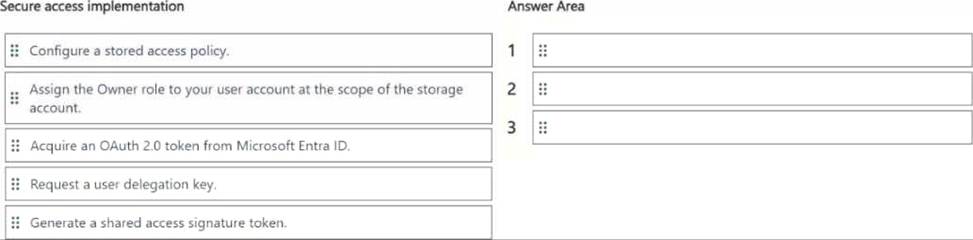
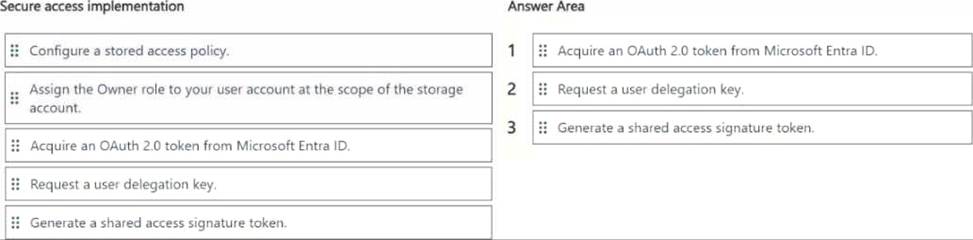
You manage an Azure subscription associated with a Microsoft Entra tenant named contoso.com. The subscription contains an Azure Bl account has the Contributor Azure role-based access control (RBAC) role within the scope of the subscription.
You plan to implement secure access to containers and blobs in storage 1.
Your solution must satisfy the following requirements:
• Authorization requests to access storage! content must be authenticated by using Microsoft Entra credentials.
• Authorized access to storage1 content must be time-limited based on arbitrary values specified when requests are raised.
• The principle of least privilege must be satisfied.
You need to implement the plan.
Which three actions should you perform in sequence? To answer, move the appropriate secure access implementation options from the list of secure access implementations to the answer area and arrange them in the correct order.
You manage an Azure subscription associated with a Microsoft Entra tenant named contoso.com. The subscription contains an Azure Bl account has the Contributor Azure role-based access control (RBAC) role within the scope of the subscription.
You plan to implement secure access to containers and blobs in storage 1.
Your solution must satisfy the following requirements:
• Authorization requests to access storage! content must be authenticated by using Microsoft Entra credentials.
• Authorized access to storage1 content must be time-limited based on arbitrary values specified when requests are raised.
• The principle of least privilege must be satisfied.
You need to implement the plan.
Which three actions should you perform in sequence? To answer, move the appropriate secure access implementation options from the list of secure access implementations to the answer area and arrange them in the correct order.
HOTSPOT
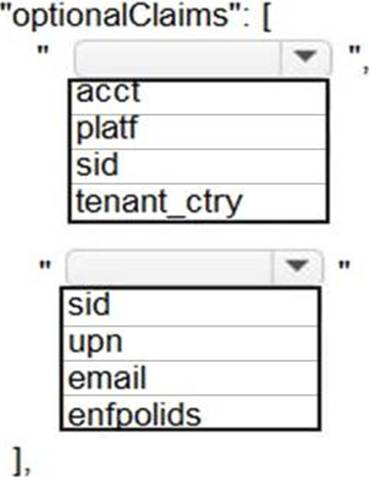
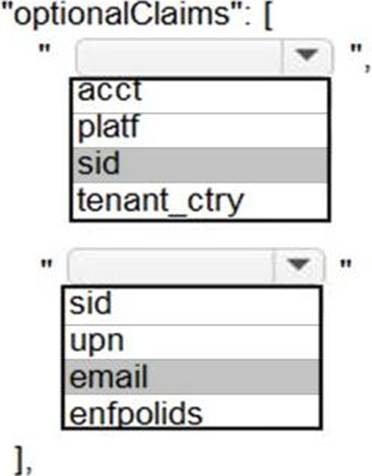
You need to add code at line AM10 of the application manifest to ensure that the requirement for manually reviewing content can be met.
How should you complete the code? To answer, select the appropriate options in the answer area. NOTE: Each correct selection is worth one point.
Explanation:
Box 1: sid
Sid: Session ID, used for per-session user sign-out. Personal and Azure AD accounts.
Scenario: Manual review
To review content, the user must authenticate to the website portion of the ContentAnalysisService using their Azure AD credentials. The website is built using React and all pages and API endpoints require authentication. In order to review content a user must be part of a ContentReviewer role.
Box 2: email
Scenario: All completed reviews must include the reviewer’s email address for auditing purposes.
You develop a website. You plan to host the website in Azure. You expect the website to experience high traffic volumes after it is published. You must ensure that the website remains available and responsive while minimizing cost. You need to deploy the website.
What should you do?
- A . Deploy the website to an App Service that uses the Shared service tier. Configure the App Service plan to automatically scale when the CPU load is high.
- B . Deploy the website to a virtual machine. Configure the virtual machine to automatically scale when the CPU load is high.
- C . Deploy the website to an App Service that uses the Standard service tier. Configure the App Service plan to automatically scale when the CPU load is high.
- D . Deploy the website to a virtual machine. Configure a Scale Set to increase the virtual machine instance count when the CPU load
C
Explanation:
Windows Azure Web Sites (WAWS) offers 3 modes: Standard, Free, and Shared.
Standard mode carries an enterprise-grade SLA (Service Level Agreement) of 99.9% monthly, even for sites with just one instance.
Standard mode runs on dedicated instances, making it different from the other ways to buy Windows Azure Web Sites.
You are developing a road tollway tracking application that sends tracking events by using Azure Event Hubs using premium tier.
Each road must have a throttling policy uniquely assigned.
You need to configure the event hub to allow for per-road throttling.
What should you do?
- A . Ensure each road has a unique connection string.
- B . Use a unique consumer group for each road
- C . Use a unique application group for each road
- D . Ensure each road stores events in a different partition.
You are implementing an Azure API app that uses built-in authentication and authorization functionality.
All app actions must be associated with information about the current user.
You need to retrieve the information about the current user.
What are two possible ways to achieve the goal? Each correct answer presents a complete solution. NOTE: Each correct selection is worth one point.
- A . HTTP headers
- B . environment variables
- C . /.auth/me HTTP endpoint
- D . /.auth/login endpoint
AC
Explanation:
A: After App Service Authentication has been configured, users trying to access your API are prompted to sign in with their organizational account that belongs to the same Azure AD as the Azure AD application used to secure the API. After signing in, you are able to access the information about the current user through the HttpContext.Current.User property.
C: While the server code has access to request headers, client code can access GET /.auth/me to get the same access tokens (
Reference:
https://docs.microsoft.com/en-us/azure/app-service/app-service-web-tutorial-auth-aad
https://docs.microsoft.com/en-us/sharepoint/dev/spfx/web-parts/guidance/connect-to-api-secured-with-aad
Note: This question is part of a series of questions that present the same scenario. Each question in the series contains a unique solution that might meet the stated goals. Some question sets might have more than one correct solution, while others might not have a correct solution.
After you answer a question in this question, you will NOT be able to return to it. As a result, these questions will not appear in the review screen.
You are developing a solution that will be deployed to an Azure Kubernetes Service (AKS) cluster. The solution will include a custom VNet, Azure Container Registry images, and an Azure Storage account.
The solution must allow dynamic creation and management of all Azure resources within the AKS cluster.
You need to configure an AKS cluster for use with the Azure APIs.
Solution: Create an AKS cluster that supports network policy. Create and apply a network to allow traffic only from within a defined namespace.
Does the solution meet the goal?
- A . Yes
- B . No
A
Explanation:
When you run modern, microservices-based applications in Kubernetes, you often want to control which components can communicate with each other. The principle of least privilege should be applied to how traffic can flow between pods in an Azure Kubernetes Service (AKS) cluster. Let’s say you likely want to block traffic directly to back-end applications. The Network Policy feature in Kubernetes lets you define rules for ingress and egress traffic between pods in a cluster.
Reference: https://docs.microsoft.com/en-us/azure/aks/use-network-policies
DRAG DROP
You are developing Azure WebJobs.
You need to recommend a WebJob type for each scenario.
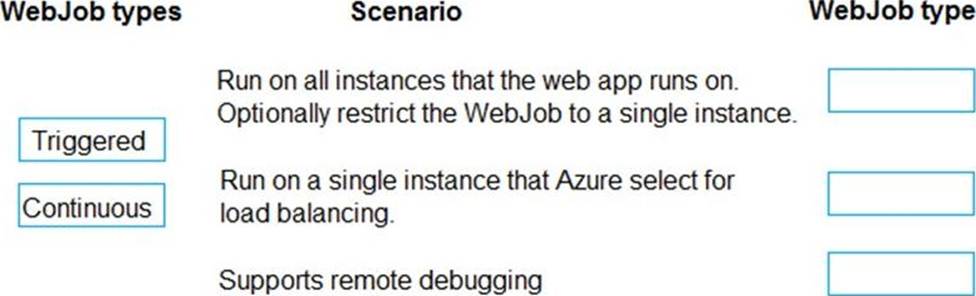
Which WebJob type should you recommend? To answer, drag the appropriate WebJob types to the correct scenarios. Each WebJob type may be used once, more than once, or not at all. You may need to drag the split bar between panes or scroll to view content. NOTE: Each correct selection is worth one point.
Explanation:
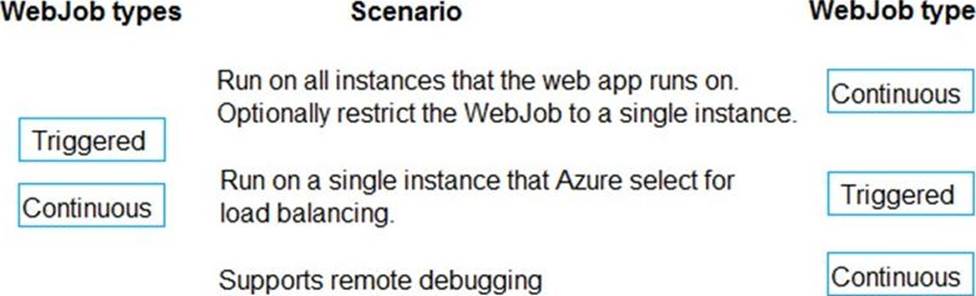
Box 1: Continuous
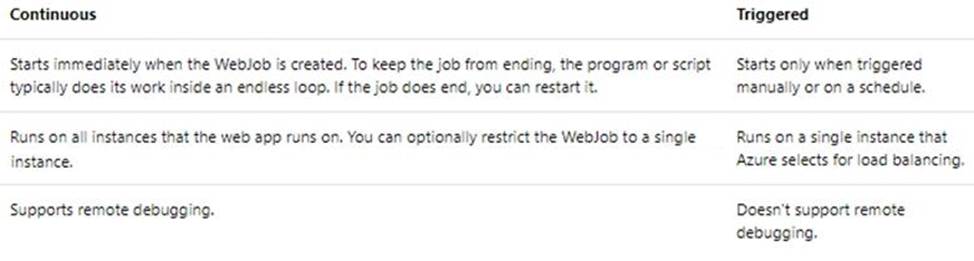
Continuous runs on all instances that the web app runs on. You can optionally restrict the WebJob to a single instance.
Box 2: Triggered
Triggered runs on a single instance that Azure selects for load balancing.
Box 3: Continuous
Continuous supports remote debugging.
Note:
The following table describes the differences between continuous and triggered WebJobs.
Reference: https://docs.microsoft.com/en-us/azure/app-service/web-sites-create-web-jobs
DRAG DROP
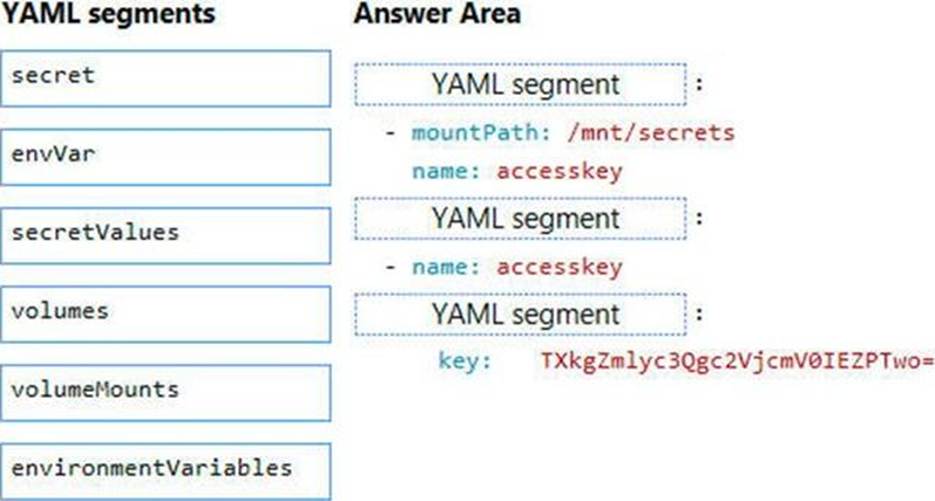
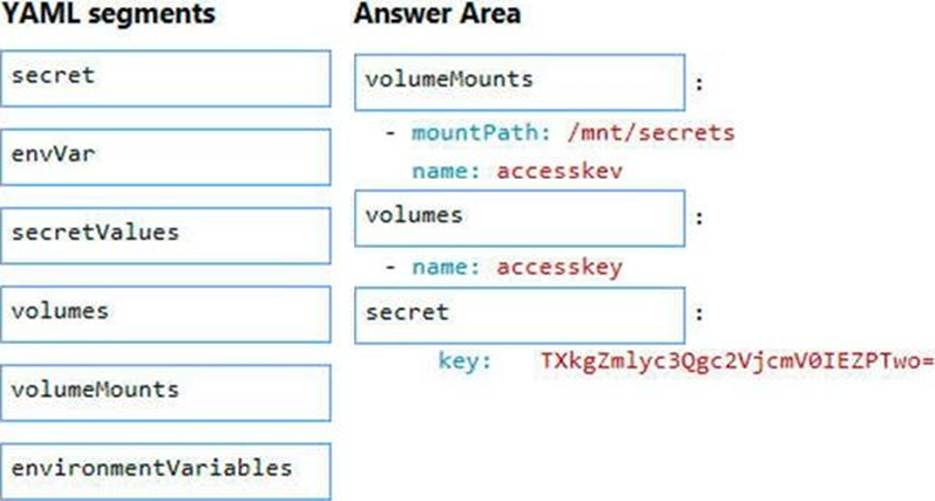
You need to add YAML markup at line CS17 to ensure that the ContentUploadService can access Azure Storage access keys.
How should you complete the YAML markup? To answer, drag the appropriate YAML segments to the correct locations. Each YAML segment may be used once, more than once, or not at all. You may need to drag the split bar between panes or scroll to view content. NOTE: Each correct selection is worth one point.
Explanation:
Box 1: volumeMounts
Example:
volumeMounts:
– mountPath: /mnt/secrets
name: secretvolume1
volumes:
– name: secretvolume1 secret:
mysecret1: TXkgZmlyc3Qgc2VjcmV0IEZPTwo=
Box 2: volumes
Box 3: secret
Reference: https://docs.microsoft.com/en-us/azure/container-instances/container-instances-volume-secret