
Microsoft AZ-204 Practice Exams
Last updated on Nov 16,2026- Exam Code: AZ-204
- Exam Name: Developing Solutions for Microsoft Azure
- Certification Provider: Microsoft
- Latest update: Nov 16,2026
You are developing an Azure Function App that runs in an App Service Plan. The Azure Function is triggered by a Timer object. You observe that the Azure Function does not reliably trigger when scheduled.
Which two actions should you perform?
- A . Verify that Always On is enabled.
- B . Modify the trigger to use a SignaIR trigger.
- C . Ensure that the function has a retry configured.
- D . Modify the trigger to use Consumption mode instead of the App Service plan.
DRAG DROP
You are maintaining an existing application that uses an Azure Blob GPv1 Premium storage account.
Data older than three months is rarely used.
Data newer than three months must be available immediately. Data older than a year must be saved but does not need to be available immediately.
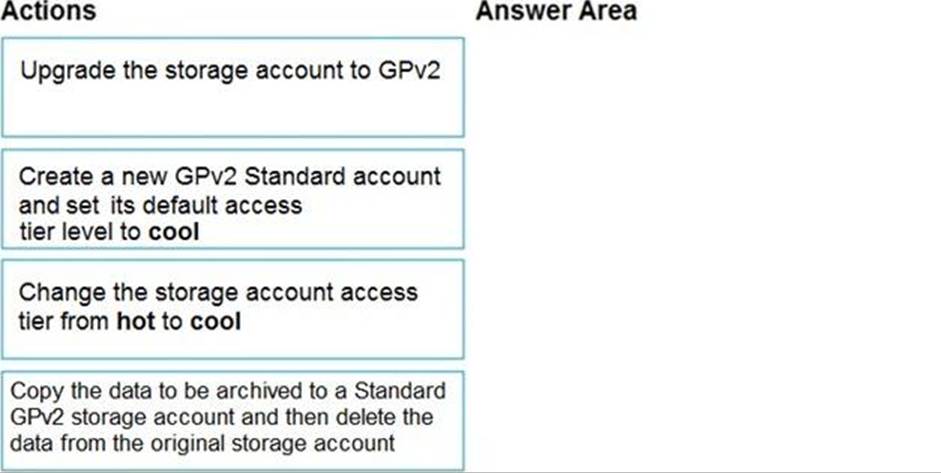
You need to configure the account to support a lifecycle management rule that moves blob data to archive storage for data not modified in the last year.
Which three actions should you perform in sequence? To answer, move the appropriate actions from the list of actions to the answer area and arrange them in the correct order.
Explanation:
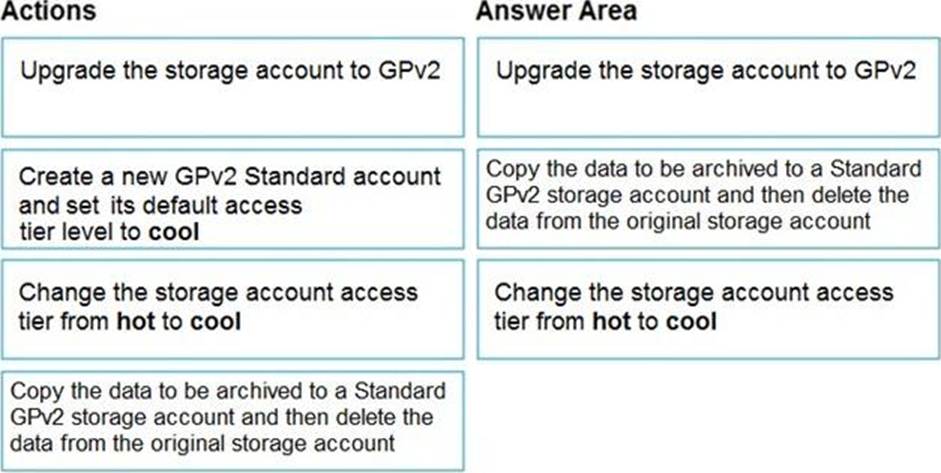
Step 1: Upgrade the storage account to GPv2
Object storage data tiering between hot, cool, and archive is supported in Blob Storage and General Purpose v2 (GPv2) accounts. General Purpose v1 (GPv1) accounts don’t support tiering.
You can easily convert your existing GPv1 or Blob Storage accounts to GPv2 accounts through the Azure portal.
Step 2: Copy the data to be archived to a Standard GPv2 storage account and then delete the data from the original storage account
Step 3: Change the storage account access tier from hot to cool
Note: Hot – Optimized for storing data that is accessed frequently.
Cool – Optimized for storing data that is infrequently accessed and stored for at least 30 days.
Archive – Optimized for storing data that is rarely accessed and stored for at least 180 days with flexible latency requirements, on the order of hours.
Only the hot and cool access tiers can be set at the account level. The archive access tier can only be set at the blob level.
Reference: https://docs.microsoft.com/en-us/azure/storage/blobs/storage-blob-storage-tiers
Note: This question is part of a series of questions that present the same scenario. Each question in the series contains a unique solution that might meet the stated goals. Some question sets might have more than one correct solution, while others might not have a correct solution.
After you answer a question in this section, you will NOT be able to return to it. As a result, these questions will not appear in the review screen.
You develop a software as a service (SaaS) offering to manage photographs. Users upload photos to a web service which then stores the photos in Azure Storage Blob storage. The storage account type is General-purpose V2.
When photos are uploaded, they must be processed to produce and save a mobile-friendly version of the image. The process to produce a mobile-friendly version of the image must start in less than one minute.
You need to design the process that starts the photo processing.
Solution: Trigger the photo processing from Blob storage events.
Does the solution meet the goal?
- A . Yes
- B . NO
B
Explanation:
You need to catch the triggered event, so move the photo processing to an Azure Function triggered from the blob upload
Note: Azure Storage events allow applications to react to events. Common Blob storage event scenarios include image or video processing, search indexing, or any file-oriented workflow.
Events are pushed using Azure Event Grid to subscribers such as Azure Functions, Azure Logic Apps, or even to your own http listener.
Note: Only storage accounts of kind StorageV2 (general purpose v2) and BlobStorage support event integration. Storage (general purpose v1) does not support integration with Event Grid.
Reference: https://docs.microsoft.com/en-us/azure/storage/blobs/storage-blob-event-overview
Create a DataSource instance and set its Container property to the DataContamer
4 Call the Documents.Suggest method of the SearchlndexClient and pass the DataSource.
Does the solution meet the goal?
- A . Yes
- B . No
DRAG DROP
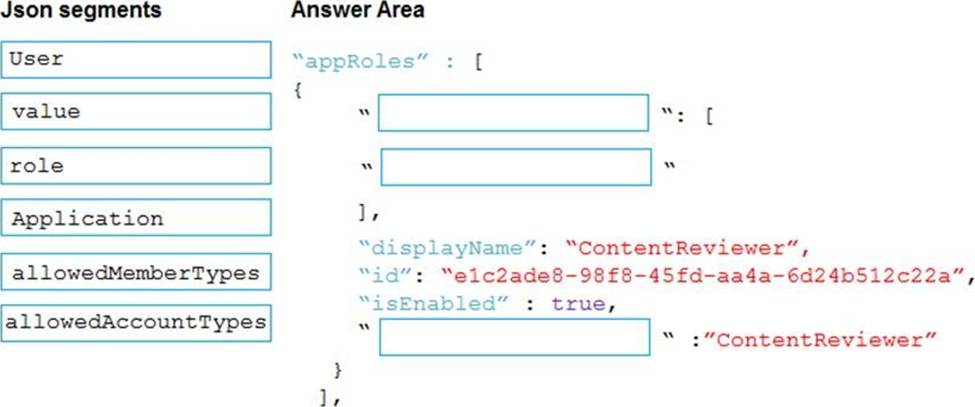
You need to add markup at line AM04 to implement the ContentReview role.
How should you complete the markup? To answer, drag the appropriate json segments to the correct locations. Each json segment may be used once, more than once, or not at all. You may need to drag the split bar between panes or scroll to view content. NOTE: Each correct selection is worth one point.
Explanation:
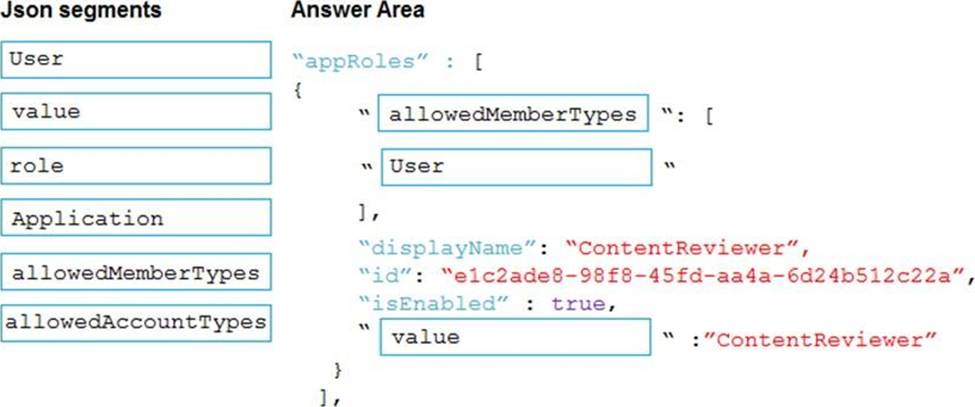
Box 1: allowedMemberTypes
allowedMemberTypes specifies whether this app role definition can be assigned to users and groups by setting to "User", or to other applications (that are accessing this application in daemon service scenarios) by setting to "Application", or to both.
Note: The following example shows the appRoles that you can assign to users.
"appId": "8763f1c4-f988-489c-a51e-158e9ef97d6a",
"appRoles": [
{
"allowedMemberTypes": [
"User"
],
"displayName": "Writer",
"id": "d1c2ade8-98f8-45fd-aa4a-6d06b947c66f",
"isEnabled": true,
"description": "Writers Have the ability to create tasks.",
"value": "Writer"
}
],
"availableToOtherTenants": false,
Box 2: User
Scenario: In order to review content a user must be part of a ContentReviewer role.
Box 3: value
value specifies the value which will be included in the roles claim in authentication and access tokens.
Reference: https://docs.microsoft.com/en-us/graph/api/resources/approle
Note: This question is part of a series of questions that present the same scenario. Each question in the series contains a unique solution that might meet the stated goals. Some question sets might have more than one correct solution, while others might not have a correct solution.
After you answer a question in this section, you will NOT be able to return to it. As a result, these questions will not appear in the review screen.
You are developing an Azure solution to collect point-of-sale fPOS) device data from 2,000 stores located throughout the world. A single device can produce 2 megabytes (MB) of data every 24 hours. Each store location has one to five devices that send data.
You must store the device data in Azure Blob storage. Device data must be correlated based on a device identifier. Additional stores are expected to open in the future.
You need to implement a solution to receive the device data.
Solution: Provision an Azure Event Hub.
Configure the machine identifier as the partition key and enable capture.
- A . Yes
- B . No
A
Explanation:
Reference: https://docs.microsoft.com/en-us/azure/event-hubs/event-hubs-programming-guide
You have an Azure Queue Storage account that contains a queue named queue1.
You plan to use Azure SDK for NET to develop a solution that uses queue1.
You need to author C# code that will return an approximate number of messages in queue1. Your solution must minimize the development effort.
Which method should you use in your code?
- A . GetProperties method of the QueueClient class
- B . GetProperties method of the QueueServiceClient class
- C . PeekMessages method of the QueueClient class
- D . GetStatlstics method of the QueueServiceClient class
DRAG DROP
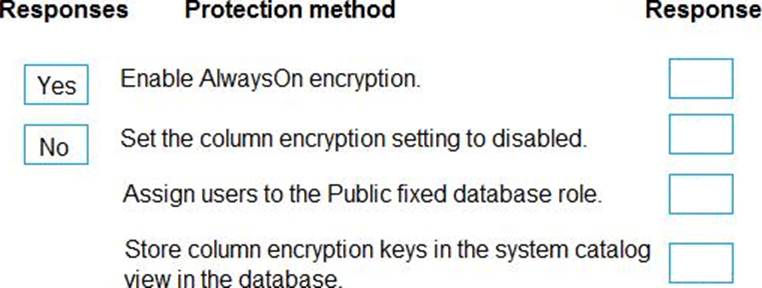
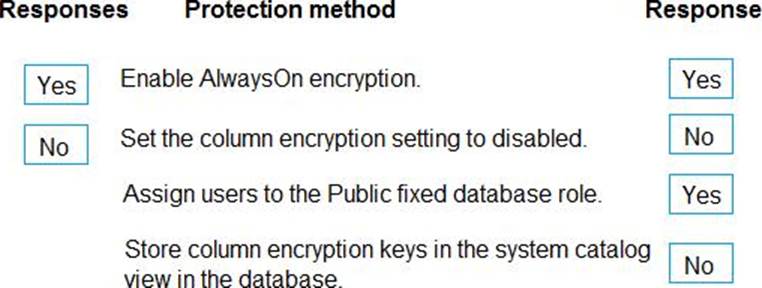
You must ensure that the external party cannot access the data in the SSN column of the Person table.
Will each protection method meet the requirement? To answer, drag the appropriate responses to the correct protection methods. Each response may be used once, more than once, or not at all. You may need to drag the split bar between panes or scroll to view content. NOTE: Each correct selection is worth one point.
Explanation:
Box 1: Yes
You can configure Always Encrypted for individual database columns containing your sensitive data. When setting up encryption for a column, you specify the information about the encryption algorithm and cryptographic keys used to protect the data in the column.
Box 2: No
Box 3: Yes
In SQL Database, the VIEW permissions are not granted by default to the public fixed database role.
This enables certain existing, legacy tools (using older versions of DacFx) to work properly.
Consequently, to work with encrypted columns (even if not decrypting them) a database administrator must explicitly grant the two VIEW permissions.
Box 4: No
All cryptographic keys are stored in an Azure Key Vault.
Reference: https://docs.microsoft.com/en-us/sql/relational-databases/security/encryption/always-encrypted-database-engine
HOTSPOT
You are developing a web application that uses the Microsoft identify platform for user and resource authentication. The web application calls several REST APIs.
You are implementing various authentication and authorization flows for the web application.
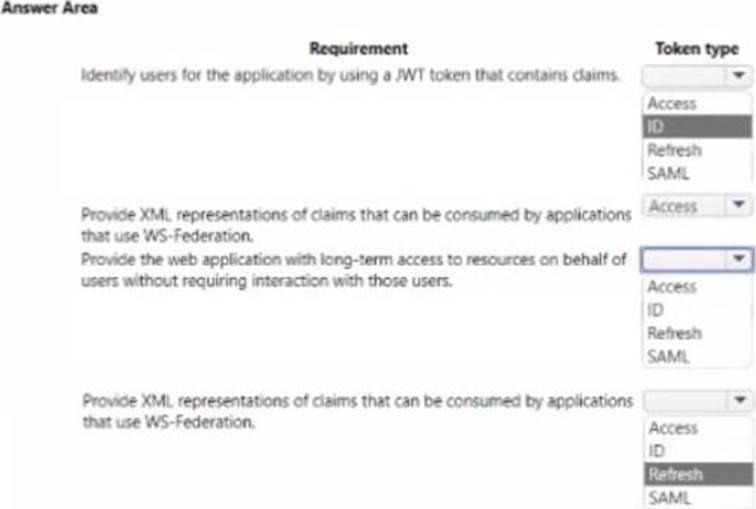
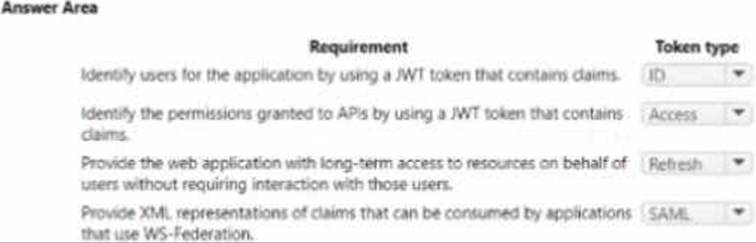
You need to validate the claims in the authentication token.
Which token type should use? To answer, select the appropriate options in the answer area. NOTE: Each correct selection is worth one point.
You are building a web application that performs image analysis on user photos and returns metadata containing objects identified. The image is very costly in terms of time and compute resources. You are planning to use Azure Redis Cache so duplicate uploads do not need to be reprocessed.
In case of an Azure data center outage, metadata loss must be kept to a minimum. You need to configure the Azure Redis cache instance.
Which two actions should you perform?
- A . Configure Azure Redis with rob persistence
- B . Configure second storage account far persistence.
- C . Set backup frequency to the minimum value.
- D . Configure Azure Redis with AOF persistence