
Microsoft AZ-204 Practice Exams
Last updated on Nov 16,2026- Exam Code: AZ-204
- Exam Name: Developing Solutions for Microsoft Azure
- Certification Provider: Microsoft
- Latest update: Nov 16,2026
HOTSPOT
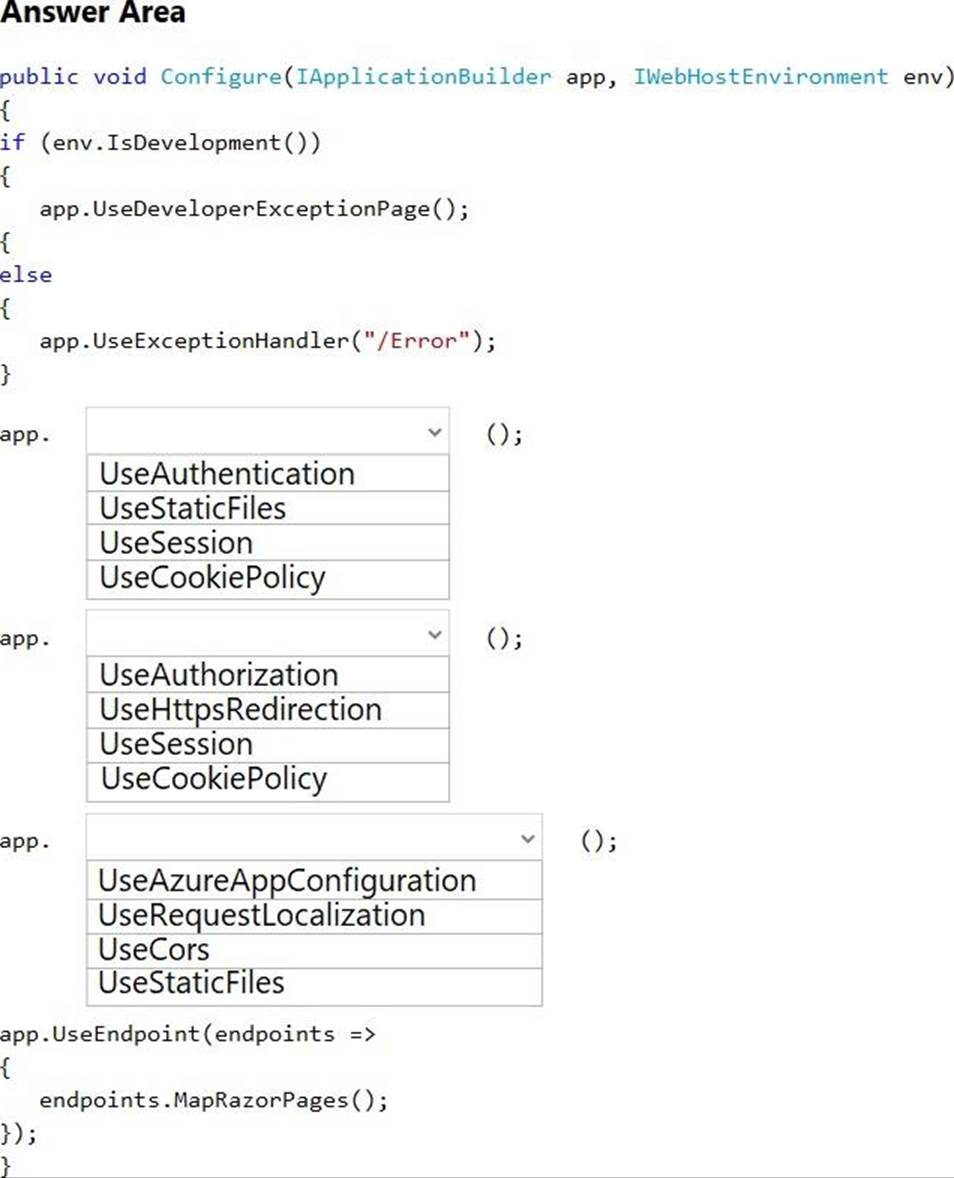
You are developing an ASP.NET Core app that includes feature flags which are managed by Azure App Configuration. You create an Azure App Configuration store named AppFeatureFlagStore that contains a feature flag named Export.
You need to update the app to meet the following requirements:
Use the Export feature in the app without requiring a restart of the app.
Validate users before users are allowed access to secure resources.
Permit users to access secure resources.
How should you complete the code segment? To answer, select the appropriate options in the answer area. NOTE: Each correct selection is worth one point.
Explanation:
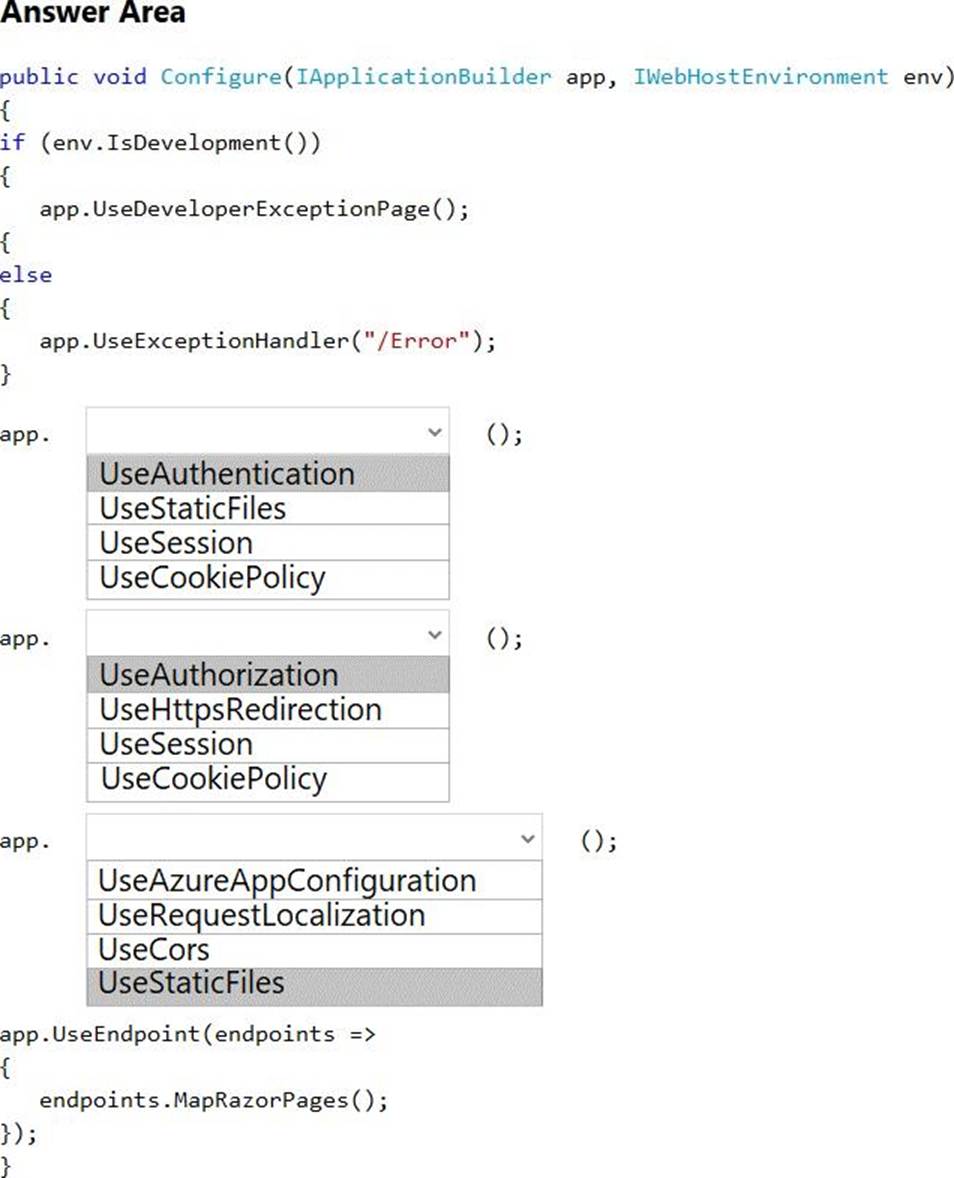
Box 1: UseAuthentication
Need to validate users before users are allowed access to secure resources.
UseAuthentication adds the AuthenticationMiddleware to the specified IApplicationBuilder, which enables authentication capabilities.
Box 2: UseAuthorization
Need to permit users to access secure resources.
UseAuthorization adds the AuthorizationMiddleware to the specified IApplicationBuilder, which enables authorization capabilities.
Box 3: UseStaticFiles
Need to use the Export feature in the app without requiring a restart of the app.
UseStaticFiles enables static file serving for the current request path
Reference: https://docs.microsoft.com/en-us/dotnet/api/microsoft.aspnetcore.builder.iapplicationbuilder?view=aspnetcore-5.0
HOTSPOT
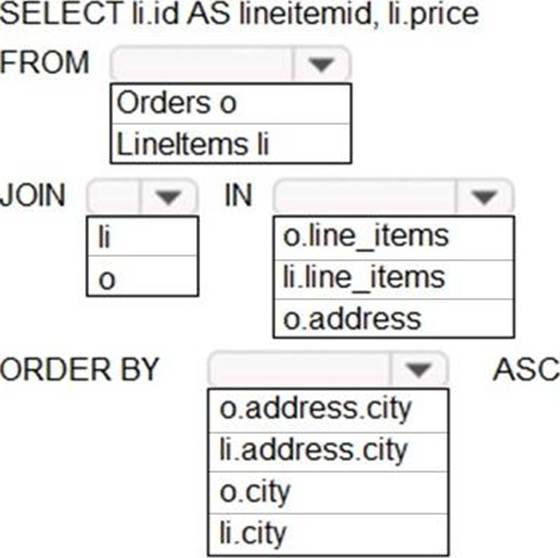
You need to retrieve all order line items from Order.json and sort the data alphabetically by the city.
How should you complete the code? To answer, select the appropriate options in the answer area. NOTE: Each correct selection is worth one point.
Explanation:
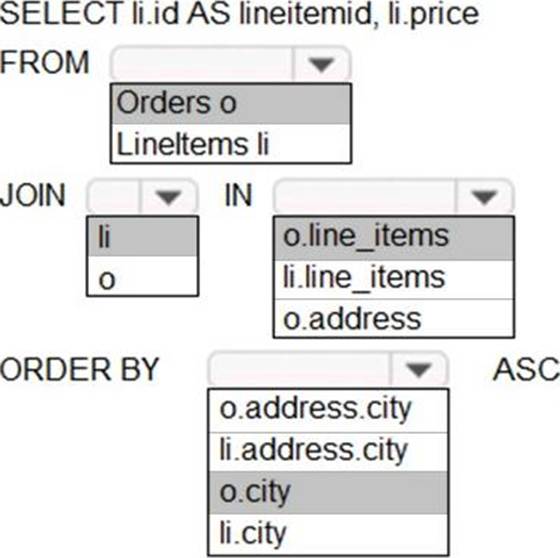
Box 1: orders o
Scenario: Order data is stored as nonrelational JSON and must be queried using SQL.
Box 2:li
Box 3: o.line_items
Box 4: o.city
The city field is in Order, not in the 2s.
HOTSPOT
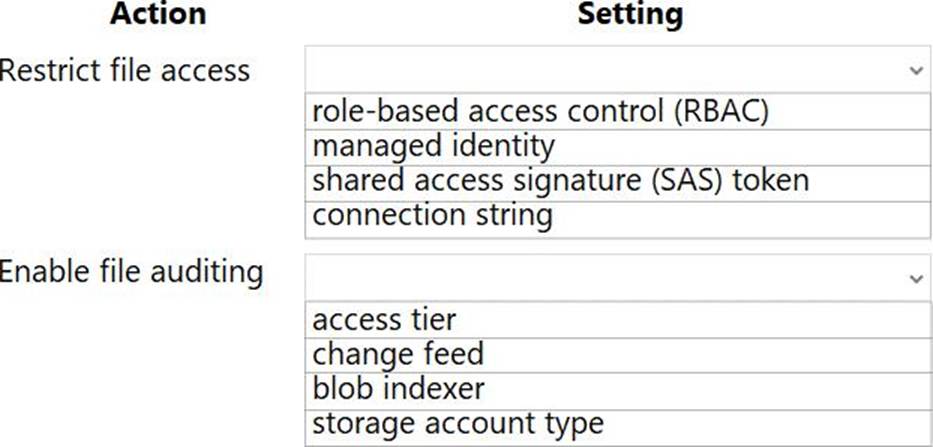
You need to configure security and compliance for the corporate website files.
Which Azure Blob storage settings should you use? To answer, select the appropriate options in the answer area. NOTE: Each correct selection is worth one point.
Explanation:
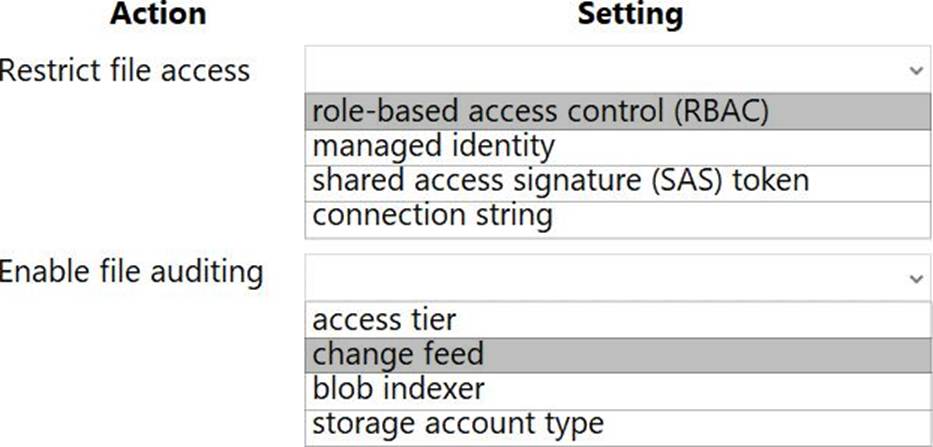
Box 1: role-based access control (RBAC)
Azure Storage supports authentication and authorization with Azure AD for the Blob and Queue services via Azure role-based access control (Azure RBAC).
Scenario: File access must restrict access by IP, protocol, and Azure AD rights.
Box 2: change feed
The purpose of the change feed is to provide transaction logs of all the changes that occur to the blobs and the blob metadata in your storage account.
The file updates must be read-only, stored in the order in which they occurred, include only create, update, delete, and copy operations, and be retained for compliance reasons.
Reference: https://docs.microsoft.com/en-us/azure/cdn/cdn-sas-storage-support
https://docs.microsoft.com/en-us/azure/storage/blobs/storage-blob-change-feed?tabs=azure-portal
HOTSPOT
You provisioned an Azure Cosmos DB for NoSQL account named account1 with the default consistency level.
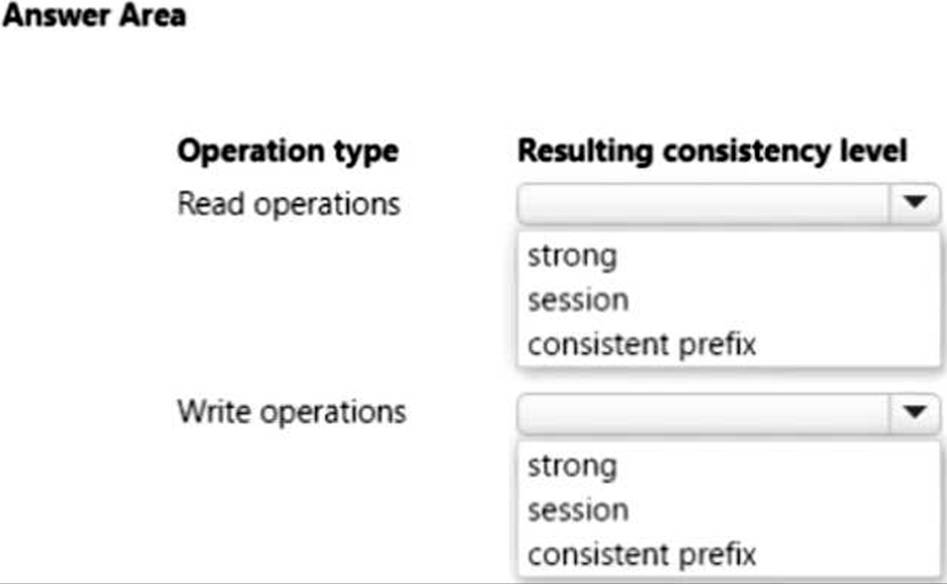
You plan to configure the consistency level on a per request basis The level needs to be set for consistent prefix for read and write operations to account1.
You need to identify the resulting consistency level for read and write operations.
Which levels should you configure? To answer, select the appropriate options in the answer area. NOTE: Each correct selection is worth one point.
Explanation:
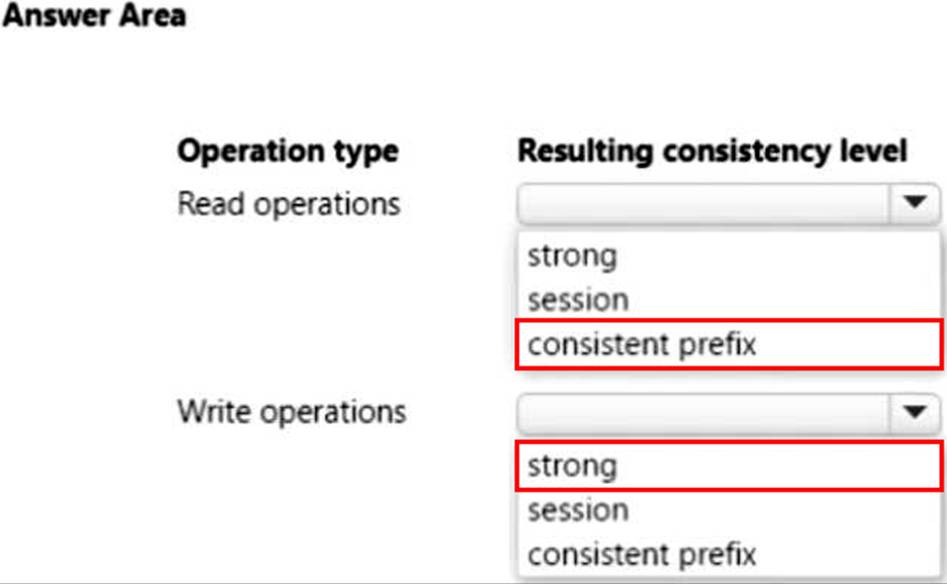
Consistent Prefix
Strong
You must implement Application Insights instrumentation capabilities utilizing the Azure Mobile Apps SDK to provide meaningful analysis of user interactions with a mobile app.
You need to capture the data required to implement the Usage Analytics feature of Application Insights.
Which three data values should you capture? Each correct answer presents part of the solution. NOTE: Each correct selection is worth one point.
- A . Trace
- B . Session Id
- C . Exception
- D . User Id
- E . Events
ADE
Explanation:
Application Insights is a service for monitoring the performance and usage of your apps. This module allows you to send telemetry of various kinds (events, traces, etc.) to the Application Insights service where your data can be visualized in the Azure Portal.
Application Insights manages the ID of a session for you.
Reference: https://github.com/microsoft/ApplicationInsights-Android
You are developing an application to store business-critical data in Azure Blob storage.
The application must meet the following requirements:
• Data must not be modified or deleted for a user-specified interval.
• Data must be protected from overwntes and deletes.
• Data must be written once and allowed to be read many times.
You need to protect the data fen the Azure Blob storage account.
Which two actions should you perform? Each correct answer presents part of the solution. NOTE: Each correct selection is worth one point.
- A . Enable version-level immutability support for the storage account.
- B . Create an account shared-access signature (SAS).
- C . Enable point-in-time restore for containers in the storage account.
- D . Create a service shared-access signature (SAS).
- E . Enable the blob change feed for the storage account.
- F . Configure a time-based retention policy for the storage account.
Note: This question is part of a series of questions that present the same scenario. Each question in the series contains a unique solution. Determine whether the solution meets the stated goals.
You are developing and deploying several ASP.Net web applications to Azure App Service. You plan to save session state information and HTML output.
You must use a storage mechanism with the following requirements:
• Share session state across all ASP.NET web applications
• Support controlled, concurrent access to the same session state data for multiple readers and a single writer
• Save full HTTP responses for concurrent requests
You need to store the information.
Proposed Solution: Deploy and configure Azure Cache for Redis. Update the web applications.
Does the solution meet the goal?
- A . Yes
- B . No
A
Explanation:
The session state provider for Azure Cache for Redis enables you to share session information between different instances of an ASP.NET web application.
The same connection can be used by multiple concurrent threads.
Redis supports both read and write operations.
The output cache provider for Azure Cache for Redis enables you to save the HTTP responses generated by an ASP.NET web application.
Note: Using the Azure portal, you can also configure the eviction policy of the cache, and control access to the cache by adding users to the roles provided. These roles, which define the operations that members can perform, include Owner, Contributor, and Reader. For example, members of the Owner role have complete control over the cache (including security) and its contents, members of
the Contributor role can read and write information in the cache, and members of the Reader role can only retrieve data from the cache.
Reference: https://docs.microsoft.com/en-us/azure/architecture/best-practices/caching
HOTSPOT
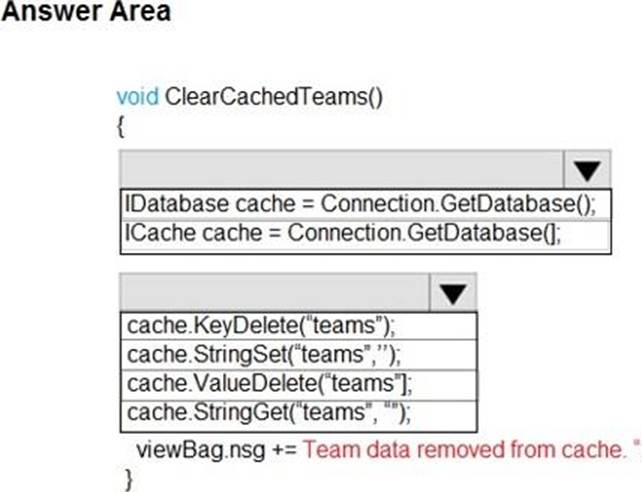
A company is developing a gaming platform. Users can join teams to play online and see leaderboards that include player statistics. The solution includes an entity named Team.
You plan to implement an Azure Redis Cache instance to improve the efficiency of data operations for entities that rarely change.
You need to invalidate the cache when team data is changed.
How should you complete the code? To answer, select the appropriate options in the answer area. NOTE: Each correct selection is worth one point.
Explanation:
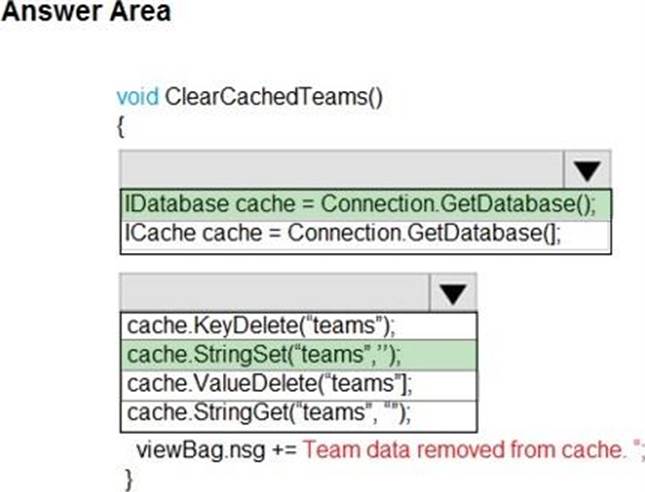
Box 1: IDatabase cache = connection.GetDatabase();
Connection refers to a previously configured ConnectionMultiplexer.
Box 2: cache.StringSet("teams",")
To specify the expiration of an item in the cache, use the TimeSpan parameter of StringSet.
cache.StringSet("key1", "value1", TimeSpan.FromMinutes(90));
Reference: https://azure.microsoft.com/sv-se/blog/lap-around-azure-redis-cache-preview/
HOTSPOT
A company is developing a gaming platform. Users can join teams to play online and see leaderboards that include player statistics. The solution includes an entity named Team.
You plan to implement an Azure Redis Cache instance to improve the efficiency of data operations for entities that rarely change.
You need to invalidate the cache when team data is changed.
How should you complete the code? To answer, select the appropriate options in the answer area. NOTE: Each correct selection is worth one point.
Explanation:
Box 1: IDatabase cache = connection.GetDatabase();
Connection refers to a previously configured ConnectionMultiplexer.
Box 2: cache.StringSet("teams",")
To specify the expiration of an item in the cache, use the TimeSpan parameter of StringSet.
cache.StringSet("key1", "value1", TimeSpan.FromMinutes(90));
Reference: https://azure.microsoft.com/sv-se/blog/lap-around-azure-redis-cache-preview/