
Microsoft AZ-204 Practice Exams
Last updated on Nov 16,2026- Exam Code: AZ-204
- Exam Name: Developing Solutions for Microsoft Azure
- Certification Provider: Microsoft
- Latest update: Nov 16,2026
HOTSPOT
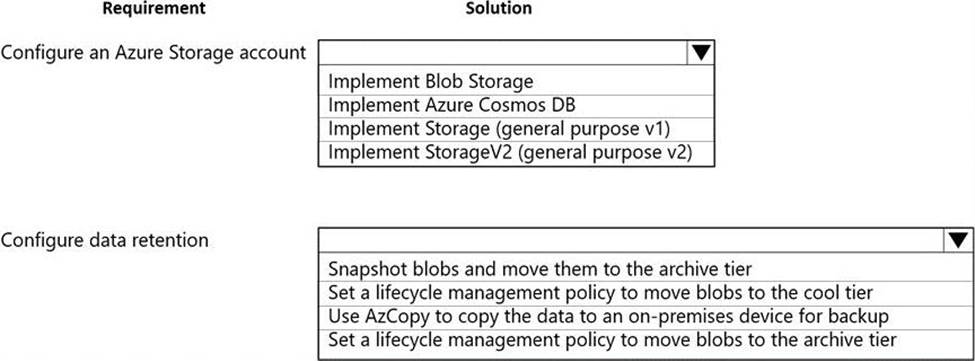
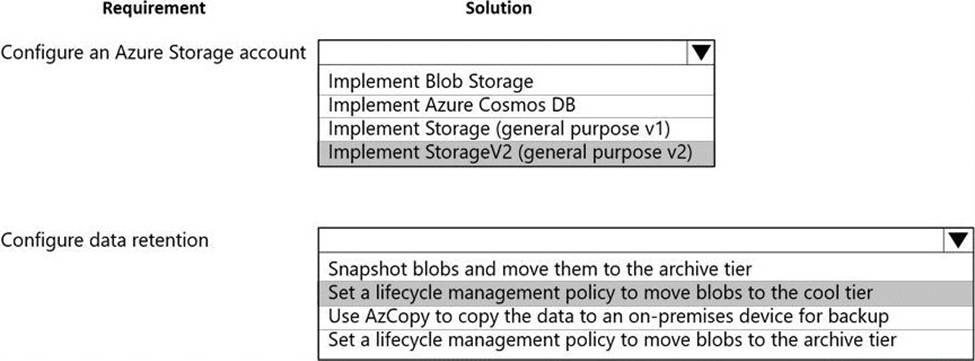
You are developing a web application that will use Azure Storage. Older data will be less frequently used than more recent data.
You need to configure data storage for the application.
You have the following requirements:
✑ Retain copies of data for five years.
✑ Minimize costs associated with storing data that is over one year old.
✑ Implement Zone Redundant Storage for application data.
What should you do? To answer, select the appropriate options in the answer area. NOTE: Each correct selection is worth one point.
Explanation:
Reference:
https://docs.microsoft.com/en-us/azure/storage/blobs/storage-blob-storage-tiers
https://docs.microsoft.com/en-us/azure/storage/common/storage-redundancy?toc=/azure/storage/blobs/toc.json
HOTSPOT
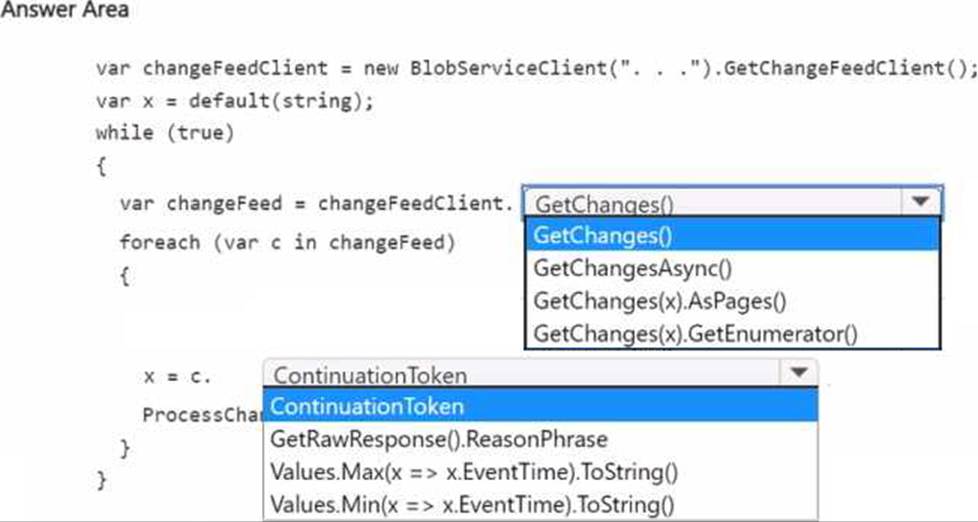
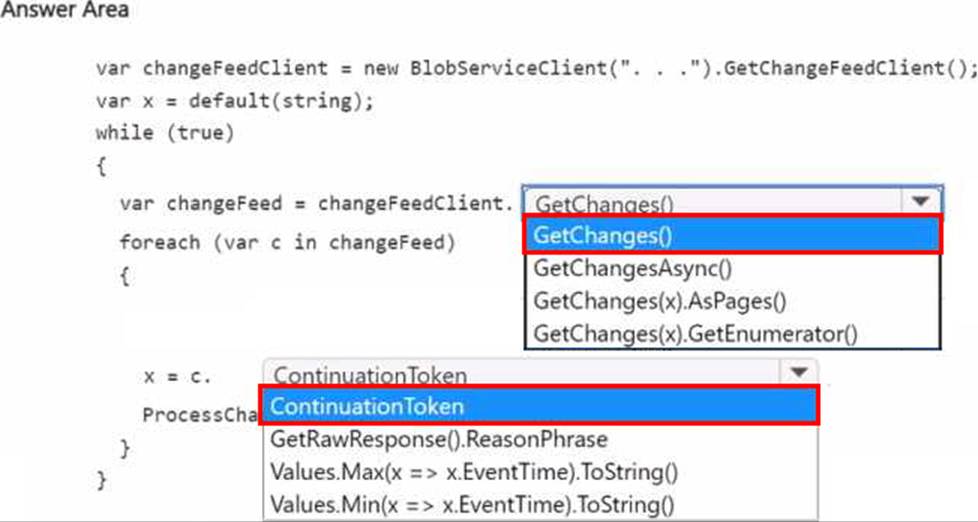
You are developing an application that monitors data added to an Azure Blob storage account.
You need to process each change made to the storage account.
How should you complete the code segment? TO answer, select the appropriate options in the answer area. NOTE: Each correct selection is worth one point.
Note: This question is part of a series of questions that present the same scenario. Each question in the series contains a unique solution that might meet the stated goals. Some question sets might have more than one correct solution, while others might not have a correct solution.
After you answer a question in this section, you will NOT be able to return to it. As a result, these questions will not appear in the review screen.
You develop an HTTP triggered Azure Function app to process Azure Storage blob data. The app is triggered using an output binding on the blob.
The app continues to time out after four minutes. The app must process the blob data.
You need to ensure the app does not time out and processes the blob data.
Solution: Use the Durable Function async pattern to process the blob data.
Does the solution meet the goal?
- A . Yes
- B . No
B
Explanation:
Instead pass the HTTP trigger payload into an Azure Service Bus queue to be processed by a queue trigger function and return an immediate HTTP success response.
Note: Large, long-running functions can cause unexpected timeout issues. General best practices include:
Whenever possible, refactor large functions into smaller function sets that work together and return responses fast. For example, a webhook or HTTP trigger function might require an acknowledgment response within a certain time limit; it’s common for webhooks to require an immediate response.
You can pass the HTTP trigger payload into a queue to be processed by a queue trigger function. This approach lets you defer the actual work and return an immediate response.
Reference: https://docs.microsoft.com/en-us/azure/azure-functions/functions-best-practices
DRAG DROP
You are developing an ASP.NET Core website that can be used to manage photographs which are stored in Azure Blob Storage containers.
Users of the website authenticate by using their Azure Active Directory (Azure AD) credentials.
You implement role-based access control (RBAC) role permissions on the containers that store photographs. You assign users to RBAC roles.
You need to configure the website’s Azure AD Application so that user’s permissions can be used with the Azure Blob containers.
How should you configure the application? To answer, drag the appropriate setting to the correct location. Each setting can be used once, more than once, or not at all. You may need to drag the split bar between panes or scroll to view content. NOTE: Each correct selection is worth one point.
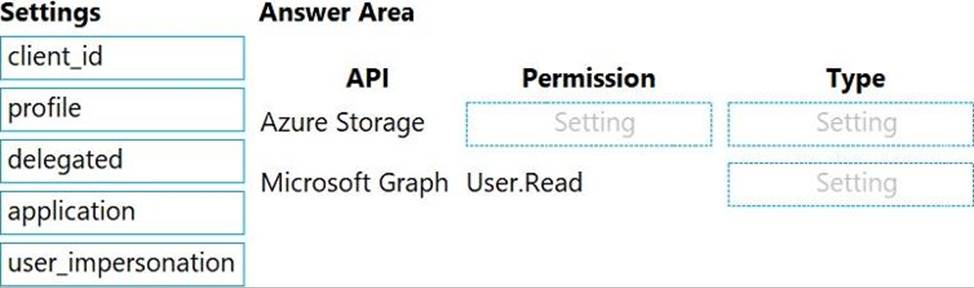
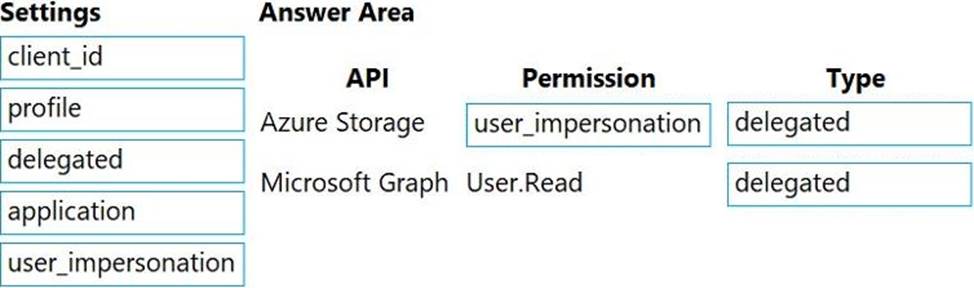
Explanation:
Box 1: user_impersonation
Box 2: delegated
Example:
You ate developing an application that allows users to find musicians that ate looking for work. The application must store information about musicians, the instruments that they play, and other related data.
The application must also allow users to determine which musicians have played together, including groups of three or more musicians that have performed together at a specific location.
Which Azure Cosmos D6 API should you use for the application?
- A . Core
- B . MongoDB
- C . Cassandra
- D . Gremlin
You are developing an Azure function that connects to an Azure SQL Database instance. The function is triggered by an Azure Storage queue.
You receive reports of numerous System.InvalidOperationExceptions with the following message: “Timeout expired. The timeout period elapsed prior to obtaining a connection from the pool. This may have occurred because all pooled connections were in use and max pool size was reached.”
You need to prevent the exception.
What should you do?
- A . In the host.json file, decrease the value of the batchSize option
- B . Convert the trigger to Azure Event Hub
- C . Convert the Azure Function to the Premium plan
- D . In the function.json file, change the value of the type option to queueScaling
A
Explanation:
With the Premium plan the max outbound connections per instance is unbounded compared to the 600 active (1200 total) in a Consumption plan.
Note: The number of available connections is limited partly because a function app runs in a sandbox environment. One of the restrictions that the sandbox imposes on your code is a limit on the number of outbound connections, which is currently 600 active (1,200 total) connections per instance. When you reach this limit, the functions runtime writes the following message to the logs: Host thresholds exceeded: Connections.
Reference:
https://docs.microsoft.com/en-us/azure/azure-functions/manage-connections
https://docs.microsoft.com/en-us/azure/azure-functions/functions-scale#service-limits
You are developing a web application that uses the Microsoft identity platform to authenticate users and resources, The web application calls several REST APIs.
The APIs require an access token from the Microsoft identity platform.
You need to request a token.
Which three properties should you use? Each correct answer presents part of the solution. NOTE: Each correct selection is worth one point.
- A . Application name
- B . Application secret
- C . Application ID
- D . Supported account type
- E . Redirect URI/URL