Microsoft AZ-204 Practice Exams
Last updated on Nov 16,2026- Exam Code: AZ-204
- Exam Name: Developing Solutions for Microsoft Azure
- Certification Provider: Microsoft
- Latest update: Nov 16,2026
Note: This question is part of a series of questions that present the same scenario. Each question in the series contains a unique solution that might meet the stated goals. Some question sets might have more than one correct solution, while others might not have a correct solution.
After you answer a question in this section, you will NOT be able to return to it. As a result, these questions will not appear in the review screen.
You are developing an Azure solution to collect point-of-sale (POS) device data from 2,000 stores located throughout the world. A single device can produce 2 megabytes (MB) of data every 24 hours. Each store location has one to five devices that send data.
You must store the device data in Azure Blob storage. Device data must be correlated based on a device identifier. Additional stores are expected to open in the future.
You need to implement a solution to receive the device data.
Solution: Provision an Azure Notification Hub. Register all devices with the hub.
Does the solution meet the goal?
- A . Yes
- B . No
B
Explanation:
Instead use an Azure Service Bus, which is used order processing and financial transactions.
Reference: https://docs.microsoft.com/en-us/azure/event-grid/compare-messaging-services
Topic 4, Proseware, Inc
Case study
Overview
This is a case study. Case studies are not timed separately. You can use as much exam time as you would like to complete each case. However, there may be additional case studies and sections on this exam. You must manage your time to ensure that you are able to complete all questions included on this exam in the time provided.
To answer the questions included in a case study, you will need to reference information that is provided in the case study. Case studies might contain exhibits and other resources that provide more information about the scenario that is described in the case study. Each question is independent of the other questions in this case study.
At the end of this case study, a review screen will appear. This screen allows you to review your answers and to make changes before you move to the next section of the exam. After you begin a new section, you cannot return to this section.
To start the case study
To display the first question in this case study, click the Next button. Use the buttons in the left pane to explore the content of the case study before you answer the questions. Clicking these buttons displays information such as business requirements, existing environment, and problem statements. When you are ready to answer a question, click the Question button to return to the question.
Background
You are a developer for Proseware, Inc. You are developing an application that applies a set of governance policies for Proseware’s internal services, external services, and applications. The application will also provide a shared library for common functionality.
Requirements
Policy service
You develop and deploy a stateful ASP.NET Core 2.1 web application named Policy service to an Azure App Service Web App. The application reacts to events from Azure Event Grid and performs policy actions based on those events.
The application must include the Event Grid Event ID field in all Application Insights telemetry.
Policy service must use Application Insights to automatically scale with the number of policy actions that it is performing.
Policies
Log policy
All Azure App Service Web Apps must write logs to Azure Blob storage. All log files should be saved to a container named logdrop. Logs must remain in the container for 15 days.
Authentication events
Authentication events are used to monitor users signing in and signing out. All authentication events must be processed by Policy service. Sign outs must be processed as quickly as possible.
PolicyLib
You have a shared library named PolicyLib that contains functionality common to all ASP.NET Core web services and applications.
The PolicyLib library must:
✑ Exclude non-user actions from Application Insights telemetry.
✑ Provide methods that allow a web service to scale itself.
✑ Ensure that scaling actions do not disrupt application usage.
Other
Anomaly detection service
You have an anomaly detection service that analyzes log information for anomalies. It is implemented as an Azure Machine Learning model. The model is deployed as a web service. If an anomaly is detected, an Azure Function that emails administrators is called by using an HTTP WebHook.
Health monitoring
All web applications and services have health monitoring at the /health service endpoint.
Issues
Policy loss
When you deploy Policy service, policies may not be applied if they were in the process of being applied during the deployment.
Performance issue
When under heavy load, the anomaly detection service undergoes slowdowns and rejects connections.
Notification latency
Users report that anomaly detection emails can sometimes arrive several minutes after an anomaly is detected.
App code
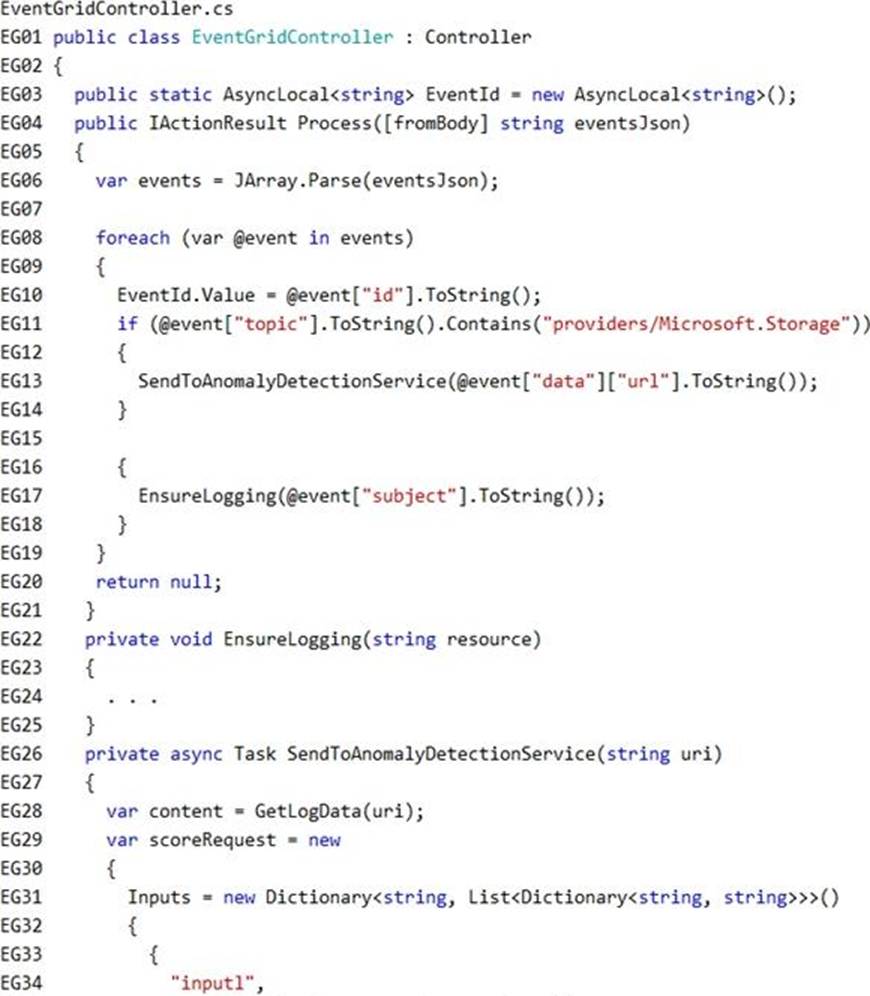
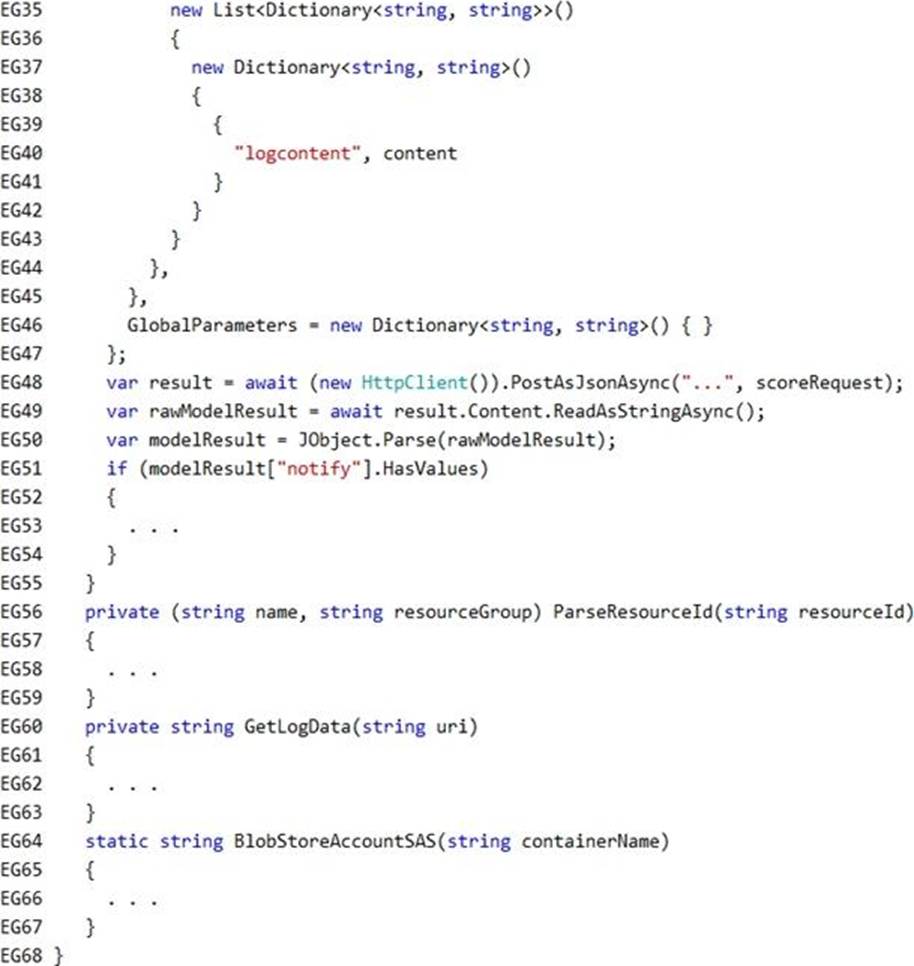
EventGridController.cs
Relevant portions of the app files are shown below. Line numbers are included for reference only and include a two-character prefix that denotes the specific file to which they belong.
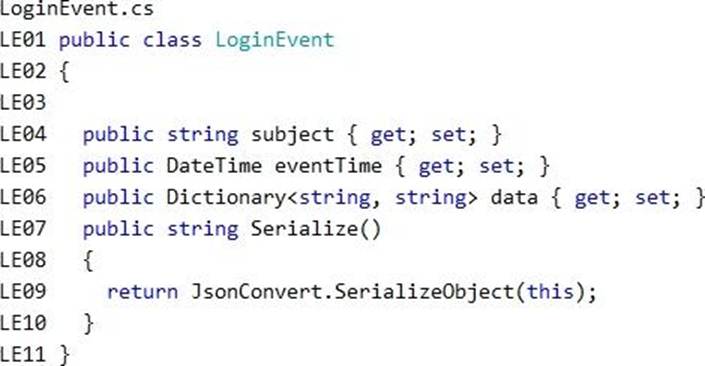
LoginEvent.cs
Relevant portions of the app files are shown below. Line numbers are included for reference only and include a two-character prefix that denotes the specific file to which they belong.
You need to resolve a notification latency issue.
Which two actions should you perform? Each correct answer presents part of the solution. NOTE: Each correct selection is worth one point.
- A . Set Always On to true.
- B . Ensure that the Azure Function is using an App Service plan.
- C . Set Always On to false.
- D . Ensure that the Azure Function is set to use a consumption plan.
AB
Explanation:
Azure Functions can run on either a Consumption Plan or a dedicated App Service Plan. If you run in a dedicated mode, you need to turn on the Always On setting for your Function App to run properly. The Function runtime will go idle after a few minutes of inactivity, so only HTTP triggers will actually "wake up" your functions. This is similar to how WebJobs must have Always On enabled.
Scenario: Notification latency: Users report that anomaly detection emails can sometimes arrive several minutes after an anomaly is detected.
Anomaly detection service: You have an anomaly detection service that analyzes log information for anomalies. It is implemented as an Azure Machine Learning model. The model is deployed as a web service. If an anomaly is detected, an Azure Function that emails administrators is called by using an HTTP WebHook.
Reference: https://github.com/Azure/Azure-Functions/wiki/Enable-Always-On-when-running-on-dedicated-App-Service-Plan
You need to resolve the log capacity issue.
What should you do?
- A . Create an Application Insights Telemetry Filter
- B . Change the minimum log level in the host.json file for the function
- C . Implement Application Insights Sampling
- D . Set a LogCategoryFilter during startup
C
Explanation:
Scenario, the log capacity issue: Developers report that the number of log message in the trace output for the processor is too high, resulting in lost log messages.
Sampling is a feature in Azure Application Insights. It is the recommended way to reduce telemetry traffic and storage, while preserving a statistically correct analysis of application data. The filter selects items that are related, so that you can navigate between items when you are doing diagnostic investigations. When metric counts are presented to you in the portal, they are renormalized to take account of the sampling, to minimize any effect on the statistics.
Sampling reduces traffic and data costs, and helps you avoid throttling.
Reference: https://docs.microsoft.com/en-us/azure/azure-monitor/app/sampling
DRAG DROP
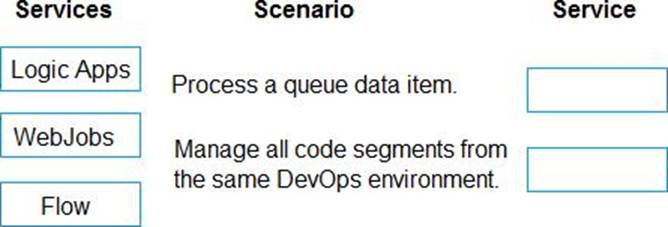
You have a web app named MainApp. You are developing a triggered App Service background task by using the WebJobs SDK. This task automatically invokes a function code whenever any new data is received in a queue.
You need to configure the services.
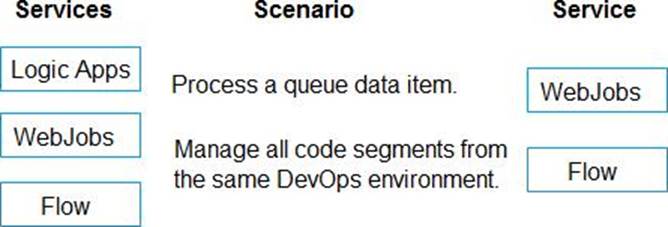
Which service should you use for each scenario? To answer, drag the appropriate services to the correct scenarios. Each service may be used once, more than once, or not at all. You may need to drag the split bar between panes or scroll to view content. NOTE: Each correct selection is worth one point.
Explanation:
Box 1: WebJobs
A WebJob is a simple way to set up a background job, which can process continuously or on a schedule. WebJobs differ from a cloud service as it gives you get less fine-grained control over your processing environment, making it a more true PaaS service.
Box 2: Flow
Incorrect Answers:
Azure Logic Apps is a cloud service that helps you schedule, automate, and orchestrate tasks, business processes, and workflows when you need to integrate apps, data, systems, and services across enterprises or organizations. Logic Apps simplifies how you design and build scalable solutions for app integration, data integration, system integration, enterprise application integration (EAI), and business-to-business (B2B) communication, whether in the cloud, on premises, or both.
Reference: https://code.msdn.microsoft.com/Processing-Service-Bus-84db27b4
You develop and deploy an Azure App Service web app. The app is deployed to multiple regions and uses Azure Traffic Manager. Application Insights is enabled for the app.
You need to analyze app uptime for each month.
Which two solutions win achieve the goal? Each correct answer presents a complete solution NOTE: Each correct selection is worth one point
- A . Application Insights alerts
- B . Application Insights web tests
- C . Azure Monitor logs
- D . Azure Monitor metrics
A, C
Explanation:
Reference: https://azure.microsoft.com/en-us/blog/creating-a-web-test-alert-programmatically-with-application-insights/
DRAG DROP
Contoso, Ltd. provides an API to customers by using Azure API Management (APIM). The API authorizes users with a JWT token.
You must implement response caching for the APIM gateway. The caching mechanism must detect the user ID of the client that accesses data for a given location and cache the response for that user ID.
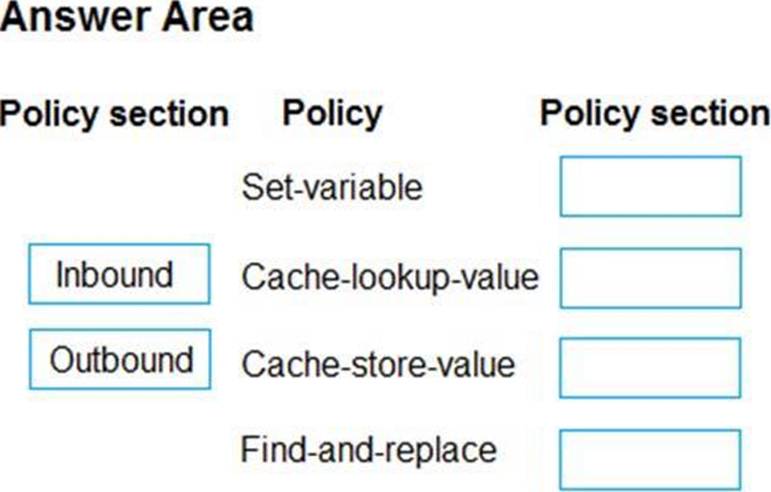
You need to add the following policies to the policies file:
• a set-variable policy to store the detected user identity
• a cache-lookup-value policy
• a cache-store-value policy
• a find-and-replace policy to update the response body with the user profile information
To which policy section should you add the policies? To answer, drag the appropriate sections to the correct policies. Each section may be used once, more than once, or not at all. You may need to drag the split bar between panes or scroll to view content. NOTE: Each correct selection is worth one point
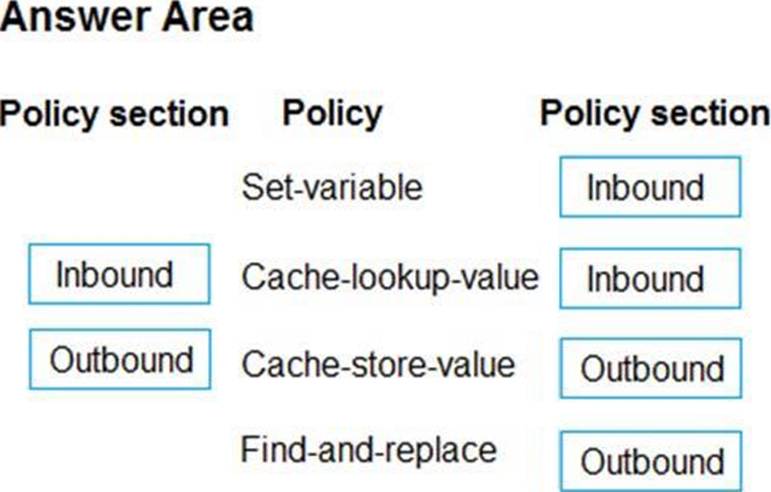
Explanation:
Box 1: Inbound.
A set-variable policy to store the detected user identity.
Example:
<policies>
<inbound>
<!– How you determine user identity is application dependent –>
<set-variable
name="enduserid"
value="@(context.Request.Headers.GetValueOrDefault("Authorization","").Split(‘ ‘)[1].AsJwt()?.Subject)" />
Box 2: Inbound
A cache-lookup-value policy
Example:
<inbound>
<base />
<cache-lookup vary-by-developer="true | false" vary-by-developer-groups="true | false" downstream-caching-type="none | private | public" must-revalidate="true | false">
<vary-by-query-parameter>parameter name</vary-by-query-parameter> <!– optional, can repeated several times –>
</cache-lookup>
</inbound>
Box 3: Outbound
A cache-store-value policy.
Example:
<outbound>
<base />
<cache-store duration="3600" />
</outbound>
Box 4: Outbound
A find-and-replace policy to update the response body with the user profile information.
Example:
<outbound>
<!– Update response body with user profile–>
<find-and-replace
from=’"$userprofile$"’
to="@((string)context.Variables["userprofile"])" />
<base />
</outbound>
Reference:
https://docs.microsoft.com/en-us/azure/api-management/api-management-caching-policies
https://docs.microsoft.com/en-us/azure/api-management/api-management-sample-cache-by-key
You develop Azure Web Apps for a commercial diving company. Regulations require that all divers fill out a health questionnaire every 15 days after each diving job starts.
You need to configure the Azure Web Apps so that the instance count scales up when divers are filling out the questionnaire and scales down after they are complete.
You need to configure autoscaling.
What are two possible autoscaling configurations to achieve this goal? Each correct answer presents a complete solution. NOTE: Each correct selection is worth one point.
- A . Predictive autoscaling
- B . CPU usage-based autoscaling
- C . Recurrence profile
- D . Fixed date profile
You are designing a web application to manage user satisfaction surveys. The number of questions that a survey includes is variable.
Application users must be able to display results for a survey as quickly as possible. Users must also be able to quickly compute statistical measures including average values across various groupings of answers.
Which Azure Cosmos 06 API should you use for the application?
- A . Core
- B . Mongo DB
- C . Gremlin
- D . Table API
DRAG DROP
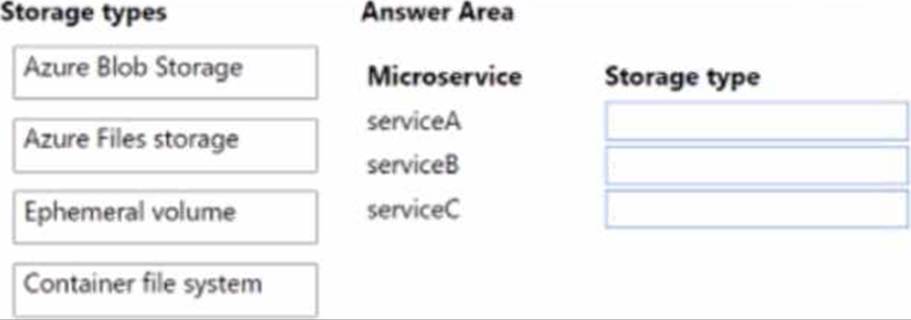
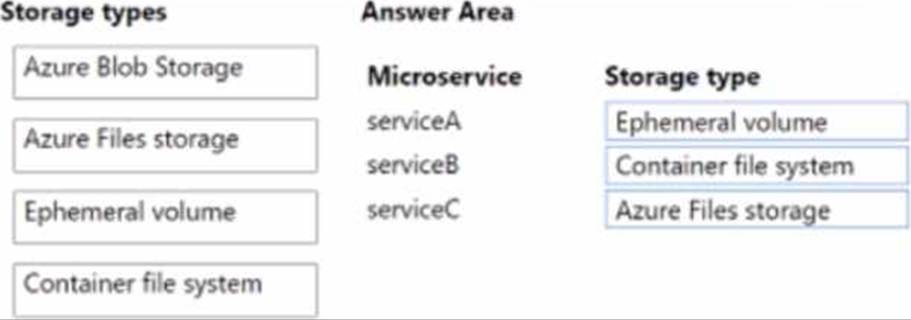
You are developing several microservices named service A. serviceB, and serviceC. You deploy the microservices to a new Azure Container Apps environment.
You have the following requirements.
• The microservices must persist data to storage.
• serviceA must persist data only visible to the current container and the storage must be restricted to the amount of disk space available in the container
• servtceB must persist data for the lifetime of the replica and allow multiple containers in the replica to mount the same storage location.
• serviceC must persist data beyond the lifetime of the replica while allowing multiple containers to access the storage and enable per object permissions.
You need to configure storage for each microservice.